Car Pedals and Accessories Guide: Common Faults and Fixes
Pedal work is safe only when travel is full, return is instant, and nothing contacts the pedal except your foot. If any pedal hangs up, returns slowly, or catches on trim or carpet, I stop driving and sort that out first. In my own checks, the fastest wins usually come from the simple stuff: a loose floor mat, a worn pad, a cover that shifts, or a dry metal pivot rather than an exotic failure.
This guide starts with the fault-isolation checklist, then answers the common questions one by one: mat interference, cover safety, lubrication, and what to do with a stiff accelerator cable. The key rule throughout is simple: diagnose the mechanical feel first, and do not spray lubricant into electronic accelerator pedal assemblies or sealed, nylon-lined parts.
Pedal-diagnostic checklist
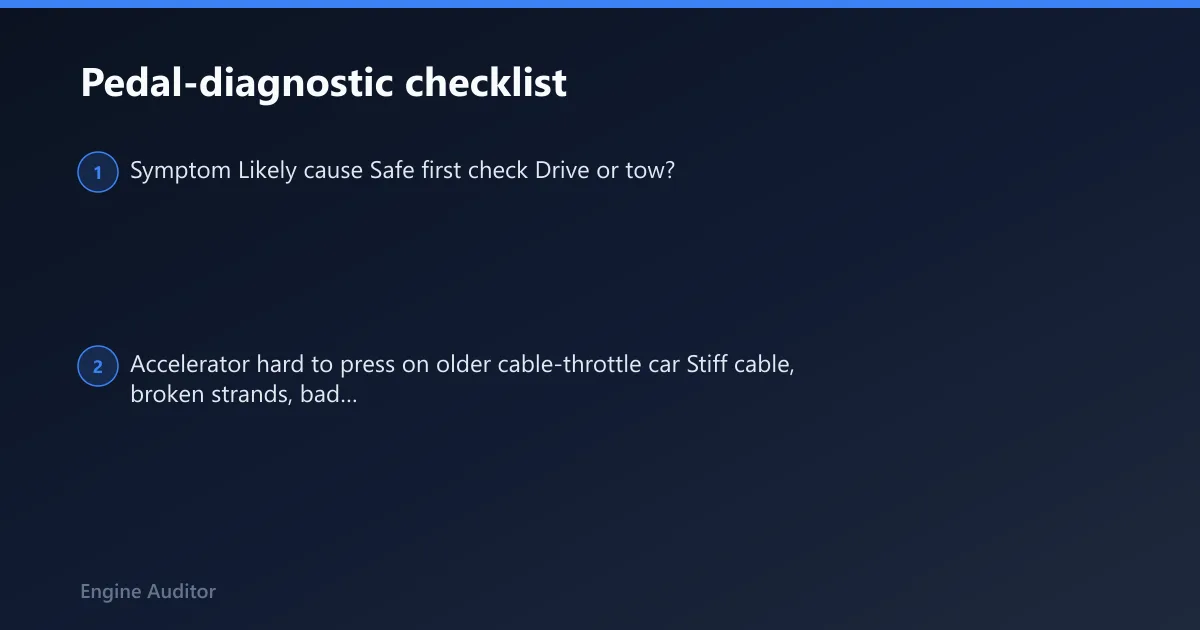
| Symptom | Likely cause | Safe first check | Drive or tow? |
|---|---|---|---|
| Accelerator hard to press on older cable-throttle car | Stiff cable, broken strands, bad routing, dry steel pivot | Engine off, disconnect nothing yet; check mat clearance, then inspect cable for fray and pivot for metal-to-metal rub | Tow if return is slow or strands are broken; drive only if action is fully free after inspection |
| Accelerator sticks near the floor | Mat overlap, thick pedal cover, carpet edge interference | Remove mat or cover and retest full stroke with engine off | Do not drive until return is instant every time |
| Accelerator slow to return on throttle-by-wire car | Mat interference, contaminated pedal hinge area, electronic pedal fault, throttle-body related issue | Rule out mat, carpet, and cover contact; do not lubricate the sensor assembly | Tow if any delay remains |
| Brake pedal squeaks at top of travel | Dry steel pivot or rubbing surface | Use a torch under the dash and inspect for shiny rub points at the pendant pivot | Usually drive after safe lubrication if pedal feel is otherwise normal |
| Brake pedal rough or side-to-side | Worn bush, worn pivot rod, metal contact, loose pad | Inspect bush material and pedal arm movement by hand | Workshop inspection soon; tow if braking feel changed suddenly |
| Clutch pedal squeak or notchiness | Dry pivot, worn bush, linkage contact | Inspect the pendant pivot and rubbing surfaces; confirm bush material before oiling | Drive only if pedal travel is smooth and disengagement is normal |
| Foot slips on brake or clutch | Worn or missing rubber pedal pad, oily contamination | Check pad condition and clean or replace; remove any oil from the tread face | Do not drive if grip is poor |
| Pedal feels normal but engine response is erratic on throttle-by-wire car | Pedal sensor issue or control fault | Confirm no interference, then scan for faults rather than lubricating parts at random | Drive only if there is no sticking and no warning behavior; otherwise tow |
How do I tell whether the problem is the pedal, cable, mat, or sensor?

Start with the mechanical checks you can verify safely with the engine off: mat clearance, pedal cover security, missing rubber pads, and whether the accelerator returns freely under spring force alone. I always split diagnosis by throttle type next, because cable-throttle and throttle-by-wire systems can feel similar at your foot but need different next steps.
Fast safety triage before any driving
- With the engine off, push each pedal from rest to the stop, then let it return fully.
- Make sure the accelerator snaps back at once, with no lag or lazy return.
- Check for floor mat overlap, bunching, or heel-pad lift near the accelerator base.
- Pull on any pedal cover by hand. If it shifts, remove it.
- Look for missing or loose rubber pedal pads that can change foot grip.
- Use a torch and look directly at the pedal pivots, rub marks, and carpet edge if needed.
- Stop and arrange a tow if the accelerator sticks, the brake pedal travel changes suddenly, or a pedal catches on trim or carpet.
Cable-throttle versus throttle-by-wire: the first split to make
Older cars with a mechanical cable connect the accelerator pedal to the throttle with an inner cable inside an outer casing. Depending on the vehicle, the accelerator pedal may be suspended from above or hinged at the floor. Either style can bind on a mat, carpet edge, or a badly fitted cover.
Throttle-by-wire cars still have an accelerator pedal, but pedal movement is read by a sensor and sent to the engine controls. The pedal can still bind mechanically on a mat, carpet edge, or bad cover. What I do not do on these cars is spray lubricant into the electronic pedal assembly or try to free it with solvent.
What a hard pedal, sticky pedal, or slow return usually points to
A hard-to-press accelerator on a cable car often points to cable drag, broken strands, bad routing, or a dry metal pivot. A sticky return can come from dirt on the floor, mat interference, a pedal cover that lifts at the edge, or a throttle-body or pedal-assembly issue on a throttle-by-wire car.
If the brake or clutch feels rough at the top of travel, inspect the pivot and rubbing surfaces first. Brake and clutch pedals usually pivot behind the dashboard. Side-play, polished rub points, and metal-to-metal contact tell me more than spraying lubricant around at random.
When the symptom means stop driving and arrange a tow
Tow it if the accelerator does not return freely, if pedal travel is trapped by a mat or trim, if an accelerator cable shows broken strands, or if brake pedal feel changes sharply and cannot be tied to a loose pad or surface rub. Delayed accelerator return alone is enough for me to stop using the car.
Must-have
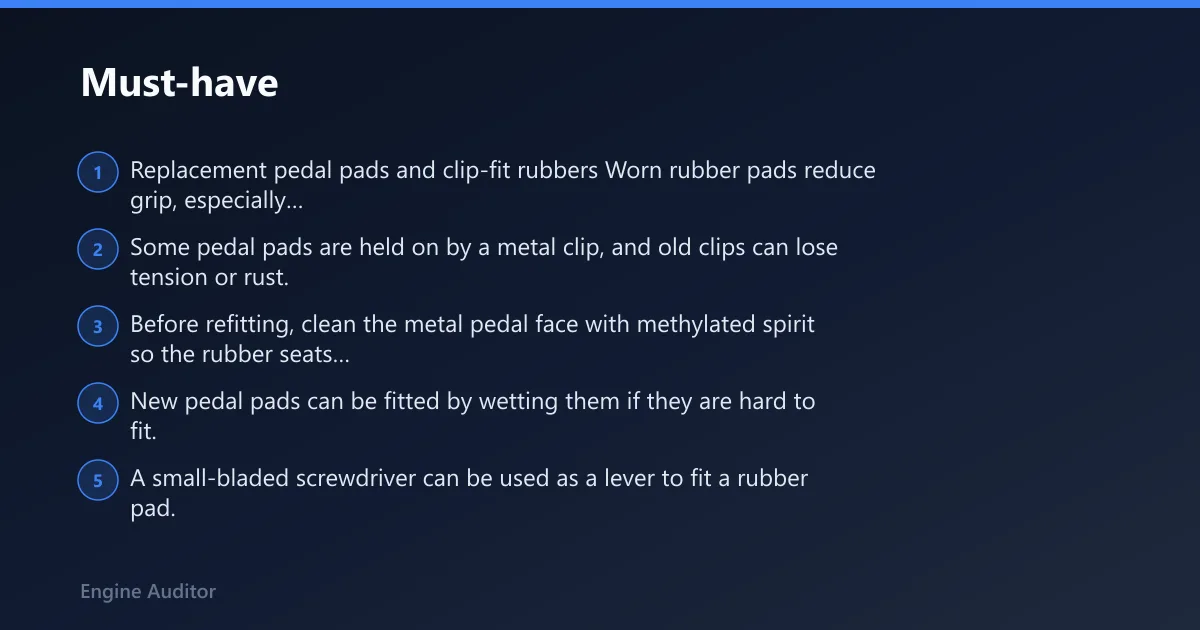
Replacement pedal pads and clip-fit rubbers
Worn rubber pads reduce grip, especially with wet shoes. Some pedal pads are held on by a metal clip, and old clips can lose tension or rust. Before refitting, clean the metal pedal face with methylated spirit so the rubber seats flat and any retaining clip fully engages.
New pedal pads can be fitted by wetting them if they are hard to fit. A small-bladed screwdriver can be used as a lever to fit a rubber pad. The real risk is tearing the new rubber or bending a clip, so steady pressure beats brute force.
Correct-fit floor mats with retention points
A floor mat is safe only when it cannot move forward, curl upward, or stack under the driver’s heel. Retention clips matter more than branding. The danger points are the accelerator base, the rear edge of the mat under heel pressure, and any overlap with a carpet lip.
Check full-stroke clearance with the engine off. Press the accelerator to the floor and release it repeatedly. If the mat shifts once, I treat that as a failed fit check.
Safe pedal covers for wet-shoe grip and worn factory pads
Pedal covers can help when the factory rubber is worn or the pedal face is small, but only if the cover matches pedal shape and stays locked over the original pad. Thickness matters. So do sharp edge lift, spacing to the next pedal, and whether the cover remains fixed under a twisting foot load.

- Made of aluminum alloy and rubber for durability
- No drilling required for easy installation
- Anti-slip surface design for improved safety
TDOFYH aluminum pedal covers
For the listed Jeep Grand Cherokee and Dodge Durango applications, a vehicle-specific cover is safer than a generic one because fit decides everything here. I would still fit it only over a sound original pedal pad and only after checking pedal spacing and full travel with the engine off.
If any edge lifts, the cover can be rolled by hand, or spacing to the brake becomes tight, remove it. A cover is acceptable only when it stays fixed and does not change control feel.

- Universal fit for most cars, trucks, and SUVs
- Anti-slip surface for improved safety
- Sturdy alloy and rubber build
WomYoks universal pedal pads
The word universal is the caution flag. Pedal shape, curvature, and spacing vary a lot, so I would consider a universal cover only as a fit-check exercise, not as an automatic buy recommendation.
If it needs improvised screws, trimming, or can be rolled off by hand after fitting, it is the wrong part for the car.
Basic inspection tools: torch, trim cloths, and cleanup materials
A torch matters because the fault is often visible only from one angle: polished steel, dust-packed fluff around a bush, or a cover edge touching carpet. Keep trim cloths ready because excess oil on pedals, carpets, or the footwell creates a new slip hazard.
Nice-to-have
Silicone lubricant for selected non-metal contact points
Silicone lubricant has a limited place on some light plastic-to-plastic contact points if the vehicle design calls for it, but it is not a cure-all. I keep it away from friction faces, rubber tread, cable inners, and any electronic accelerator pedal assembly.
Petroleum jelly for light protection where appropriate
Petroleum jelly can help on exposed, lightly loaded metal parts where corrosion protection matters more than flow. It is too thick for freeing a stiff cable and wrong for nylon-lined or sealed components. A thin smear is enough where the design actually allows it.
A mirror or phone camera for under-dash pivot checks
Pedal pivots hide above insulation and trim. A phone camera or small inspection mirror helps spot clip orientation, cracked bushes, and rubbing marks on the pedal arm. That matters most on brake and clutch pedals where access is poor.

- Made of aluminum alloy and rubber for durability
- No drilling required for easy installation
- Non-slip surface for improved safety
BOYUER pedal cover kit
This is another case where vehicle-specific fit matters more than materials or styling. If used on the listed Mazda CX-5, the safety question is still the same one I use for every cover: does it stay fixed and preserve normal pedal spacing?
After fitting, check full brake and accelerator travel in your normal footwear. If a shoe edge can catch the accelerator during braking, remove the kit.

- Custom throttle response control with 4 dynamic modes
- Simple plug and play installation
- Anti-theft feature with wireless app control
Pedal Commander throttle response controller
This changes throttle-response mapping on compatible vehicles, but it does not cure a sticking pedal, a bad mat, a dry pivot, or a failing cable. I would not use a response controller as part of pedal diagnosis.
Use a controller only after the pedal system is known to move freely and return correctly. It is an accessory, not a repair.
Consumables and spares
Clean engine oil and heavy gear oil: where each belongs
For exposed metal pedal pivots and visible metal-to-metal rubbing points, a drop or two of light oil can be appropriate if the service design allows it. I avoid heavy applications because drips become a footwell hazard, and I do not oil nylon bushes or sealed pivots.
Pedals with nylon bushes do not need oiling. Oil on nylon attracts dust and fluff, turns debris into paste, and can make the action worse rather than better.
Accelerator cables, adjusters, and clips for older cable systems
A sticky accelerator cable may have broken strands snagging the outer casing. If a cable is damaged, renew it as soon as possible. For lubrication, the safe rule is to identify the cable type first: many modern replacement and OE cables are lined or sealed and should not be lubricated, while some older unlined serviceable cables may allow a light lubricant only if the vehicle manual permits it.
Routing also matters. A cable bent too tightly near the firewall or throttle body can feel heavy even when it looks intact.
Pedal pad rubbers, retaining clips, and cover hardware
Clip hardware often gets ignored, yet loose or missing clips let a pad creep sideways. That changes grip and can expose a bare metal edge. Keep the right clip with the right pad, and replace distorted hardware rather than trying to flatten it back into service.
Cleaning supplies including methylated spirit for pad refit work
Methylated spirit is useful on the bare pedal face before fitting rubber pads because it cuts old residue and dries clean. Keep it off painted trim and out of areas where it could soften unrelated materials. Dry surfaces grip better during assembly.

- Exceptional quality and performance
- Direct replacement with no fuss
- Perfect compatibility with specific vehicle models
PartCatalog accelerator pedal sensor
This is relevant only for a narrow set of vehicles and only after mechanical interference has been ruled out. On a throttle-by-wire car, I treat the pedal assembly as an electrical part to diagnose or replace, not as something to lubricate in hope.
If a throttle-by-wire pedal shows erratic input or fault codes, diagnosis belongs with the correct scan tools and service information.
Can floor mats interfere with car pedals?
Yes. Floor mats can trap the accelerator, reduce return speed, or change how far the brake or clutch can move if the mat slides, bunches, stacks, or curls near the pedal base. Retention points and full-stroke clearance matter more than a mat merely appearing to fit the footwell.
Floor-mat entrapment points around the accelerator base
The common problem area is the lower edge of the accelerator, especially on floor-hinged pedals. Some accelerator pedals pivot at the floor, which makes mat interference easy to miss unless you watch the lower edge directly.
Look for heel-pad bunching, a mat corner creeping under the pedal, or a second loose mat laid on top of the retained one. Those faults can slow return without fully jamming the pedal.
Pedal-cover retention, thickness, and pedal-spacing checks
A cover should fit over the rubber pad securely, with no wobble or edge lift. On the accelerator, extra thickness can move the contact point closer to the brake. On the brake, extra width can reduce spacing and make two-pedal contact more likely with wider shoes.
Any cover that needs improvised fasteners or trimming to clear the carpet is the wrong part.
Full-stroke clearance test with engine off
- Set the driver’s seat where it is normally used.
- Wear the shoes normally worn for driving.
- Press each pedal fully and release it several times.
- Watch the mat and cover edges during movement.
- Check that the accelerator returns instantly every time.
- Turn the steering wheel through its range if under-dash trim is close to the pedal box.
Common fitment mistakes that create delayed pedal return
The usual mistakes are stacking mats, fitting a universal mat with weak retention, leaving a loose cover over a worn factory rubber, and ignoring a carpet edge that folds upward after cleaning. None of those are minor once the accelerator return changes.
Are pedal covers safe to use in a car?
Pedal covers are safe only when they match the pedal shape exactly, clamp or lock over the original pad securely, preserve spacing to adjacent pedals, and allow full travel without touching carpet or trim. Loose, thick, sharp-edged, or poorly retained covers should be removed immediately.
When covers help
Covers can make sense for wet-shoe grip, a worn factory pad, or a small accelerator face on a vehicle with adequate spacing. The safer examples are vehicle-specific and no-drill, because improvised drilling and screws add new failure points.
When covers create their own fault
A cover can create a hard pedal feel by rubbing carpet at the bottom of travel. It can create a sticky return by catching the mat edge. It can also make emergency braking worse if brake-to-accelerator spacing is reduced enough for a wide sole to brush both pedals.
Legal and inspection concerns
If a cover is loose, alters pedal control, or interferes with full travel, it can fail a safety inspection or create liability after a collision. The key question is simple: does it stay fixed and preserve full control? If the answer is uncertain, remove it.
How do I lubricate car pedals safely?
Lubricate only the actual moving contact points, and only after confirming whether the pivot uses bare metal or nylon/plastic bushings. Exposed metal pivots may take a very small amount of appropriate lubricant if the service design allows it; nylon bushes stay dry. Keep lubricant off pads, carpets, covers, cables unless approved, sensors, and any electronic pedal assembly.
Finding the pivot point on pendant, floor-pivoted, and organ-style pedals
Brake and clutch pedals often have a suspended design with pivots behind the dashboard. Accelerators may be suspended from above or hinged at the floor depending on the vehicle. The goal is to find where the arm actually rotates, plus any rubbing pad, stop, or link.
Use a torch to inspect pedal pivot points if needed. I look for shiny wear marks, dust build-up, cracked bushes, and anything touching carpet or trim through the full stroke.
Steel rod pivots versus nylon bushes: oil, dry, or silicone only
Exposed metal pedal pivots may need a drop or two of lubricant at the pivot and rubbing surfaces. Look for polished contact lines, squeak marks, and visible metal-on-metal rub. Pedals with nylon bushes do not need oiling. Dust and fluff stick to oil on nylon and can build a draggy paste around the bush.
Where the design includes a minor plastic contact away from the main pivot, a tiny amount of silicone lubricant may be acceptable. The working rule is material first, product second.
How much lubricant is enough and where drips become a hazard
One or two drops at the pivot is usually the right starting point. Work the pedal by hand, watch where the lubricant spreads, then wipe away any run-off. Drips onto trim are messy. Drips onto carpet or a pedal pad are dangerous.
What should never be sprayed or coated
Do not flood the pedal box. Do not coat rubber tread surfaces. Do not oil nylon-lined cables, nylon inserts, or electronic throttle pedal assemblies. Thick grease can also hold dirt on exposed pivots unless the design specifically calls for it.
What should I do if an accelerator cable feels stiff?
On a cable-throttle car, a stiff accelerator cable should be treated as a likely wear fault first, not a lubrication issue first. Check for broken strands, casing drag, and bad routing. If damage is visible or pedal return is delayed, stop driving and replace the cable rather than trying to nurse it along.
How to spot broken strands and casing drag
A sticky accelerator cable may have broken strands snagging the outer casing. Fray is easiest to spot where the inner cable emerges near an adjuster or throttle lever. The casing itself can also stiffen internally, especially after heat and moisture exposure.
If the pedal effort rises unevenly through the stroke, the cable is a prime suspect. If effort is heavy from the first millimeter, check the pedal pivot too.
Temporary strand trimming: when it is only a get-you-home measure
Owners sometimes trim a single loose strand to stop snagging. That is a temporary get-you-home measure at best, because broken strands mean the cable has already started to fail. If a cable is damaged, renew it as soon as possible.
Replacement routing and adjustment basics
Follow the original path, clips, and bend radius. A new cable routed too tightly can feel nearly as bad as the old one. If the manual for an older unlined cable system allows lubrication, use only a light amount and keep it out of the pedal area. Do not oil lined, sealed, or nylon-lined cables.
Adjustment should leave the throttle returning cleanly with no preload that holds it open. On a throttle-by-wire car, this section does not apply because there is no mechanical accelerator cable to adjust.
Expected cost and time
Pad replacement is usually a low-cost, short job. Cover fitting is similar, but only if the fit is right on the first attempt. Cable replacement costs more in parts and labor because access and adjustment take time. On throttle-by-wire cars, workshop diagnosis usually makes more sense than random parts swapping once interference has been ruled out.
Budget setups
| Setup | Who it suits | Suggested parts | Price |
|---|---|---|---|
| Starter | Daily drivers with unknown pedal feel who need a safety-first check | Retained floor mat, fresh pedal pad rubbers, cleanup supplies; WomYoks universal pedal pads only if fit is verified | $6.99 |
| Mid | Older cable-throttle cars needing grip and a known-good pedal surface | TDOFYH vehicle-specific covers or BOYUER vehicle-specific kit, plus correct lubricant and cable inspection | $18.69 or $30.88 |
| Serious | Throttle-by-wire troubleshooting after mat and cover issues are ruled out | Vehicle-specific pedal sensor where diagnosis supports it; response controller only after the base system is fault-free | $114.23 or $269.99 |
Frequently asked questions
Why is my gas pedal hard to press?
A hard gas pedal usually points to mat interference, a bad pedal cover, a dry steel pivot, or cable drag on older cable-throttle cars. On throttle-by-wire cars, the pedal can still bind mechanically even though engine control is electronic. Check return speed first. Any delay means stop driving.
What causes a sticky accelerator pedal?
Common causes are a loose floor mat, carpet contact, a cover catching at the edge, broken cable strands, a stiff outer cable casing, or a throttle-related fault on electronic systems. The key split is whether the problem is physical interference at the pedal or a fault deeper in the control system.
How do I replace a worn pedal pad?
Remove the old rubber, clean the pedal face with methylated spirit, and inspect any retaining clip. New pedal pads can be fitted by wetting them if they are hard to fit, and a small-bladed screwdriver can be used as a lever carefully. Confirm the pad sits flat before driving.
Do brake and clutch pedals need lubrication?
Sometimes, yes. Brake and clutch pedals often have pivots behind the dashboard, and exposed metal pivots may need light lubrication at service intervals. Nylon bushes should stay dry. Lubricate only the actual pivot or rubbing surface, then wipe away excess so it cannot reach the pad or carpet.
How do I lubricate car pedals safely?
Identify the pivot material first. Exposed metal pivots may take a very small amount of lubricant at the pivot and rubbing surfaces; nylon bushes do not get oiled. Use a torch, apply only a drop or two, cycle the pedal, and clean any drips at once.
Can floor mats interfere with car pedals?
Yes, and the interference can be partial rather than obvious. A mat can bunch under the heel, overlap the accelerator base, or creep forward after repeated use. Check retention clips, mat shape, stack height, and full accelerator travel with the engine off before blaming the pedal itself.
Sources
- National Highway Traffic Safety Administration (NHTSA), consumer guidance and recalls related to floor-mat and pedal interference.
- Owner’s manuals and factory service information for vehicle-specific pedal cover fit, pedal travel checks, and accelerator cable routing.
- Brake & Clutch pedal inspection practices used in routine workshop service for exposed metal pivots, bush wear, and under-dash interference checks.
- Manufacturer service guidance for electronic accelerator pedal assemblies and throttle-by-wire diagnosis: inspect, scan, and replace as required; do not lubricate the sensor assembly.
- General service guidance for lined versus unlined control cables: lubricate only where the manual explicitly allows it; many nylon-lined or sealed cables should be left dry.
If you are deciding what to do next, use the checklist first: rule out the mat, rule out the cover, confirm instant return, then decide whether you are dealing with a metal pivot, an older cable, or an electronic pedal assembly.
Products related to this article
Sponsored / affiliate links. As an Amazon Associate I earn from qualifying purchases. I may earn additional commission from eligible campaigns.