Why Is My Gas Pedal Hard to Press? Common Causes
Start with the symptom pattern, not the part name. A pedal that resists your foot points to the pedal path or an obstruction. A pedal that moves normally but the vehicle barely responds points to throttle control, sensors, air flow, or ECU logic. Those are different fault paths.
A gas pedal feels hard to press when the throttle cable binds, the pedal pivot sticks, the throttle body gums up, or a floor mat blocks travel; if the pedal moves but acceleration lags, suspect the throttle body, pedal sensor, or engine control issue. Ignoring it can leave you with sudden loss of response, unsafe merging, or a stuck-open throttle. This guide maps each symptom pattern to the most likely cause and the checks that separate a pedal problem from an engine problem.
Gas pedal diagnosis matrix
| Cause | Pedal feels physically stiff | Pedal moves but car responds slowly | Pedal presses normally but engine barely accelerates | Quick checks | Stop-driving flags |
|---|---|---|---|---|---|
| Floor mat interference | Yes, if the mat wedges under the pedal or catches the edge | Sometimes, if the pedal cannot travel fully | Sometimes, if travel is partly blocked | Check mat size, position, and whether the retention hooks or clips are present and locked in | Pedal jams, sticks, or stays partly down |
| Pedal hinge or pivot wear | Yes, from corrosion, debris, or dry bushings | No, unless travel is limited by binding | No | Look for scraping, rust, dirt, or rough return motion | Pedal does not return cleanly |
| Return spring fatigue or breakage | Usually yes, with poor return feel or uneven effort | Sometimes, if the pedal lags on the way back | No | Watch for slow return, slack, or a different pedal feel | Pedal hangs up or fails to return |
| Throttle body carbon buildup | No, unless the throttle plate is physically sticking | Yes, common on drive-by-wire vehicles | Yes, with delayed response and poor throttle opening | Check for dirty throttle plate, rough idle, or hesitation | Warning lights plus poor response or limp mode |
| TPS or accelerator pedal position sensor fault | No, the pedal usually still moves normally | Yes, with signal dropouts or erratic response | Yes, especially with limp mode or reduced power | Look for check engine light, traction control light, and codes | Loss of power with warning lamps on |
| Air intake restriction or ECU failsafe | No | Yes, but the pedal itself feels normal | Yes, the engine may barely climb in rpm | Check air filter condition, intake blockage, and brake switch logic | Surging, severe hesitation, or unintended throttle cut |
Say your pedal feels stiff only on the last inch of travel. That points more to a binding pedal path, floor mat interference, or a throttle cable issue than to a sensor fault. Suppose the pedal moves smoothly but the car still creeps forward slowly; that pattern fits throttle body, sensor, or engine management problems better than a jammed pedal.
Why does my gas pedal feel hard to press?
A hard pedal usually means resistance in the pedal path itself, not a bad engine sensor. On cable-throttle vehicles, a binding cable or pulley can add effort. On drive-by-wire cars, the pedal should still feel smooth; abnormal resistance usually comes from the hinge, pivot, floor mat, or return spring.
Normal resistance versus abnormal binding
Some resistance is normal. The pedal should move with a steady, predictable feel and return without hesitation. Abnormal binding feels gritty, notchy, or suddenly heavy at one spot in the travel. If the effort changes from one press to the next, suspect a mechanical problem before you suspect the throttle body.
Return spring behavior and pedal return feel
The return spring should bring the pedal back promptly and fully. A fatigued or broken spring can make the pedal feel wrong even if it still moves. Slow return is more concerning than high effort alone, because a pedal that does not return cleanly can create unwanted throttle opening or a hung idle.
Cable-throttle and drive-by-wire differences
Older cable-throttle setups can bind in the cable sheath, at the cable end, or at the throttle lever. Drive-by-wire vehicles do not use a direct throttle cable, so a hard pedal is more likely to come from the pedal assembly, floor interference, or a damaged hinge. The fix path changes with the design.
Pedal hinge, pivot, and floor mat checks
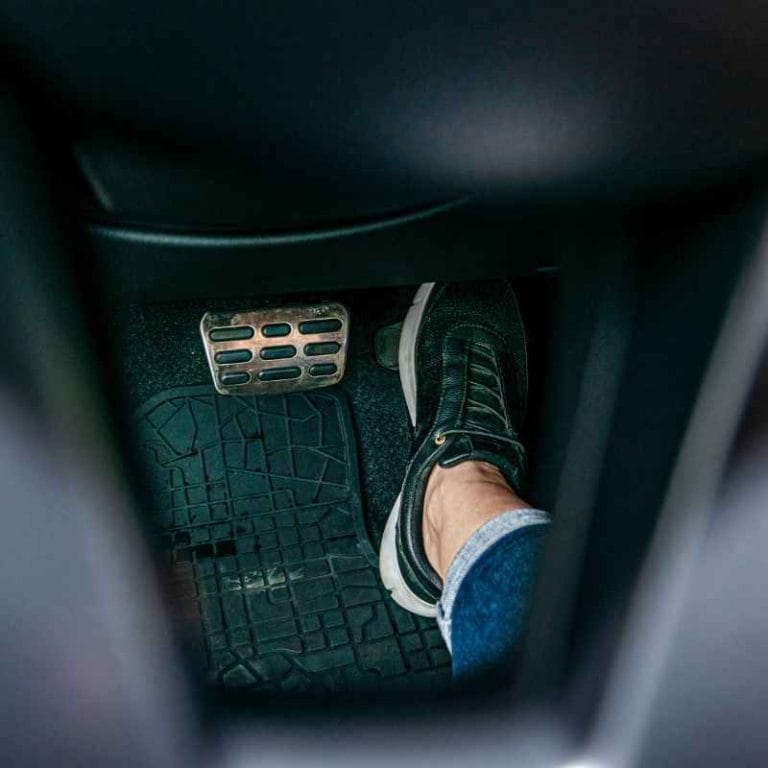
Check the pedal path first. The hinge, pivot, and carpet area are the fastest places to find a true hard-pedal fault. A floor mat can trap the pedal. A dirty or corroded pivot can make the pedal feel heavy before the vehicle has any engine-side problem at all.
Floor mat fit and retention clips
Yes, floor mats can affect the gas pedal. Look for the mat edge curling under the pedal, the wrong mat for the model, or missing retention hooks or clips. An unsecured mat can slide forward during braking and interfere with pedal travel, which is a safety issue, not a nuisance.
Corrosion, debris, and worn pivot points
Debris around the hinge or pivot can create drag. Rust on the pivot pin or dry bushings can do the same. If the pedal squeaks, feels rough, or returns in a jerky motion, the hinge area deserves attention before any throttle body cleaning. Lubrication points vary by vehicle, so avoid guesswork.
Simple safe checks before you drive again
- Remove loose objects around the pedal area.
- Verify the floor mat matches the vehicle and is fully clipped in.
- Press the pedal by hand with the engine off and feel for binding.
- Watch that it returns fully and does not hang at mid-travel.
- If it binds or sticks, do not force it.
A common first-timer mistake is blaming the throttle body before checking the mat. A loose all-weather mat can shift forward by 2 or 3 inches and catch the pedal edge, which feels like a mechanical failure even though the fix is simply correct fit and retention.
Is a hard gas pedal a throttle body problem?
Sometimes, but not always. A dirty throttle body usually affects engine response more than pedal effort. Carbon buildup can make the throttle plate stick, and on drive-by-wire vehicles the electronic throttle actuator interface can lag or fail. That creates poor acceleration, not necessarily a stiff pedal.
Carbon buildup and a sticking throttle plate
Carbon around the throttle plate can keep it from opening and closing smoothly. Drivers often notice hesitation, low power, rough idle, or delayed response after pressing the pedal. If the pedal itself feels normal, the throttle body becomes a stronger suspect than the pedal assembly or floor area.
Electronic throttle actuator interface faults
On electronic throttle control systems, the pedal sends a request and the throttle actuator opens the plate. Faults in that interface can trigger reduced power, unstable response, or limp mode. The pedal may still feel normal because the resistance comes from the pedal spring, not the engine-side throttle plate.
What a dirty throttle body usually feels like
A dirty throttle body usually does not make the pedal physically hard to push. It more often causes a sluggish takeoff, a stumble after tip-in, or an engine that seems late to follow your foot. If the pedal resists your foot, look at the pedal path first; if the pedal feels normal, move to the throttle body.
Can a bad throttle sensor cause no acceleration?
Yes. A failing throttle position sensor or accelerator pedal position sensor can cause signal dropouts, reduced power, warning lights, or limp mode. The pedal may move normally, but the ECU may ignore part of the request if the signal is implausible or missing.
Throttle position sensor and pedal position sensor symptoms
Common signs include delayed throttle response, intermittent surging, an uneven pedal feel only in the vehicle response, and a check engine light. On some cars the traction control or throttle control light also comes on. The sensor itself does not usually make the pedal physically stiff.
Signal dropouts, warning lights, and limp mode
Signal dropouts matter because the ECU compares sensor values for agreement. If the readings disagree, the system may limit throttle opening to protect the engine and driver. That can be one reason a car may idle normally yet barely accelerate. The pedal moves, but the control system refuses full response.
Cruise control and ECU intervention on drive-by-wire cars
Drive-by-wire systems can allow the ECU to override the pedal request. Cruise control shares parts of that logic, and brake input or traction events can cancel throttle demand. If the brake switch misreads as pressed, or the ECU enters failsafe mode, acceleration can be cut even when the pedal works mechanically.
Why does my car hesitate when I press the gas pedal?
Hesitation usually points to engine-side response delay, not pedal resistance. A dirty air filter, restricted intake, throttle control fault, or brake switch issue can delay acceleration while the pedal still feels normal. If the pedal itself is hard to move, separate that from hesitation before you chase the wrong part.
Air intake restriction and dirty air filter symptoms
A dirty air filter or blocked intake usually causes weak acceleration, not a stiff pedal. The engine cannot breathe well enough to match the pedal request, so response feels flat or delayed. This is a response problem, not a pedal-effort problem, and it often comes with reduced high-rpm power.
Brake switch and pedal interlock logic
Some vehicles reduce throttle if the brake switch says the brake is applied. That logic prevents unintended acceleration, but a faulty switch can cause a no-go condition or reduced power. If the engine cuts throttle as soon as you touch the gas, brake interlock logic belongs on the checklist.
How engine-side faults differ from pedal resistance
Engine-side faults leave the pedal feel mostly unchanged. Pedal resistance points to the footwell, hinge, cable, or spring. Weak acceleration with normal pedal effort points to sensors, throttle body, airflow, or ECU intervention. That split is the fastest way to narrow the fault without replacing the wrong part.
When to stop driving now
Stop driving if the pedal sticks, jams, fails to return, or stays partly down. Also stop if a warning light appears with throttle or traction indicators and the car enters limp mode. These symptoms can point to a failsafe event or a throttle control fault that should not be pushed through.
Other red flags include surging, unintended acceleration, or a pedal that feels normal one moment and blocked the next. A car that barely accelerates into traffic can be unsafe even if it still moves. If the fault is not obvious after the safe checks, have a mechanic inspect it.
Quick decision point
If the pedal is physically jammed, do not force it. If the pedal moves normally but the car will not accelerate, scan for codes and inspect the throttle system. If a warning light and reduced power arrive together, the car may be in failsafe mode and needs diagnosis before further driving.
Frequently asked questions
Why is my gas pedal not working?
If the pedal moves but the car does nothing, the fault is often in the throttle sensor, throttle body, brake switch logic, or ECU failsafe. If the pedal itself will not move or returns badly, check the mat, hinge, pivot, cable, and spring first. The symptom pattern tells you where to look.
Why does my gas pedal feel loose?
A loose pedal often means wear in the hinge, pivot, or pedal mounting, or a return spring that no longer gives a firm feel. In cable-throttle systems, slack in the cable can also create a loose sensation. A pedal that feels loose but still returns cleanly is different from one that binds.
Why is my gas pedal sticking?
A sticking pedal usually points to the pedal assembly, floor mat interference, corrosion in the hinge, debris in the pivot, or a binding cable on older vehicles. Do not force it. A pedal that catches on the way down or fails to return is a stop-driving condition until the cause is found.
Why is my car slow to accelerate when I press the gas?
Slow acceleration with a normal-feeling pedal usually points to throttle body contamination, a sensor fault, low airflow from a dirty filter, or ECU intervention. If the pedal effort is normal, look past the pedal assembly and toward the engine management side. Warning lights make that path more likely.
Can floor mats affect the gas pedal?
Yes. An incorrect or unsecured mat can block pedal travel, catch the pedal edge, or change how the pedal returns. Check the mat shape, placement, and retention hooks or clips. If the pedal cannot move freely, remove the mat before driving again and verify full travel.
When is a hard gas pedal unsafe to keep driving?
It is unsafe when the pedal jams, stays down, fails to return, or changes behavior abruptly. It is also unsafe when the problem comes with check engine, throttle, or traction control lights and the car loses power in traffic. Those signs call for immediate inspection, not continued driving.
Products related to this article
Sponsored / affiliate links. As an Amazon Associate I earn from qualifying purchases. I may earn additional commission from eligible campaigns.