Are Pedal Covers Safe? Fitment and Legal Checks
A pedal cover is only safe if it matches the pedal shape, locks tightly, leaves full travel and side clearance, stays legal for road use, and fits within any vehicle-specific guidance from the manufacturer; if any one fails, skip it. A bad fit can slip under braking, block full pedal travel, or create inspection problems in places that treat modified pedal pads as defects. Use the four checks here for fitment, retention, clearance, and legality.
Safety checklist
Use this as a pass/fail screen before you buy or install anything. A cover that fails any one check moves from safe to caution or avoid, even if the surface feels grippy in your hand. Real safety also depends on the pedal material, the OEM pedal design, and whether the vehicle manufacturer allows modifications.
| Check | What good looks like | Red-flag signs | Risk rating |
|---|---|---|---|
| Fitment | Matches pedal shape, size, and mounting points; sits centered with even contact | Side play, overlap at the edges, uneven contact, misaligned holes, rocking on the pedal | Safe if exact match; caution if minor mismatch; avoid if it shifts or hangs over |
| Retention | Mechanical attachment or a tight friction fit that does not move during repeated presses | Loose slip-on fit, weak clamps, stripped screws, missing hardware, visible corrosion, cover coming off under hard brake use | Safe if secure and stable; caution if hardware needs frequent retightening; avoid if it can loosen while driving |
| Clearance | Full pedal travel with space around the edges and no contact with carpet, trim, or mats | Rubbing, binding, pedal return delay, contact with floor mat edges, carpet pile, or nearby trim | Safe if nothing touches; caution if contact appears only at the end of travel; avoid if any pedal movement is affected |
| Legality | Allowed by local road rules, inspection standards, and any vehicle-use conditions from your insurer | Unknown local rule, inspection failure risk, modification not approved, insurance question left unanswered | Safe only after verification; otherwise caution; avoid if your rules prohibit it |
A practical rule: if a cover is simple to install but easy to shift, it is not safe enough for a road car. That matters most on the brake pedal, where even a short delay or slip can change an emergency stop.
What pedal covers change
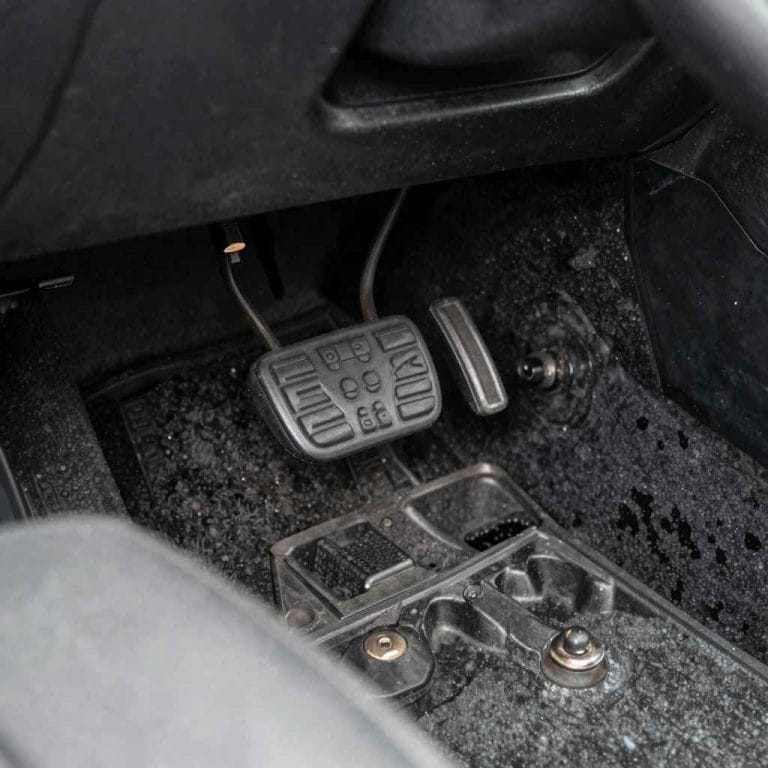
Pedal covers are aftermarket accessories, usually sold in rubber, metal, or drilled and bolt-on styles. Some use friction fit, some use metal spring leaf clamps, and some are fastened with screws, bolts, or rivets where the pedal design and manufacturer guidance allow it. Their main purpose is to change pedal surface feel, and sometimes to add grip through ridges or texture.
Grip can improve on smooth metal or worn rubber, but only when the surface texture actually bites into the sole of the shoe. Wet shoes, mud, and worn tread can reduce that benefit fast. A polished or greasy surface can do the opposite.
The accelerator and brake do not carry the same risk profile. The accelerator should move freely and return fully. The brake pedal should be reachable immediately and keep its full travel and feel, because any interference can affect emergency stopping.
A common first-timer mistake is buying a universal cover that “looks close enough” in the package. On the car, the pedal face is slightly wider than the cover, one edge sits proud, and the driver feels a small catch when lifting off the accelerator. That is a clearance problem, not a cosmetic one.
Do pedal covers fit your car?
Yes, but only if the cover matches your vehicle’s pedal shape, size, and mounting points closely enough to sit flat and stay centered. Vehicle-specific fit lowers the chance of looseness and interference, but it does not guarantee safety if the part is poorly made or installed badly.
What to measure before you buy
Measure the pedal face itself and the space around it in the footwell, then compare those dimensions with the cover’s opening, depth, and hole pattern. A ruler or caliper is fine for the pedal face; use a straightedge to check whether the cover would sit flat. Compare the product to the actual pedal, not just to the brand listing. If the product is meant for a specific model, verify that exact trim or pedal style.
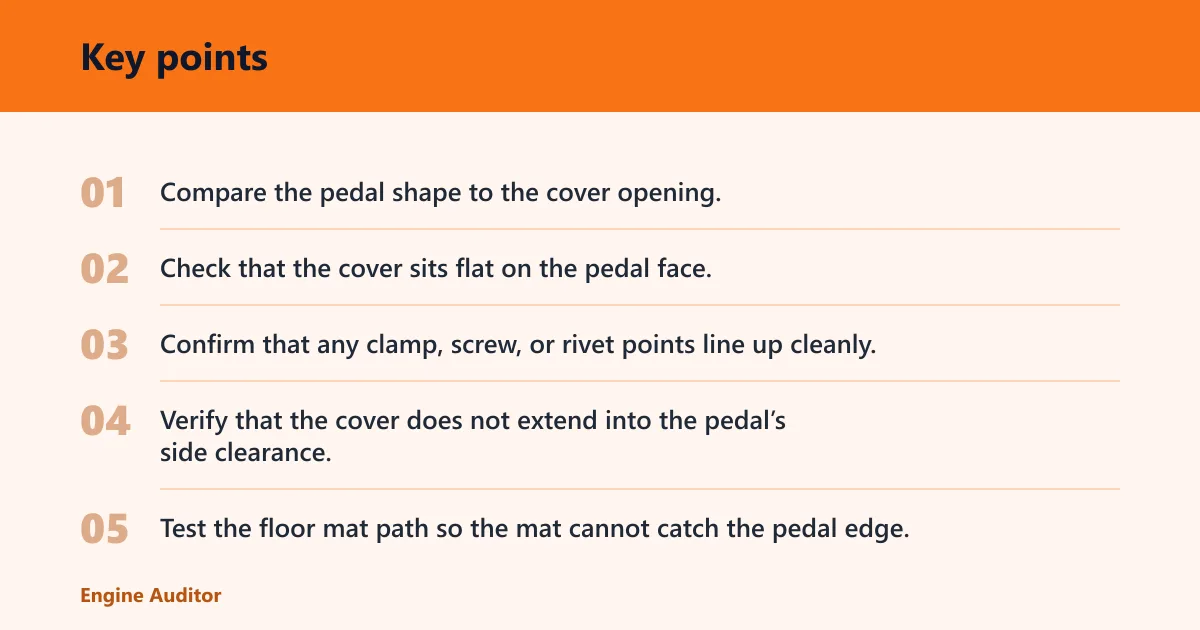
- Compare the pedal shape to the cover opening.
- Check that the cover sits flat on the pedal face.
- Confirm that any clamp, screw, or rivet points line up cleanly.
- Verify that the cover does not extend into the pedal’s side clearance.
- Test the floor mat path so the mat cannot catch the pedal edge.
Red flags are simple. Side play means the cover can shift left or right. Overlap means the cover extends beyond the pedal and can hit trim. Uneven contact means one corner carries the load while the rest floats, which invites movement and wear. Misaligned holes are a warning that the part is wrong for the vehicle.
Suppose your brake pedal is narrow and the new cover wraps around the lower edge, but the top edge leaves a gap. That gap can collect movement and let the cover tilt under repeated braking. A cover that “almost fits” is still a bad fit.
How secure is the retention?
Retention is the part that keeps a cover from coming loose while driving. Slip-on and clamp-on covers are more likely to come loose, while fastened covers can be secure only when the pedal design supports them and the vehicle manufacturer allows the modification. That said, any style can fail if it is the wrong size or installed badly.
Retention methods compared
Friction fit is the simplest method. It can work on the right pedal, but it relies on tight contact and clean surfaces. Spring leaf clamps add mechanical grip, while screws, bolts, and rivets can add secure attachment when the pedal design and manufacturer guidance support them.
Do not assume “bolt-on” means automatic safety. A loose bolt, stripped hole, or thin pedal face can create a false sense of security. The real question is whether the cover stays fixed during repeated pedal cycles, hard braking, and temperature changes.
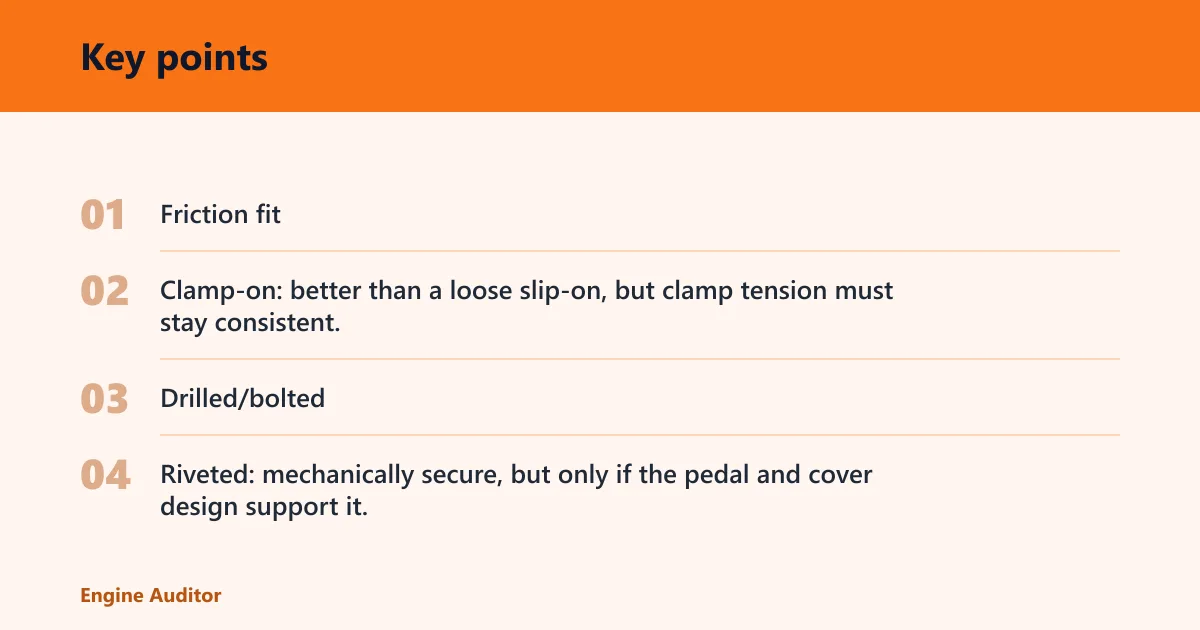
- Friction fit: best when the cover is model-specific and pressure is even.
- Clamp-on: better than a loose slip-on, but clamp tension must stay consistent.
- Drilled/bolted: can be secure when the vehicle design and manufacturer guidance allow it.
- Riveted: mechanically secure, but only if the pedal and cover design support it.
After installation, press the pedal repeatedly by hand, then inspect the fasteners, the edges, and any signs of movement. Recheck after the first few drives, then during regular vehicle inspections and after any service that could affect pedal or mat position, and sooner if you hear squeaks, feel wobble, or see corrosion.
Some pedal covers can come off during hard braking. That is why the retention check is not optional. If the cover moves around and creates gaps, it fails the basic safety standard.
Can they interfere with pedals?
Yes. Interference is one of the main reasons pedal covers become unsafe. The brake pedal must keep its full travel and feel, and the accelerator must release and return without any sticking, rubbing, or obstruction. If a cover changes either behavior, stop using it.
Brake travel and pedal feel
Brake feel should remain immediate and predictable. You should not have to push through a notch, a drag point, or a shifting cover face before the brake responds. If the cover compresses, slides, or catches against the pedal arm or footwell trim, it can slow response in a stop.
Accelerator release and full return
The accelerator must move freely and spring back without hanging up on the cover’s edge. A cover that raises the pedal surface too much can also change ankle angle and make release less natural. In an emergency, that matters as much as grip.
Floor mats, carpet, and trim
Floor mats deserve a separate check. A mat edge can press against a cover, curl under the pedal, or reduce the gap needed for free movement. Carpet pile and nearby trim can do the same. The question is not whether the pedal looks accessible when parked; it is whether it stays unobstructed through the full motion range.
Picture a daily commuter car with thick winter mats. The accelerator cover clears the pedal face, but the lower mat edge sits close enough to brush the cover on return. That is a clearance fault, and it becomes more serious if the mat shifts after the driver’s heel loads it.
Legal and inspection checks
Legality varies by state or country, and pedal covers may be treated differently depending on the inspection system or roadworthiness rules in your area. Before buying, check road-use rules, inspection rules, and any vehicle modification limits that apply to the brake and accelerator area. Insurance and liability questions matter too, because a modification that passes installation can still create a claim problem later.
What to confirm before you buy
Ask whether aftermarket pedal modifications are permitted, whether the vehicle must keep OEM-style pedal pads, and whether the cover changes an inspection item. If your area has annual inspections, confirm that the inspector treats pedal covers as an allowed accessory rather than an unsafe alteration.
- Does your state or country allow non-OEM pedal covers on road vehicles?
- Will the part affect inspection approval?
- Does your insurer treat pedal changes as a notification item?
- Does the product meet any local commercial or roadworthiness rule?
If the answer is unclear, treat the part as caution until you verify it. A cover that is fine on a track car or show car may not be acceptable for a commuter car. That difference matters because daily driving depends on repeatable pedal feel, not just appearance.
When OEM replacement is the safer fix
When the original pedal pad is worn, cracked, or missing chunks, an OEM replacement pedal pad is often the safer choice. It restores the intended shape and surface without adding a new attachment point, and it avoids the fitment and legality questions that come with an aftermarket cover.
Frequently asked questions
Are pedal covers safe to use on a daily driver?
They can be, but only when fitment, retention, clearance, and legality all pass. Daily use adds repeated brake and accelerator cycles, so a part that feels fine in a parked test can still loosen, rub, or shift over time. If any check is weak, skip it.
Do slip-on pedal covers come loose while driving?
They can. Slip-on and clamp-on pedal covers are more likely to come loose than mechanically attached styles, especially if the pedal shape is not a close match or the surface is worn. A cover that moves under braking, creates gaps, or feels soft at the edges should be removed.
Are bolt-on or drilled pedal covers safer than clamp-on covers?
Not automatically. Fastened covers can be secure when the pedal design and manufacturer guidance allow the modification, but safety still depends on fit, hardware quality, and installation. A bad fastened setup can still fail if it is misaligned or poorly tightened.
Can pedal covers interfere with brake or accelerator travel?
Yes. A cover can block full pedal travel, change pedal feel, or rub against carpet, trim, or a floor mat. The brake must stay instantly reachable and the accelerator must return freely. Any sticking, binding, or delayed return is a stop-use warning.
Are pedal covers legal in my state or country?
Maybe, but you need to verify it for your location. Rules vary by state and country, and some places treat pedal modifications as an inspection issue or a roadworthiness issue. Check local laws, inspection rules, and any insurance condition before you install a cover.
How do I know if a pedal cover fits my vehicle correctly?
A correct fit should sit flat, center on the pedal face, and leave even clearance around the edges. It should not rock, overlap, or leave misaligned holes. If the cover needs to be forced into place, or if it touches trim or the floor mat, the fit is wrong.
Can pedal covers improve grip in wet shoes or bad weather?
Sometimes. Ridges and textured surfaces may improve grip over smooth metal or rubber, especially with damp soles. But traction depends on surface condition, wear, moisture, and footwear. A worn or polished cover can lose that benefit fast, so texture is only one part of the decision.
How often should pedal covers be replaced or checked?
Check them after installation, again after the first few drives, and then during regular vehicle inspections or service visits. Replace them if you see cracks, loose hardware, corrosion, edge wear, or movement under pedal pressure. Any change in brake feel, accelerator return, or pedal clearance is a reason to inspect immediately.
Products related to this article
Sponsored / affiliate links. As an Amazon Associate I earn from qualifying purchases. I may earn additional commission from eligible campaigns.