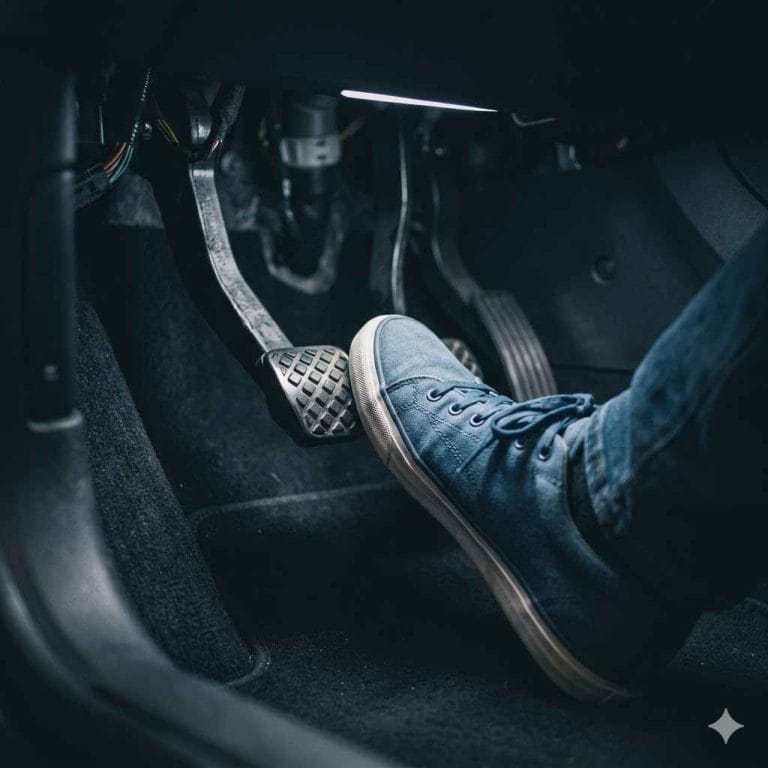
How to Fix a Sticking Accelerator Pedal Safely
If the accelerator sticks, keep both hands on the wheel, shift to Neutral, brake firmly, and stop the car. Then separate a mechanical jam from an electronic throttle fault before you drive again. Ignoring it can cause loss of speed control, rear-end risk, or a dead-stop breakdown if you pick the wrong fix. This guide gives a safe step-by-step triage path for both failure types and tells you when to stop driving and call for help.
What should I do if the accelerator pedal sticks while driving?


Lift off the gas, steer straight, brake smoothly, and move the selector to Neutral if the engine is still pulling the car forward. Use the parking brake only after the car is under control. Shut the engine off only when the vehicle is stopped or nearly stopped and you can do so safely.
A stuck pedal is not one problem. It can be a mechanical bind at the pedal, carpet, cable, or throttle body, or it can be an electronic throttle input fault that keeps the engine responding after your foot leaves the pedal.
What you’ll need
- Flashlight
- Owner’s manual
- Trim or inspection tool for covers or panels, if fitted
- OBD-II scanner if the check engine light or throttle warning is on
- Clean cloth for visible debris only
How do I fix a sticking accelerator pedal safely?
Start with the easiest causes first, floor mat, carpet, and loose debris. Then check pedal travel, pivot movement, and the return spring. If the vehicle uses a cable throttle, inspect the cable next. If it uses electronic throttle control, move to sensor and throttle body checks only after the mechanical path is clear.
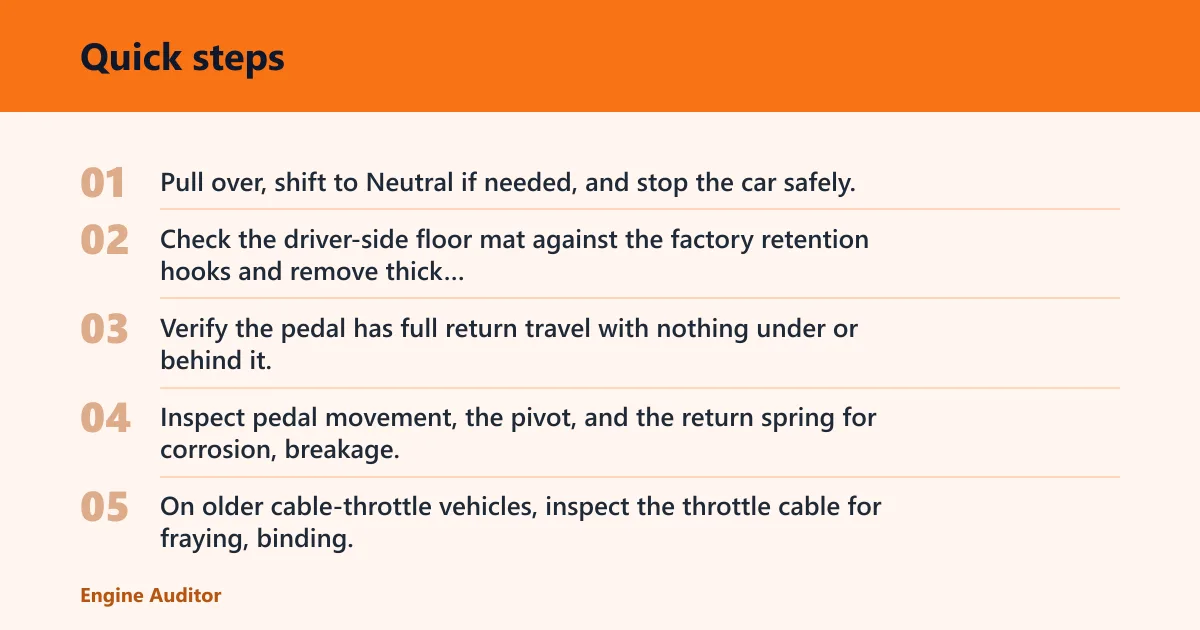
- Pull over, shift to Neutral if needed, and stop the car safely.
- Check the driver-side floor mat against the factory retention hooks and remove thick aftermarket mats.
- Verify the pedal has full return travel with nothing under or behind it.
- Inspect pedal movement, the pivot, and the return spring for corrosion, breakage, or loss of tension.
- On older cable-throttle vehicles, inspect the throttle cable for fraying, binding, or poor adjustment.
- On electronic throttle vehicles, inspect the throttle body for carbon buildup and visible throttle plate movement.
If that didn’t work, try this next
If the pedal still binds after those checks, the next step is diagnosis, not guesswork. An OBD-II scanner can pull throttle-related diagnostic trouble codes and live data. If the scanner shows unstable pedal signal, throttle response faults, or a warning light, stop driving until the system is diagnosed.
Say your floor mat sits 1 inch too far forward and catches the pedal edge only when the seat is all the way back. Remove that mat and recheck pedal return. If the pedal still hangs with the mat out, the fault is farther inside the pedal, cable, or throttle body path.
Can a floor mat cause the gas pedal to stick?
Yes. A badly fitted mat can block pedal travel, especially if it is not locked onto the factory retention hooks or if an aftermarket mat is thicker than the original. Driver-side placement matters, because a mat that shifts forward can trap the pedal even when it looks centered.
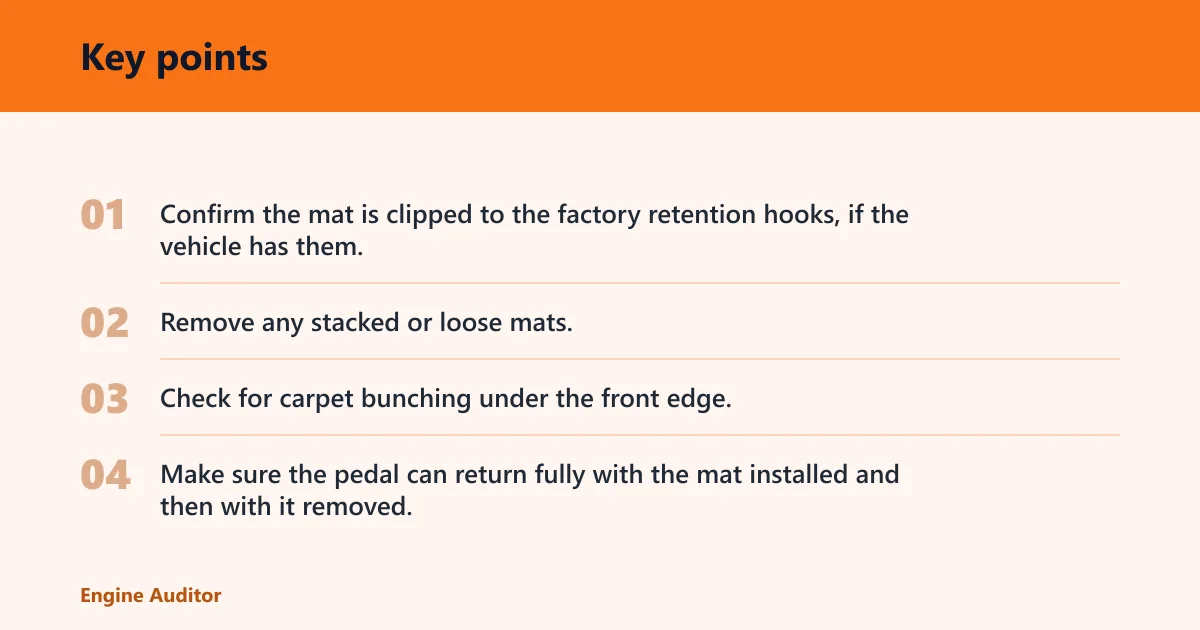
Inspect mat fit first
- Confirm the mat is clipped to the factory retention hooks, if the vehicle has them.
- Remove any stacked or loose mats.
- Check for carpet bunching under the front edge.
- Make sure the pedal can return fully with the mat installed and then with it removed.
If the pedal works normally with the mat out, do not keep driving with the mat in place until it is corrected or replaced. A mat fault is simple, but the risk is immediate.
How do I inspect the pedal, mat, and throttle linkage for problems?
Look at the full travel path, not just the pedal face. The pedal should move smoothly, return on its own, and show no visible interference. On cable-throttle vehicles, the linkage should move without fraying or sticking. On drive-by-wire vehicles, the pedal and throttle body should respond without lag or binding.
Inspection order
- Check the pedal pad for cracks, loose trim, or shifted fasteners.
- Move the pedal by hand and feel for rough pivot movement.
- Inspect the return spring for corrosion, breakage, or weak tension.
- Look for dirt, sticky residue, or a bent pedal arm.
- On cable systems, inspect the cable route for tight bends, fraying, or binding.
- On electronic systems, inspect access to the throttle body and throttle plate movement.
Suppose the pedal returns normally by hand but sticks only when the engine is running. That points away from the floor mat and toward a cable drag problem, a throttle body issue, or an electronic throttle fault that needs scan data.
Could the sensor be the problem?
Yes, but only after the mechanical checks are done. An accelerator pedal position sensor problem can show warning lights, diagnostic trouble codes, inconsistent throttle response, or a signal that does not match pedal movement. Sensor replacement should follow diagnosis, because a bad reading may come from wiring, connector damage, or the throttle body itself.
What to scan
- Use an OBD-II scanner to read throttle-related trouble codes.
- Check live data for pedal signal that jumps, drops out, or disagrees between channels.
- Look for throttle body or electronic throttle codes, not just generic engine codes.
If the scanner shows a pedal position code and the signal is unstable, the next step is proper diagnosis, not a parts swap. A sensor can fail, but so can its connector, wiring, or reference circuit.
Should I turn off the engine if the gas pedal sticks?
Not first. Shut the engine off only after the car is under control, since turning the key too early can remove power steering or power brake assist on some vehicles. Neutral, steady braking, and a safe stop come before engine-off in most cases.
Use this sequence
- Hold the wheel straight.
- Brake firmly and smoothly.
- Shift to Neutral if the car is still accelerating.
- Pull over or coast to a stop.
- Apply the parking brake once the vehicle is controlled.
- Turn the engine off only when stopping conditions allow it.
Common mistakes
Do not force the pedal back with your foot, because that can bend the pedal arm or hide the real fault. Do not spray cleaners into hidden parts you cannot inspect, because excess fluid can damage electronics or worsen residue. Do not replace the sensor before checking the mat, pedal, cable, and throttle body.
Do not ignore a weak return spring or damaged pedal assembly. A return spring should restore the pedal to idle position. If it is corroded, loose, or broken, the pedal can hang again even after a temporary cleanup.
Do not keep driving if the problem returns after one stop. A recurring bind is generally treated as a tow-level problem unless the cause is clearly a floor mat and can be corrected immediately.
When does a sticking accelerator pedal mean I need a mechanic?
You need diagnosis if the pedal still sticks after mat removal and a basic visual check, if the check engine light is on, or if the car uses electronic throttle control and the scanner shows throttle-related codes. You also need help if the throttle cable is frayed or the pedal pivot is visibly damaged.
Sticking accelerator pedal safely repair decision table
| Finding | Likely path | Safe next step |
|---|---|---|
| Mat or carpet blocks pedal travel | Mechanical obstruction | Remove or refit the mat, then retest at idle |
| Pedal pivot is rough, spring is weak, or parts are bent | Mechanical pedal fault | Do not drive far; arrange repair |
| Frayed or binding throttle cable on an older vehicle | Cable-throttle fault | Tow if binding is severe; repair cable and adjust it |
| Throttle warning light or throttle codes with erratic response | Electronic throttle fault | Stop driving and scan the system |
| Pedal sticks again after all visible checks | Unresolved fault | Tow to a shop for diagnosis |
Frequently asked questions
Can I drive with a sticking accelerator pedal?
Only long enough to reach a safe stop if the problem appears suddenly and you can control the car with brake and steering input. If the pedal sticks again, if the engine keeps pulling, or if a warning light is on, do not continue driving. Tow it and get a diagnosis.
How do I know if the accelerator pedal sensor is bad?
Look for throttle-related codes, inconsistent pedal signal in live data, or a response that jumps, hesitates, or does not match foot movement. A scan tool can confirm the signal pattern. Do not replace the sensor until wiring, connector condition, and the throttle body have been checked.
How to fix accelerator pedal sensor issues
Start by reading OBD-II codes and live data, then inspect the connector and wiring at the pedal assembly. If the signal is still inconsistent, the sensor or pedal module may need replacement. After repair, clear the codes and confirm that the pedal signal rises smoothly from idle to full throttle.
Products related to this article
Sponsored / affiliate links. As an Amazon Associate I earn from qualifying purchases. I may earn additional commission from eligible campaigns.