What Is the Accelerator Pedal and How It Works in Cars?
The accelerator pedal is a driver input that asks the engine control system for more or less power; it does not directly control road speed. Miss a pedal or throttle fault, and you can get hesitation, limp mode, stalling, or unsafe surging. This guide explains cable and electronic pedal systems, how they work, and how to diagnose common symptoms safely.
What does the accelerator pedal do?



The accelerator pedal is the driver’s request signal. Pressing it asks the engine for more power. Releasing it asks for less. In a modern car, the pedal does not open the throttle by itself in the way many people picture. The request goes to the engine control unit, which decides how much air and fuel to deliver.
Pedal input versus vehicle speed
Road speed depends on engine output, transmission ratio, tire size, grade, and load. A light pedal press may produce little change on a flat road, while the same input can feel stronger on a hill or during a downshift. That is why the pedal is better thought of as a demand lever than a speed knob.
How the driver asks for more engine power
On the simplest systems, the pedal changes a cable position. On modern systems, it changes sensor voltage or signal patterns. CTS says the accelerator pedal regulates the quantity of fuel supplied to the engine, and Autocarresource notes that the accelerator pedal changes how open the throttle is. Both descriptions point to the same idea: the pedal requests output, and the control system responds.
📊 CTS describes over 150 million pedals in the field. Source: Accelerator Pedals.
How does the accelerator pedal work from foot to throttle?
Foot pressure starts the chain. In a cable system, pedal movement pulls a cable and opens the throttle plate directly. In an electronic system, pedal travel changes a sensor signal sent to the ECU, which commands a throttle actuator. The pedal is the first input in that chain, not the final output.
Signal path in a cable system
A cable-throttle pedal has a physical connection from the pedal arm to the throttle body. Pressing the pedal pulls the cable, the cable rotates the throttle plate, and more air enters the engine. The ECU still matters on many older systems, but the cable does the opening work.
Signal path in an electronic system
Drive-by-wire systems remove that direct cable. Autocarresource describes modern systems as using sensors instead of cables. The pedal module reads position, sends that request to the ECU, and the ECU commands an electric actuator at the throttle body. The throttle body then opens to the angle the ECU wants, within safety limits.
Where the ECU fits in
The ECU receives the pedal signal, compares it with other inputs, and adjusts air-fuel delivery. It can reduce torque for traction, emissions, transmission shift strategy, or brake override. If the pedal request and throttle feedback do not agree, the ECU may store a fault code or enter limp mode.
What is the difference between a cable throttle and drive-by-wire pedal?
A cable throttle uses a mechanical link between pedal and throttle body. A drive-by-wire pedal uses sensors and an ECU-controlled actuator instead. The cable setup gives a direct mechanical feel. The electronic setup gives the ECU more authority over throttle opening, torque limits, and safety logic.
Mechanical cable pedal layout
Older vehicles often use a pedal arm, spring return, and cable routed to the engine bay. If the cable frays, binds, or falls out of adjustment, the pedal can feel heavy or sticky. The fault path is visible and physical, which helps diagnosis, but wear can still leave the throttle partly open.
Electronic pedal and actuator layout
Many modern vehicles use a sensor module at the pedal and an electric motor at the throttle body. CTS says it offers both contacting and non-contacting pedal technologies, and that its pedals can be used in electric, hybrid, or gasoline powered vehicles. CTS also notes optional kick-down features and pedal arms in plastic or metal.
What the driver may feel at the pedal
Drive-by-wire pedals can feel lighter and more filtered. That is normal. A stiff pedal points more toward return spring, floor debris, or cable drag on a mechanical system. An inconsistent or dead pedal on an electronic system points more toward the sensor, connector, wiring, or ECU response logic.
What sensors are inside an electronic accelerator pedal?
Electronic accelerator pedals commonly use a potentiometer sensor, a Hall effect sensor, or an inductive sensor. The first is a contacting design. The latter two are non-contacting designs. All three turn pedal travel into an electrical signal that the ECU can read and compare for plausibility.
Potentiometer sensor
CTS says contacting pedals use a traditional potentiometer system. A potentiometer changes resistance as the pedal moves. Because it has a moving electrical contact, wear or contamination can create dropouts, dead spots, or noisy signal changes. That often shows up as hesitation, uneven response, or a fault light.
Hall effect sensor
A Hall effect sensor is a non-contacting technology used in some accelerator pedal modules. It reads changes in a magnetic field as the pedal moves. Because there is no wiper sliding across a track, it can avoid some wear issues found in contacting designs. It still depends on clean power, grounding, and signal plausibility.
Inductive sensor
An inductive sensor is another non-contacting option. CTS names Hall effect and inductive sensing as non-contacting pedal technologies. Inductive sensing uses changes in an electromagnetic field to infer pedal position. If its signal becomes implausible, the ECU may limit throttle opening or set a diagnostic code.
| Pedal type | How it works | Common symptom pattern | What to inspect first |
|---|---|---|---|
| Cable | Pedal pulls a physical cable to open the throttle body | Stiff pedal, slow return, sticking at partial throttle | Floor-mat interference, cable routing, cable return spring |
| Contact sensor | Potentiometer converts pedal travel into changing resistance | Inconsistent acceleration, dropouts, check engine light | Connector condition, worn sensor track, pedal travel |
| Non-contact sensor | Hall effect or inductive sensor measures position without sliding contacts | Dead pedal, limp mode, mismatch between pedal and throttle | Connector condition, wiring, plausibility codes, mounting |
What is the throttle body, and what does the ECU do?
The throttle body is the part of the intake system that opens wider when more air is needed. In modern vehicles, the ECU mediates that opening. It compares pedal request with engine speed, load, temperature, and other inputs, then commands the throttle actuator and fuel delivery together.
Throttle body opening and airflow
More throttle opening lets more air enter the intake. The ECU then supplies the fuel needed for that airflow. If the throttle plate sticks or the actuator lags, the engine may feel flat, surge, or fail to respond the way the pedal suggests.
Brake override system basics
The brake override system can reduce engine power when the brake and accelerator are pressed together. That can protect against a stuck pedal or driver conflict. If the car suddenly loses power while the brake is pressed, do not keep pressing both pedals harder. Stop and investigate.
Diagnostic checklist: what to inspect first when the pedal feels wrong
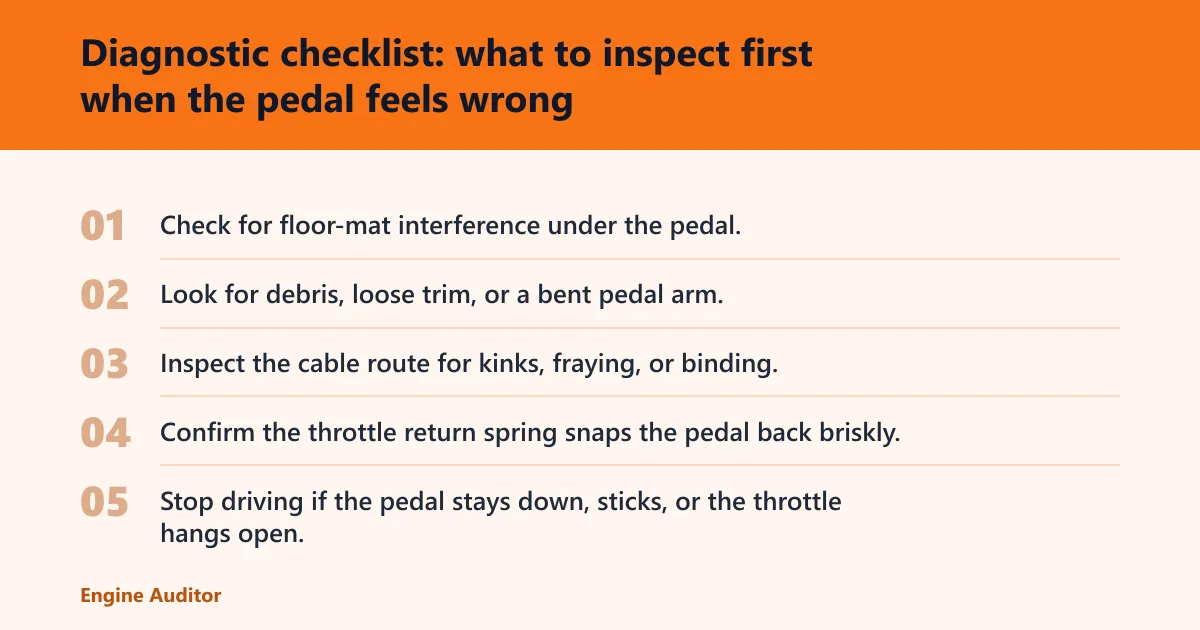
Start with the simplest checks. Many pedal complaints come from interference, connector issues, or cable drag rather than a failed pedal assembly. If the throttle seems stuck, the engine races, or the car enters limp mode, stop driving and seek repair. That is especially true if the brake override system is active or the throttle does not return normally.
Cable pedal checks
- Check for floor-mat interference under the pedal.
- Look for debris, loose trim, or a bent pedal arm.
- Inspect the cable route for kinks, fraying, or binding.
- Confirm the throttle return spring snaps the pedal back briskly.
- Stop driving if the pedal stays down, sticks, or the throttle hangs open.
Contact sensor pedal checks
- Verify the pedal moves freely through its full travel.
- Inspect the connector for corrosion, loose pins, or water intrusion.
- Check for a check engine light or pedal-related fault code.
- Watch for dead spots, hesitation, or a changing signal that feels uneven.
- Stop driving if acceleration cuts in and out or the engine enters limp mode.
Non-contact sensor pedal checks
- Inspect the connector, locking tab, and wiring strain relief.
- Check mounting bolts and surrounding trim for looseness or impact damage.
- Look for sensor plausibility faults if the dash shows reduced power.
- Verify the pedal returns smoothly without rubbing the carpet or mat.
- Stop driving if the pedal signal is lost, the car surges, or power is sharply limited.
Picture a compact car with a thick rubber floor mat pushed too far forward. The pedal travels only halfway before touching the mat. That can mimic a bad sensor, but the first fix is to remove the interference and verify full pedal return before replacing parts.
Suppose a sedan with electronic throttle begins to hesitate at part throttle, then flashes a warning light. The problem may be a corroded connector at the pedal module, not the pedal itself. A sensor that cannot report a believable position can force the ECU to cut power.
Can accelerator pedal behavior affect fuel economy?
Yes. Smooth pedal use can reduce fuel use because it avoids repeated surges and unnecessary throttle swings. Abrupt changes force the ECU to add more fuel quickly, and hard acceleration raises engine load. Gentle, steady input usually keeps throttle, transmission, and torque demand more stable.
Why steady throttle input helps
Steady input lets the drivetrain hold a more efficient operating range. That matters most in stop-and-go traffic and on rolling roads. Sudden lifts and stomps create more speed change than most drivers need, which often wastes fuel and invites extra shifting.
How abrupt pedal changes raise consumption
A rapid press opens the throttle quickly and demands more fuel to match the extra air. A rapid lift can trigger downshifts or engine braking. The result is a wider swing in load and speed. Smooth pedal timing is usually easier on fuel use and drivetrain behavior.
Frequently asked questions
What does accelerator pedal do?
The accelerator pedal asks the engine control system for more or less power. It does not directly set road speed. In a cable system it pulls the throttle open; in a modern drive-by-wire system it sends a sensor signal to the ECU, which decides how much throttle opening and fuel delivery to allow.
How does electronic accelerator pedal work?
An electronic accelerator pedal converts foot travel into an electrical signal. The signal goes to the ECU, which compares it with engine and safety data, then commands a throttle actuator. The throttle body opens only as much as the ECU permits, so the pedal is a request input rather than a direct mechanical link.
How does a gas pedal control engine speed?
The gas pedal controls engine speed indirectly by asking for more airflow and fuel. More pedal input usually means more throttle opening, more air into the intake, and more fuel from the ECU. The engine then makes more torque, which can raise vehicle speed depending on gear ratio and load.
What is the difference between a cable throttle and drive-by-wire pedal?
A cable throttle has a physical wire that links the pedal to the throttle body. A drive-by-wire pedal has sensors instead of a direct cable, and the ECU commands an actuator at the throttle body. The electronic setup adds control logic, torque limits, and brake override behavior.
Why does my accelerator pedal feel stiff or inconsistent?
A stiff pedal often points to mechanical drag, floor-mat interference, debris, or a cable issue. An inconsistent pedal on an electronic system often points to a worn contact sensor, connector trouble, or signal mismatch. If the pedal sticks or the car surges, stop driving and inspect the pedal area first.
What should I check if the accelerator pedal feels abnormal?
Check floor-mat clearance, pedal travel, debris around the hinge, connector condition, and any warning lights. On cable systems, inspect the return spring and cable routing. On sensor-based systems, look for loose plugs and damaged wiring, and fault codes tied to plausibility. If power cuts out or the throttle hangs, seek repair right away.
Products related to this article
Sponsored / affiliate links. As an Amazon Associate I earn from qualifying purchases. I may earn additional commission from eligible campaigns.