Brake Pedal Feel: What Soft or Hard Pedals Usually Mean
A soft or spongy brake pedal usually points to air, fluid loss, or a hydraulic leak; a hard pedal points to booster assist or vacuum trouble; if the pedal is high and improves after pumping, check rear drum adjustment first. Wrong diagnosis can lengthen stopping distance or send you after parts that are fine. This guide gives a fast symptom-to-system check for hydraulics, booster assist, and rear drum adjustment before you open the hood.
This guide is part of our Car pedals and accessories guide series.
Brake pedal feel: what changed, and why it matters


Soft, spongy, hard, or sinking: the main pedal patterns
A brake is a mechanical device that inhibits motion. In modern vehicles, pedal force moves the master cylinder, which sends hydraulic pressure through brake fluid to the wheel brakes. If the pedal feel changes, the system is telling you which part of that chain is not behaving normally.
Soft or spongy usually means air, vapor, or another compressible pocket is in the hydraulic circuit. Hard usually means the brake booster is not multiplying your foot pressure. A pedal that slowly sinks after being held can point to an internal master-cylinder problem or a leak somewhere in the system. A low pedal that improves on a second push often points to rear drum adjustment or extra take-up in the rear shoes.
Why first-press versus second-press feel helps narrow the fault
The first pedal stroke and the second one do not always feel the same. That difference is useful. The first stroke can be used taking up clearance before pressure builds, especially with rear drum brakes or a large shoe-to-drum gap. If the second press feels much better, the problem is often travel, not pure hydraulic failure.
If repeated pumping only gives a brief improvement, treat that as a warning sign, not a fix. Air can compress, a hose can balloon, and a leak can leave the circuit low enough that the pedal firms up for a moment and then drops again. Do not confuse that temporary change with repaired brakes.
Soft or spongy brake pedal: what usually causes it
A soft or spongy brake pedal usually means compressible air or vapor has entered the hydraulic system. Brake fluid is intended to be nearly incompressible under normal operation, so a pedal that feels elastic or vague often means the system now contains a gas pocket, a fluid loss, or a hose that expands under pressure.
Air in the hydraulic circuit
Air in the hydraulic circuit is the classic cause of a spongy pedal. It often enters after brake service, after a leak, or when the reservoir level drops low enough to draw air. Because gas compresses, the pedal can travel farther before the calipers or wheel cylinders move.
One common clue is a pedal that firms up after pumping. That does not repair anything. It only moves fluid and air pockets around long enough to change the feel for a moment. If pumping helps only briefly, bleeding is usually part of the next repair step.
Low fluid, leaks, and failed hose or line sections
Low brake fluid should always be treated as a cause, not a coincidence. Brake fluid is hygroscopic, which means it can absorb water over time. Bosch lists DOT 4 wet boiling point after 3.7% water contamination at 155 degrees Celsius, and Bosch lists DOT 4 dry boiling point at 230 degrees Celsius. That gap is why periodic flushing matters.
Leaks are a separate concern from moisture. Brake lines and flexible hoses transfer hydraulic pressure, and leaks can introduce air. If the reservoir is low, inspect the obvious places first: caliper seals, wheel cylinders, line fittings, hose ends, and the master cylinder body and outlet ports.
Hose expansion and what it feels like
A flexible hose that balloons under pressure can add pedal travel and make the pedal feel soft even when the system is full. That often shows up more when the brakes are applied hard. The pedal may feel normal at first, then longer or softer under stronger braking.
That symptom can be mistaken for air in the lines, because both increase pedal travel. A practical difference is that air often gives a more springy feel and may improve after pumping, while hose expansion is tied to pressure demand and often returns under repeated hard stops.
Rear drum adjustment problems on vehicles with drums
Drum brakes use brake shoes forced into the brake drum to stop the vehicle. On many vehicles, they are on the rear axle. A rear drum self-adjuster that stops working can make the pedal feel low and spongy on the first push. The first stroke may be spent taking up clearance before pressure builds.
That is why all-disc and rear-drum vehicles do not always diagnose the same way. A soft-feeling first press that gets much better on the second press often points to rear drum adjustment before it points to a hydraulic defect.
Why does my brake pedal feel hard to press?
A hard brake pedal usually means the power booster stopped multiplying pedal effort. The brake booster adds force to the master cylinder using engine vacuum, and many newer vehicles use an electric vacuum pump instead. When vacuum supply, the check valve, or the booster itself fails, the pedal can become very hard.
Brake booster assist loss
The brake booster sits between your foot and the master cylinder. It reduces the effort needed at the pedal by using engine vacuum or a vacuum pump. If that assist disappears, the master cylinder still works, but you must push much harder to get the same braking force.
A hard pedal is not the same as “good brakes.” It can mean the braking system is still converting force, just without assist. That is especially obvious during parking-lot speeds, where the vehicle may still stop but require much more leg effort than normal.
Vacuum supply, vacuum pump, and check valve checks
Vacuum supply and the check valve are part of the hard-pedal branch. A vacuum hose split, a failed check valve, or a problem with the electric vacuum pump can remove booster assist. On some vehicles, the fault only shows up after the engine has been off for a while or after several pedal applications.
Inspect the vacuum hose for cracks, loose fitment, or oil contamination. Check the one-way valve near the booster. If the vehicle uses an electric vacuum pump, a warning light or pump noise change may be part of the clue set, but the pedal feel is still the main symptom.
Engine-off test and what it tells you
A simple engine-off test helps separate booster problems from hydraulic ones. With the engine off, press the brake pedal several times to remove stored vacuum. Then hold steady pressure and start the engine. A functioning booster often makes the brake pedal drop slightly as assist comes in.
If the pedal stays hard with the engine running, booster assist is suspect. If the pedal feel changes normally with engine vacuum but remains soft or long-travel, the issue may be farther downstream in the hydraulic circuit.
When a hard pedal points away from the booster
Not every hard pedal is a booster fault. A blocked line, seized caliper, or severe mechanical brake issue can also change pedal feel, though those usually bring other symptoms too. If assist is present but braking is uneven, noisy, or pulls to one side, inspect the wheel-end hardware as well.
Soft pedal or hard pedal: the quick decision tree
Start with the easiest clues first: fluid level, warning lamps, and whether the symptom changes with pumping. Then split the diagnosis by first-press versus second-press behavior and by engine-off versus engine-running feel. That sequence narrows the fault faster than guessing at parts.
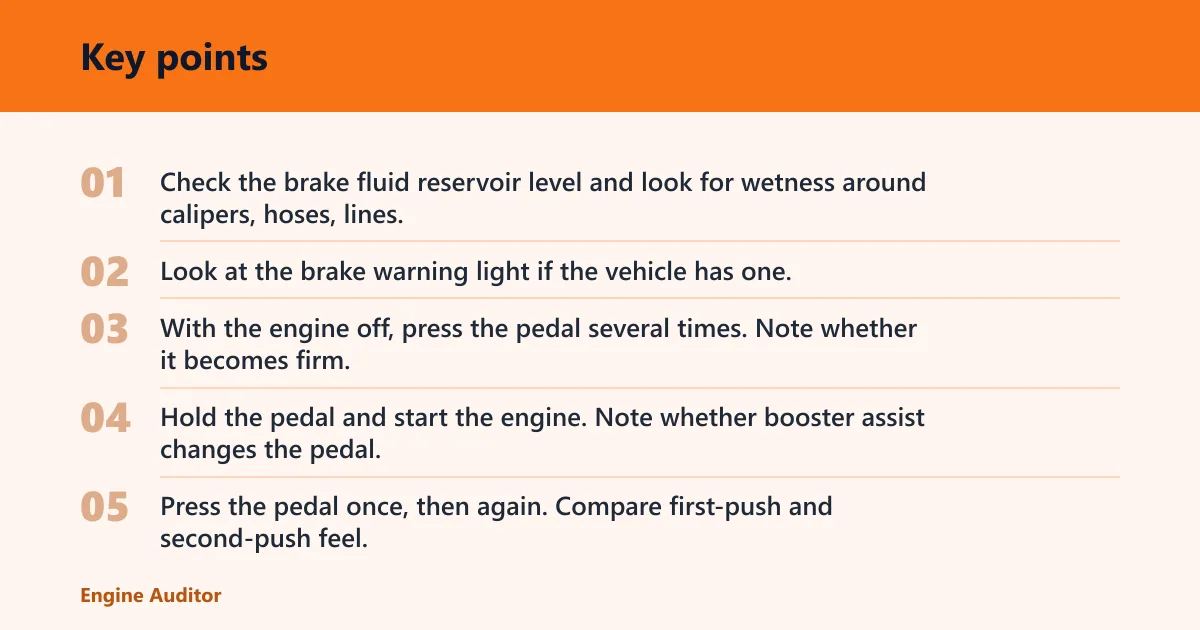
- Check the brake fluid reservoir level and look for wetness around calipers, hoses, lines, wheel cylinders, and the master cylinder area.
- Look at the brake warning light if the vehicle has one.
- With the engine off, press the pedal several times. Note whether it becomes firm.
- Hold the pedal and start the engine. Note whether booster assist changes the pedal.
- Press the pedal once, then again. Compare first-push and second-push feel.
- If pumping briefly improves feel, treat that as a clue, not a repair.
Picture a sedan with rear drums that feels low on the first stop after sitting overnight. The second push is much better. That pattern points first to rear shoe adjustment, not a master-cylinder swap. Suppose a truck pedal goes hard with the engine running and the vacuum hose is cracked at the booster. That points toward assist loss before wheel-end parts.
| Symptom pattern | Likely subsystem | Simplest driveway check | Stop-driving threshold |
|---|---|---|---|
| Soft pedal that firms up after pumping | Air in hydraulic circuit or low fluid | Check reservoir level and visible leaks; note whether the pedal improves only briefly | Stop if fluid is low, the pedal sinks, or braking distance grows |
| Soft first press, better second press | Rear drum adjustment or excess shoe clearance | Compare first-press versus second-press travel at low speed | Stop if the pedal gets low enough that braking feels delayed |
| Hard pedal, little assist with engine running | Brake booster, vacuum supply, or check valve | Do the engine-off/start test and inspect vacuum hose and check valve | Stop if normal stopping effort is no longer available |
| Pedal slowly sinks while held | Master cylinder or external hydraulic leak | Hold steady pressure and watch for drop; inspect for leaks | Stop immediately if the pedal continues to sink |
| Pedal changes after a long downhill or repeated stops | Brake fluid heat, moisture, or brake fade conditions | Check fluid condition and service history; look for contaminated or overdue fluid | Stop if braking changes sharply after heat build-up |
How disc brakes and drum brakes change the diagnosis
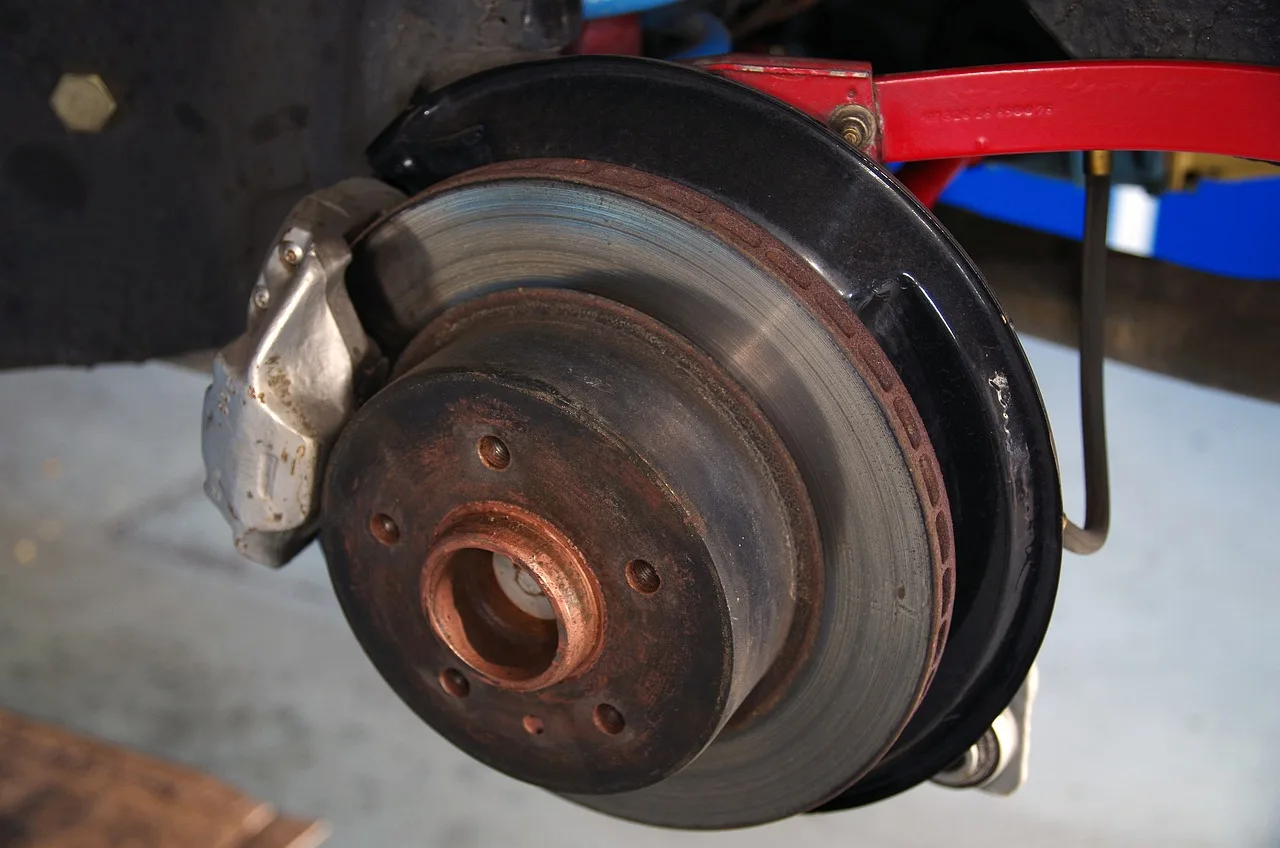
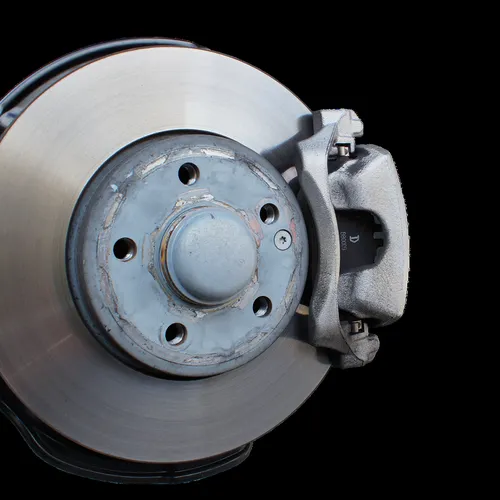
Disc brakes use pads that press against a rotor when the pedal is applied. Calipers clamp the rotor, and on most modern vehicles the front brakes do most of the work. That means front-end hydraulic problems often show up strongly in pedal feel and stopping power.
Front disc brake systems and common pedal clues
On all-disc vehicles, a low or spongy pedal is more likely to point toward air, fluid loss, hose expansion, or master-cylinder trouble than toward shoe clearance. Because there is no rear drum self-adjuster in the rear, repeated-push improvement is less likely to be an adjustment clue.
Rear drum systems, self-adjusters, and extra travel
Drum brakes use brake shoes forced into the brake drum to stop the vehicle. The wheel cylinder pushes the shoes outward, and the self-adjuster keeps the shoe-to-drum gap within range. If that adjuster stops working, the first pedal stroke may feel low while the second stroke feels better.
That pattern is one of the best reasons to separate first-press from second-press behavior before replacing parts. A driver who skips that step may mistake a rear adjustment issue for a hydraulic leak.
All-disc systems versus mixed systems
All-disc systems usually point more quickly toward hydraulic causes when the pedal is soft. Mixed systems with rear drums add one more branch to the tree. If the vehicle has rear drums, keep self-adjustment on the list until the pedal behavior rules it out.
What parts should I check first when brake feel changes?
Start with brake fluid level, visible leaks, and the warning light. Then separate the symptom by feel: soft, hard, sinking, or low on the first press. That order catches the problems most likely to change pedal feel without guessing at calipers, boosters, or master cylinders too early.
One-page brake pedal feel decision table
| Symptom pattern | Likely subsystem | Simplest driveway check | Stop-driving threshold |
|---|---|---|---|
| Soft or spongy, pedal firms after pumping | Air in hydraulic circuit | Check for recent service, low reservoir level, or visible leaks | Stop if pumping only masks the symptom briefly |
| Soft and gets worse over time | Leak or failing hose/line | Inspect hoses, fittings, calipers, and wheel cylinders for wetness | Stop immediately if fluid level is falling |
| High first push, normal second push | Rear drum self-adjuster or shoe clearance | Compare the first and second pedal strokes in a safe area | Stop if the first push is too long to trust |
| Hard pedal with engine running | Booster assist loss | Do the engine-off test and inspect vacuum hose and check valve | Stop if the vehicle needs far more pedal effort than normal |
| Pedal sinks while held | Master cylinder or hydraulic leak | Hold steady pressure and watch for slow drop | Stop driving right away |
Why does the pedal feel different after the car sits overnight?
A pedal that feels different after sitting overnight often points to a clue that changes with vacuum, fluid migration, or rear shoe position. Vacuum assist may bleed off while parked, and rear drum shoes may settle slightly farther from the drum. That makes the first press feel different from later presses.
What to check before driving again
- Check the reservoir level against the minimum mark.
- Look for wet areas around the wheels, lines, hoses, and master cylinder.
- Press the pedal once, then again, and note the change.
- Start the engine and see whether the pedal drops slightly as assist returns.
- If the pedal remains abnormal, do not assume it will “work itself out.”
A common first-timer mistake is to pump the pedal and call the problem fixed. Pumping can change feel for a moment, but it can also hide a fluid loss long enough to create a worse failure later.
Is it safe to drive with a soft brake pedal?
A soft brake pedal is not something to ignore. It can mean air, fluid loss, hose expansion, or another hydraulic fault that increases stopping distance. If the pedal is soft enough that you need extra travel or repeated pumping to stop normally, the car should be inspected before more driving.
When to stop driving and tow the car
Stop driving and arrange a tow if the pedal sinks, the reservoir is low, the brake warning light is on with changing pedal feel, or the vehicle needs pumping to stop safely. A brief improvement after pumping is a warning sign, not clearance to continue.
Is it safe to drive with a hard brake pedal?
A hard brake pedal can make the vehicle difficult to stop because the booster is not multiplying pedal effort. If the engine-off test points to lost assist, or if normal pedal force no longer produces normal braking, treat that as a safety problem rather than a comfort issue.
When a hard pedal should stop the trip
Do not keep driving if the pedal requires unusual leg force, the engine vacuum test fails, or braking becomes unpredictable. A hard pedal can still stop the vehicle, but not with the margin the system is designed to provide.
Can low brake fluid make the pedal feel soft?
Yes. Low brake fluid can make the pedal feel soft because it often means a leak or air entry, and air is compressible. Low fluid can also let vapor or air into the circuit during cornering, braking, or heat soak, which changes pedal feel again.
Can a bad brake booster cause a hard brake pedal?
Yes. A bad brake booster can cause a hard brake pedal because the booster adds force to the master cylinder using engine vacuum. If vacuum supply, the hose, the check valve, or the booster itself fails, the pedal usually still works, but it takes much more effort.
When does a spongy pedal mean air in the brake lines?
A spongy pedal often means air in the brake lines when it appears after service, after a leak, or after the reservoir level dropped low. If the pedal firms up after pumping and then softens again, that pattern strongly supports air or vapor in the hydraulic circuit.
When should I stop driving and tow the car?
Stop driving if the pedal sinks, the fluid level is low, the brake warning light stays on with a feel change, the pedal becomes hard enough that normal stopping effort is gone, or pumping only gives a temporary fix. Those are not nuisance symptoms. They are brake-system warnings that need inspection.
Frequently asked questions
Why does my brake pedal feel soft or spongy?
A soft or spongy pedal usually means compressible air or vapor has entered the hydraulic system, or that a hose is expanding under pressure. Low fluid and leaks can start the chain. If the pedal firms up after pumping, the system still needs diagnosis, not just more leg effort.
Products related to this article
Sponsored / affiliate links. As an Amazon Associate I earn from qualifying purchases. I may earn additional commission from eligible campaigns.