Do All Cars Have a Clutch Pedal? Manual vs Automatic
No, most automatic cars do not have a clutch pedal. Manuals usually have one on the far left, while many automatics still use clutch parts inside the transmission. Mixing them up can lead to the wrong car choice, bad driving habits, or missed signs of transmission trouble. This guide shows how to spot manual vs automatic from the driver’s seat and explains where clutches still exist in automatics.
Do all cars have a clutch pedal?
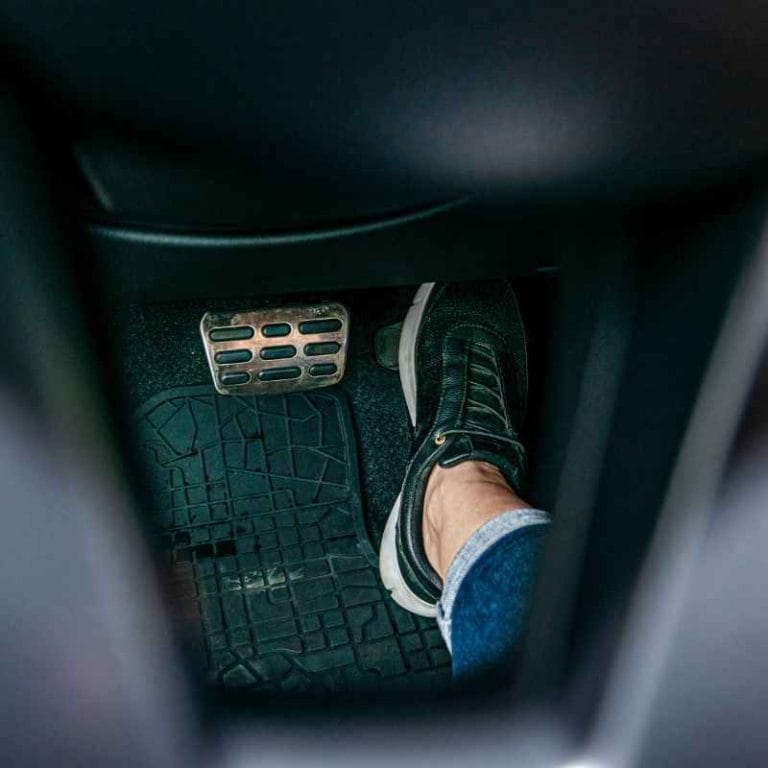
No. Manual cars typically have a clutch pedal, while most automatics usually do not. From the driver’s seat, the quickest check is pedal count: three pedals usually means manual, two pedals usually means automatic. The gear selector also matters, because a PRND-style selector usually suggests an automatic-style setup.
Clutch pedal vs clutch system
The clutch pedal is the driver-operated control that disconnects the engine from the drivetrain during a gear change in a manual car. The clutch system is different: it means the clutch parts inside the transmission, and those parts can exist even when no pedal is present. That is where many car descriptions get sloppy.
People often say “the car has a clutch” when they really mean “the transmission has clutch parts.” That shortcut hides the real question for a driver: what happens under your left foot, and who controls the shift?
Manual transmission: the setup with a clutch pedal
A manual transmission usually gives the driver a clutch pedal, a gear lever, and responsibility for choosing the gear. The left foot presses the clutch to disconnect drive, the right hand selects the gear, and the clutch comes back out to reconnect power smoothly.
That coordination is why manuals feel different from automatics. From the driver’s seat, a manual typically has three pedals and no PRND-style selector doing the shifting for you.
What is the difference between a manual and automatic clutch?
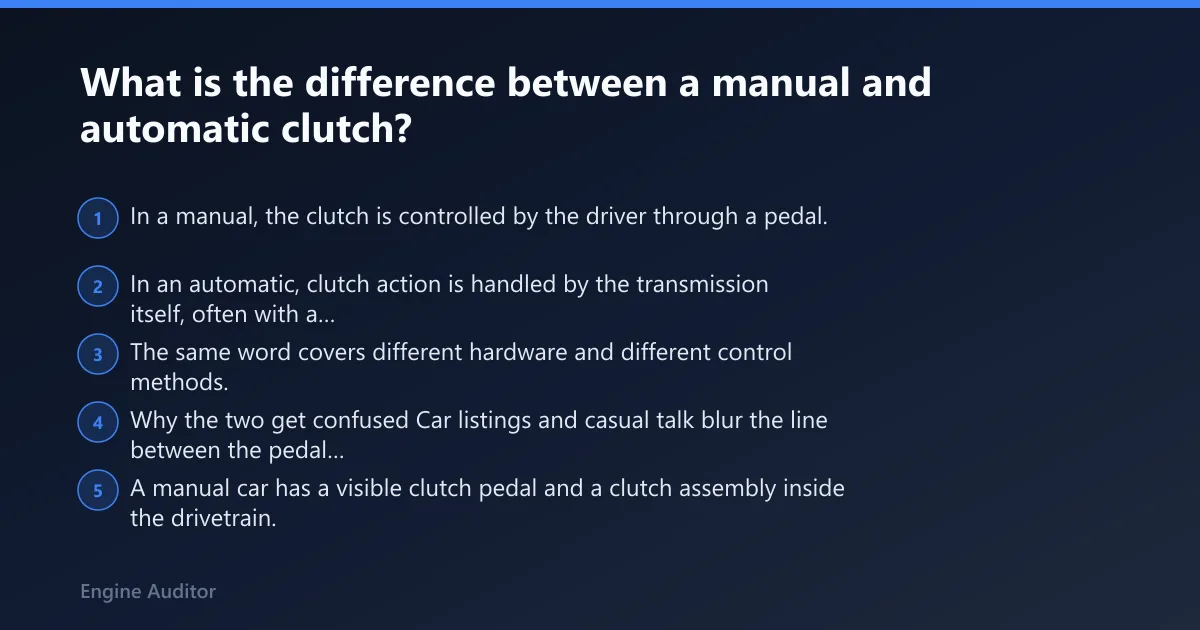
In a manual, the clutch is controlled by the driver through a pedal. In an automatic, clutch action is handled by the transmission itself, often with a torque converter and internal clutch packs, so the driver does not work a clutch pedal during normal driving. The same word covers different hardware and different control methods.
Why the two get confused
Car listings and casual talk blur the line between the pedal and the part. A manual car has a visible clutch pedal and a clutch assembly inside the drivetrain. An automatic may have no pedal at all, yet still contain clutch packs that engage and disengage on their own.
The key is control. If the driver has to manage clutch engagement directly, it is manual territory. If the transmission manages it internally, the pedal is absent even if clutch parts still exist.
Automatic transmission: why there is usually no clutch pedal
Traditional automatic cars usually do not have a clutch pedal because the torque converter handles that role instead of the driver. The torque converter keeps power flowing smoothly and lets the car stop without stalling. That is why an automatic can idle in gear at a stoplight with the brake held.
Internal clutch packs inside automatics
Automatic cars can still have internal clutch components. In traditional automatics, internal clutch packs are controlled automatically and help select or hold gear elements inside the transmission. They do not change the pedal layout because the driver never operates them directly.
This is the point many people miss: no clutch pedal does not mean no clutch parts. It means the clutch function has moved out of the driver’s footwork and into the gearbox logic.
Gear selector and driver role
In a traditional automatic, the gear selector does the driver-facing work of choosing Park, Reverse, Neutral, Drive, and sometimes lower ranges. The transmission then handles gear changes on its own. The driver still influences motion, but not with a clutch pedal or hand shifts in normal driving.
What types of automatics still use clutches?
Automated manual transmissions and dual-clutch transmissions both use clutch systems without giving the driver a clutch pedal. That matters because “automatic” does not always mean torque converter. It can also mean the car shifts by sensors and electronics while the clutch work happens behind the scenes.
Automated manual transmission
An automated manual transmission still uses manual-transmission hardware, but it usually does not have a driver clutch pedal. Sensors and electronic controls operate the clutch and manage gear changes. The driver usually gets automatic-style operation from the seat, even though the underlying gearbox is closer to a manual.
This setup is the clearest proof that clutch pedal and clutch system are separate ideas. The clutch still exists. The pedal does not.
Dual-clutch transmission
A dual-clutch transmission uses two separate clutches, one for odd-numbered gears and one for even-numbered gears. That arrangement allows the transmission to prepare the next gear path in advance while still keeping the driver out of clutch work.
A DCT therefore has clutches inside, often more than one, but no clutch pedal in the cabin. The driver interacts through the selector and any shift mode buttons, not through a left-foot control.
Pedal-layout decision table: manual, automatic, and DCT or AMT
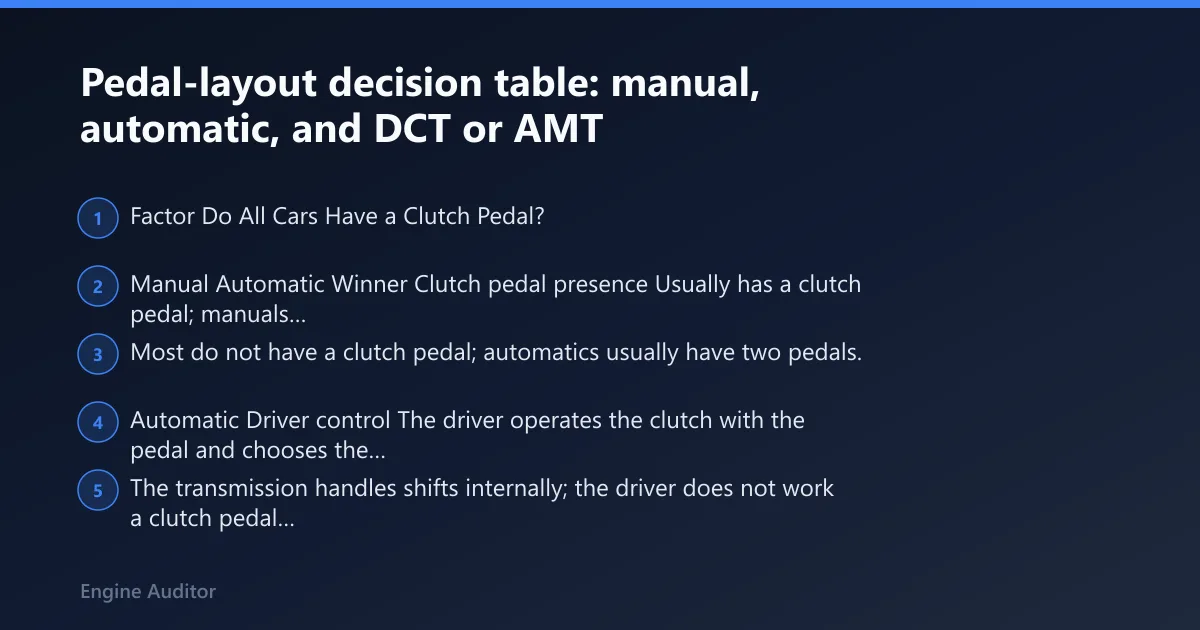
| Factor | Do All Cars Have a Clutch Pedal? Manual | Automatic | Winner |
|---|---|---|---|
| Clutch pedal presence | Usually has a clutch pedal; manuals typically have three pedals with a far-left clutch pedal. | Most do not have a clutch pedal; automatics usually have two pedals. | Automatic |
| Driver control | The driver operates the clutch with the pedal and chooses the gear with the lever. | The transmission handles shifts internally; the driver does not work a clutch pedal during normal driving. | Do All Cars Have a Clutch Pedal? Manual |
| Performance / driving feel | Provides direct left-foot control and full involvement in gear changes. | Shifts on its own and keeps power flowing smoothly with a torque converter, letting the car idle in gear without stalling. | Tie |
| Maintenance / hardware complexity | Has a visible clutch pedal and a clutch assembly inside the drivetrain; the driver controls clutch engagement directly. | May still contain internal clutch packs, but they are controlled automatically inside the transmission and are not operated by the driver. | Tie |
| Best-fit use | Best for buyers who want full left-foot control and direct driver involvement. | Best for buyers who want simplicity at the pedals and automatic-style driving. | Tie |
| How to identify from the driver’s seat | Three pedals and an H-pattern/manual-style shifter usually mean manual. | Two pedals and a PRND-style selector usually mean automatic-style shifting. | Tie |
| Clutch system inside the transmission | Has clutch parts inside the drivetrain as part of the manual setup. | Can also have clutch parts inside, including internal clutch packs, DCT clutches, or AMT clutch actuation. | Tie |
| Typical automatic variants mentioned | Not applicable in the article’s automatic-style variants discussion. | Traditional automatic, DCT, and AMT can all operate without a clutch pedal. | Automatic |
Manual
Manual wins on direct driver involvement. The pedal count is the giveaway, and the clutch pedal is part of everyday gear changes. If a buyer wants full left-foot control, this is the setup that provides it.
Traditional automatic
Traditional automatic wins for simplicity at the pedals. The torque converter lets the car idle at a stop without stalling, and the transmission handles shifts internally. That is why most people identify it instantly from the driver’s seat.
DCT or AMT
DCT and AMT sit in the middle. They behave like automatics from the driver’s seat because there is no clutch pedal, yet both still use clutch hardware inside the transmission. That makes them useful when the buyer wants automatic-style operation without assuming the gearbox works like a conventional torque-converter automatic.
How can I tell if my car is manual or automatic by the pedals?
Look at the pedals first. Three pedals with a far-left clutch pedal usually means manual; two pedals usually means automatic or an automatic-style transmission such as a DCT or AMT. Then check the selector: a PRND layout strongly suggests automatic-style shifting rather than a standard manual shifter.
- Count the pedals from left to right.
- Check whether the left pedal is a clutch pedal.
- Look for a PRND-style gear selector or an H-pattern shifter.
- If there are two pedals and a PRND selector, think automatic, DCT, or AMT.
- If there are three pedals and a clutch pedal, think manual.
Why don’t automatic cars need a clutch pedal?
Automatic cars do not need a clutch pedal because the transmission handles disengagement and re-engagement of drive internally. In traditional automatics, the torque converter manages smooth power transfer and lets the engine keep running when the vehicle is stopped. The driver therefore does not need to time a pedal during each shift.
What the driver feels matters more
What matters from the seat is not whether the gearbox contains a clutch somewhere inside. It is whether the driver must operate one. If the car shifts on its own and the left foot is free, the vehicle behaves as an automatic, even if internal clutch parts are present.
What is a clutch pedal used for in a manual car?
In a manual car, the clutch pedal is used to disconnect the engine from the drivetrain so the driver can change gears without grinding or stalling. It also helps the car start moving from a stop in a controlled way. That makes the pedal central to both launch and shifting.
The pedal is not there for decoration. It is the driver’s control point for taking engine power out of the driveline and putting it back in at the right moment.
Can an automatic ever have clutch packs or an internal clutch?
Yes. Automatic cars can still have internal clutch components, and traditional automatics commonly use internal clutch packs that are controlled automatically. These parts operate inside the transmission and are not the same thing as a clutch pedal in the cabin. The driver never presses them.
What types of automatics use a clutch system?
Traditional automatics use internal clutch packs, and DCTs use two separate clutches for odd and even gears. AMTs also use a clutch, but sensors and electronic control units handle the actuation instead of the driver’s foot. So several automatic-style systems still depend on clutch hardware.
Is an automated manual transmission the same as a manual car?
No. An automated manual transmission uses manual transmission hardware, but the car does not give the driver a clutch pedal. The clutch work is handled by sensors and electronic control units, so the driving experience is automatic-style even though the underlying gearbox traces back to manual architecture.
That difference matters for shoppers. An AMT may sound like a manual on paper, but from the seat it behaves more like an automatic because the driver does not coordinate clutch pedal use.
Do dual-clutch transmissions have two clutches?
Yes. A dual-clutch transmission uses two separate clutches, one for odd-numbered gears and one for even-numbered gears. The driver still does not press a clutch pedal. The transmission manages the clutch work internally while shifting under electronic control.
That is why DCTs can feel quick on upshifts and downshifts without turning the cabin into a manual. Two clutches live inside the gearbox, but the left foot stays out of the job.
Choose manual if… / Choose automatic if…
Choose manual if you want direct clutch and gear control, do not mind three pedals, and want the driver to handle shift timing. Choose automatic if you want the car to handle shifts for you, prefer two pedals, or want easier stop-and-go driving. Choose DCT or AMT if you want automatic-style operation but need to know that hidden clutch hardware may still be present.
- Choose manual if you want a visible clutch pedal and full control over each shift.
- Choose manual if you are learning to coordinate clutch and shifter use by foot and hand.
- Choose automatic if you want no clutch pedal and the least driver workload in traffic.
- Choose automatic if you want the transmission to manage clutch action internally.
- Choose DCT or AMT if you want two-pedal driving but should not assume there is no clutch system inside.
Frequently asked questions
Do all cars have a clutch pedal?
No. Manual cars usually have a clutch pedal, and most automatic cars do not. If a car has two pedals and a PRND-style selector, it is usually automatic-style. If it has three pedals with a far-left clutch, it is usually manual.
What is the difference between a manual and automatic clutch?
A manual clutch is operated by the driver through a pedal, while an automatic clutch system is handled by the transmission itself. In a traditional automatic, that may mean a torque converter and internal clutch packs. The driver controls the selector, not a clutch pedal.
Do automatic cars have a clutch at all?
Some do, but not in the way drivers usually mean. Traditional automatics often have internal clutch packs, and DCTs and AMTs also use clutch hardware. What they usually do not have is a clutch pedal for the driver’s left foot.
Why don’t automatic cars need a clutch pedal?
Automatic cars do not need a clutch pedal because the transmission handles power interruption and gear changes internally. A torque converter in a traditional automatic smooths power flow and lets the car stop without stalling. That removes the need for driver clutch timing.
What is a clutch pedal used for in a manual car?
The clutch pedal disconnects the engine from the drivetrain so the driver can select a gear without damaging the transmission. It also helps the car move away from rest smoothly. In a manual, it is a core part of everyday driving, not an optional control.
Can an automatic ever have clutch packs or an internal clutch?
Yes. Traditional automatics can have internal clutch packs, and those parts are controlled automatically. DCTs also use two clutches, and AMTs use a clutch with electronic actuation. The difference is that none of these setups require a driver clutch pedal.
Products related to this article
Sponsored / affiliate links. As an Amazon Associate I earn from qualifying purchases. I may earn additional commission from eligible campaigns.