Vehicle types by purpose: Daily driving vs work use
Pick the vehicle around the commute first; for light work, I start with a car or SUV, and I move to a van or truck when tools, towing, or heavy hauling show up every week. Pick wrong and you pay for it in fuel, cargo strain, and faster wear. This guide compares cars, SUVs, vans, and trucks for commuting, hauling tools, and side-business trips, then flags when work use becomes business or commercial use.
This guide is part of our Vehicle types guide series.
| Decision factor | Vehicle types by purpose: Daily driving | work use | Winner |
|---|---|---|---|
| Commute comfort and parking | Usually better: easier to park, quieter cabin, less fatigue in stop-and-go traffic | Usually worse: larger footprint, higher step-in, more effort in tight lots | Vehicle types by purpose: Daily driving |
| Cargo and tool capacity | Limited cargo room, especially with passengers on board | Better: larger load space, open bed or enclosed van area, easier tie-downs | work use |
| Fuel use and mileage sensitivity | Usually better for long commutes and frequent errands | Often worse when the body style is larger or work equipment adds weight | Vehicle types by purpose: Daily driving |
| Insurance and admin complexity | Usually simpler if use stays personal or commuting | More complex when the vehicle is business-owned, employee-driven, or set up for service work | Vehicle types by purpose: Daily driving |
| Best-fit use case | Commuting, school runs, errands, occasional light hauling | Tools, products, clients, service calls, and work-first duty cycles | Tie |
What counts as daily driving versus work use?

Daily driving is the duty cycle built around commuting, parking at a destination, errands, and family trips. Work use starts when the vehicle regularly carries tools, products, clients, or business equipment, or when the body style and add-ons are chosen for job tasks first and commuting second.
Personal use, commuting use, and pleasure use
A vehicle is a machine made for self-propulsion, and vehicles move people, cargo, or both. Personal use means the vehicle is owned and used for private life, commuting use means driving to and from work or school, and pleasure use means it is not driven to work or school and is used only occasionally.
That last category matters for insurance. Some insurers may classify fewer than 7,500 miles per year as pleasure use, while the average U.S. driver travels 13,476 miles per year. Mileage alone does not decide the class, but it often pushes the rate and the use label.
Business-use vehicle versus commercial use
A business-use vehicle may still be personally owned and used for appointments, light business travel, or carrying a few tools. Commercial use is a stronger label: business-owned vehicles, employee-driven vehicles, delivery routes, taxi-like work, and service fleets usually fit there because the exposure and claim pattern change.
The line is not just ownership. A personal car used to visit clients may still fit a personal policy if the insurer accepts the actual use, while the same car used daily to transport tools, products, or customers can cross into commercial territory.
When light business travel stays personal and when it does not
Light business travel usually stays personal when the trips are infrequent, the cargo is minor, and the vehicle still looks and behaves like a commuter car. It moves toward commercial use when the work load becomes routine, when the vehicle is stocked like a mobile tool cabinet, or when the car is part of a paid service operation.
According to Vehicle – Wikipedia — ISO 3833-1977 is the international standard for road vehicle types.
Which vehicle types fit daily driving best?
For most commuters, sedans and compact crossovers are the easiest fit because they balance parking, fuel use, and comfort. Minivans can beat trucks when the driver needs passenger room, a low step-in, and flexible cargo space without the harsher parking burden of a pickup.
Sedans for commuting and parking ease
Sedans are the simplest answer for a pure commuter. They usually park more easily, fit tighter spaces, and keep daily operating costs in check. The tradeoff is cargo volume; once tools, boxes, or bulky returns enter the picture, the trunk starts to feel small fast.
Crossovers and small SUVs for mixed errands
Crossovers and small SUVs make sense when the vehicle must handle school pickups, grocery runs, and occasional work items. They give a higher seating position and more flexible cargo space than a sedan, but they still drive more like a daily vehicle than a jobsite rig.
When a minivan makes more sense than a truck
A minivan can be the right answer when the driver needs sliding doors, easy loading, and a cabin that handles people and gear every day. For contractors who haul light tools and also carry family or clients, a van often feels less wasteful than a truck with an empty bed most of the week.

Which vehicle types work better for tools, cargo, and site visits?
Trucks and vans fit work tasks better because they are built around cargo, access, and load management. If the vehicle has to carry tools, weather-sensitive supplies, or bulky equipment, body style matters more than badge or trim level.
Pickup trucks for payload and bed access
Pickup trucks are useful when open-bed loading, tie-down points, and dirty cargo are routine. They are a poor fit for a pure commute if the bed stays empty, because the added size and fuel use buy capability that never gets used.
Cargo vans for enclosed storage and weather protection
Cargo vans work well when tools need to stay dry, secure, and organized. Enclosed space also helps with branded shelving, lockable storage, and keeping small parts from shifting around on the road. That same boxy body makes parking harder and visibility more demanding.
Body-on-frame SUVs and their tradeoffs for work use
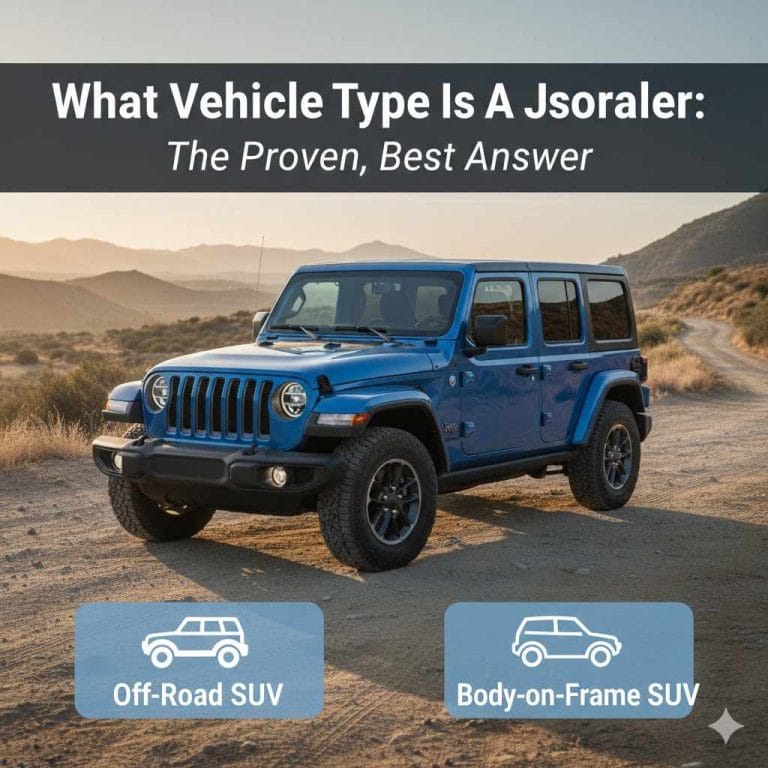
Body-on-frame SUVs can split the difference for owners who need passengers, some cargo, and occasional towing. They usually do not load as cleanly as a van or truck, and they often cost more to fuel than a smaller commuter vehicle, but they can work when one vehicle has to do both jobs.
How do insurers look at commuting, mileage, and business use?

Insurers look at more than nameplate and year. Mileage, rush-hour exposure, and business purpose all affect pricing, and a vehicle that lives in traffic all week carries a different risk pattern than one used only on weekends. Undisclosed work use can also create claim problems if the policy does not match reality.
Mileage thresholds and insurer-specific breakpoints
There is no single universal cutoff. Some insurers may use a relatively low annual mileage figure as a pleasure-use marker, while policies may treat a much higher mileage level very differently if the vehicle is being used like a high-mileage commuter. Those breakpoints are insurer-specific, not fixed law.
The mileage number matters in two ways. It affects pricing, and it also tracks wear, downtime, and resale risk. A vehicle driven hard every weekday can need tires, brakes, and suspension work sooner, even if the insurance class never changes.
Rush-hour exposure and annual driving pattern
A car driven through peak commute traffic every day has more exposure to low-speed collisions and parking damage than a weekend-only vehicle. That is part of why annual miles are only one piece of the pricing puzzle. When the driving pattern is heavy and repetitive, the risk profile shifts.
Why undisclosed work use can create claim problems
If a personal policy is written for private commuting and the vehicle is actually used for business deliveries, client transport, or a service route, the insurer may argue that the risk was misclassified. The common result is a coverage gap at the worst time, which is why use labels have to match the real duty cycle.
Mixed-use decision matrix: how to score a vehicle for both roles
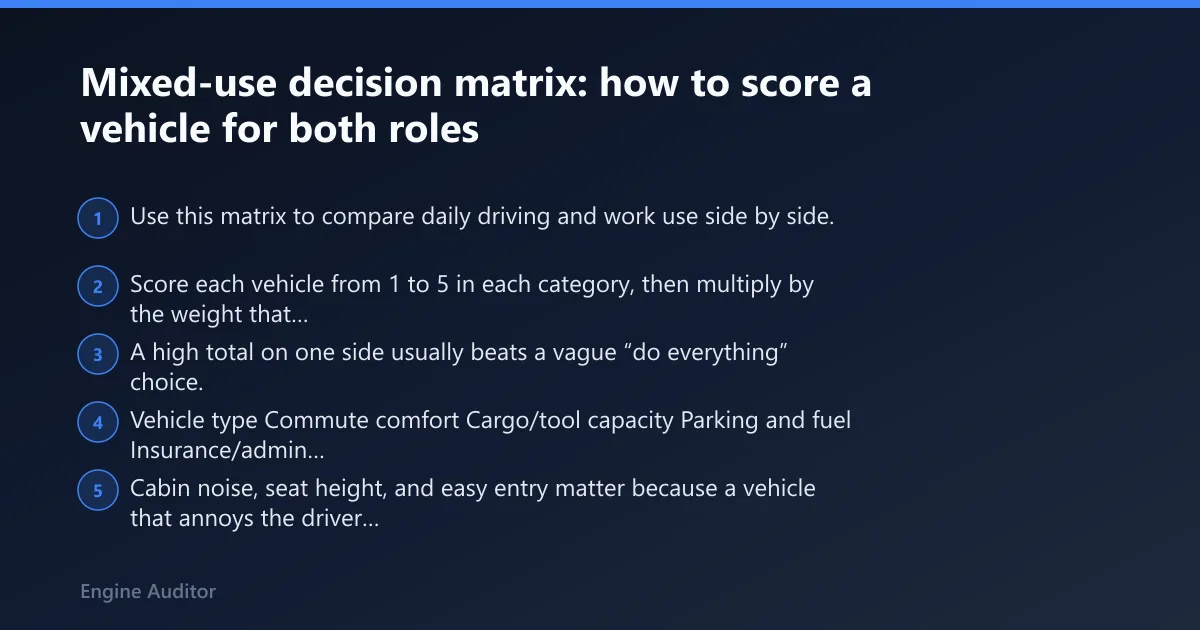
Use this matrix to compare daily driving and work use side by side. Score each vehicle from 1 to 5 in each category, then multiply by the weight that matches the owner’s real need: commute comfort, cargo/tool capacity, parking and fuel, and insurance/admin complexity. A high total on one side usually beats a vague “do everything” choice.
| Vehicle type | Commute comfort | Cargo/tool capacity | Parking and fuel | Insurance/admin complexity | Best use |
|---|---|---|---|---|---|
| Compact sedan | 5 | 2 | 5 | 5 | Daily driving with light errands |
| Small crossover | 4 | 3 | 4 | 4 | Mixed commuting and occasional work items |
| Minivan | 4 | 4 | 3 | 4 | Family use plus bulky but not dirty cargo |
| Pickup truck | 3 | 5 | 2 | 3 | Tools, hauling, towing, site work |
| Cargo van | 3 | 5 | 2 | 3 | Secure storage, service calls, deliveries |
Commute comfort score
For daily driving, the winning vehicle is the one the driver actually wants to sit in every weekday. Cabin noise, seat height, and easy entry matter because a vehicle that annoys the driver becomes a chore. A truck can be fine, but it usually loses this category unless work needs outweigh comfort.
Cargo and tool capacity score
For work use, cargo volume, tie-down points, and load shape decide the winner. A sedan can swallow groceries and a laptop bag, but a toolbox, extension ladder, or product bins change the math quickly. This is where vans and pickups usually pull ahead.
Parking and fuel score
Daily driving rewards smaller footprints and lighter bodies. A vehicle that is easy to park near an office, apartment, or school saves time every single day, while a larger work vehicle adds friction every time the driver has to squeeze into a lot or spend more at the pump.
Insurance and admin complexity score
The more the vehicle looks like a business tool, the more paperwork tends to follow. Business-owned vehicles, employee-driven vehicles, and vehicles with commercial add-ons can trigger separate policy questions, documentation, and renewal checks. Georgia, for example, requires annual vehicle registration, says vehicle registration must be renewed each year, and renewal may require a license plate number or VIN number and proof of liability insurance on file. (georgia.gov) (georgia.gov)
When does a vehicle need commercial auto coverage?
A vehicle needs commercial auto coverage when its actual use creates a business risk that a personal policy may not accept. That usually includes business-owned vehicles, employee-driven vehicles, delivery or taxi-like work, and vehicles that spend most of their time moving tools, products, or clients for pay.
Business-owned vehicles and employee-driven vehicles
When the business owns the vehicle, or when employees drive it for company tasks, commercial auto policy language usually becomes the right starting point. That policy structure is built for different loss patterns than a private commuter policy, especially when more than one driver uses the same unit.
Delivery, client transport, and service calls
Driving to a client meeting can still be personal use in some policies, but frequent service calls, product drops, and passenger transport for pay are different. Once the vehicle is part of a business operation rather than a personal commute, the chance of a coverage mismatch rises fast.
Add-ons that point to work-first use
Cranes, lift-gates, winches, and snow plows are strong signals that the vehicle is no longer just a commuter. Those add-ons change the job, the risk, and often the policy class. A truck fitted for plowing or lifting cargo is built around work exposure, not grocery runs.
What features matter most in a vehicle used for both work and daily driving?
The best mixed-use vehicle fits people first and cargo second without creating daily friction. Cabin access, seat layout, visibility, payload, and cargo shape matter more than badge prestige. A good mixed-use choice should park acceptably, carry work gear safely, and still feel tolerable in traffic.
Cabin access, seat layout, and visibility
Easy entry matters when the driver is getting in and out several times a day. Good outward visibility helps in crowded lots, loading zones, and neighborhood streets. A vehicle that hides its corners or makes loading awkward burns time every week.
Payload, tie-down points, and cargo volume
Work gear needs a place to sit still. Tie-down points, flat floors, and enough payload for the actual load are more useful than a long list of trim features. If the cargo slides, gets wet, or blocks rear visibility, the vehicle is not doing its job.
Parking footprint, ride comfort, and fuel use
Daily driving puts a premium on the easy stuff: parking, ride quality, and fuel use. That is why a commuter car can be cheaper to insure than a work vehicle in many cases. The commuter spends more of its life doing low-risk tasks, while the work vehicle often sees more miles, more weight, and more business exposure.
Choose daily driving if…
Choose daily driving if the vehicle spends most of its life commuting, parking at a fixed destination, and handling family errands. A sedan or small crossover usually wins when cargo is light, mileage is moderate to high, and the driver wants lower fuel use and simpler insurance classification.
Choose work use if…
Choose work use if the vehicle regularly carries tools, products, clients, or equipment, or if it has work add-ons like a lift-gate, winch, crane, or snow plow. A truck, cargo van, or body-on-frame SUV fits better when the load, access, and business exposure matter more than parking ease.
Frequently asked questions
What’s the difference between a daily driver and a work vehicle?
A daily driver is built around commuting, parking, errands, and comfort. A work vehicle is built around carrying tools, products, clients, or equipment, often with more cargo room, more wear, and more insurance or registration questions tied to business use.
Can I use my personal car for work without a commercial policy?
Sometimes, yes, if the use stays light and the insurer accepts it. A personal car used for a few appointments or small errands may still fit a personal policy, but undisclosed deliveries, client transport, or tool hauling can create a coverage gap if the policy does not match the real use.
What vehicle types are best for commuting every day?
Sedans are usually the easiest daily commuters because they park well and use less fuel. Small crossovers are the next step up when the driver wants more cargo room, while minivans make sense when people-moving and daily loading matter more than a compact footprint.
What vehicle types are better for carrying tools or equipment?
Pickup trucks and cargo vans are usually better because they are built for load access and secure storage. Trucks handle open-bed cargo and dirty materials well, while vans protect tools from weather and theft better. Body-on-frame SUVs can work, but they are usually a compromise.
When does a vehicle count as commercial use?
It starts looking commercial when the vehicle is business-owned, employee-driven, or used for delivery, taxi-like work, or routine client and service transport. Add-ons such as cranes, lift-gates, winches, and snow plows also point toward work-first use because they change the vehicle’s purpose.
How many miles per year is considered pleasure use?
Some insurers may classify fewer than 7,500 miles per year as pleasure use, but that is not universal. Annual mileage affects pricing, wear, and resale value, and insurer rules can change by company, location, and how the vehicle is actually driven during the year.
Products related to this article
Sponsored / affiliate links. As an Amazon Associate I earn from qualifying purchases. I may earn additional commission from eligible campaigns.