Hatchback vs sedan: Which works better for daily use?
A hatchback usually works better for daily use if you want easier parking, simpler cargo loading, and more flexible storage. Pick a sedan if highway noise, trunk security, or rear-seat comfort matters more. Choose wrong, and you feel it every day in tight spaces, grocery runs, and awkward loading. This guide compares commuting, parking, errands, and occasional hauling so you can choose the body style that fits your routine.
This guide is part of our Vehicle types guide series.
| Decision factor | Hatchback | sedan: Which type works better for daily use | Winner |
|---|---|---|---|
| Cargo access | Wide rear opening, fold-flat rear seats | Smaller trunk opening, fixed trunk shape | Hatchback |
| City parking and visibility | Often easier in tight spaces, better rear sightlines | Can be easier to judge the tail in some parking spots | Hatchback |
| Highway quietness | Open cargo area can pass more cabin noise forward | Separated trunk can calm the cabin | sedan: Which type works better for daily use |
| Fuel economy | Can be helped by lighter weight, but depends on model | Can benefit from better aerodynamics, but depends on model | Tie |
| Security for cargo | More visible storage area through the cabin | Hidden trunk keeps bags out of sight | sedan: Which type works better for daily use |
| Ownership cost | Varies by trim; often competitive | Varies by trim; often competitive | Tie |
How the two body styles differ
Hatchback layout and cargo access
A hatchback usually has a rear door that lifts up, with the cargo area tied directly to the cabin. That gives a larger loading opening, and the rear seats often fold flat for long or awkward items. In daily use, that shape matters as much as total volume.
Sedan layout and trunk separation
A sedan uses a separate trunk behind the rear seat. The three-box profile often looks sleeker, and the trunk can quiet luggage noise because it is isolated from the cabin. It also hides cargo better, which helps when bags, tools, or packages stay in the car.
Why the same nameplate can behave differently by trim or year
Same-nameplate comparisons need caution. Two versions of the same nameplate can differ in cargo shape, curb weight, glass area, wheel size, and equipment, and those differences may affect fuel economy, noise, and price as much as, or more than, the body style itself. Verify the trim and model year before deciding, as they can affect the choice.
Which is easier to live with in daily tasks?
A hatchback is usually easier to live with when daily tasks include mixed cargo, tight parking, and frequent stop-and-go errands. A sedan often feels calmer on the highway and hides cargo better. The better choice is the one that causes less repeat friction in your actual week, not the one that looks better on paper.
| Daily task | Hatchback | sedan: Which type works better for daily use | Winner |
|---|---|---|---|
| Parking in tight city spaces | Usually easier to place and judge | Can be fine, but trunk shape adds less flexibility | Hatchback |
| Loading bulky items | Large opening helps with awkward shapes | Smaller trunk opening can limit the load angle | Hatchback |
| Cabin quiet on highways | More exposure from cargo area | Trunk separation usually helps | sedan: Which type works better for daily use |
| Rearward visibility | Often better due to larger, more upright rear window | Can be fine, but rear glass often feels smaller | Hatchback |
| Cargo security | Items are easier to see from the cabin | Trunk hides bags from view | sedan: Which type works better for daily use |
Quick read on which tasks favor a hatchback
Hatchbacks usually win on parking ease, loading convenience, and rearward sightlines. They also fit daily work that changes shape from day to day: groceries one trip, a box or stroller the next, and weekend luggage after that. The wide rear opening is the point.
Quick read on which tasks favor a sedan
Sedans usually win when the commute is long, the highway share is high, or the cargo needs to stay out of view. Their trunk separation can cut noise and make the cabin feel more settled. If the rear seat stays upright most of the time, the sedan’s packaging is often enough.

Which body style works best for cargo and errands?
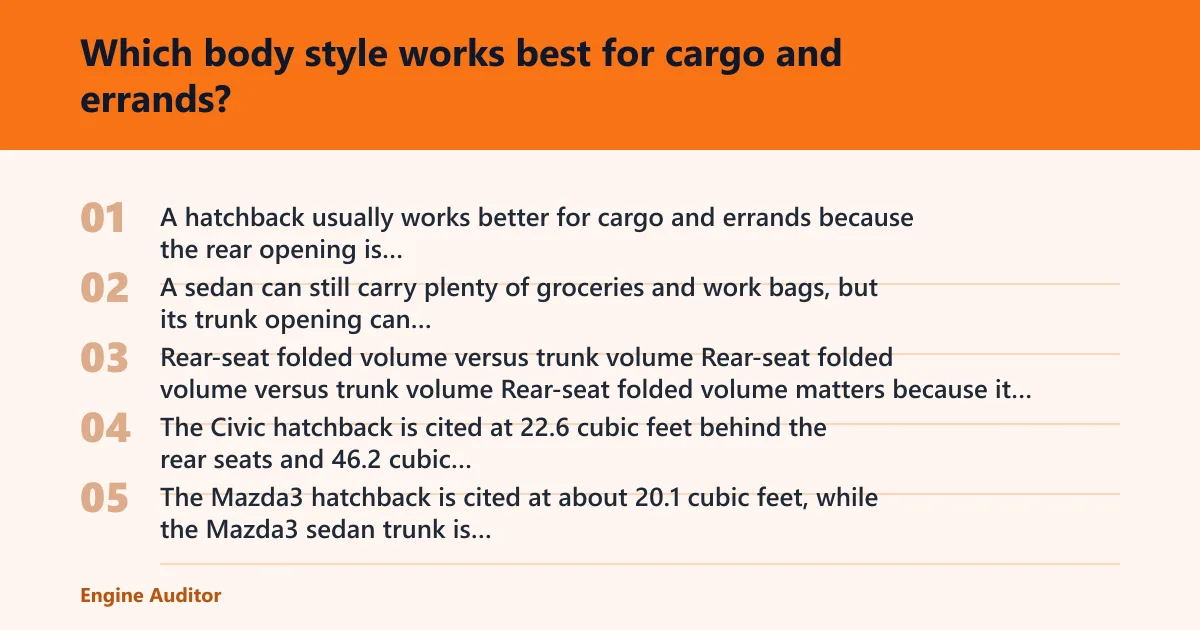
A hatchback usually works better for cargo and errands because the rear opening is larger and the rear seats fold flat. A sedan can still carry plenty of groceries and work bags, but its trunk opening can make bulky items harder to load even when the trunk volume looks similar on a spec sheet.
Rear-seat folded volume versus trunk volume
Rear-seat folded volume matters because it tells you how much space appears when you need it. The Civic hatchback is cited at 22.6 cubic feet behind the rear seats and 46.2 cubic feet with the seats folded, while the Civic sedan is cited at 15.1 cubic feet in the trunk. The Mazda3 hatchback is cited at about 20.1 cubic feet, while the Mazda3 sedan trunk is cited at about 13.2 cubic feet.
Bulky-item loading: strollers, boxes, grocery runs, sports gear
For a stroller, a laundry hamper, flat-pack boxes, or a stack of grocery bags, the hatchback’s opening usually matters more than the raw number. The load floor is easier to use, and long items slide in with less contortion. Sedans can do the job, but the trunk opening is the bottleneck.
When a hatch opening matters more than total volume
Total volume is only part of the story. A low, wide hatch opening helps when the item is tall, angled, or awkwardly shaped. If daily hauling is mostly soft bags, the difference shrinks. If your week includes child gear, hobby equipment, or boxy deliveries, the hatchback usually removes more frustration.
Which is easier to park and see out of?
A hatchback is often easier to park in the city because it is compact, has a shorter rear overhang, and usually gives better rearward sightlines. A sedan can still park well, especially with good cameras and sensors, but the body shape alone usually gives the hatchback a small edge in tight spaces.
City parking, tight spaces, and rear visibility
Hatchbacks are often slightly lighter and easier to place in tight city streets. That can make lane changes, curb parking, and three-point turns feel less awkward. The rear window is usually larger and more upright, which helps when backing into a narrow spot or checking for a low post behind the car.
Camera and sensor help versus body shape alone
Driver aids matter. A good rear camera, parking sensors, and clear mirror placement can make either body style easier to live with. Still, body shape affects the baseline. If a car already has a small rear glass area, the camera is doing more work every time you back out of a space.
Which is quieter, more efficient, and more comfortable?
A sedan usually has the edge for quiet highway driving because the separate trunk isolates luggage noise and can calm the cabin. Fuel economy is less settled by body style than many shoppers think, because weight, aerodynamics, and powertrain matter more. For comfort, the better choice depends on seat space, noise control, and suspension tuning.
Highway noise and the sedan trunk advantage
A separated trunk can block some road and cargo noise from reaching the passenger area. That matters on long commutes and road trips, where a small rise in cabin noise becomes tiring. Hatchbacks can still be quiet, but the open cargo connection gives noise one more path forward.
Fuel economy: weight, aerodynamics, and EPA ratings
Fuel economy depends more on the specific model than body style alone. Hatchbacks can be slightly lighter, and that can help in stop-and-go driving. Sedans can have better aerodynamic shapes, and the Mazda3 sedan can edge out the hatchback in highway fuel economy. Compare the EPA ratings for the specific trim, not just the badge.
Handling and ride feel in daily commuting
For daily commuting, the difference often comes down to tuning. Some hatchbacks feel a bit more agile in traffic, while some sedans feel more settled at speed. Tire choice, wheel size, and suspension setup can matter more than the rear door style, so the trim sheet deserves attention.
Daily-use decision matrix: score the body style that fits your life

Use this as a working filter. Give each row a low-to-high score for the body style that suits your routine best, then total the side that fits more of your day. If your week leans toward short trips, curbside parking, and mixed cargo, the hatchback score usually climbs. If your week is mostly highway miles, trunk security, and quiet commuting, the sedan score usually climbs.
| Daily-use task | Weight in your life | Hatchback score | sedan: Which type works better for daily use score | What usually tips it |
|---|---|---|---|---|
| Commute length and highway share | Low / Medium / High | 1-3 | 1-3 | Sedan if quiet highway time matters most |
| Parking in tight city spaces | Low / Medium / High | 1-3 | 1-3 | Hatchback if you park in cramped lots or streets |
| Errands and grocery runs | Low / Medium / High | 1-3 | 1-3 | Hatchback if bags and boxes vary week to week |
| Bulky hauling | Low / Medium / High | 1-3 | 1-3 | Hatchback if loading angle matters |
| Cabin noise tolerance | Low / Medium / High | 1-3 | 1-3 | Sedan if a quieter cabin matters |
| Fuel cost sensitivity | Low / Medium / High | 1-3 | 1-3 | Usually model-specific, so verify EPA ratings |
| Need to hide cargo | Low / Medium / High | 1-3 | 1-3 | Sedan if security and privacy matter |
| Long-term ownership cost | Low / Medium / High | 1-3 | 1-3 | Depends on insurance, maintenance, tires, resale |
How to total the score
After scoring each task, add the points for each body style. A hatchback often works better when city parking, cargo access, and flexibility matter more than road-trip quiet. A sedan usually wins when daily miles are longer, the trunk stays full, and you want less cabin exposure to what is in the back.
Final recommendation by use pattern
If your week is mostly commuting plus errands, the hatchback usually fits better. If your week is mostly highway miles with occasional luggage, the sedan often fits better. If the score is close, use cargo loading and cabin noise as the tie-breakers, because those are the pain points you feel most often.
Choose Hatchback if… / Choose sedan: Which type works better for daily use if…
Choose a hatchback if your daily routine includes city parking, short trips, grocery runs, child gear, or hauling items that do not fit neatly through a trunk opening. Choose a sedan if your commute is long, you want a quieter cabin, or you prefer to keep cargo hidden and separate from the passenger area.
Choose hatchback if…
Choose a hatchback if you regularly fold the rear seats, carry strollers or sports gear, park on crowded streets, or want the easiest loading shape for awkward items. It also suits drivers who value rear visibility and a compact footprint more than trunk separation.
Choose sedan if…
Choose a sedan if highway time is a big part of your week, you value a quieter cabin, or you want a trunk that hides bags and reduces clutter in the passenger area. It also suits buyers who rarely need the rear opening to do more than carry groceries or a suitcase.
What to verify before buying the same model in both forms
Check the exact trim, model year, EPA ratings, cargo figures, wheel size, safety equipment, and driver-assist list. Same-nameplate cars can differ enough to change the answer. Verify cargo volume, trunk volume, rear opening size, and the presence of cameras or parking sensors before you sign.
Frequently asked questions
Is a hatchback or sedan better for daily driving?
A hatchback is usually better for daily driving if you mix commuting with errands, parking, and occasional hauling. A sedan is usually better if your commute is longer and you care more about cabin quiet and hidden cargo. The better daily car is the one that creates less repeat hassle in your routine.
Which is easier to park in the city, a hatchback or sedan?
A hatchback is usually easier to park in the city because it tends to be compact and gives better rearward sightlines. That said, cameras, sensors, wheelbase, and overall length can outweigh the body style. A well-equipped sedan can be easier than a poorly equipped hatchback.
Do hatchbacks get better gas mileage than sedans?
Sometimes, but not by default. Fuel economy depends more on the engine, transmission, weight, tires, and aerodynamics than on hatchback versus sedan alone. Some hatchbacks are slightly lighter, while some sedans cut drag better at highway speed. Compare the exact EPA ratings for the trim you want.
Which body style has more cargo space, hatchback or sedan?
A hatchback usually has more usable cargo space because the rear seats fold flat and the opening is larger. That does not always mean a bigger published number in every situation, but it often means easier loading and better flexibility. The Civic and Mazda3 figures make that practical difference clear.
Which is quieter on the highway, a hatchback or sedan?
A sedan is usually quieter on the highway because the trunk separates cargo noise from the cabin. That separation can matter during long commutes and road trips. Some hatchbacks are still very quiet, but the open cargo area gives noise more paths into the passenger space.
Which is cheaper to own, a hatchback or sedan?
Neither body style is always cheaper to own. Purchase price, insurance, maintenance, tires, and resale value vary by model, trim, and mileage pattern. A hatchback can be cheaper in one nameplate and a sedan can be cheaper in another, so compare the full ownership picture before buying.
Products related to this article
Sponsored / affiliate links. As an Amazon Associate I earn from qualifying purchases. I may earn additional commission from eligible campaigns.