
Ford scheduled maintenance vs repair: what’s the difference?
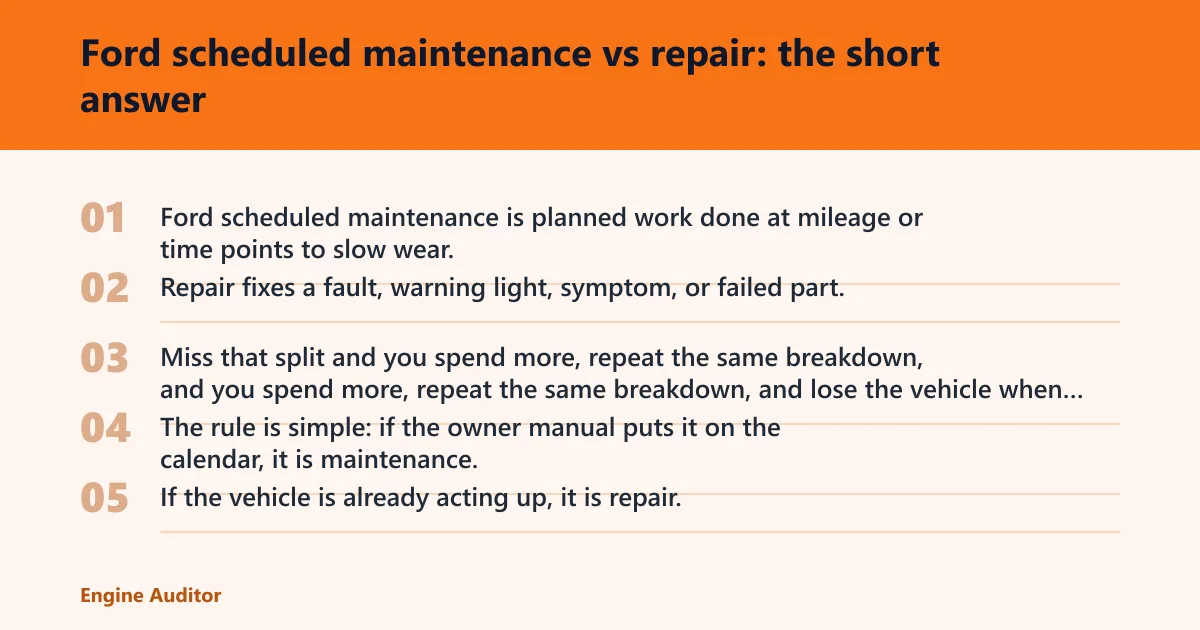
Ford scheduled maintenance is planned work done at mileage or time points to slow wear. Repair fixes a fault, warning light, symptom, or failed part. Miss that split and you spend more, repeat the same breakdown, and lose the vehicle when you need it.
The rule is simple: if the owner manual puts it on the calendar, it is maintenance. If the vehicle is already acting up, it is repair. Ford Expert Service can do both, but the booking choice should follow the cause, not convenience.
Ford scheduled maintenance vs repair: the short answer
| Decision factor | Ford scheduled maintenance | Repair: what’s the difference? | Winner |
|---|---|---|---|
| Trigger | Mileage or time interval | Symptom, warning light, leak, or failure | Neither; they solve different jobs |
| Timing | Planned ahead | Booked after a problem appears | Ford scheduled maintenance for planning |
| Urgency | Usually can wait for the interval | May need same-day inspection | Repair for urgent faults |
| Goal | Prevent wear and keep service on track | Restore function after a fault | Neither; goals differ |
| Typical examples | Oil change, tire rotation, brake check, battery check | Brake pad replacement, dead battery, leak diagnosis, drivability fix | Neither; examples differ by cause |
| Mobile Service fit | Often yes for selected items | Sometimes, but not for every fault | Ford scheduled maintenance |
Why the table splits them this way
Maintenance follows the owner schedule. Repair starts when the vehicle signals a fault. The same part can move between those buckets depending on the situation.
An oil change on schedule is maintenance. A no-start after an oil leak, battery failure, or engine fault is a repair path because the car has already moved from prevention into diagnosis.
According to Ford — Ford F-150 is positioned as the #1 full-size truck for new-vehicle quality.
Scheduled maintenance: what Ford owners plan ahead for
Scheduled maintenance is preventive work usually set by mileage or time. It is routine service meant to reduce wear, keep fluids fresh, and catch normal aging before it turns into a fault. The exact interval can vary by model, engine, age, and use pattern.
Mileage and time intervals
Owner maintenance intervals are not one-size-fits-all. A truck used for towing, short trips, or dusty roads may need attention sooner than a vehicle used for easy highway miles. The owner manual sets the schedule; the vehicle’s job changes how that schedule should be read.
Common maintenance items
Oil changes, tire rotations, brake checks, and battery checks belong here when they are done on schedule. These are preventive visits. They do not mean a part has failed; they mean the part is being checked or refreshed before trouble starts.
Repair: what it means when a Ford has a problem

Repair is work done after a fault, symptom, warning light, or breakdown. The vehicle is already telling the owner that something is wrong. The goal shifts from prevention to diagnosis and correction.
Symptoms, warning lights, leaks, and drivability changes
Dashboard messages, noise, vibration, fluid spots, hard starts, rough shifting, and steering pull are common reasons to move into repair. These signs should not wait for the next mileage visit. They call for inspection now because the problem may grow while the vehicle is still being driven.
Why failed parts and diagnosis belong here
Once a part has failed, the job is no longer routine service. A dead battery, a worn brake pad near replacement point, or a leaking hose usually needs diagnosis and a fix. That is repair, even if the same component was once only a maintenance check item.
When a breakdown needs immediate attention
Loss of power, a no-start event, overheating, heavy brake noise, or a flashing warning light should be treated as higher priority. Waiting for the next scheduled interval is the wrong move when the car is already showing a live fault.
Side-by-side: Ford scheduled maintenance vs repair
The choice comes down to cause. Scheduled maintenance is planned because the calendar or mileage says it is time. Repair is reactive because the vehicle has already shown a symptom or failure.
| Factor | Ford scheduled maintenance | Repair: what’s the difference? | Winner |
|---|---|---|---|
| Cause | Planned prevention | Existing fault or failed part | Tie |
| Urgency | Set by the service interval | Set by the symptom severity | Repair |
| Best booking cue | Owner manual or service reminder | Warning light, noise, leak, drivability change | Tie |
| Mobile Service fit | Often a fit for selected jobs | Only for selected repair jobs | Ford scheduled maintenance |
| Need for diagnostics | Usually lower | Usually higher | Ford scheduled maintenance |
Trigger and timing
Maintenance is triggered by elapsed time or mileage. Repair is triggered by evidence that something has gone wrong. That is the simplest way to avoid mixing a service reminder with a fault.
Urgency and risk of waiting
Waiting on maintenance is normal when the interval has not arrived. Waiting on repair can make the problem worse. A brake warning, leak, or no-start event changes the timing completely.
Where Ford Expert Service fits
Ford promotes Expert Service as dealer service with parts and technicians. That matters because both scheduled service and repair can be handled in the Ford service network. The decision is not about whether Ford can do the work. It is about what kind of work the vehicle actually needs.
What counts as routine Ford service, and what does not?
Routine Ford service is preventive work done before a failure. It includes items that are expected to wear, age, or need inspection on a schedule. It does not include fixing a part after it has already failed.
Oil changes and fluid service
An oil change is scheduled maintenance when it follows the interval. Fluid checks and top-offs are also maintenance if they are part of the planned visit. If a leak is found, the leak itself becomes a repair issue.
Tire rotation and tire checks
Tire rotation is routine maintenance because it manages wear. Tire pressure checks and tread inspections fit the same category when they are done on schedule. A puncture, sidewall damage, or tire that will not hold air is repair work.
Brake inspections versus brake replacement
Brake checks are maintenance. Brake pad replacement, rotor service after damage, or diagnosis after a grinding noise is repair. The line is crossed when wear has moved from inspection into correction.
Battery testing versus battery replacement
Battery checks are maintenance. A battery replacement after failure is repair. Slow cranking, repeated jump-starts, or a no-start event mean the battery has moved out of the routine check bucket and into a fix-now job.
When does a Ford issue become a repair instead of maintenance?
A Ford issue becomes a repair when the vehicle stops behaving normally. If the problem is a symptom, a warning lamp, or a failed part, do not wait for the next service interval. That is the point where maintenance planning ends and repair scheduling begins.
Brake wear that crosses from inspection to replacement
Brake inspections are scheduled. Brake pad replacement is repair when wear reaches the limit or noise begins. A squeal that turns into grinding means the schedule has already been overtaken by the fault.
Battery testing, slow starts, and no-start events
A battery test is usually maintenance when the vehicle is healthy. Slow starts, dim lights, or a no-start after sitting point toward repair. At that stage, testing is no longer the whole job; the failed part has to be fixed or replaced.
Leaks, noises, vibration, and warning lamps
Leaks, unusual noise, vibration, and warning lamps are repair signals. They tell the owner to stop waiting and book service now. These signs are not part of a normal interval, even if they first appear near one.
When to stop waiting for the schedule
If the car changes behavior, the schedule loses priority. A service reminder can wait; a fault cannot. That is the line Ford owners should use every time.
Use this decision table before you book
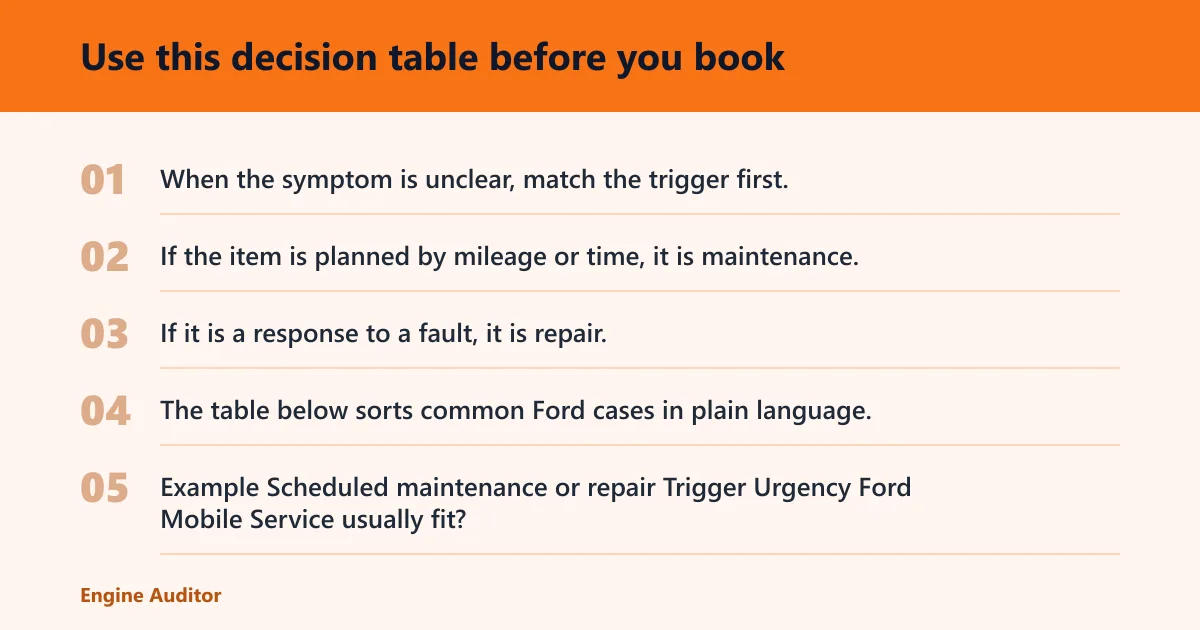
When the symptom is unclear, match the trigger first. If the item is planned by mileage or time, it is maintenance. If it is a response to a fault, it is repair. The table below sorts common Ford cases in plain language.
| Example | Scheduled maintenance or repair | Trigger | Urgency | Ford Mobile Service usually fit? |
|---|---|---|---|---|
| Oil change at the service interval | Scheduled maintenance | Time or mileage | Book at the next open slot | Yes, usually |
| Tire rotation | Scheduled maintenance | Planned wear management | Book by interval | Yes, usually |
| Brake inspection with no symptom | Scheduled maintenance | Routine check | Book by interval | Yes, usually |
| Battery check during a service visit | Scheduled maintenance | Routine testing | Book by interval | Yes, usually |
| Brake pad replacement after wear | Repair | Worn part or brake noise | High if braking changes | Sometimes |
| Dead battery after a no-start | Repair | Failure to start | High | Yes, often |
| Slow crank on start-up | Repair | Weak battery or charging fault | High | Sometimes |
| Fluid leak on the driveway | Repair | Visible leak | High | Usually no |
| Check engine light | Repair | Warning lamp | High if steady, very high if flashing | Sometimes |
| Rough idle or poor drivability | Repair | Performance symptom | High | Usually no |
| Cabin air filter replacement on schedule | Scheduled maintenance | Planned interval | Book by interval | Yes, usually |
| Grinding brakes | Repair | Brake fault and wear | Immediate | Usually no |
How to read the table when the symptom is unclear
If a part is being checked because the calendar says so, treat it as maintenance. If a sound, leak, light, or no-start is already present, treat it as repair. Borderline cases move fast once the vehicle changes behavior.
Choose scheduled maintenance if… / Choose repair if…
Choose scheduled maintenance if the work is planned, the owner manual or service reminder points to it, and the vehicle is not showing a fault. Choose repair if the vehicle already has a warning light, symptom, leak, noise, vibration, or breakdown. That is the clean split Ford owners can trust.
Choose scheduled maintenance if…
The visit is for an oil change, tire rotation, brake check, battery check, or another item listed by mileage or time. The vehicle drives normally. Ford Mobile Service may fit well when the job is one of the selected maintenance items it can handle.
Choose repair if…
The car is already misbehaving. There is a warning lamp, hard start, leak, brake noise, or drivability change. Ford Pickup & Delivery is useful when the repair will take longer or when a dealer visit makes more sense for diagnosis and the full fix.
Frequently asked questions
What is the difference between scheduled maintenance and repair on a Ford?
Scheduled maintenance is planned by mileage or time to prevent wear. Repair is booked after a symptom, warning light, breakdown, or failed part appears. If the vehicle is healthy and the calendar says service is due, that is maintenance. If something already feels wrong, it is repair.
Is an oil change scheduled maintenance or a repair?
An oil change is scheduled maintenance when it is done on the planned interval. It becomes repair only if another fault is involved, such as an oil leak or engine problem that must be diagnosed first. The oil change itself is still routine service.
What counts as routine Ford service?
Routine Ford service includes oil changes, tire rotations, brake checks, and battery checks when they are done on schedule. It also includes other planned inspections and fluid-related visits listed in the owner maintenance intervals. The key is that nothing has failed yet.
When does a Ford problem become a repair instead of maintenance?
A Ford problem becomes a repair once there is a symptom, warning light, leak, noise, vibration, or no-start event. At that point, the vehicle needs diagnosis and correction, not just a scheduled check. Waiting for the next interval is the wrong move.
Does Ford scheduled maintenance cover brakes and batteries?
Yes, for inspection and testing. Brake checks and battery checks are routine maintenance items when they are done on schedule. Brake pad replacement or battery replacement after failure is repair, because the part has already crossed from checking into fixing.
Is Ford Mobile Service able to handle maintenance and repairs?
Ford Mobile Service can perform selected maintenance items, including oil changes, brakes, batteries, and tire rotations. It may also handle some repair work, but not every fault is a mobile job. If the car has a major symptom, dealer inspection or Pickup & Delivery may fit better.
Products related to this article
Sponsored / affiliate links. As an Amazon Associate I earn from qualifying purchases. I may earn additional commission from eligible campaigns.