Which Vehicle Type Is Best for Hauling Gear?
For most gear, a cargo van is the best fit; choose a pickup for dirty, heavy, or oversized loads, and an SUV or wagon for secured, enclosed cargo with frequent passenger use. Picking the wrong body style wastes space, limits access, and can leave expensive gear exposed or unsafe. This guide maps bulk, length, dirtiness, security, and loading frequency to the vehicle type that fits each job.
Which vehicle type fits your gear?
The right vehicle depends on what your gear looks like, not only how much of it you have. Enclosed cargo space works best for secure, weather-protected loads; an open bed fits dirty or oversized items; and fold-flat cabin space handles mixed passenger-and-gear use better than a cargo bed.
Open bed vs enclosed cargo
A pickup is the cleanest fit for muddy tools, gravel bags, mower decks, and other loads that would dirty a cabin. An SUV, wagon, hatchback, or cargo van keeps gear enclosed, which matters for instruments, electronics, camping bins, and anything left in a parking lot.
Open beds are easier to hose out and quicker to load from the side. Enclosed cargo is better when you need locking storage and protection from rain, dust, and theft.
Fold-flat cabin space
An SUV, wagon, or hatchback uses the passenger cabin as part of the cargo area when the rear seats fold flat. That helps with boxes, duffels, folded tents, and short-to-medium gear that benefits from a level floor and a liftgate or rear hatch.
Use this layout when you need to carry people on some trips and gear on others. It is less useful for filthy items and less flexible than a pickup bed for long, hard cases.
Shape, weight, and loading frequency
Shape matters as much as volume. A tall cooler, a 9-foot paddle, a bike, or a fragile keyboard case may fit poorly even if the cubic footage looks large on paper. Weight matters too, because payload capacity sets the real ceiling for passengers plus cargo.
If you load gear every week, easy access matters more than peak volume. If you load only occasionally, a smaller vehicle with clever folding seats may be enough.
Vehicle types at a glance
These classes solve different hauling problems. SUVs and pickups cover most gear-hauling use cases, while wagons and hatchbacks are smaller-space alternatives that trade capacity for easier parking, lower running costs, and better everyday drivability.
| Vehicle type | Best for | Main strength | Main compromise |
|---|---|---|---|
| SUV | Mixed passenger-and-gear use | Fold-flat rear seats and a wide liftgate opening | Less convenient than a bed for dirty or oversized items |
| Pickup truck | Heavy, dirty, or oversized gear | Open bed length, payload rating, and towing capacity | Gear is exposed unless you add a cover or cap |
| Wagon | Long but not huge cargo | Long roofline, lower load floor, car-like drivability | Usually less capacity than a larger SUV |
| Hatchback | Compact gear loads | Small footprint and folding rear seats | Usually less capacity than wagons and SUVs |
| Cargo van | Secure, weather-protected gear | Enclosed cargo area with shelving options | Bigger exterior size can reduce easy parking |
What makes a vehicle good for gear?

A good gear-hauler balances cargo space, payload, towing, access, and ground clearance. Cargo space tells you how much volume is available. Payload tells you how much weight the vehicle can carry with passengers included. Towing matters only if you are pulling a trailer, boat, or equipment behind the vehicle.
Cargo space in cubic feet
Cargo space is the first number most shoppers notice, and it matters. The Subaru Outback offers over 75 cubic feet of cargo space with the rear seats folded down. The Honda Passport has nearly 78 cubic feet. The Toyota 4Runner offers up to 89.7 cubic feet with second-row seats folded.
Larger three-row SUVs can go further. The Ford Expedition offers 104.6 cubic feet of space, the Ford Expedition MAX offers 121.5 cubic feet when second and third rows are folded flat, and the Chevrolet Tahoe offers up to 122.9 cubic feet of cargo room with seats folded down.
Payload capacity in pounds
Payload capacity is the combined weight limit for passengers and cargo, measured in pounds. It is the number that keeps a load legal and safe when the vehicle is full of people, tools, coolers, or building materials. Light-duty pickup truck payload typically ranges from 1,000–3,000 lbs.
Some pickups sit near the middle of that range. The Ram 1500 can offer a max payload capacity of 2,300 pounds, and the Honda Ridgeline has a 1,580-pound payload capacity. Those figures are a reminder that bed size alone is not the whole story.
Towing capacity in pounds
Towing capacity matters for trailers and boats. It is measured in pounds and varies widely by vehicle class. Power, cooling, brakes, hitch setup, and trailer weight distribution all matter because a vehicle that can pull a load still needs control when stopping or descending hills.
Do not treat towing capacity as a shortcut for cargo space. A vehicle that tows well may still have a small cabin or bed. If you do not haul a trailer, towing capacity is secondary to payload and cargo access.
Ground clearance and access
Ground clearance helps on rough roads, at campsites, and at trailheads. It matters when you need to reach dirt lots, rutted access roads, or uneven curb cuts with gear aboard. SUVs and off-road trucks are common choices when the route matters as much as the cargo.
How do you compare load access?
Load access is often the deciding factor. A wide liftgate and folding rear seats help an SUV or wagon. A bed that is long enough for the load helps a pickup. A low floor helps in and out of a wagon or hatchback. A cargo van wins when you need a secure, weather-protected box with repeated loading.
Liftgate opening and rear seat fold
A wide liftgate opening makes bulky items easier to load without twisting them sideways. Fold-flat rear seats create a longer, flatter space for bins, boxes, and soft luggage. This is where many SUVs earn their keep for mixed-use drivers.
That said, the cargo floor shape matters. A split-fold rear seat, a high floor, or a sloped roof can make the published cargo number less useful than it looks.
Bed length and cab layout
A pickup’s bed works best when the item can sit outside the cabin. Long lumber, ladders, wet coolers, and dirty gear stay separate from passengers. Crew cab versus extended cab also changes how much interior space remains for people and secure smaller items.
Choose a crew cab if you carry passengers often. Choose an extended cab if bed utility matters more than rear-seat room and your passenger needs are occasional.
Low load floor and long roofline
Wagons use a long roofline and lower load floor to make tall stacks less awkward than in many SUVs. That layout helps with boxes, long duffels, dog crates, and skis that benefit from a straighter cargo path. A wagon often feels easier to place items into because the floor sits lower.
Hatchbacks do the same thing on a smaller scale. They give you a wide rear opening and folding rear seats in a compact footprint, but they usually run out of room sooner than wagons or SUVs.
Weather protection and security
Enclosed cargo is the better choice for tools, instruments, pet gear, and anything that should not be left visible. A cargo van gives the most secure, weather-protected space, especially if shelving or partitions are part of the setup. SUVs and wagons also protect gear from rain and road spray.
Open beds are the least protected option unless you add a cover, cap, or locked toolbox. That trade-off is acceptable for dirty or oversized freight, but it is a poor match for fragile gear left unattended.
Gear decision matrix
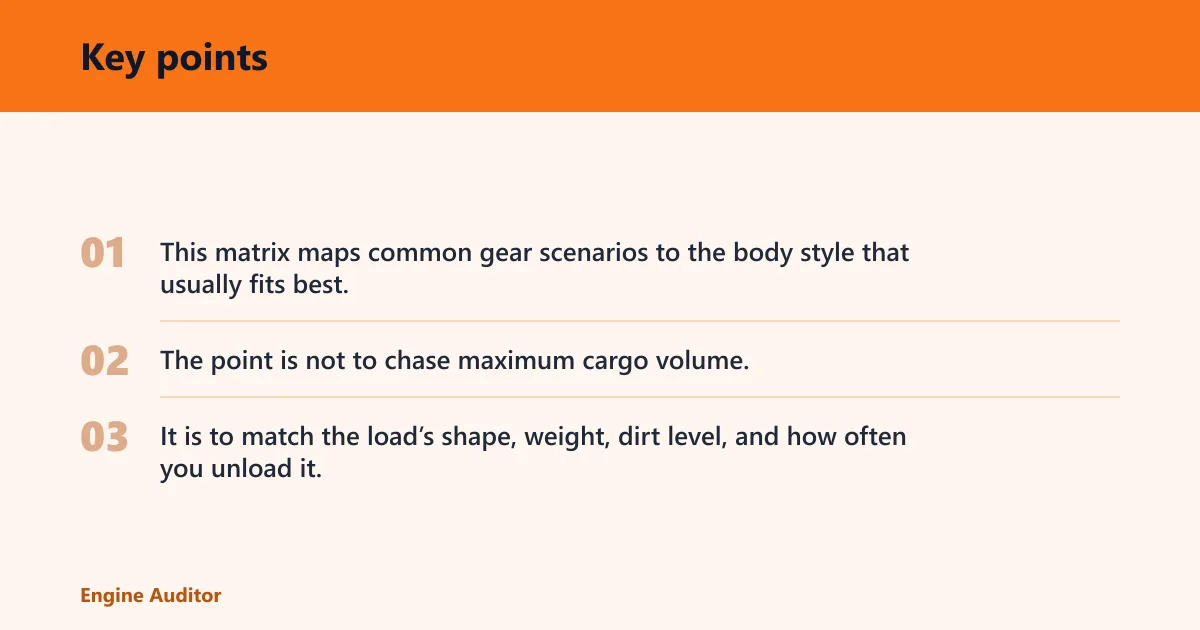
This matrix maps common gear scenarios to the body style that usually fits best. The point is not to chase maximum cargo volume. It is to match the load’s shape, weight, dirt level, and how often you unload it.
| Gear scenario | Best vehicle type | Why it fits | Key compromise |
|---|---|---|---|
| Camping bins | SUV | Fold-flat rear seats and a wide liftgate opening make stacked bins easier to load and secure. | Less ideal than a van if you camp every weekend with a lot of hard-sided gear. |
| Bikes | Pickup truck | An open bed fits a bike without dirtying the cabin, and the tailgate handles long wheelbases well. | Needs tie-downs or a rack to keep the bike from moving. |
| Skis | Wagon | A long roofline and lower load floor make long, narrow cases easier to slide inside. | Less cargo room than a larger SUV if you carry multiple sets and boots. |
| Contractor tools | Cargo van | Enclosed cargo area keeps tools secure and organized, and shelving options improve access. | Bigger exterior size can be harder in tight urban parking. |
| Moving boxes | Pickup truck | A bed handles volume well, and boxes are easier to stack when dry weather is not a problem. | Boxes need weather protection if rain is possible. |
| Home-improvement materials | Pickup truck | Long lumber, sheet goods, and heavy bags suit an open bed and a high payload rating. | Payload can run out before bed space does. |
| Musical instruments | Cargo van | Locked, enclosed storage protects fragile gear from weather, theft, and hard impacts. | Requires more room to park and turn than a smaller car. |
| Pets plus gear | SUV | Rear seats can fold when needed, and the cabin stays enclosed and climate controlled. | Pet hair and muddy paws are harder to manage than in a van with a separate cargo area. |
| Muddy outdoor gear | Pickup truck | Dirty boots, wet tarps, and soiled coolers belong in an open bed, not the cabin. | Exposed cargo needs secure tie-downs and sometimes a cover. |
| Towing a small trailer | Pickup truck | Towing capacity and hitch setup matter most, and a truck is built around that use case. | Trailer weight still has to stay within the truck’s rating and payload limit. |
Is an SUV or pickup better?
An SUV is better when people and gear share the same vehicle often. A pickup is better when the load is dirty, oversized, or frequently tied down outside the cabin. The real choice is usually between enclosed convenience and open-bed utility, not between two equal cargo solutions.
Choose SUV if you carry people too
Choose an SUV if you need one vehicle to do school runs, road trips, and weekend gear hauling. Fold-flat rear seats, a wide liftgate opening, and available AWD or 4WD variants make it a practical mixed-use option. Cargo volume is measured in cubic feet, but cabin usability matters just as much.
Choose pickup if the load is dirty or oversized
Choose a pickup if the gear is muddy, wet, abrasive, or awkwardly shaped. A bed is easier to rinse out, and a bed length can accommodate items that would not fit through a liftgate. Payload rating and towing capacity are central here, not optional details.
Crew cab vs extended cab
Crew cab models prioritize passenger room. Extended cab models prioritize bed utility with less rear-seat space. If you frequently carry four or five people, the crew cab makes more sense. If your passengers are occasional and your cargo is long, the shorter cab can be the better fit.
Payload and towing limits
Never ignore the weight side of the equation. Payload is the combined limit for passengers and cargo, and overloading hurts braking, handling, and tire life. Towing capacity is separate, but the trailer still counts against the vehicle’s limits once hitch weight and cargo are added in.
Picture a contractor who needs to haul tile, a wet saw, and two coworkers. A half-ton truck with the right payload margin works better than a big SUV with an impressive cargo number, because the load is heavy before the tools even hit the floor.
Choose wagon or hatchback if…
Choose a wagon or hatchback when your gear is compact, your parking space is tight, and you do not need truck-style capacity. These body styles fit people who want lower running costs, easier maneuvering, and a load floor that is easier to reach than a tall SUV or truck bed.
You want easier parking and lower running costs
Wagons are often more efficient than larger SUVs, and hatchbacks usually use even less space on the road and in parking lots. That makes them practical when gear hauling is occasional rather than constant. They are a good fit for drivers who want utility without moving up to a larger vehicle class.
Your gear fits inside a smaller footprint
If your load is mostly bags, folding chairs, duffels, or narrow cases, a hatchback or wagon may be enough. A small footprint helps in city garages and on narrow streets. The trade-off is clear: less capacity than wagons and SUVs, and much less than a pickup or cargo van.
You need a low load floor
Lower load floors help when you are lifting awkward items repeatedly. That matters for pet crates, boxed electronics, and light furniture that you do not want to hoist over a tall bumper. The lower the lift, the easier the loading day usually goes.
You do not need truck-style capacity
Skip the larger vehicle if your gear never approaches the payload or volume limits. A smaller vehicle is easier to live with, and it avoids the fuel economy penalty that comes with larger SUVs and trucks. It also simplifies daily driving when the cargo area is empty most of the week.
Say your weekend load is two camping bins, a cooler, and a folded camp chair set. A wagon or hatchback may be enough if the bins fit flat and the rear opening is wide enough. Add a bike, muddy boots, and a second passenger row, and the case for an SUV gets stronger.
What features make a vehicle good for hauling bulky items?
Bulky items need shape, access, and restraint. You want a wide opening, a flat or nearly flat floor, enough cargo length for the item, and a tie-down strategy that keeps the load from shifting. For dirty items, an open bed helps. For fragile items, enclosed cargo is the safer choice.
Look for fold-flat seats in SUVs and wagons, a low bumper lip, and an opening that does not pinch the load at the sides. For trucks, check bed length and payload. For vans, look for a cargo partition or shelving layout if you haul tools often.
Frequently asked questions
Which vehicle type is best for hauling gear?
For most gear, a cargo van is the strongest all-around choice because it combines enclosed storage, weather protection, and organized access. If your load is dirty, very heavy, or oversized, a pickup is better. For mixed family and gear use, an SUV is often the practical middle ground.
What car has the best handling?
Handling depends on chassis tuning, suspension, tire setup, and weight distribution, not cargo capacity. Smaller cars and wagons often feel more agile than taller SUVs or trucks, but the best handler is not automatically the best hauler. If handling matters most, do not let cargo volume make the decision for you.
What car has the most gears?
“Most gears” usually refers to transmission gears, not cargo capacity. That question is separate from hauling ability. A vehicle with more transmission ratios may suit efficiency or performance goals, but it does not tell you how much cargo space, payload, or towing capacity it has.
What car has the most cargo space for gear?
Among the vehicle types covered here, larger SUVs and cargo vans offer the most cargo space. The Chevrolet Tahoe offers up to 122.9 cubic feet of cargo room with seats folded down, and the Ford Expedition MAX offers 121.5 cubic feet when the second and third rows are folded flat. Cargo vans can be even more flexible because of their enclosed box shape.
Is an SUV or pickup better for hauling gear?
An SUV is better for enclosed cargo and frequent passenger use. A pickup is better for dirty, heavy, or oversized gear, especially when you want an open bed and strong payload margins. If your gear is wet, muddy, or long, the pickup usually wins.
Is a wagon better than an SUV for gear hauling?
A wagon can be better when you want car-like drivability, a lower load floor, and good efficiency with moderate cargo needs. An SUV usually wins on absolute cargo volume, higher ground clearance, and more flexible passenger space. For large or bulky gear, the SUV usually has the advantage.
Products related to this article
Sponsored / affiliate links. As an Amazon Associate I earn from qualifying purchases. I may earn additional commission from eligible campaigns.