Vehicle Types by Size: From Subcompact to Heavy-duty
Vehicle size classes run from subcompact, compact, midsize, and full-size to heavy-duty. The best pick is the smallest class that fits your people, cargo, parking, and towing needs. Pick too small and you get cramped seats or weak towing. Pick too large and you pay with harder parking, poorer fuel use, and extra bulk. This guide compares each class by space, driving feel, cargo room, towing, and everyday use. It also reflects the way these classes are actually encountered in the market: a Honda Civic, Toyota Corolla, and Hyundai Elantra all land in the compact car conversation; a Ford F-250, Ram 2500, and Chevrolet Silverado 2500HD represent the heavy-duty pickup side of the ladder; and vehicles like the Mazda3, Toyota Camry, and Ford Expedition show how size class and body style can point in very different directions.
Vehicle size ladder
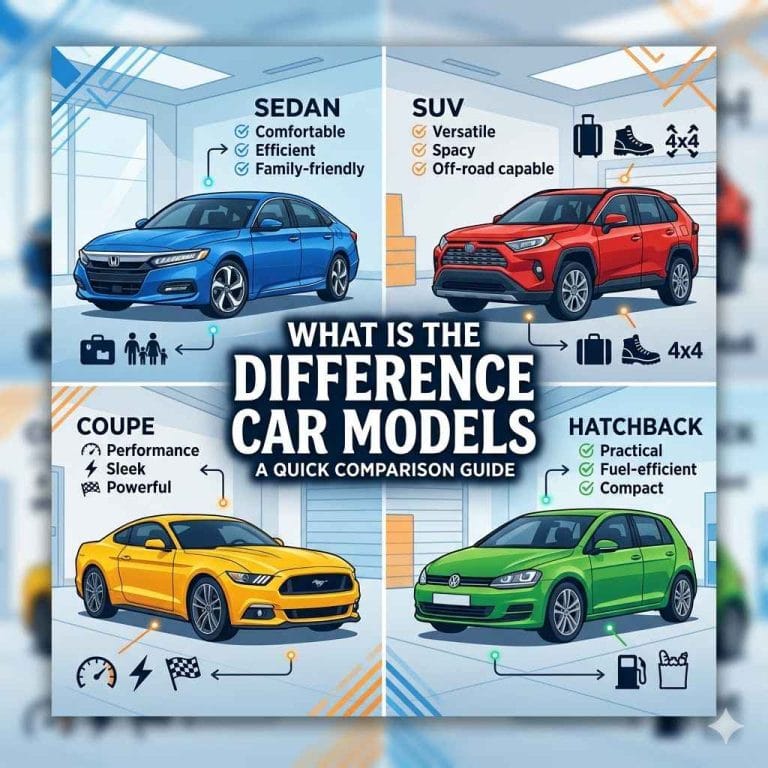
Start with size class, then add body style. A sedan, hatchback, SUV, pickup, minivan, and chassis-cab truck can each land in more than one size band, and the same body style can show up in several bands. That split matters because a compact hatchback and a compact SUV package space in different ways. For a shopper who wants a quick reality check, that means comparing a Honda Civic hatchback against a Subaru Crosstrek is not the same exercise as comparing a Toyota Camry against a Ford Explorer.
What each tier usually includes
For passenger cars, the U.S. EPA uses interior volume, not exterior length, to sort the common size classes. Subcompact is below 100 cubic feet, compact is 100 to 109 cubic feet, midsize is 110 to 119 cubic feet, and full-size is 120 cubic feet or more. The classification reference is tied to EPA fuel economy data, while truck and SUV shoppers often also need the gross weight framework used by regulators. For GVWR, see the NHTSA GVWR definitions. Europe often uses length-based segments instead, so the class names do not always match.
Typical dimensions and room
Wheelbase, width, height, and interior volume matter most. Wheelbase affects stability, ride, and cabin layout. Width controls shoulder room and garage fit. Height changes headroom and cargo stacking. Interior volume shows how much usable passenger-and-luggage space a car class actually gives you. In practical terms, a compact sedan such as a Honda Civic, Toyota Corolla, or Mazda3 will usually feel easier to place than a full-size sedan such as a Toyota Avalon or Chrysler 300, but the longer wheelbase and larger cabin of the bigger class can pay off on long trips.
Common buyer mistake at each tier
Shoppers often buy for the badge on the window sticker instead of the fit in the driveway. The usual mistake at the small end is assuming every compact feels roomy enough once child seats, adult rear passengers, or cargo are added. At the large end, the mistake is paying for space that stays empty most days. That is why the real-world comparison usually starts with concrete models: Honda Civic and Hyundai Elantra at the compact end, Toyota Camry and Honda Accord in midsize, and Ford F-250 or Ram 2500 when the job truly requires heavy-duty capability.
- List the people who ride most often.
- Measure the parking space, garage opening, and driveway clearance.
- Check cargo needs with real items, not vague “utility.”
- Decide whether towing is occasional or routine.
- Compare the next larger class only if the current one fails a real need.
How do you identify a vehicle’s size class?
Use the measurement that matches the market you are shopping in. In the U.S., passenger-car classes are usually sorted by EPA interior volume. In Europe, buyers often see length-based segments such as A-class city cars and B-class superminis, so the same vehicle can carry different labels by region. If you are comparing shopping crossovers and cars side by side, the practical shortcut is to combine the EPA class with the actual model lineup: Chevrolet Spark, Mitsubishi Mirage, and Mini Cooper are common subcompact reference points, while Honda Civic, Toyota Corolla, and Hyundai Elantra are common compact reference points.
Use wheelbase, width, height, and interior volume
Wheelbase is the fastest clue to how a vehicle will feel on the road. A longer wheelbase usually settles the ride and opens more cabin space, while a shorter wheelbase often feels easier in tight turns and parking lots. Width and height fill in the rest, especially for garage fit and rear-seat comfort. For example, a compact sedan like a Honda Civic or Toyota Corolla is typically shorter in wheelbase than a midsize sedan like a Toyota Camry or Honda Accord, and that difference shows up in rear-seat stretch and highway composure.
Where EPA classes stop and market segments begin
EPA classes stop at the passenger-car boundary. SUVs, pickups, minivans, and commercial vehicles often fall into market segments or weight-based categories instead of EPA car classes. That is why a compact sedan and a compact SUV are not measured with the same yardstick, even if buyers call them similar “sizes.” A Subaru Forester, Toyota RAV4, and Honda CR-V may all be crossovers in the compact conversation, but they are not sorted the same way as a compact passenger car.
Why body style is not the same as size class
Body style tells you the shape and layout. Size class tells you the space band. A vehicle-size-class guide separates body style from size, and that is the right way to think about shopping. A hatchback can be subcompact or compact. A sedan can be compact, midsize, or full-size. An SUV can range from subcompact crossover to full-size SUV. The same is true on the truck side: a Ford Ranger, Toyota Tacoma, and Chevrolet Colorado sit in the mid-size pickup conversation, while a Ford F-150, Ram 1500, and Chevrolet Silverado 1500 are the usual full-size references.
What changes as vehicles get larger?

As vehicles get larger, parking gets harder, turning room grows, and cabin space usually expands. Fuel use also tends to rise as size increases, though powertrain, weight, and drivetrain matter too. Bigger vehicles often ride more calmly on the highway, but that extra size is a cost, not a free upgrade. The pattern shows up across classes: a subcompact like a Honda Fit or Mazda2 is usually easier to live with in dense urban parking, while a larger vehicle like a Toyota Highlander, Ford Explorer, or Chevrolet Tahoe brings more room but more mass to manage.
Parking and maneuvering
Smaller vehicles fit better in tight city spaces and are easier to thread through narrow lanes. That is why hatchbacks are often favored for city driving. Bigger SUVs and crew-cab pickups need more room to swing, straighten, and park without extra back-and-fill moves. A compact hatchback such as a Honda Civic hatchback or Toyota Corolla Hatchback is simpler to place than a full-size SUV like a Ford Expedition or Chevrolet Tahoe, and both are easier to maneuver than a crew-cab truck such as a Ford F-150 SuperCrew or Ram 1500 Crew Cab.
Passenger room and cargo volume
Moving from subcompact to full-size usually buys more rear-seat room, more shoulder room, and more cargo volume. Midsize cars often become the practical sweet spot for families because they add legroom and luggage room without jumping all the way to truck-like bulk. Full-size cars push farther toward comfort and space before many buyers move into SUVs or pickups. In the real model mix, that often means a Honda Civic or Toyota Corolla works for commuting, a Honda Accord or Toyota Camry works better for regular family duty, and a Chevrolet Impala or Toyota Avalon gives even more trunk and cabin room.
Ride feel, stability, and fuel use
A longer wheelbase can calm the ride and make the vehicle feel more settled at speed. A larger body can also carry more mass, which can help highway composure but usually hurts fuel economy. The pattern is simple: more vehicle usually means more space and more weight, and more weight usually means more fuel burned. That is one reason EPA-rated fuel economy often drops as vehicles move from compact sedans toward larger SUVs and pickups in the same buyer’s garage.
Say your daily route includes narrow street parking and a small garage. A subcompact or compact sedan may fit with room to spare, while a full-size SUV may turn every arrival into a planning exercise. The size difference matters more than the badge on the tailgate. A Honda Civic or Toyota Corolla can be the easy answer for tight parking, while a Ford Explorer or Chevrolet Tahoe is usually the answer only when the extra room is needed regularly.
Where do SUVs, pickups, and trucks fit?
SUVs and pickups sit beside passenger cars, not inside the same EPA ladder. SUVs range from subcompact crossover through full-size SUV, and they are often grouped by market segment or gross vehicle weight rating rather than interior volume. Pickups split into mid-size and full-size, with cab and bed choices changing the tradeoff between people space and cargo use. Common reference points include a Honda HR-V, Toyota Corolla Cross, and Mazda CX-30 for smaller crossovers, then a Honda CR-V, Toyota RAV4, Ford Explorer, and Chevrolet Tahoe as the vehicles get larger.
Subcompact to full-size SUVs
Subcompact SUVs trade some car-like handling for a higher seating position and a bit more cargo flexibility. Compact and midsize SUVs add rear-seat and load space. Full-size SUVs add more third-row and luggage room, but they also take more space in parking and often cost more to run. Their usefulness comes from packaging, not from size alone. For example, a Hyundai Kona or Nissan Kicks sits at the small end, a Honda CR-V or Toyota RAV4 lands in the compact mainstream, and a Ford Expedition or Chevrolet Suburban is the kind of full-size SUV that buys real third-row and cargo capacity.
Mid-size and full-size pickups
Pickups are usually described by body size and cab layout together. Regular cab, extended cab, and crew cab designs change passenger room, while bed length changes cargo space. Car and Driver separates mid-size and full-size pickups, and it also distinguishes light-duty and heavy-duty variants, because those are different shopping decisions. A Toyota Tacoma, Ford Ranger, or Chevrolet Colorado usually anchors the mid-size side, while a Ford F-150, Chevrolet Silverado 1500, or Ram 1500 anchors the full-size side.
Cab, bed, and towing tradeoffs
A crew cab with a short bed gives passengers room at the expense of bed length. A regular cab with a longer bed does the opposite. If you tow often, the drivetrain, axle ratio, payload, and trailer setup matter as much as the nameplate. A pickup that looks “big” can still be the wrong tool for the trailer you plan to pull.
How do you tell light-duty from heavy-duty?
Use GVWR, but use it carefully. Light-duty vehicles are defined as having GVWR up to 8,500 pounds. Many shopper-facing heavy-duty pickups are built for heavier work and are commonly referenced as 2500 or 3500 models, but the exact GVWR depends on trim, cab, bed, and drivetrain. The common pickup market sits in the middle too, which is why the distinction between light-duty and these trucks is often treated as a key shopping divide rather than a simple size ladder.
Why 2500 and 3500 lines matter
Many shopper-facing heavy-duty pickups wear 2500 or 3500 badges, but exact ratings can vary by trim, cab, bed, and drivetrain. The badge is a clue, not the whole classification. For instance, a Ram 2500, Chevrolet Silverado 2500HD, and Ford F-250 are all heavy-duty shopping references, but exact ratings can vary by trim, cab, bed, and drivetrain.
Payload, towing, and compliance
GVWR matters because it ties into payload, compliance, and towing categories. A truck can look similar to another truck and still carry less in the cab and bed, or be rated for a different trailer setup. If you need work use, check the manufacturer’s listing for your exact model rather than relying on the trim name alone.
Where vans and chassis-cabs fit
Minivans and full-size vans are often chosen for passengers and cargo packaging rather than towing. Chassis-cab commercial vehicles sit even farther from the normal car ladder because the upfit determines the final job. Those vehicles are better judged by payload, wheelbase, and body configuration than by the passenger-car labels used for sedans. A Ford Transit, Chevrolet Express, or Ram ProMaster can make more sense than a large SUV when the task is cargo-first rather than family-first.
Which size fits your use case?
For city parking and short trips, start with compact or subcompact. For a family of five, midsize is often the first class that feels balanced, though some compact SUVs and full-size sedans can also work. For towing or heavy hauling, do not size by length alone; check GVWR, payload, and the trailer rating for the exact vehicle. A Honda Civic, Mazda3, or Toyota Corolla is often enough for commuting, while a Honda Accord, Toyota Camry, or Hyundai Sonata is a common midsize step up.
City parking and short trips
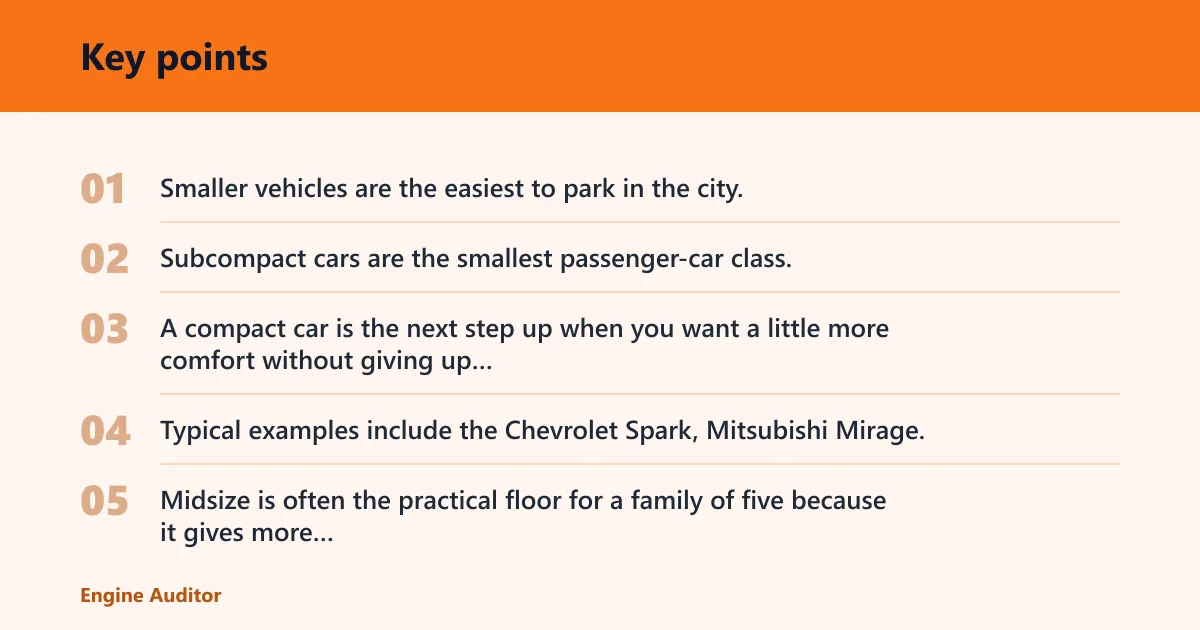
Smaller vehicles are the easiest to park in the city. Subcompact cars are the smallest passenger-car class, and they are often chosen when parking, maneuvering, and low running costs matter more than rear-seat room. A compact car is the next step up when you want a little more comfort without giving up too much urban ease. Typical examples include the Chevrolet Spark, Mitsubishi Mirage, and Mini Cooper on the subcompact side, then the Honda Civic, Toyota Corolla, and Mazda3 on the compact side.
Family of five and road trips
Midsize is often the practical floor for a family of five because it gives more rear-seat room than a compact and usually more cargo space for luggage, strollers, or sports gear. Full-size cars add even more room, but some families will find that a midsize SUV or minivan carries people and bags better than a larger sedan. Common examples include the Toyota Camry, Honda Accord, and Hyundai Sonata in the midsize sedan lane, with the Toyota Sienna, Honda Odyssey, and Chrysler Pacifica often serving as the family-hauling alternatives.
Towing, hauling, and work use
If towing is the priority, look first at the trailer rating and payload, then at the class badge. A pickup or heavy-duty truck is usually the right tool for bigger towing and hauling jobs, but a larger vehicle is not automatically the best answer if the load is light or occasional. Match the truck to the actual job.
Suppose a buyer wants a truck for weekend towing and daily commuting. A full-size heavy-duty model may solve the trailer problem but create a parking and fuel penalty all week. A lighter-duty pickup may be the better fit if the trailer stays within its ratings.
Vehicle size ladder table
Use this table as a quick screen. It separates passenger-car size classes from SUVs, pickups, and heavy-duty trucks, and it shows where the next larger class becomes a poor fit for a normal buyer.
| Class | Typical dimensions | Passenger capacity | Parking difficulty | Cargo utility | Towing usefulness | Common buyer mistake |
|---|---|---|---|---|---|---|
| Subcompact car | EPA interior volume below 100 cubic feet; wheelbase often about 95 to 102 inches; cargo volume often about 11 to 26 cubic feet depending on body style | 4 to 5 | Low | Limited, but usable for daily errands | Low | Buying it for rear-seat comfort it cannot realistically give |
| Compact car | EPA interior volume 100 to 109 cubic feet; wheelbase often about 103 to 108 inches; cargo volume often about 12 to 30 cubic feet depending on body style | 4 to 5 | Low to moderate | Moderate for groceries, luggage, and commuting | Low to moderate, model-dependent | Assuming “compact” means cramped in every trim |
| Midsize car | EPA interior volume 110 to 119 cubic feet; wheelbase often about 109 to 114 inches; cargo volume often about 13 to 16 cubic feet for sedans and higher for hatchbacks or wagons | 5 | Moderate | Good for family luggage and road trips | Low to moderate, model-dependent | Ignoring whether the rear seat is wide enough for three across |
| Full-size car | EPA interior volume 120 cubic feet or more; wheelbase often about 114 to 122 inches; cargo volume often about 15 to 19 cubic feet for sedans | 5 to 6 in some layouts | Moderate to high | High for a car, with more trunk and cabin room | Low to moderate, model-dependent | Choosing it when garage length or city parking is tight |
| Subcompact SUV / crossover | Smaller crossover footprint; often wheelbase about 99 to 104 inches; cargo volume often about 17 to 28 cubic feet behind the second row | 4 to 5 | Low to moderate | Useful load floor, but less volume than larger SUVs | Usually limited | Assuming the higher ride height means real cargo room |
| Full-size SUV | Largest SUV body, often long wheelbase and tall roofline; wheelbase often about 120 to 134 inches; cargo volume often about 45 to 95 cubic feet behind the second row depending on seating layout | 7 to 8 or more | High | High passenger and cargo space | Moderate to high, model-dependent | Buying it for occasional use that never fills the cabin |
| Mid-size pickup | Smaller than a full-size pickup; wheelbase often about 125 to 140 inches depending on cab and bed; bed volume is functionally about 43 to 59 cubic feet depending on box length | 2 to 5, depending on cab | Moderate to high | Good bed utility with size tradeoffs | Moderate | Picking the wrong cab and bed combination for the worksite |
| Full-size pickup | Larger frame, longer wheelbase options, and bigger cab and bed choices; wheelbase often about 126 to 147 inches or more; bed volume often about 52 to 70 cubic feet depending on box length | 2 to 6, depending on cab | High | High for hauling and bed use | High, model-dependent | Thinking every full-size truck is equally capable |
| Heavy-duty truck | Built on heavier platforms; many shopper-facing models sit in the 8,501 to 14,000 pound GVWR range, with some categories above 14,000 pounds; wheelbase often about 140 to 170 inches depending on configuration | 2 to 6, depending on cab | High | Very high for payload-focused work | Very high for the right trailer and setup | Buying one for status when the job does not need the extra rating |
Frequently asked questions
What are the different vehicle sizes from subcompact to heavy-duty?
The basic ladder runs subcompact, compact, midsize, and full-size for passenger cars, then moves into SUVs, pickups, and heavy-duty trucks as separate categories. EPA passenger-car classes use interior volume, while SUVs and trucks are usually sorted by segment or GVWR instead of that same volume index. In practical shopping terms, that means a Chevrolet Spark, Honda Civic, Toyota Camry, Ford Expedition, and Ford F-250 all fit different parts of the ladder even though some buyers might casually call them “small,” “medium,” or “big.”
How do I know if a car is subcompact, compact, or midsize?
Check the EPA interior volume. Full-size cars are 120 cubic feet or more. Exterior length alone does not tell the whole story. A Honda Civic or Toyota Corolla is a familiar compact reference, while a Toyota Camry or Honda Accord is a familiar midsize reference.
What is the difference between a full-size SUV and a heavy-duty truck?
A full-size SUV is a large passenger-focused vehicle with a tall body and major cargo room, while a heavy-duty truck is built for bigger towing and hauling jobs. The truck classification leans on GVWR and work ratings. The SUV classification leans more on market segment and packaging. A Ford Expedition or Chevrolet Tahoe is designed around passenger and cargo packaging, while a Ford F-250 or Ram 2500 is designed around work ratings first.
Which vehicle size is easiest to park in the city?
Subcompact is usually easiest, followed by compact. Shorter wheelbase, smaller width, and less overall length make parking and turning simpler. Hatchbacks are often favored in city use because their compact dimensions help in tight spaces, while full-size SUVs and pickups usually take the most effort. A Mini Cooper, Chevrolet Spark, or Mitsubishi Mirage is easier to tuck into a narrow street spot than a Ford Expedition or Chevrolet Silverado 2500HD.
What size vehicle is best for a family of five?
Midsize is often the best starting point for a family of five because it usually gives more rear-seat and cargo room than a compact. A full-size sedan, compact SUV, midsize SUV, or minivan may also fit depending on child seats, luggage, and how often all five seats are used. Typical family-friendly reference points include the Honda Accord, Toyota Camry, Honda CR-V, Toyota Sienna, and Honda Odyssey.
How does vehicle size affect towing and hauling?
Larger vehicles usually give you more towing and hauling headroom, but the rating matters more than the label. Check GVWR, payload, and trailer rating. A bigger body does not automatically mean a stronger tow setup, and a smaller vehicle can still handle a modest trailer if its ratings allow it.
What is the difference between light-duty and heavy-duty vehicles?
Light-duty vehicles are defined as having GVWR up to 8,500 pounds. Heavy-duty classification starts above 14,000 pounds for some categories. Many common pickups sit between those points, so the light-duty versus heavy-duty split should be read with care, especially when comparing 2500 and 3500 truck lines. The key is to verify the exact trim and configuration, not just the badge.
Are bigger vehicles always safer or better for road trips?
No. Bigger vehicles can feel calmer on the highway and may offer more space, but that does not make them automatically safer or better for every trip. A larger vehicle can be harder to park, cost more to fuel, and be less convenient if most of its space goes unused. A Honda Accord or Toyota Camry may be a better road-trip tool than a larger SUV if the trip does not require extra seating or cargo height.
How do vehicle dimensions compare across sedans, SUVs, and pickups?
Sedans are usually judged by EPA interior volume and wheelbase. SUVs are often described by segment and overall packaging, while pickups add cab and bed length to the picture. Wheelbase, width, height, and interior volume are the most useful dimensions when you compare those body styles side by side. That is why a Honda Civic, Toyota RAV4, and Ford F-150 need different comparison points even when they all look like everyday commuter vehicles to a casual buyer.
Which size class uses less fuel?
Smaller classes usually use less fuel because they carry less mass and present less body to move through the air. That means subcompact and compact vehicles tend to do best, while larger SUVs and pickups usually use more. Powertrain choice still matters, so size is only part of the answer. EPA fuel economy data is useful here because it shows how the same class can still vary by engine, drivetrain, and body style.
Products related to this article
Sponsored / affiliate links. As an Amazon Associate I earn from qualifying purchases. I may earn additional commission from eligible campaigns.
 DALLUX Heavy Duty Vehicle Truck Bus Backup Camera System,Waterproof Night Vision Rear View Camera with 7 inch Monitor+66ft 4 PIN Camera Cable for Bus Truck Van Trailer RV Campers Motor Home(12V 24V)
 Heavy Duty Vehicle Truck Bus Backup Camera Kit,4 PIN Cab Cam with 7inch LCD Monitor Waterproof Night Vision Rear View Camera+66ft Extension Cable for Bus Truck Van Trailer RV Campers(12V 24V)