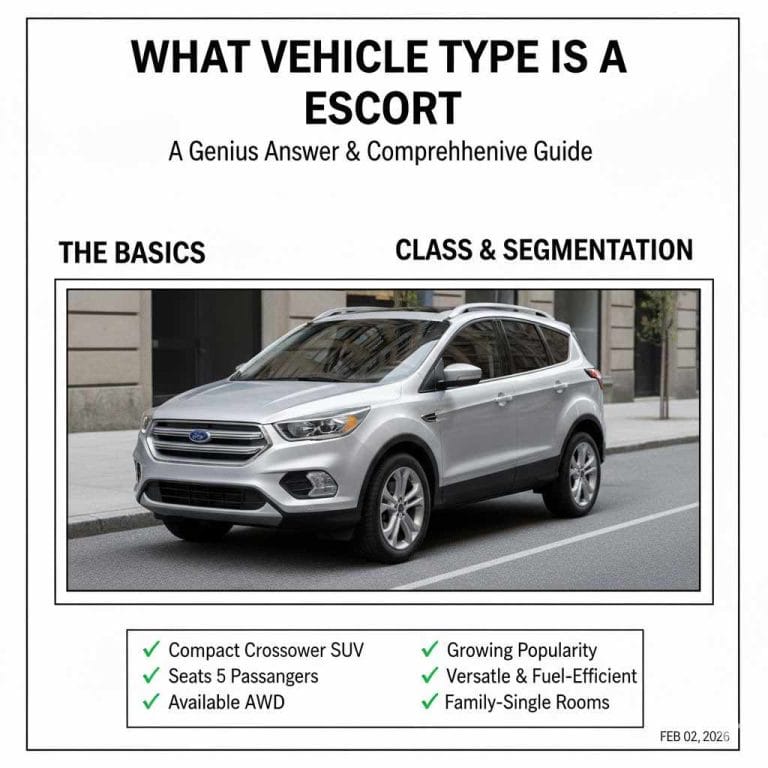
Vehicle Types for Long Road Trips: Comfort and Fuel Economy
For most road trips, midsize sedans or hybrids are the best fit: they usually ride quietly, return strong mpg, and hold 2 adults plus 2 carry-ons. Choose an SUV or minivan when you need 3+ passengers or bulky luggage. Pick the wrong body style and you can end up with cramped seats, extra fuel stops, or cargo space that forces awkward packing. This guide compares sedans, hatchbacks, wagons, SUVs, minivans, and EVs by comfort, fuel economy, cargo room, and refueling or charging ease.
How to read the comparison
The right road-trip choice depends on what you load into the vehicle and how many hours you spend in it. A short solo run has different needs than a long family drive with extra gear and passengers.
Use the matrix here as a filter, not a badge. Comfort combines seat support, ride quality, cabin quietness, and driver-assist features. Efficiency combines fuel economy with refueling stops or charging friction.
What each score means
Each body style gets a simple 1-to-5 score. A 5 means the body style is near the top for that category on long trips. A 1 means it is weak for that use case.
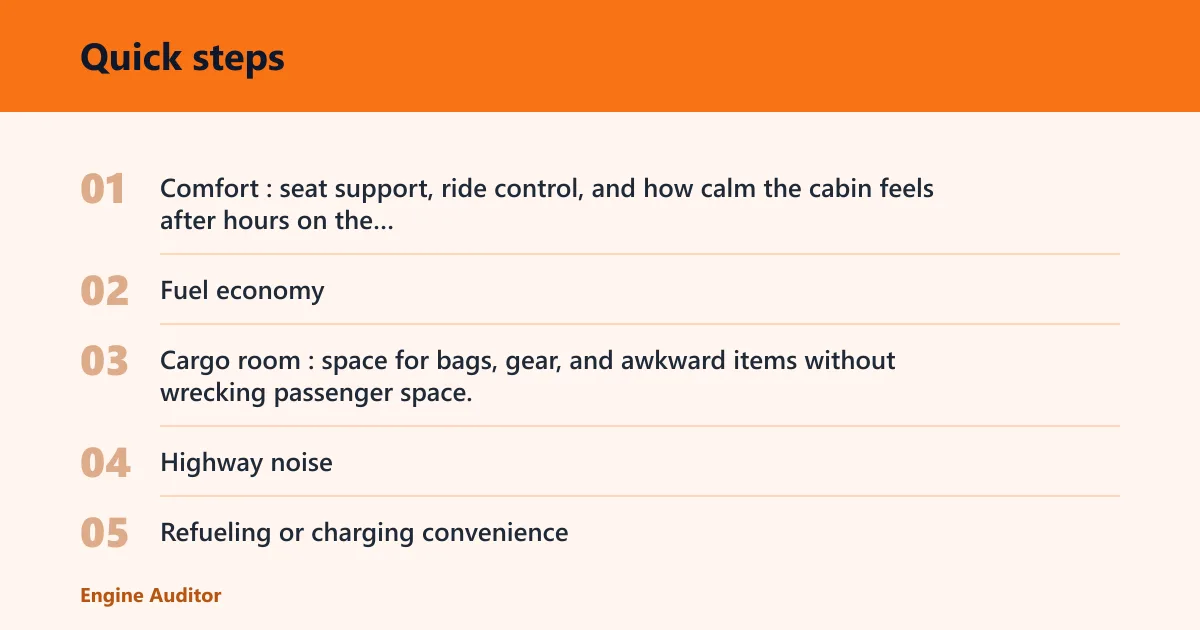
- Comfort: seat support, ride control, and how calm the cabin feels after hours on the highway.
- Fuel economy: how little energy or fuel the body style tends to use on long trips.
- Cargo room: space for bags, gear, and awkward items without wrecking passenger space.
- Highway noise: how much wind, tire, and road noise reaches the cabin.
- Refueling or charging convenience: how easy it is to keep the trip moving.
Best fit by trip type
MotorTrend groups road-trip picks by trip type, including family trips, camping, towing, and more, which is the right way to think about this decision. A vehicle that is excellent for two adults and light bags can be a poor fit once you add a third rider and a week’s worth of gear.
Say your trip is a 500-mile highway run with two adults and one small suitcase each. A hybrid sedan or hatchback can be the cleanest answer because it keeps fuel use low without adding charging stops. Add two children, a folded stroller, and snack bags, and the minivan or wagon starts to make more sense.
Which vehicle type is best for long road trips?
The best vehicle type depends on passenger count and luggage before anything else. Solo drivers and couples usually get the most from a hybrid sedan or hatchback. Families, especially with bulky gear, are usually better served by a minivan or a wagon. SUVs sit in the middle, with more space but usually less efficiency.
Solo drivers and couples
For one or two people, a hybrid sedan is often the best all-around pick. It tends to be quiet, efficient, and easy to park, and it usually avoids the cargo penalty that comes with larger body styles. If luggage stays modest, a hatchback can be just as practical.
Small families
For 3 to 4 occupants, wagons and midsize SUVs become more attractive because they add cargo room without forcing the driver into a full-size footprint. If the family packs light, a hybrid sedan can still work. If the trip includes a stroller or sports gear, cargo volume matters more than a small mpg edge.
Large families and heavy luggage
For 5 or more people, the minivan usually wins. The Chrysler Pacifica can seat up to seven adults and their things, and its Stow ’n Go seats fold flat into the floor. That combination makes it easier to carry people and gear without forcing a compromise on legroom or luggage space.
Why comfort matters on highway miles

Comfort matters more as the hours stack up. A vehicle can be efficient on paper and still feel tiring if the seat support is poor, the ride is busy, or the cabin is loud. Those factors are separate, and all three matter on long highway runs.
Seat support and driving position
Good road-trip seats hold the torso without pressing on the shoulders or thighs. A lower seating position can help some drivers feel more settled, while a higher one can make entry and exit easier. The right answer depends on body size and how long the seat is occupied without a break.
Ride quality and body control
Ride quality is not the same as softness. A vehicle can feel firm but controlled, which often works better than a floaty suspension that keeps moving after every bump. Station wagons often do well here because they combine cargo space with a lower ride height than many SUVs.
Cabin quietness and fatigue
Cabin noise adds up over time. Wind noise, tire roar, and engine noise all drain concentration. The Subaru Outback, for example, offers a quieter cabin and a redesigned infotainment system, which matters because a calm cabin can feel less tiring even when the route is long.
Which body styles balance space and efficiency?
Wagons and minivans usually give the best mix of space and comfort, while SUVs trade some efficiency for height, versatility, and weather use. If the trip is long and the cargo is large, the right body style can reduce fatigue more than a small fuel-savings edge from a smaller vehicle.
Minivans for maximum family comfort
Minivans are the easiest answer for large families because they pair strong passenger space with easy loading and unloading. Fold-flat rear seats are a major advantage, and the low floor helps with child seats, coolers, and bags. For road trips, that means less packing stress and fewer compromises on legroom.
Station wagons for low ride height and cargo room
Wagons are the smart compromise when you want cargo space without the bulk of a tall SUV. The lower ride height usually makes them easier to settle into on long drives, and the cargo area often swallows luggage better than a compact crossover. That is why wagons can feel so settled on highways.
SUVs for versatility with a tradeoff
SUVs give you a flexible cabin, useful ground clearance, and more room than many sedans. AWD is available on some road-trip picks and helps with weather and grip, but it is not the primary efficiency winner. For long-distance travel, that tradeoff matters when fuel stops and cabin quietness matter more than traction.
How do hybrids and EVs compare?
Hybrids are usually the easiest long-road-trip efficiency choice because they deliver strong fuel economy without charging planning. EVs can be excellent too, but their trip success depends on range, charging speed, and network access. For many drivers, the deciding factor is how much planning they want to do before departure.
Why hybrids suit long miles
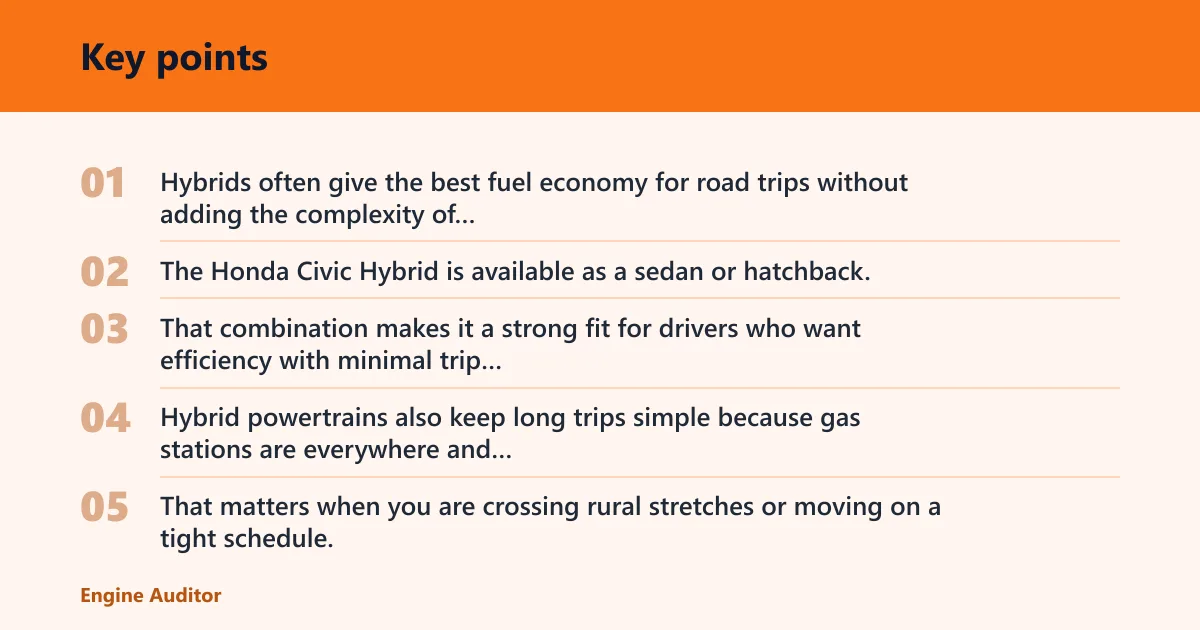
Hybrids often give the best fuel economy for road trips without adding the complexity of charging stops. The Honda Civic Hybrid is available as a sedan or hatchback, and it is praised for exceptional fuel economy. That combination makes it a strong fit for drivers who want efficiency with minimal trip friction.
Hybrid powertrains also keep long trips simple because gas stations are everywhere and refill times are short. That matters when you are crossing rural stretches or moving on a tight schedule. A hybrid gives you efficiency and performance balance without forcing route decisions around plugs.
When an EV fits a road trip
An EV can be an excellent road-trip vehicle when range is high and fast charging is easy to access. The Hyundai Ioniq 5 is rated at up to 318 miles of range, and it can recharge from 5 to 80 percent in as little as 22 minutes on a 350-kW charger. That kind of charging speed can work well on planned highway routes. (Motortrend)
Still, EV road-tripping often requires route planning beforehand. Charging stops need to line up with the vehicle’s range, the charger’s speed, and the availability of the right connector. That is why EVs reward drivers who plan ahead and punish drivers who want the same stop pattern as a gas car.
Charging network compatibility and route planning
Charging network compatibility is a real trip-planning factor, not a side note. The Ioniq 5 now comes standard with NACS plugs for Tesla Superchargers, which reduces friction on many routes. That does not make every EV trip easy, but it can improve charging access where Superchargers are available.
Picture a driver leaving at dawn with a full battery and a route built around one fast charger near lunch. That trip can work well. Picture the same driver arriving at a charger with a wait, a low-power unit, or an incompatible plug. The schedule changes fast.
What should you look for in a road-trip car?
Start with passenger count, luggage volume, and how much highway time you expect. Then look at seat comfort, cabin quietness, driver-assist systems, and the convenience of refueling or charging. AWD helps in poor weather, but it should not be treated as the main answer to a road-trip question.
Cargo volume versus passenger space
Cargo volume matters most when people and bags compete for the same space. A large cargo area helps families and gear, but it only helps if it does not force passengers into cramped rear seats. That is why minivans and wagons often work better than small SUVs for real road-trip loads.
Driver-assist systems that reduce fatigue
Driver-assist systems can cut fatigue on long highway drives by reducing steering, speed, or lane-keeping effort. Some models offer hands-free capability, which can be a major comfort feature on long, straight stretches. The key is not novelty; it is whether the system lowers workload without constant correction.
AWD, traction, and weather use
AWD is useful when rain, snow, or rough access roads are part of the trip. It can improve grip and confidence, especially in shoulder seasons or mountain weather. It should be viewed as a traction tool, though, not as the best path to fuel economy or road-trip comfort.
Road-trip vehicle decision table
This table ranks common body styles for long-distance use. A higher score means the body style usually works better in that category for road trips, not that every model in that class will behave the same way.
| Body style | Comfort | Fuel economy | Cargo room | Highway noise | Refuel or charge convenience | Best fit |
|---|---|---|---|---|---|---|
| Hybrid sedan | 4 | 5 | 2 | 4 | 5 | Solo drivers and couples |
| Hatchback | 4 | 4 | 3 | 4 | 5 | Light packing, urban-to-highway trips |
| Station wagon | 5 | 4 | 4 | 4 | 5 | Cargo room with a lower ride height |
| Midsize SUV | 4 | 3 | 4 | 3 | 5 | Mixed family use, weather flexibility |
| Minivan | 5 | 3 | 5 | 4 | 5 | Large families and heavy luggage |
| EV crossover or sedan | 4 | 5 | 3 | 5 | 3 | Planned routes with charging access |
Solo drivers: choose a hybrid sedan first. It gives you the best efficiency with the least trip-planning friction.
Couples: choose a sedan, hatchback, or wagon depending on luggage size. If quietness matters more than height, the wagon is the cleaner fit.
Small families: start with a wagon or midsize SUV. Move to a minivan if child seats, strollers, or coolers start eating into cargo space.
Large families: the minivan is usually the best answer. It gives you passenger room, easier loading, and far less packing stress than a compact or midsize SUV.
Frequently asked questions
What type of vehicle is best for long road trips?
For most people, a hybrid sedan, wagon, or minivan is the best long-trip answer. The right choice depends on passenger count and luggage. If you travel light, efficiency matters more. If you travel with family and gear, comfort and cargo space should outrank small mpg differences.
Which vehicles are most comfortable for highway driving?
Minivans and station wagons are often the most comfortable because they combine supportive seating, calm ride quality, and practical cargo room. Some midsize SUVs are close behind, but they can be noisier and less settled. The quietest choice is not always the tallest one.
What vehicle gets the best fuel economy for road trips?
Hybrids usually get the best fuel economy for road trips without adding charging stops. A hybrid sedan is often the easiest way to save fuel while keeping trip planning simple. EVs can use less energy per mile, but charging access changes the equation for many routes.
Are hybrids or EVs better for long road trips?
Hybrids are better for simplicity. EVs can be better if you have high range, fast charging, and a route that supports the stops you need. If you want the least hassle, pick a hybrid. If you want very low energy use and can plan around charging, an EV can work well.
Is a minivan better than an SUV for long-distance travel?
Yes, when passenger and cargo space are the priority. A minivan usually offers easier access, better packaging, and more room for people and luggage than a similarly sized SUV. SUVs still make sense for weather, ground clearance, or mixed-use needs, but minivans often win for family comfort.
How much range do I need for an electric road trip?
Range needs depend on route density and charging speed, but longer is safer. A vehicle with up to 318 miles of range gives more flexibility than one with much less, especially on rural routes. The real threshold is whether the next charger fits within your comfort margin, not the largest number on a spec sheet.
Products related to this article
Sponsored / affiliate links. As an Amazon Associate I earn from qualifying purchases. I may earn additional commission from eligible campaigns.