Car Shakes When Accelerating: What the Vibration Means
If the shake follows engine RPM more than road speed, suspect a misfire. If it rises with vehicle speed, look at tires, wheels, or bearings. If it shows up only under throttle, check drivetrain joints or mounts. Guessing at the wrong system burns time and can turn a minor repair into a tow. This guide sorts those patterns so you can separate engine, tire and wheel, and drivetrain faults quickly.
Why the shake happens under acceleration
Acceleration-only vibration is usually load-related. The fault appears when the engine and driveline are pushing, not when the car is just rolling. The first split is simple: does the shake follow throttle and RPM, or does it follow road speed?
If the vibration changes with RPM while the car is held in gear, the engine itself or a torque-loaded drivetrain part moves up the list. If it stays tied to the same road speed no matter how lightly you press the gas, tires, wheels, or a wheel-end problem move up fast.
Where you feel the shake matters too. Steering-wheel vibration usually points toward the front end. Seat or floor vibration points more toward the body, the rear of the car, or the driveline. VehicleRuns notes that steering-wheel shake can suggest front tire, wheel, axle, or suspension issues, while seat or floor vibration often points to an inner CV joint, driveshaft, rear wheel issue, or mount-related problem.
How throttle, RPM, and road speed separate the fault groups
Use three questions in order. Does the shake appear only when you press the gas? Does it change with engine RPM, or only with road speed? Does it disappear when you lift off the throttle and coast? That pattern usually separates engine misfire, drivetrain torque faults, and speed-dependent wheel problems in minutes.
A common first-timer mistake is to replace tires because the steering wheel shakes at highway speeds, then discover the vibration also happens around 35 mph only when climbing a hill, which suggests the issue is more likely load-dependent than purely speed-dependent. The first pattern is speed-dependent. The second is load-dependent, which points away from tire balance and toward drivetrain or engine work.
Where the shake is felt
Steering wheel, seat, and floor are not interchangeable clues. A steering-wheel shake that stays at the same speed is classic tire or wheel territory. A floor or seat shake that gets worse under throttle is more often an inner CV joint, driveshaft, axle, or mount problem.
Suppose a front-wheel-drive car shudders only when pulling away from a stop, and the shake is strongest in the seat cushion. That pattern fits an inner CV joint better than a wheel balance problem. Now change one thing: if the same car shakes at a steady 70 mph with the gas held steady, tire or wheel trouble moves back up the list.
Car acceleration vibration matrix
This table is the quickest way to sort the pattern before you replace parts. Read across the row that matches the driving condition, then compare where the vibration is felt, whether RPM changes matter, and what to check first.
| Driving condition | Vibration location | RPM behavior | Likely subsystem | First check | Urgency |
|---|---|---|---|---|---|
| Accelerate from a stop | Seat or floor | Rises with throttle load | Inner CV joint, axle, driveshaft, mount | Look for torn CV boots and loose mount movement | Diagnose soon |
| Cruise at same speed | Steering wheel or whole car | Little change with RPM | Tire imbalance, bent wheel, separated belt | Inspect tire condition and wheel runout clues | Diagnose soon |
| Uphill load | Seat, floor, or whole body | Worsens as engine works harder | Misfire, inner CV joint, transmission shudder | Check for CEL, rough running, or shift flare | Diagnose soon |
| Hard throttle | Floor or seat | Sharp increase under load | Misfire, axle, U-joint, mount | Scan for codes and inspect axle joints | Urgent if severe |
| Light throttle | Seat or floor | May come and go at tip-in | Transmission shudder, driveline lash | Check fluid condition and repeatable RPM band | Diagnose soon |
| Flashing CEL | Whole car may shake | Often accompanies misfire under load | Engine misfire | Stop driving and scan codes | Stop driving |
| Seat shake | Seat | Usually load-related | Inner CV joint, driveshaft, rear axle, mount | Check boots, mounts, and rear driveline parts | Diagnose soon |
| Floor shake | Floorboard | Often tied to acceleration | Inner CV joint, axle, U-joint, mount | Inspect undercarriage for play or damage | Diagnose soon |
| Steering-wheel shake | Steering wheel | Usually speed-dependent | Tire, wheel, front axle, front suspension | Inspect tires and wheels first | Diagnose soon |
| Clunk on takeoff | Front or rear of car | Happens as torque loads the drivetrain | Engine mount, driveline lash, CV joint | Check engine movement in gear | Diagnose soon |
| Shudder during shifts | Seat or floor | Appears during gear changes | Transmission, torque converter | Review fluid condition and shift behavior | Diagnose soon |
| Vibration disappears when coasting | Depends on system | Load-related rather than speed-only | Engine misfire, CV joint, mount, driveline | Repeat the same speed with throttle on and off | Diagnose soon |
| Vibration persists at the same speed | Often steering wheel | Stable at one road speed | Tire imbalance, bent wheel, tire defect | Inspect tire wear, bulges, and wheel condition | Diagnose soon |
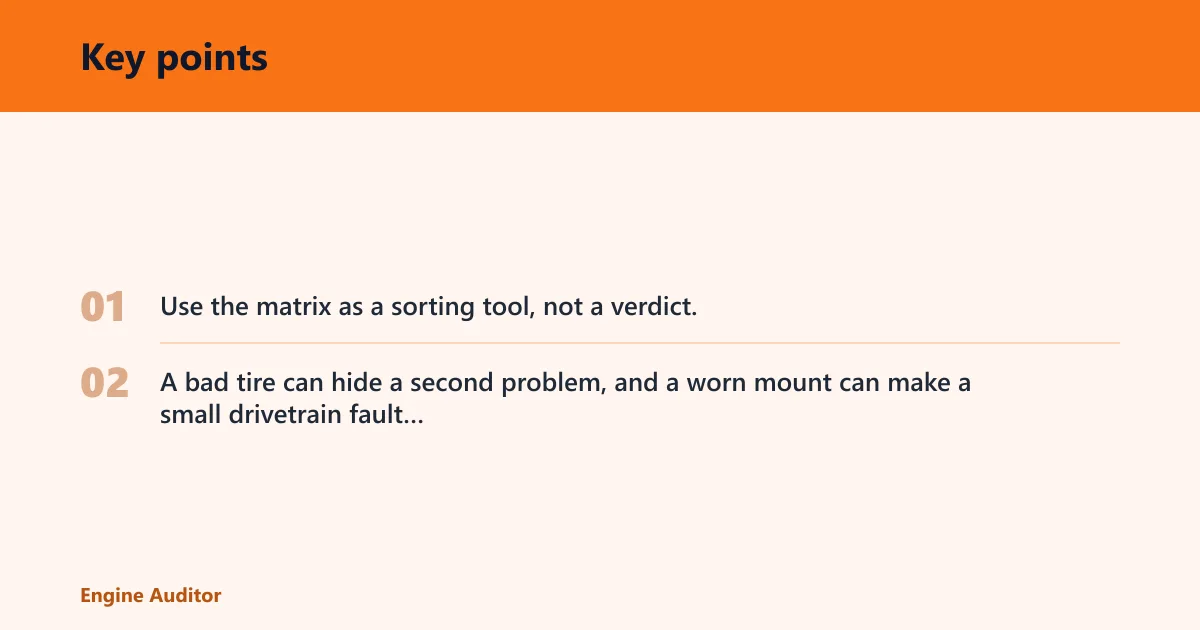
Use the matrix as a sorting tool, not a verdict. A bad tire can hide a second problem, and a worn mount can make a small drivetrain fault feel worse. The goal is to avoid guessing at parts.
Does the vibration point to the engine?
Yes, if the shake tracks RPM, comes with rough running, or pairs with a flashing or solid check engine light. Engine misfire under load is a common cause of acceleration shudder, and it can damage the catalytic converter if it is ignored.
What a misfire feels like
A misfire often feels like a harsh stumble, jerking, or a repeated cut-out as the engine is asked to pull harder. It may be mild at light throttle and much worse on a hill or during passing. That makes it different from a tire vibration, which usually stays tied to road speed instead of engine load.
The most common causes are spark plugs, coils, injectors, or airflow issues. A scan tool can point you toward the cylinder or system that is failing, but the key clue is behavior: the engine sounds and feels rough, and the vibration often changes with RPM more than with speed.
Check engine light clues
A flashing check engine light with jerking means stop driving. VehicleRuns treats that combination as urgent, and for good reason: the engine is misfiring hard enough to risk more damage. A solid light is less immediate, but it still supports scan-based diagnosis instead of guessing.
When the light flashes only under acceleration and then settles down at cruise, that pattern is strongly engine-side, not wheel balance. That is the time to scan codes first, not start replacing tires or axle parts.
Could it be the drivetrain?
Yes. If the shake appears only under throttle, disappears when coasting, and is felt in the seat or floor, the drivetrain moves up fast. Inner CV joints are a classic load-related source, and drivetrain failures are a primary cause of acceleration-only shaking.
Inner CV joint symptoms
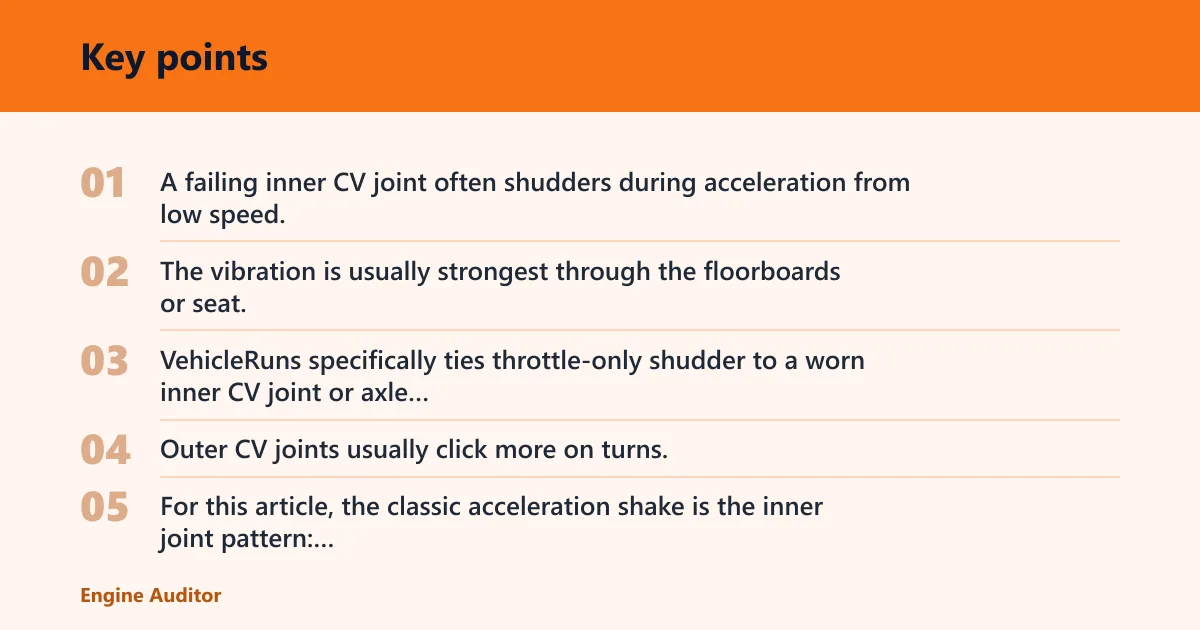
A failing inner CV joint often shudders during acceleration from low speed. The vibration is usually strongest through the floorboards or seat, not the steering wheel, because the joint is transmitting torque under load. VehicleRuns specifically ties throttle-only shudder to a worn inner CV joint or axle problem.
Outer CV joints usually click more on turns. That is a different clue. For this article, the classic acceleration shake is the inner joint pattern: straight-ahead pull, low-speed load, floor or seat vibration, and relief when the throttle comes off.
Driveshaft, axle, and U-joint faults
On rear-wheel-drive and many AWD vehicles, driveshaft and U-joint wear can create a seat or floor shake on acceleration. Axle issues can do the same. The layout matters: FWD cars put more suspicion on front axles and inner joints, while RWD and AWD vehicles bring the driveshaft and rear axle into the picture.
That is why the same complaint should not be diagnosed the same way on every car. A front-drive hatchback and a rear-drive sedan can both shake under throttle, but the likely failure points are not identical.
Transmission shudder and torque converter behavior
A transmission shudder can feel like a vibration during steady acceleration or during shifts. The same source notes that a repeatable rumble-strip feel at a specific speed may point to torque converter or transmission shudder. Fluid condition and RPM behavior matter here, because the problem often shows up in a narrow operating band.
If the vibration happens as the transmission changes gears, or it comes back at the same RPM band in top gear, the transmission becomes more likely than a wheel problem. That is different from a tire imbalance, which should not care about throttle position in the same way.
Tires, wheels, and road-speed shake
Tire imbalance is the classic speed-dependent vibration source. It usually shows up at highway speed, often through the steering wheel, and it may remain even when the engine is barely loaded. CarXplorer notes that unbalanced tires cause speed-dependent shakes.
What to look for on the tires and wheels
Check for uneven wear, bulges, separated belts, and bent wheels. Those defects can make the car shake at a repeatable speed band without any throttle input at all. A wheel with a bent lip or a tire with a broken belt can feel much worse on the highway than around town.
Why does the steering wheel shake when you press the gas? Usually because the road speed is already in the range where the front wheel problem shows up, and acceleration only makes you notice it more. If the shake remains at the same speed when you coast, the wheel-end diagnosis moves ahead of drivetrain work.
How to separate tires from drivetrain
Try the same road speed with light throttle, then with the accelerator released. If the shake stays at the same speed and the same steering-wheel location, tires or wheels are more likely. If the shake fades when you coast and returns only when you load the engine, look at joints, mounts, misfire, or transmission behavior instead.
That distinction matters because tire imbalance is not a general acceleration fault. It is mainly a speed fault. Treat it that way unless the pattern clearly points elsewhere.
Mounts and clunking on takeoff
Yes, worn engine mounts can cause a shake during acceleration. A weak mount lets normal engine movement become a noticeable lurch or vibration when torque comes in, and CarXplorer notes that worn motor mounts let the engine shift excessively when torque is applied.
What a bad mount feels like
The clue is often a clunk or thump on takeoff, not a high-speed vibration. In gear, the engine may move too far when the throttle is applied, then settle back when you lift off. That movement can be felt as a jolt through the cabin, especially from a stop or during a quick tip-in.
Bad mounts can also make a small misfire or drivetrain lash feel larger than it is. That is why visible engine movement in gear is worth checking before replacing harder parts.
What to check first before a repair visit
Start with a short pattern check, then move to visible inspection. The goal is to sort load-related vibration from speed-related vibration before any parts are replaced. If the CEL is on, scan codes before anything else.
- Note the speed where the shake starts.
- Hold that same road speed and lift off the throttle.
- See whether the vibration disappears, stays the same, or gets worse.
- Watch where the shake is felt: steering wheel, seat, floor, or the whole car.
- Inspect tires for bulges, uneven wear, and visible wheel damage.
- Check axle boots for tears or grease spray.
- Look for fluid leaks and obvious broken mount rubber.
- Scan for trouble codes if the check engine light is on.
When to stop driving
Stop driving if the vibration is severe, the car jerks hard under throttle, or the check engine light flashes. The same source says a flashing check engine light with jerking means stop driving. Severe vibration can also make the vehicle harder to control, which turns diagnosis into a safety issue.
Diagnose soon if the shake is repeatable, but the car still drives normally enough to reach a shop. That category covers many inner CV joints, mounts, and speed-dependent tire problems. Can-drive does not mean ignore. It means the car is not in immediate danger, but the problem should not wait.
Frequently asked questions
Why does my car shake only when I accelerate?
That pattern usually means the fault appears under load, not just from road speed. The main suspects are engine misfire, inner CV joints, axle or driveshaft wear, transmission shudder, or weak mounts. The key clue is whether the shake follows throttle and RPM, or whether it stays tied to the same speed.
Is it safe to drive if my car shakes when accelerating?
It depends on severity and warning lights. Mild, repeatable shake can often be driven only long enough to reach a shop, but severe vibration or a flashing check engine light means stop driving. A hard misfire can damage the catalytic converter, and severe drivetrain shake can make the vehicle harder to control.
Does a bad CV joint cause shaking when accelerating?
Yes. A worn inner CV joint is one of the most common load-related causes. It usually shudders most when pulling away from a stop or climbing a hill, and the vibration is often felt through the seat or floor. Outer CV joints are more likely to click while turning than shudder under straight-line throttle.
Can misfires make a car vibrate under load?
Yes. Engine misfire can show up most clearly during acceleration, especially uphill or at heavier throttle. It often comes with rough running and may trigger a flashing or solid check engine light. Spark plugs, coils, injectors, and airflow problems are common causes, and a hard misfire can damage the catalytic converter.
How do I tell if the vibration is tires or drivetrain?
Use speed and throttle as your split. A tire or wheel problem usually stays tied to a road speed and often shakes the steering wheel. A drivetrain problem usually appears only under throttle, eases when coasting, and is more likely felt in the seat or floor. That pattern is the fastest separator.
What does it mean if the check engine light flashes while accelerating?
It usually means an active misfire is severe enough to threaten the catalytic converter. If the flashing happens while the car jerks or runs rough, stop driving. A solid light still matters, but a flashing light under load is the urgent case and should be treated as a stop-driving condition.
How can I diagnose a car shudder without replacing parts?
Start with a road test that compares throttle on, throttle off, and the same speed on flat ground and uphill. Then inspect tires, wheels, axle boots, leaks, and mounts, and scan codes if the CEL is on. The goal is to match the symptom pattern to a system before any part is replaced.
Products related to this article
Sponsored / affiliate links. As an Amazon Associate I earn from qualifying purchases. I may earn additional commission from eligible campaigns.