Best Vehicle Types for Families (2026): we compared
For most families, the best choices are a minivan for maximum space, a midsize three-row SUV for mixed use, or a wagon/compact SUV when parking is tight; choose the one that fits your child-seat count and cargo needs first. Pick the wrong body style and you get cramped third rows, awkward car-seat installs, and cargo shuffling every day. I use this guide to compare vehicle types by family setup, seat layout, cargo demand, safety needs, and powertrain.
This guide is part of our Vehicle types guide series.
Quick comparison
| Product | Badge | Best for | Price | ||
|---|---|---|---|---|---|
 |
Migaven Car Cover Multi-Layer Fit for Honda Odyssey MinivanMigaven | Also great | Honda Odyssey 1999-2026 Multi-Layer Cover | $47.49
Price as of 29 Sep 2026
|
View |
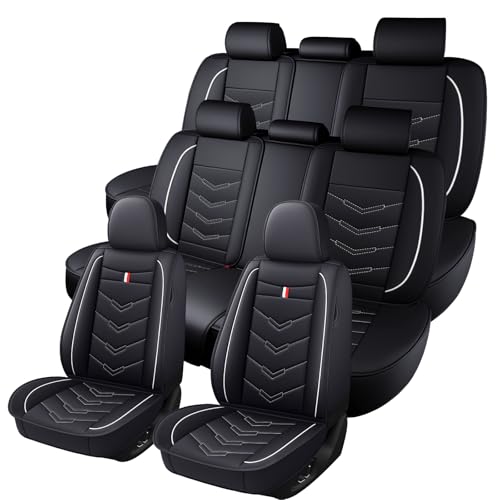 |
Mascys Car Seat Covers 8 Seats for Subaru Ascent 2019-2026Mascys | Our pick | Subaru Ascent 8-Seat Custom Covers | $229.18
Price as of 29 Sep 2026
|
View |
Start with safety, then check whether the vehicle fits your actual family pattern: car seats, strollers, school bags, groceries, and parking space. The best answer is rarely the biggest body style; it is the one that makes daily loading, buckling, and driving less annoying.
How we chose
The comparison below weighs several things that matter in family use: safety results, crash-avoidance tech, car-seat access, usable cargo space with seats up, and the cost of living with the vehicle over time.
It also separates crash safety from day-to-day safety use. I have seen models score well in a crash test and still be a pain if the LATCH anchors are buried, the rear door opening is tight, or the third row is so cramped that kids hate climbing in.
Fuel economy matters too, but fit should come first. A family commuter with strong fuel economy can save money, and long-trip family cars are often most comfortable when they fall in a relatively efficient MPG range, but a poor seat layout can still make the wrong vehicle.

Family vehicle decision matrix
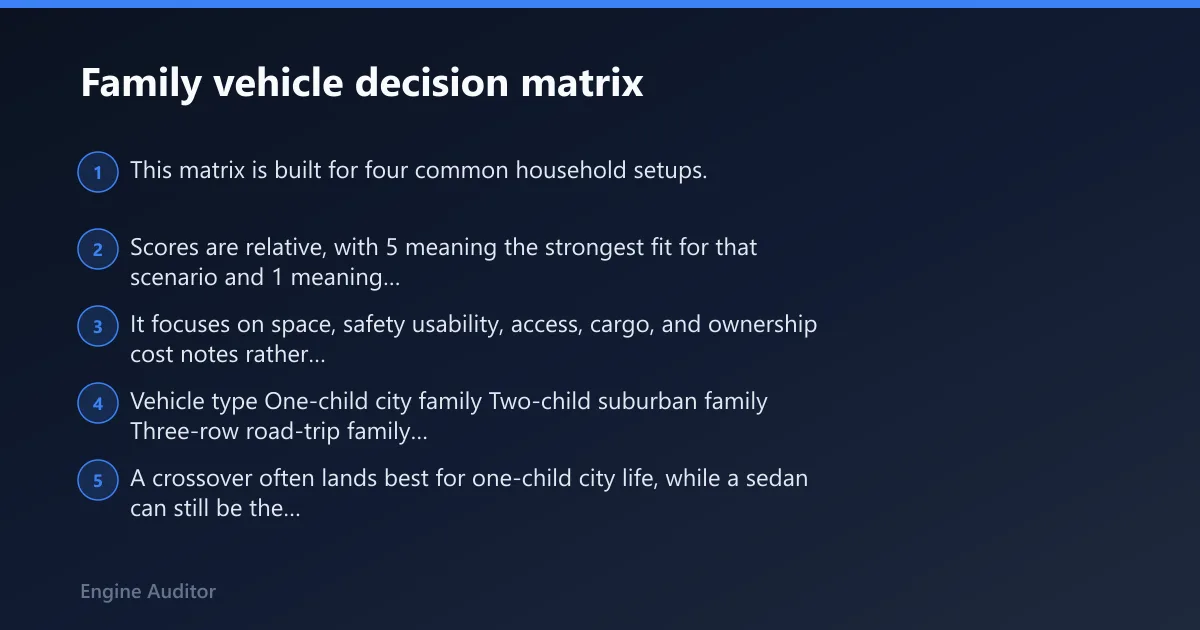
This matrix is built for four common household setups. Scores are relative, with 5 meaning the strongest fit for that scenario and 1 meaning the weakest fit. It focuses on space, safety usability, access, cargo, and ownership cost notes rather than brand image.
| Vehicle type | One-child city family | Two-child suburban family | Three-row road-trip family | Car-seat-heavy family | Space | Safety usability | Access | Cargo | Ownership-cost note |
|---|---|---|---|---|---|---|---|---|---|
| SUV | 3 | 4 | 4 | 3 | Good in two-row form, strong in larger three-row models | Often strong if equipped with blind-spot monitoring, automatic emergency braking, lane-keeping assistance, and a rearview camera | Higher step-in height can help some adults, but it is less friendly for toddlers and loaded gear | Useful with seats folded, but cargo behind an upright third row can shrink fast | Fuel use and tires often cost more than a crossover; AWD adds capability and sometimes complexity |
| Minivan | 4 | 5 | 5 | 5 | Best overall passenger packaging for families that carry people and gear together | Usually very good when paired with strong crash-test scores and family safety tech | Sliding doors and a low floor make buckling and loading easier in tight parking spaces | Excellent behind the second row and usually strongest seats-up utility | Often cheaper to live with than a large SUV when judged by ease, fuel use, and time saved |
| Crossover | 4 | 4 | 3 | 3 | Smaller footprint than a full-size SUV, with useful room for a small household | Good when the model scores well and includes rear-seat reminders and crash-avoidance tech | Easier to park than larger SUVs; access is usually better than a sedan, worse than a minivan | Enough for daily life, but strollers and luggage can crowd the rear when seats stay up | Often stronger fuel economy than larger SUVs, so running costs can be easier to manage |
| Sedan | 5 | 3 | 2 | 2 | Best for smaller families that do not carry bulky cargo every day | Can be very safe if crash scores are strong and active safety gear is present | Low ride height can make child loading harder, especially with rear-facing seats | Trunk space is useful, but stroller shape and seat backs limit flexibility | Usually cheaper to buy and fuel than larger vehicles |
| Hybrid | 4 | 4 | 3 | 3 | Depends on the body style it is based on, but fuel use is usually the main advantage | Safety depends on the platform and equipment, not the powertrain alone | Access mirrors the underlying vehicle type, so it can be sedan-like or SUV-like | Cargo depends on the base vehicle and battery packaging | Best for commuters and high-mileage families because lower fuel use can offset extra purchase cost |
| EV | 4 | 3 | 2 | 3 | Can work well for a family if the layout is right and the range fits the routine | Safety can be excellent, but the family-friendly question is charging access as much as crash protection | Access varies by body style; low floors can help, charging planning matters every week | Cargo may be reduced by battery packaging, though some EVs still fit family life well | Lower fuel spending can help, but home charging and route habits decide whether ownership is easy or annoying |
For the four scenarios, the minivan is the clear leader for a car-seat-heavy household and for road-trip families. A crossover often lands best for one-child city life, while a sedan can still be the smartest budget pick when the family is small and cargo needs stay light.
Minivan: best for car seats and cargo
A minivan is the strongest answer when the family has multiple child seats, a stroller, and frequent loading and unloading. Sliding doors, a low floor, and reconfigurable seats make daily use easier than image-driven SUV packaging, especially in narrow parking spaces and school pickup lanes.
What stands out is practical access. With lower step-in height and wide openings, a minivan usually makes it easier to reach the LATCH system, tighten harnesses, and get kids in without twisting your back.
The drawback is simple: many shoppers do not want the look. That does not change the fact that, based on the spec sheet, owner feedback, and range experience, minivans often beat three-row SUVs when the priority is passenger and cargo space with the least hassle.
Why sliding doors help in tight parking spots
Sliding middle rows are especially useful when the car is parked close to another vehicle or a wall. You can open the door without worrying as much about door dings, and that matters when a child still needs help climbing in.
Low floor entry for kids, grandparents, and loaded gear
Families often forget how much easier a low floor is after a long day. The lower step-in height helps children, older relatives, and anyone carrying a diaper bag, backpack, or grocery haul.
When a minivan beats a three-row SUV for real family duty
When the third row will be used often and cargo still needs to fit, the minivan usually wins. Many three-row SUVs lose most of their luggage space once every seat is occupied, while a minivan keeps more usable room behind passengers.
SUV: best for mixed use and available AWD

An SUV works well for families that want a higher seating position, available AWD, and a shape that can handle commuting, school runs, and bad weather. Two-row SUVs are easier to live with than large three-row models, while three-row versions suit mixed family and cargo needs when the third row is mostly for kids.
What stands out is flexibility. Many SUVs come with family safety features such as blind-spot monitoring, automatic emergency braking, lane-keeping assistance, and a rearview camera, and some offer AWD for difficult conditions.
The drawback is third-row honesty. In many SUVs, the third row is fine for short rides and children, but cargo space gets tight fast when all seats are up. That is where minivans usually pull ahead.
Two-row vs three-row SUV tradeoffs
A two-row SUV is easier to park and usually leaves more room for cargo behind the rear seat. A three-row SUV gives more seating, but the extra row can shrink luggage room and make access awkward, especially for adults.
Higher seating position and all-wheel-drive choices
Many buyers like the higher seating position because it feels easier to see traffic and curbs. AWD can help in snow, rain, or gravel driveways, but it is not a substitute for tire choice, crash protection, or a smart cabin layout.
Where SUV cargo space falls short with every seat occupied
If the third row stays upright, the remaining cargo area can be too small for a stroller plus family luggage. That is the failure case many brochures hide, and it is why an SUV should be judged with the seats you will actually use, not the seats you hope to fold.
Car-seat covers: best for protecting a family SUV interior
The Mascys car seat covers make sense for a family SUV when spills, crumbs, and heavy use are part of daily life. The custom fit for Subaru Ascent 2019-2026 models, airbag and LATCH child seat compatibility cutouts, and water-repellent fabric are the main reasons they stand out on the spec sheet.
The honest drawback is fit limitation. These are built for the Subaru Ascent, so they are not a general answer for every family vehicle, and the price is higher than basic universal covers. For the right SUV, though, they help protect the second row where child seats usually live.
Crossover: best for city families
A crossover is often the best middle ground for families that need more room than a sedan but do not want the footprint of a full-size SUV. It usually rides on a car-based platform, parks more easily, and often returns stronger fuel economy than larger SUVs.
What stands out is daily usability in tight spaces. For apartment garages, older city streets, and short school runs, a crossover can hit the sweet spot between access and size without feeling oversized.
The drawback is capacity discipline. A crossover can be big enough for a family of five, but only if the family is not trying to carry a third row, multiple large suitcases, and a full stroller at the same time.
Why a crossover often fits apartments and tight garages better
The smaller footprint matters more than most people expect. Easier parking, simpler curbside loading, and less stress in narrow garages are real advantages when a vehicle gets used every day.
When crossover rear-seat and cargo space are enough for a family of five
If two child seats or boosters are the main rear-seat challenge, many crossovers handle the job well. The key is checking rear seat width, door opening size, and whether the stroller still fits without folding seats down.
Sedan: best budget pick for smaller families
A sedan is still a smart family choice when the household is small, the budget is tight, and fuel economy matters more than maximum room. It usually costs less to buy and operate than larger vehicles, and it can be a very efficient school-run car.
What stands out is simplicity. A sedan can be the right answer for one child, one stroller, and light weekend cargo, especially if the family values lower running costs over extra cabin height.
The drawback is access. The lower ride height makes rear-facing car seats more awkward to load, and a deep stroller or bulky sports gear can be a nuisance in a trunk that looks bigger on paper than it feels in use.
When a sedan still works with one child or light cargo
For one-child city families, a sedan can be enough if the child-seat count stays low and the cargo is modest. It is also a good pick when parking is tight and fuel economy matters more than carrying capacity.
Limits to watch: rear access, stroller loading, and long-trip comfort
Rear access is the biggest issue, especially with rear-facing seats. Long-trip comfort can also suffer if rear passengers need more legroom or headroom than the sedan offers.
Hybrid: best for lower running costs
A hybrid fits families that drive a lot and want lower fuel spending without changing the body style too much. It is often the best answer for commuting, school drop-offs, and errands because the cost savings add up when the vehicle sees daily use.
What stands out is the balance between familiar packaging and better efficiency. A hybrid can be built on a sedan, crossover, or SUV platform, so the family gets the shape it needs while trimming fuel use.
The drawback is that the powertrain alone does not solve fit issues. If the underlying vehicle is too small, the hybrid badge will not fix car-seat access or cargo squeeze.
Why commuters and high-mileage families benefit most
Families that pile on miles are the ones most likely to feel the fuel savings. If a commuter family spends every weekday in traffic and weekend miles still add up, a hybrid can be easier to live with than a thirstier SUV.
Fuel savings versus extra upfront cost
The tradeoff is simple. A hybrid may cost more up front, but lower operating costs can make sense over time if the family drives enough to use the efficiency advantage.
EV: best for home charging and predictable routes
An EV can be family-friendly when the route pattern is predictable, the home has charging access, and the body style fits the household. School runs, commuting, and short regional trips are easier to manage than a lifestyle built around unplanned long-distance driving.
What stands out is low routine maintenance and convenient home charging when everything is set up correctly. The drawback is range planning. A family that cannot charge at home, or that regularly takes long trips with a full cabin, may find the setup annoying.
EV ownership cost depends on charging access and route habits more than on the badge. For some households that is a good trade. For others, it is the wrong fit from day one.
Range planning for school, work, and weekend trips
Families should map the weekly driving pattern before choosing an EV. If the vehicle can handle school, work, errands, and the occasional weekend trip without charging stress, it may be a very practical choice.
Charging access at home and on the road
Home charging is the cleanest way to make an EV work for a family. Without it, the ownership experience depends on public charging reliability, which can complicate busy mornings and travel days.
What makes an EV family-friendly, and when it is the wrong pick
An EV is family-friendly when the cabin fits child seats, the range matches the routine, and charging is easy. It is the wrong pick when road trips are frequent, charging access is weak, or the family does not want to plan around battery range.
Which one should you buy
Choose a minivan if your top priority is easy child-seat use and cargo room. Choose an SUV if you want higher seating and optional AWD, especially for mixed weather and mixed duties. Choose a crossover if you need family space in a smaller footprint.
Choose a sedan if budget and fuel economy matter more than maximum room. Choose a hybrid if you drive enough to benefit from lower fuel use, and choose an EV only if your charging setup and route habits fit the battery schedule.
For a family of five, the best answer is often a crossover or a three-row SUV if the third row is for kids only. For a car-seat-heavy household, the minivan usually wins because door access and LATCH reach matter every single day.
If the family’s main pain point is parking, a crossover may be the better compromise. If the pain point is loading kids and gear without a fight, the minivan is hard to beat.
Frequently asked questions
What vehicle type is best for a family?
For most families, a minivan is the best all-around choice because it combines sliding doors, low floor access, and flexible cargo space. A midsize three-row SUV is the next best option if you want higher seating and available AWD, while a crossover works better for smaller households and city parking.
Are SUVs or minivans better for families?
Minivans are usually better for families that use car seats, strollers, and cargo every day. SUVs are better when the family wants a higher seating position or AWD. The deciding factor is usually not image; it is how often you need third-row access, door clearance, and easy buckling.
What safety features should a family vehicle have?
Start with NHTSA and IIHS crash-test results, then look for blind-spot monitoring, automatic emergency braking, lane-keeping assistance, rearview cameras, and rear-seat reminders. Safety should come first, but the family also needs easy child-seat installation through a well-placed LATCH system and clear rear visibility.
How much cargo space do I need for kids and strollers?
Enough for a stroller, diaper bag, groceries, and luggage without folding seats every time is the right target. Seats-up cargo matters more than max cargo on a brochure. A family should check whether the stroller fits behind the second row, and whether the lift-over height is manageable.
Are crossovers big enough for a family of five?
Sometimes, yes. A crossover can be big enough for a family of five if the rear seat is wide enough for the child-seat count and the cargo needs are modest. It becomes tight when two child seats, a booster, and a full stroller all need to live in the cabin.
Should I choose a hybrid or EV for a family car?
Choose a hybrid if you want lower fuel costs without changing your fueling routine. Choose an EV if you have dependable home charging, predictable daily routes, and a vehicle layout that fits your family. If road trips are frequent and charging access is uncertain, a hybrid is usually the easier bet.
How do I check car seat fit in a family vehicle?
Bring the actual car seat to the vehicle and check the LATCH anchors, buckle access, rear seat width, and front-seat clearance with the seat installed. Make sure rear-facing seats do not force the front passenger too far forward, and confirm that the seat can be tightened without awkward reach.
Products related to this article
Sponsored / affiliate links. As an Amazon Associate I earn from qualifying purchases. I may earn additional commission from eligible campaigns.