Which Vehicle Type Is Best for Towing a Small Trailer?
For a small trailer, start with the lightest vehicle that still clears the trailer’s gross weight, payload, and tongue-weight needs, with enough wheelbase margin. A midsize crossover or body-on-frame SUV often makes more sense than a truck for occasional towing. Skip those limits, and you can get squat, sway, overheating, and an overloaded hitch or rear axle. This guide shows how to compare vehicle types by tow rating, payload, wheelbase, and towing equipment.
Tow rating vs horsepower



The published tow rating is the first number to check. Horsepower helps with acceleration, but it does not tell you whether the chassis, brakes, cooling system, hitch, and rear axle are approved for the load. Tow rating is the maker’s limit for the trailer plus cargo, so it must cover the fully loaded trailer, not the empty shell.
That is why a vehicle with decent power can still be a poor tow choice. A small trailer may look harmless, but the total gross trailer weight can rise fast once tools, fuel, water, gear, or a boat motor are added.
How payload can stop a setup before tow rating does
Payload matters because it includes passengers, cargo, hitch hardware, and tongue weight. In many SUVs and crossovers, payload runs out before tow rating does. That means the vehicle may be “rated” to pull the trailer, yet still be overloaded at the rear axle once real people and gear are onboard.
A common first-timer mistake is to read only the tow number and ignore tongue weight. A loaded trailer with a 10% tongue weight can put a meaningful load on the rear suspension, and that load shares space with passengers and luggage.
Where wheelbase fits in the decision
Wheelbase affects stability. A longer wheelbase usually gives better straight-line control, less trailer push in crosswinds, and calmer behavior at highway speed. Short-wheelbase vehicles can still tow light trailers, but they need more margin and more attention to loading.
That is one reason body-on-frame SUVs and pickups often feel steadier than small car-based crossovers once the trailer gets close to the vehicle’s limit.
What vehicle type is best for small trailers?
For many small trailers, the best vehicle type is the lightest one that still clears the trailer’s gross weight, tongue weight, and payload needs with some margin. For many buyers, that ends up being a midsize or body-on-frame SUV. A pickup becomes the safer all-around choice when the trailer is heavier, the route includes highway miles, or the cargo load changes often.
When a pickup is the right answer
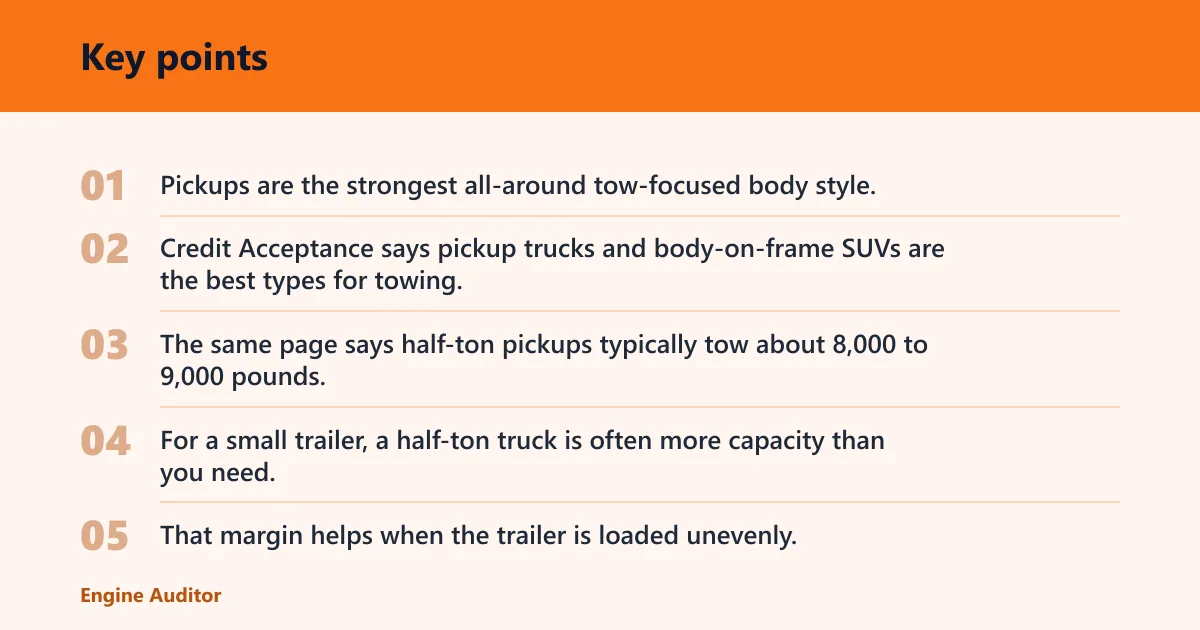
Pickups are the strongest all-around tow-focused body style. Credit Acceptance says pickup trucks and body-on-frame SUVs are the best types for towing. The same page says half-ton pickups typically tow about 8,000 to 9,000 pounds, while heavy-duty pickups often have tow ratings from 15,000 to 37,000+ pounds.
For a small trailer, a half-ton truck is often more capacity than you need, but it gives you margin. That margin helps when the trailer is loaded unevenly, the passenger count is higher than expected, or the trip includes long highway stretches.
When a body-on-frame SUV is the better match
Body-on-frame SUVs often hit the best middle ground. Full-size body-on-frame SUVs often tow 7,500 to 9,600 pounds when configured properly, and they usually bring stronger frames and drivetrains than car-based crossovers. They also handle passengers and cargo better than many smaller tow vehicles.
That makes them a strong fit for a boat, a pop-up camper, or a utility trailer that sees occasional weekend use rather than daily heavy hauling.
When a crossover or minivan is enough
Crossovers and minivans can work for light-duty towing, especially for short trips and lighter trailers. Some minivans and crossovers can tow up to 3,600 and 7,200 pounds respectively, but the higher end should not be read as a blanket fit for every model. Many compact SUVs are described as capable of towing light-duty trailers, and a compact SUV can tow a 4×8 trailer only with limitations.
For neighborhood runs, yard waste, camping gear, or a small trailer with little cargo, these vehicles can be enough. For frequent highway towing, tall loads, or heavier tongue weight, they stop being the comfortable choice sooner than a body-on-frame SUV or pickup.
Pickup trucks for towing
Pickups remain the safest all-around choice when the trailer gets heavier or the load changes often. Their frames, rear suspension tuning, hitch options, and cooling capacity are built around hauling and towing more often than most passenger-focused vehicles. That does not mean every truck is right for every trailer, though.
Half-ton trucks for small trailer duty
Half-ton pickups cover many small trailer jobs without moving into heavy-duty territory. They usually provide enough tow rating, stronger payload headroom, and a longer wheelbase than smaller crossovers. That combination makes them easy to live with when the trailer is light one day and fuller the next.
If the trailer is a small boat, a compact camper, or a utility trailer with tools and materials, a half-ton often gives a comfortable cushion instead of a hard limit.
When heavy-duty trucks are unnecessary
Heavy-duty pickups are useful when the trailer is large, the cargo is heavy, or the towing is frequent. For a small trailer, they are usually more truck than the job requires. The extra capacity is real, but the ride, size, and parking tradeoffs can be hard to justify for occasional use.
If your trailer stays in a light-to-moderate weight band, a half-ton truck or body-on-frame SUV usually makes more sense than stepping up to a heavy-duty class.
What payload and frame strength add
Payload is one of the biggest advantages of a pickup. It gives room for tongue weight, passengers, and gear at the same time. Frame strength also matters because towing loads do not act only on the engine; they move through the chassis, hitch structure, suspension, and brakes.
That is why truck buyers should look past engine size alone and compare the actual tow package, payload sticker, and rear-axle rating.
Can an SUV tow a small trailer safely?
Yes, an SUV can tow a small utility trailer safely if the trailer stays inside the SUV’s tow rating and payload limits, and if the wheelbase and tow equipment fit the job. Body-on-frame SUVs are usually the safer SUV choice because they have stronger structures and better stability than many car-based crossovers.
Why body-on-frame SUVs usually beat car-based crossovers
Body-on-frame SUVs are built more like trucks, so they generally handle tongue weight, rear-axle load, and trailer motion better than lighter crossovers. Full-size versions often tow 7,500 to 9,600 pounds when configured properly, which gives a much larger safety cushion for a small trailer.
Crossovers can still be fine for light trailers, but the margin shrinks fast once passengers, cargo, and headwinds are added.
Typical tow ratings for properly equipped SUVs
Proper equipment matters. A tow package often adds cooling upgrades, trailer wiring, brake-controller support, and trailer-monitoring tech where available. Those parts do not change physics, but they can help the vehicle control heat, braking, and trailer behavior under load.
For SUV buyers, the question is not simply whether the vehicle can pull the trailer. The better question is whether it can do it without eating into payload, braking control, or rear suspension travel.
When passengers and cargo change the answer
Passengers and cargo can move a “yes” into a “no” fast. A family load, coolers, camping gear, and a tongue-heavy trailer can use up payload long before the tow rating is reached. That is especially true in three-row SUVs and smaller crossovers where cargo space is already doing double duty.
Say your trailer looks light enough at the curb, but the actual trip includes four people, a cooler, and a generator. The vehicle may still be within tow rating and still be overloaded on payload.
Trailer towing decision table
This table matches common small-trailer scenarios to the vehicle type that fits best. It uses loaded trailer weight, not empty trailer weight, so you can compare real trip weight rather than the shell sitting in the driveway.
| Common trailer scenario | Loaded trailer weight band | Expected tongue weight | Passenger and cargo load in the vehicle | Safer vehicle type | When to move up |
|---|---|---|---|---|---|
| Empty 4×8 utility trailer for local errands | 600 to 900 pounds | 60 to 90 pounds | 1 to 2 people, light cargo | Crossover or minivan | Move up if the trailer starts carrying dense tools, soil, or building materials |
| Loaded 4×8 utility trailer for yard work or moving supplies | 1,200 to 1,500 pounds | 120 to 150 pounds | 2 to 4 people, some cargo | Small-to-midsize crossover only if rated and lightly loaded; midsize SUV preferred | Move up if payload is tight or the route includes highway miles |
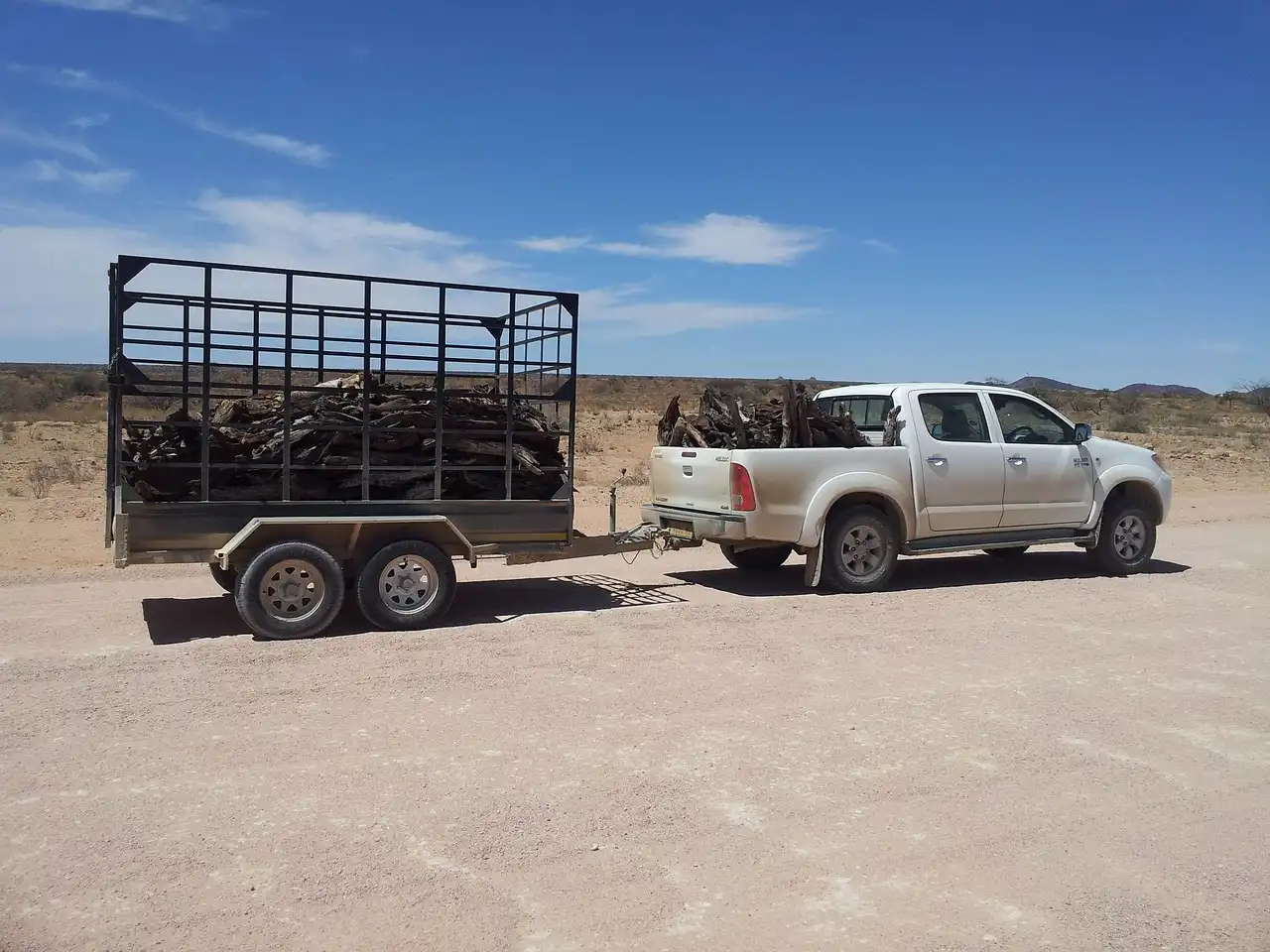
| Small boat on a light trailer | About 1,500 to 3,000 pounds | 150 to 300 pounds | 2 to 5 people, gear, fuel | Midsize crossover or body-on-frame SUV | Move up if the boat, fuel, or gear pushes the loaded total close to the rating limit |
| Pop-up camper with camping gear | About 2,000 to 3,500 pounds | 200 to 350 pounds | 3 to 5 people, luggage, food, water | Body-on-frame SUV or half-ton pickup | Move up if your passenger load is high or the trailer brakes are required by law |
| Heavier small trailer with equipment or water onboard | Above 3,500 pounds | 350 pounds or more | Several passengers plus cargo | Half-ton pickup or full-size body-on-frame SUV | Move up when payload, wheelbase, or brake control becomes the limiting factor |
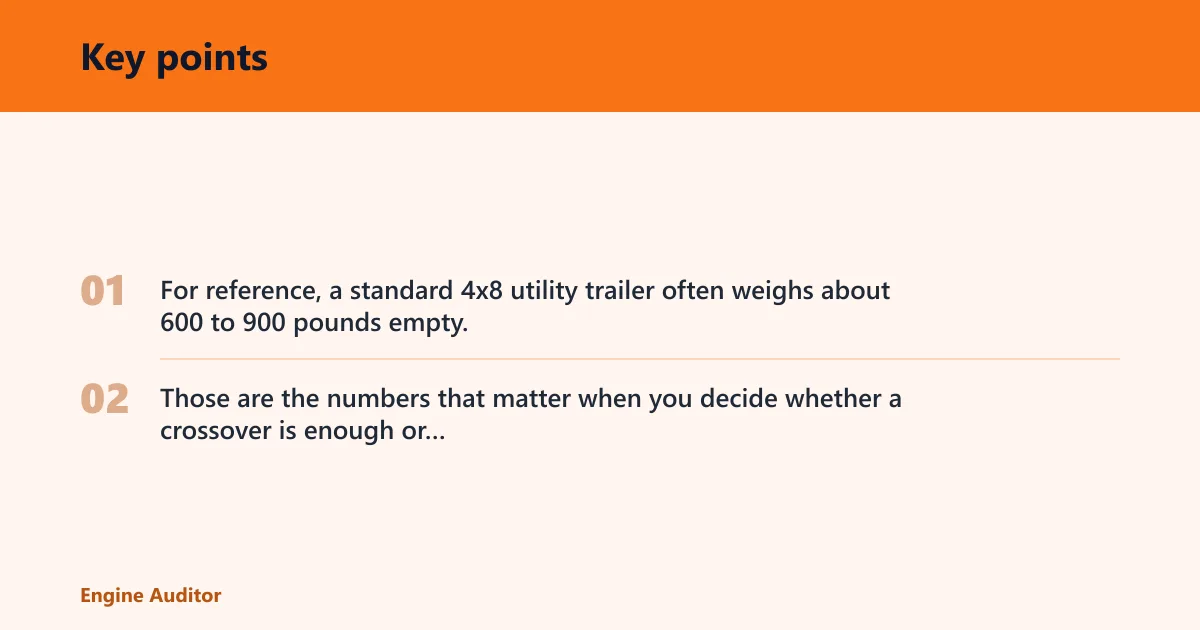
For reference, a standard 4×8 utility trailer often weighs about 600 to 900 pounds empty, and a loaded 4×8 utility trailer may weigh about 1,200 to 1,500 pounds. Those are the numbers that matter when you decide whether a crossover is enough or whether an SUV is the safer fit.
Are crossovers or minivans enough?
Crossovers and minivans are enough for light trailers, but only when the loaded weight stays modest and the payload margin remains healthy. Some minivans and crossovers can tow up to 3,600 and 7,200 pounds respectively, yet many real-world setups run out of payload, cooling, or stability before they hit those headline numbers.
The light trailer range they can cover
Many crossovers can handle a small utility trailer, a light cargo trailer, or a small boat on a properly matched trailer. Credit Acceptance maps small utility trailers or jet skis to many crossovers, minivans, or compact trucks above 2,000 pounds capacity. That is the zone where these vehicles make the most sense.
For occasional towing on local roads, a minivan or crossover can be the practical choice if the trailer stays light and the trip stays short.
Common limits from payload and cooling
Payload is the usual brake on the decision. Add tongue weight, people, cargo, and a full tank, and the vehicle can hit its limit early. Cooling can also matter because towing adds heat to the transmission and drivetrain, especially on grades or in hot weather.
That is why a crossover rated for towing can still feel strained with a trailer that is technically within the number on paper.
When they stop being the safer fit
Crossovers and minivans stop being the safer fit when the trailer weight leaves little cushion, the passengers are numerous, or the trip is mostly highway. In those cases, the longer wheelbase, stronger frame, and extra payload of a body-on-frame SUV or pickup matter more than a smaller vehicle’s day-to-day comfort.
Suppose a minivan is rated for a small camper, but the cargo area is full of water jugs, bedding, and a generator. The rating may still look acceptable, yet the combined load can leave very little margin for braking or emergency maneuvering.
What features should I look for in a tow vehicle?
Start with a tow package, then verify the owner’s manual, maker specs, and the vehicle’s actual payload sticker. A good tow package often includes cooling upgrades, trailer wiring, brake-controller support, and trailer monitoring tech where available. Those items matter more than glossy trim or a bigger infotainment screen.
- Check the maximum tow rating for the exact engine, axle, and tow package.
- Check payload rating before you count people, luggage, hitch hardware, and tongue weight.
- Compare the trailer’s loaded gross weight, not the empty weight.
- Look for a longer wheelbase if you will tow at highway speed or in wind.
- Use a trailer brake controller for heavier small-trailer setups when required or recommended.
- Keep the loaded trailer under 80% of the vehicle’s rated limit for a margin of safety.
That 80% target is a practical buffer, not a substitute for the rating itself. It gives room for passengers, gear, hills, wind, and minor loading changes.
How much trailer weight is too much for a crossover or minivan?
A crossover or minivan is usually past its comfortable range when the loaded trailer pushes close to its maximum tow rating and the vehicle is also carrying several passengers or cargo. Even if the number is technically legal on paper, the usable margin can disappear fast once tongue weight and payload are counted.
For many light-duty setups, staying well below the rating is often the safer move. In many places, trailer-brake rules start around 1,000 to 1,500 pounds, so it is smart to check local law before deciding that a lightweight vehicle is enough.
Frequently asked questions
What vehicle type is best for towing a small trailer?
For most small trailers, a midsize or body-on-frame SUV is the best balance of towing confidence, daily comfort, and usable payload. A pickup is the better answer when the trailer will get heavier, the route is mostly highway, or you want the most margin. Crossovers and minivans fit lighter jobs.
Can an SUV tow a small utility trailer safely?
Yes, if the SUV’s tow rating, payload, and wheelbase all fit the trailer setup. Body-on-frame SUVs are the stronger choice because they usually handle tongue weight and highway stability better than car-based crossovers. The loaded trailer, passengers, and cargo all have to fit under the vehicle’s limits.
Do you need a truck to tow a small trailer?
No. You do not need a truck for every small trailer. Many small utility trailers, light boats, and pop-up campers fit within the ratings of midsize SUVs, some crossovers, and some minivans. A truck becomes the better choice when the loaded trailer weight rises or the use is frequent.
How much towing capacity do I need for a small trailer?
Pick a vehicle whose tow rating comfortably exceeds the trailer’s gross weight, then check payload for tongue weight, passengers, and cargo. A common safety target is to keep towing weight under 80% of the vehicle’s rated limit. That leaves margin for hills, wind, and loading changes.
Are crossovers good for towing small trailers?
Crossovers are good for light-duty towing, not heavy or margin-tight jobs. Some compact SUVs are described as capable of towing light-duty trailers, but payload and cooling often become the real limit. They work best for short trips, lighter loads, and drivers who keep the trailer well below the rating.
What matters more for towing: horsepower or tow rating?
Tow rating matters more than horsepower because it reflects what the maker says the whole vehicle can safely handle. Horsepower helps with acceleration, but it does not account for payload, brakes, cooling, hitch rating, or chassis limits. Always start with the published tow number and payload sticker.
Products related to this article
Sponsored / affiliate links. As an Amazon Associate I earn from qualifying purchases. I may earn additional commission from eligible campaigns.