Vehicle Types for Daily Driving vs Weekend Use
Bottom line: Pick the smallest body style that fits your largest regular cargo item, your usual passenger count, and roughly 10–20% extra room. That approach usually beats buying a bigger SUV “just in case” because it keeps fuel use, parking stress, tire costs, and daily hassle under control. EPA fueleconomy.gov data consistently shows smaller, lighter vehicles tend to return better mpg than larger vehicles, while manufacturer specs show how much wheelbase, cargo volume, and ground clearance vary by body style.
This guide compares sedans, hatchbacks, wagons, crossovers, SUVs, and minivans for weekday commuting and weekend use, with an emphasis on the body style that fits your actual life rather than the one that looks most capable in a showroom.
Answer first: The best vehicle type for mixed daily driving and weekend use is usually the smallest body style that still fits your normal cargo. For many buyers, that means a hatchback; for others, it is a sedan, wagon, smaller crossover, or minivan. The right choice depends on passenger count, stroller and luggage fit, bike loading, and how often you actually need the extra room.
| Factor | Vehicle types for daily driving | weekend use | Winner |
|---|---|---|---|
| Fuel cost | Usually lower, especially with a sedan or hatchback. EPA fueleconomy.gov generally shows smaller vehicles posting better mpg than larger body styles, especially in highway driving. | Usually higher because larger bodies weigh more and carry more frontal area. | Vehicle types for daily driving |
| Parking and maneuvering | Shorter wheelbase and smaller footprint make city parking easier. Shorter vehicles are also easier to place in tight garages and curbside spaces. | Larger body length and height add stress in garages, curb cuts, and tight lots. | Vehicle types for daily driving |
| Cargo access | Hatchbacks and wagons do well, but a sedan trunk limits tall items. | Minivans and many crossovers carry bulky gear, strollers, and suitcases more easily. | weekend use |
| Ride height and road tolerance | Lower ride height helps access and handling, but gives less curb and rough-road clearance. | Higher ground clearance helps on broken pavement, steep driveways, and light snow. | weekend use |
| Daily comfort and fatigue | Car-like handling, lower step-in height, and less bulk can feel easier every day. | More seating height and space can help on long trips, but often adds weight and size. | Vehicle types for daily driving |
Which vehicle type fits mixed use?
Answer first: The best fit is usually the smallest body style that still holds your normal weekend load. A sedan is enough for many commuters. A hatchback often gives the best small-footprint compromise. Move up to a wagon, crossover SUV, or minivan only when your cargo shape, passenger count, or loading needs truly require it.
Daily commute needs
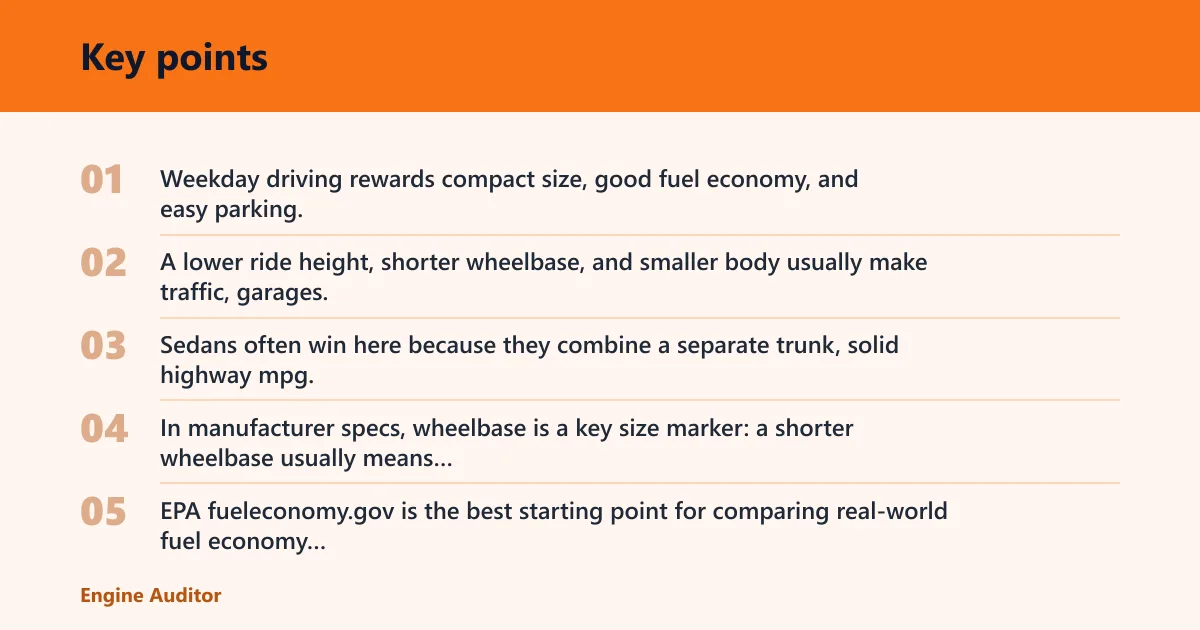
Weekday driving rewards compact size, good fuel economy, and easy parking. A lower ride height, shorter wheelbase, and smaller body usually make traffic, garages, and tight curbside spaces less tiring. Sedans often win here because they combine a separate trunk, solid highway mpg, and a calm road feel. In manufacturer specs, wheelbase is a key size marker: a shorter wheelbase usually means a smaller footprint and easier parking, while a longer wheelbase often adds stability but also length. EPA fueleconomy.gov is the best starting point for comparing real-world fuel economy assumptions across trims.
Weekend trip needs
Weekend use is not one thing. Road trips need luggage space and fuel range. Outdoor gear needs a wide opening for bikes, coolers, or camping bins. Family visits may need child seats, strollers, or extra passengers. Those demands can point to very different body styles. For example, one cross-shop may be a compact sedan that fits two carry-ons and groceries, while another may be a hatchback or wagon that can swallow a stroller frame, a folded bike with the front wheel removed, and a duffel without forcing the rear seats down.
Where size starts to cost you
A larger vehicle adds real overhead even when the extra space sits unused five days a week. Expect higher fuel use, more tire cost, more parking stress, and more time spent squeezing into spaces that were easy in a smaller car. Bigger also means more weight, which often dulls acceleration and braking. IIHS and NHTSA safety context also matters here: bigger vehicles can bring different crash-energy and visibility tradeoffs, but “bigger” is not the same thing as “safer” in every scenario. The safest choice is still the vehicle that matches your use case and is driven within its limits.
Vehicle types matrix

This matrix compares the main body styles shoppers cross-shop for mixed daily and weekend use. The scores are practical, not absolute. A 5 means strongest fit for that factor, and a 1 means weakest fit. Assumptions: city parking is moderately tight, weekend cargo is typical family gear rather than commercial hauling, and fuel economy matters for at least half the driving year. One failure case is included for each body style so the tradeoff is explicit.
| Body style | Daily commute ease | Cargo flexibility | Parking stress | Fuel cost | Weekend gear fit | Choose this if… |
|---|---|---|---|---|---|---|
| Sedan | 5 | 2 | 5 | 5 | 2 | You mostly commute, want lower fuel cost, and only need a trunk for bags, groceries, or a carry-on suitcase. |
| Hatchback | 4 | 4 | 5 | 4 | 4 | You want a small footprint with fold-flat seats and a liftgate for mixed city use and lighter weekend cargo. |
| Wagon | 4 | 5 | 4 | 4 | 5 | You want car-like handling plus a long roof for luggage, pets, or sports gear, and you can find one. |
| Crossover SUV | 3 | 4 | 3 | 3 | 5 | You want a higher seat, available all-wheel drive, and more cargo room than many sedans without moving to a full-size SUV. |
| Minivan | 2 | 5 | 2 | 2 | 5 | You haul people, child seats, strollers, or bulky weekend gear more often than you park in tight city spaces. |
Sedan
Sedans are usually the cheapest and most fuel efficient of this group, especially on the highway. Their lower ride height and separate trunk help with daily cargo security and aerodynamics, but the trunk opening limits tall or awkward items. EPA fueleconomy.gov often reflects that advantage in both city and highway figures, depending on the drivetrain and trim.
A sedan suits the buyer whose week looks like commuting, grocery runs, and the occasional suitcase. It stops making sense when the weekend list starts to include bikes, folded strollers, or tall storage bins that do not fit through a trunk opening. A common failure case is a family trying to load a large stroller or two hard-shell suitcases plus a cooler and discovering the trunk volume is adequate on paper but not through the opening.
Hatchback
Hatchbacks often give the best compromise for city buyers because they keep a compact footprint while adding rear liftgate access and fold-flat seats. That shape makes loading easier than a sedan, even if the quoted cargo volume looks similar on paper. In practice, a hatchback can be the difference between fitting a folded stroller and having to leave a seat down all week.
The catch is rear-seat cargo area still depends on seat-up versus seat-down measurements. If you need to carry a stroller upright or a pair of bikes with wheels removed, the opening shape matters as much as the cubic-foot number. A hatchback’s failure case is usually very tall cargo that clears the opening width but not the height of the liftgate aperture.
Wagon
Wagons pair car-like handling with a longer roof and cargo floor, so they can carry more without rising to SUV height. They also keep a lower step-in height than many crossovers, which helps daily loading. Manufacturer cargo specs often show wagons giving sedan-like driving manners with cargo volume that rivals or exceeds many crossovers when measured behind the second row.
The limitation is market availability. Wagons are less common, so you may have fewer trims and fewer used examples to choose from. When you find one, it can be the cleanest answer for buyers who want space without a tall body. A wagon’s failure case is not usually volume; it is availability, trim scarcity, or a price that is higher than the shopper expected for a niche body style.
Crossover SUV
Crossover SUVs usually bring a higher seating position, more cargo room than many sedans, and available all-wheel drive on many trims. They also weigh more than comparable cars, which usually raises fuel use and can make parking and braking less pleasant. EPA fueleconomy.gov commonly shows that step-up in size carrying a mpg penalty relative to smaller cars, even before options and drivetrain choices are considered.
Ground clearance matters here in inches, not in marketing language. Extra clearance helps with steep driveways, curb scrapes, and rough parking lots, but it does not help much for ordinary commuting if your roads are already smooth. A crossover’s failure case is buying it mainly for “safety” or “versatility” and then never using the height or available all-wheel drive enough to justify the extra fuel and parking penalty.
Minivan
Minivans are the strongest choice for family hauling and large weekend cargo loads. Sliding doors make tight parking spaces far easier for child seats and loading on crowded curbs, and the third row plus large cargo volume are hard to match. Manufacturer cargo specs typically show minivans leading the pack for usable interior volume because the packaging prioritizes people and stuff over style.
That strength comes with daily tradeoffs. A minivan is larger, less convenient in small city spaces, and often less efficient than a sedan or hatchback. It makes sense when family visits, sports gear, and luggage are regular tasks, not rare events. Its failure case is the reverse of the sedan’s: the van works brilliantly when full, but can feel oversized and unnecessary for a solo commute or two-person errand run.
Sedan vs SUV for weekdays and weekends

Answer first: A sedan is enough when your weekday life is mostly one or two passengers, modest cargo, and regular commuting distance. An SUV earns its extra size when you regularly need a higher seat, extra ground clearance, or cargo room that a sedan cannot handle without folding seats every trip.
The hidden cost of moving up a size is not only purchase price. Larger vehicles usually mean more fuel use, more tire area to replace, more parking stress, and more weight to move through traffic. If the SUV’s extra space sits empty most days, the cost penalty is easy to overpay. EPA fueleconomy.gov is useful here because it lets shoppers compare mpg across trims instead of relying on body-style stereotypes.
When a sedan is enough
Choose a sedan if your weekend load is usually luggage, groceries, or a couple of duffel bags. The separate trunk keeps daily cargo out of sight, and highway mpg is often better than in larger vehicles. That is a strong match for commuters who value a calmer ownership bill. A sedan is also easy to cross-shop when the real requirement is “fits a carry-on, a backpack, and a laptop bag” rather than “swallows bulky gear.”
When an SUV earns its extra size
Choose a crossover SUV when your weekend gear is tall, bulky, or dirty enough that you want a wider opening and more cabin volume. Available all-wheel drive can help in rain and light snow, but it is not required for most weekend driving. Many shoppers need the space more than the traction aid. Ground clearance in the manufacturer spec sheet matters most if your route includes steep aprons, unplowed lots, or repeated curb contact.
The hidden cost of moving up a size
Oversizing a vehicle affects every weekday. Taller bodies can catch more wind, heavier vehicles usually stop and start less efficiently, and bigger footprints are harder to place in city parking. If the weekend use is occasional, that extra mass becomes a tax on every errand. The same effect shows up when a shopper buys an SUV to solve a luggage problem that a hatchback or wagon could have solved at lower cost.
How much cargo space do you really need?
Answer first: Cargo volume matters, but only when you compare the same measurement method and the same body shape. Seats-up versus folded can change the number a lot, and a square opening often matters more than the headline cubic feet. For mixed use, think about the shape of the item first, then the total volume.
Cargo volume numbers that matter
Cargo volume is usually listed in cubic feet, but the useful question is whether that number is with the rear seats upright or folded. A small number with a wide opening can be easier to use than a larger number behind a narrow trunk opening. That is why hatchbacks and wagons often feel bigger than their stats suggest. Manufacturer cargo specs are the right citation source for this comparison because they show the same body style’s measured volume in a standardized way.
Seat-up space versus folded-seat space
Seat-up space matters for daily life. Seat-down space matters for road trips and outdoor gear. If you only fold seats once a month, buying a larger body just to maximize folded capacity can leave you with too much vehicle for the other 29 days.
Picture a 36-inch folding stroller and a week’s groceries. A sedan trunk may handle the groceries but fail on the stroller. A hatchback with the rear seats upright might still work if the opening is tall enough, while a minivan will handle both with far less fuss. The same logic applies to luggage: two carry-ons and a backpack may fit in a sedan, but a family of four with hard-sided suitcases often crosses the line into hatchback, wagon, or minivan territory.
Gear fit for luggage, bikes, and strollers
Weekend trips split into three patterns: luggage for road trips, awkward shapes for outdoor gear, and mixed loads for family visits. A wagon or hatchback can often handle luggage and folded bikes. A crossover or minivan is more likely to handle full-size strollers, coolers, and multiple passengers at once. For bike fit specifically, the differentiator is often hatch opening height and cargo floor length rather than the advertised cubic feet alone.
Ride height, wheelbase, and parking stress
Answer first: Ground clearance, wheelbase, and footprint shape affect how a vehicle feels every day. Higher ground clearance can help with curbs and rough roads. Longer wheelbases can improve ride stability on the highway. Shorter vehicles usually park more easily and turn in tighter spaces. Manufacturer specs are the place to verify the numbers instead of guessing from body style alone.
Ground clearance for curbs and rough roads
Ground clearance is commonly measured in inches. Crossovers and SUVs often sit higher, which helps with rutted driveways, snow piles, and steep ramps. That does not mean a low sedan is unsuitable; it simply means the driver should match clearance to the actual roads and curbs in the commute. IIHS/NHTSA crash context can matter here too: clearance is not a substitute for careful driving, and it does not automatically solve visibility, braking, or rollover risk tradeoffs.
Wheelbase and road-trip comfort
Wheelbase is the distance between the front and rear axles. A longer wheelbase can calm highway motion and help the vehicle feel steadier on long stretches. A shorter wheelbase helps with parking and tight city maneuvering, which matters more if the car spends most of its time in downtown traffic.
Why shorter vehicles are easier to live with in cities
City life punishes length, width, and height. Compact vehicles fit more parking spots, clear more garages, and ask less of the driver at the curb. That is why a hatchback often feels easier to live with than a taller crossover, even when the crossover looks more useful on paper. It is also why a short wheelbase and a modest overall length often matter more to daily satisfaction than a large cargo spec that only gets used on rare weekends.
Fuel economy and ownership cost tradeoffs
Answer first: Fuel economy is measured in mpg or L/100 km, and city and highway numbers matter for different reasons. Commuters care about city mpg if traffic is slow and stop-start. Highway mpg matters more if the daily route is long. Larger vehicles usually lose on both counts, so EPA fueleconomy.gov is the best source for trim-by-trim comparisons before you pay for unused size.
City and highway mpg differences
Many sedans post better highway numbers than larger SUVs because they ride lower and push less air. In city use, a smaller vehicle often benefits from lower curb weight. If your week is mostly commuting, those savings show up far more often than the extra cargo room of a bigger body.
Weight penalties in larger vehicles
Crossovers and minivans often carry more mass than a comparable car. That extra weight affects braking, acceleration, tire wear, and fuel use. All-wheel drive also adds weight and cost, so it should be treated as a traction aid, not a default answer.
Suppose two shoppers both need space for weekend bags. One buys a tall crossover “just in case,” while the other chooses a hatchback with fold-flat seats. The second driver usually gets easier parking, lower fuel stops, and enough room for the same bags without hauling extra mass every weekday. That difference is easy to see when a cargo spec is compared alongside fuel economy data rather than in isolation.
Why smaller often costs less to run
Smaller vehicles usually cost less to operate because they use less fuel and need less tire and brake material. Insurance and repair bills can also stay lower, though actual rates vary by model. The broad rule is simple: unused size still gets paid for. For many commuters, the best ownership value comes from the vehicle that does the job with the least excess footprint.
Choose vehicle types for daily driving if…
Answer first: Choose the daily-driving side if your routine is mostly commuting, parking, short errands, and one or two passengers. Choose the weekend-use side if your weekends regularly involve bulky gear, several passengers, or long trips where cargo access and ride height matter more than fuel savings. Most buyers land in the middle, where a hatchback, wagon, or smaller crossover fits best.
- Best pick for solo commuting: sedan. It gives lower fuel use, a separate trunk, and the easiest city parking.
- Best pick for mixed city and weekend use: hatchback. It keeps a small footprint while giving real cargo flexibility.
- Best pick for families and heavy gear: minivan. Sliding doors, third-row seating, and large cargo volume solve the loading problem better than a bigger SUV for many buyers.
Wagons sit between the hatchback and crossover. They are rare, but they are worth a close look if you want car-like handling with more useful cargo length. Crossovers make sense when you want a higher seat and more clearance without moving all the way to a minivan. If your regular test is “does it fit a stroller, two suitcases, or a bike with the front wheel off,” wagons and hatchbacks should be checked before a larger SUV is assumed to be necessary.
Frequently asked questions
What type of vehicle is best for daily driving and weekend trips?
Answer first: The best answer is usually a hatchback or wagon, with a smaller crossover as the next step up. Those body styles keep weekday parking and fuel use under control while still handling bags, folding seats, and occasional gear. If your weekend cargo is small, a sedan can still be enough.
Should I get a sedan or SUV for commuting and weekends?
Answer first: Choose a sedan if commuting is the main job and weekend use is limited to luggage or groceries. Choose a crossover SUV if you need higher seating, more cargo room, or occasional all-wheel drive for rain and light snow. Do not buy the SUV unless the extra space gets used often.
What is the most practical vehicle for both city driving and road trips?
Answer first: A hatchback is often the most practical single answer because it stays easy to park in the city and still expands for road-trip bags. A wagon is similar but less common. If you carry a family on road trips, a minivan may be more practical despite its larger footprint.
Which car type is easiest to live with every day but still good for weekends?
Answer first: A hatchback is usually the easiest compromise. It keeps the footprint small, the rear access wide, and the seats flexible. A sedan is easier on fuel, but the hatchback gives more usable space for weekend gear without the daily penalty of a larger vehicle.
How do I choose between fuel economy and comfort for a daily driver?
Answer first: Start with commute length, traffic, and parking. If the drive is long and mostly highway, a sedan or wagon may give the best mix of comfort and mpg. If rough pavement, a steep driveway, or winter access matters more, a crossover may be worth the higher running cost.
What vehicle type is best if I want cargo space without driving a big SUV every day?
Answer first: Look first at a wagon or hatchback. Both give better cargo access than a sedan without forcing you into a tall, heavy SUV. If you need more room than either can provide, move to a smaller crossover before jumping all the way to a minivan.
Sources
- EPA fueleconomy.gov, fuel economy and vehicle comparison data.
- IIHS and NHTSA, safety ratings and crash-test context for vehicle size and structure tradeoffs.
- Manufacturer specifications for cargo volume, wheelbase, and ground clearance across sedans, hatchbacks, wagons, crossovers, SUVs, and minivans.
Products related to this article
Sponsored / affiliate links. As an Amazon Associate I earn from qualifying purchases. I may earn additional commission from eligible campaigns.