Transmission Control Pressure Sensor Bad: Signs and Cost
A bad transmission pressure sensor often shows stuck, erratic, or implausible pressure data; if wiring and connector checks pass, the sensor is often the next suspect, and the part usually costs somewhere in the tens to low hundreds of dollars. Ignoring it can mean harsh shifts, limp mode, or replacing a valve body, TCM, or transmission for far more. I use scan data, connector checks, and repair pricing to sort the fault before parts get ordered.
What a bad transmission control pressure sensor feels like


A failing transmission pressure sensor usually shows up as harsh shifts, delayed engagement, flare between gears, erratic shift timing, or a sudden move into limp mode. The TCM may react to bad input by changing shift strategy, so the symptom can look like a hydraulic failure even when the sensor or wiring is the real problem.
Common drivability signs
The most common pattern is inconsistency. One drive starts normal, the next has a hard 2-3 shift, a late reverse engagement, or gear hunting on light throttle. A transmission pressure sensor reports line pressure, so a bad signal can make the control system think pressure is too low or too high.
Warning lights often arrive early. A transmission warning lamp, check engine light, or both may come on before the vehicle feels seriously wrong. Some vehicles also log a code and keep shifting, while others drop into limp mode and hold one gear to limit damage.
When limp mode happens and what one-gear behavior usually means
Limp mode is a failsafe. The TCM may lock the transmission into one gear, often to protect the clutches and keep the vehicle movable. That behavior does not prove the sensor is bad; it means the control system lost trust in sensor data, fluid pressure feedback, or its own outputs.
Which warning lights and codes often show up first
Drivers often see codes related to pressure sensor range, performance, circuit faults, or pressure-control solenoids. The code family matters, but the symptom pattern matters more. A hard fault that returns immediately points differently from an intermittent complaint that shows up only when conditions are hot, wet, or after a voltage event.
According to Transmission (mechanical device) – Wikipedia — Automatic transmissions became available in the US market starting in 1939. (source)
What the transmission pressure sensor actually does
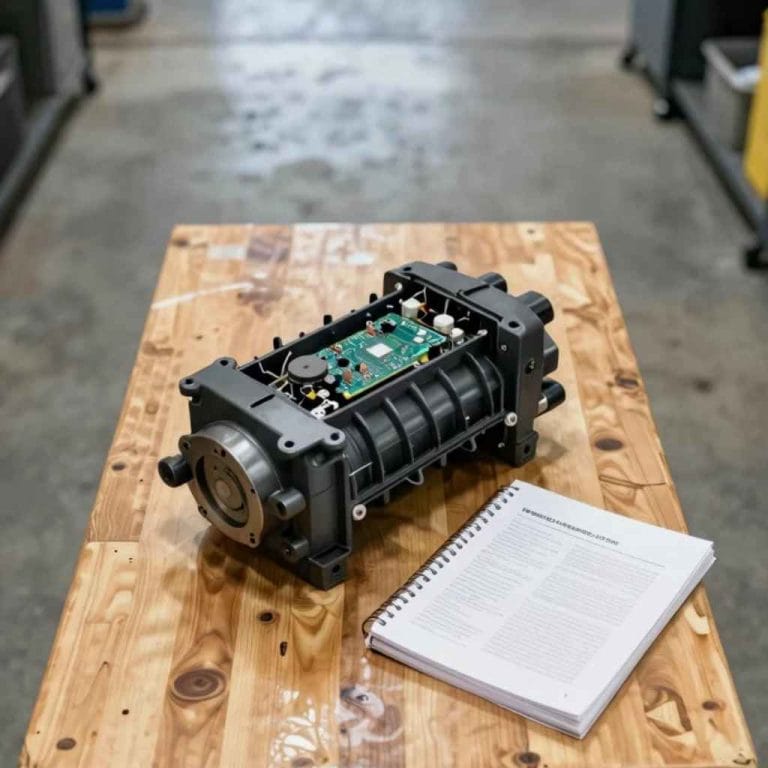
The transmission pressure sensor measures line pressure and sends that signal to the TCM as an input for transmission control. The TCM uses that input to adjust shift strategy, command solenoids, and watch whether actual pressure matches what it asked for. The sensor is one piece of a larger control loop.
How the sensor reports line pressure to the TCM
Transmission fluid pressure is the hydraulic force that applies clutches and bands. If actual pressure is low, shifts can flare or slip. If it is high, shifts can feel harsh. The sensor gives the TCM a pressure reading so it can correct those changes in real time.
A transmission can have one fixed ratio or multiple variable ratios. Most currently produced passenger cars use 4–10 forward gear ratios. Electric vehicles typically use fixed-ratio or two-speed transmissions. Automatic transmissions became available in the US market starting in 1939. (en.wikipedia.org)
Why the TCM may react to bad sensor data instead of bad hydraulic pressure
The TCM controls shift strategy and communicates over the vehicle network. If the pressure sensor lies, the TCM may command the wrong solenoid pattern, delay a shift, or trigger limp mode. That is why a pressure sensor code can be a control problem, a wiring problem, or a hydraulic problem.
Where the sensor fits in the transmission control system
The sensor does not work alone. It sits alongside the wiring loom, transmission connector, solenoids, valve body, and TCM. A fault in any one of those can cause a similar complaint on the road. Diagnosing the sensor first, without looking at the rest, wastes parts and labor.
What trouble codes can a pressure sensor fault cause?
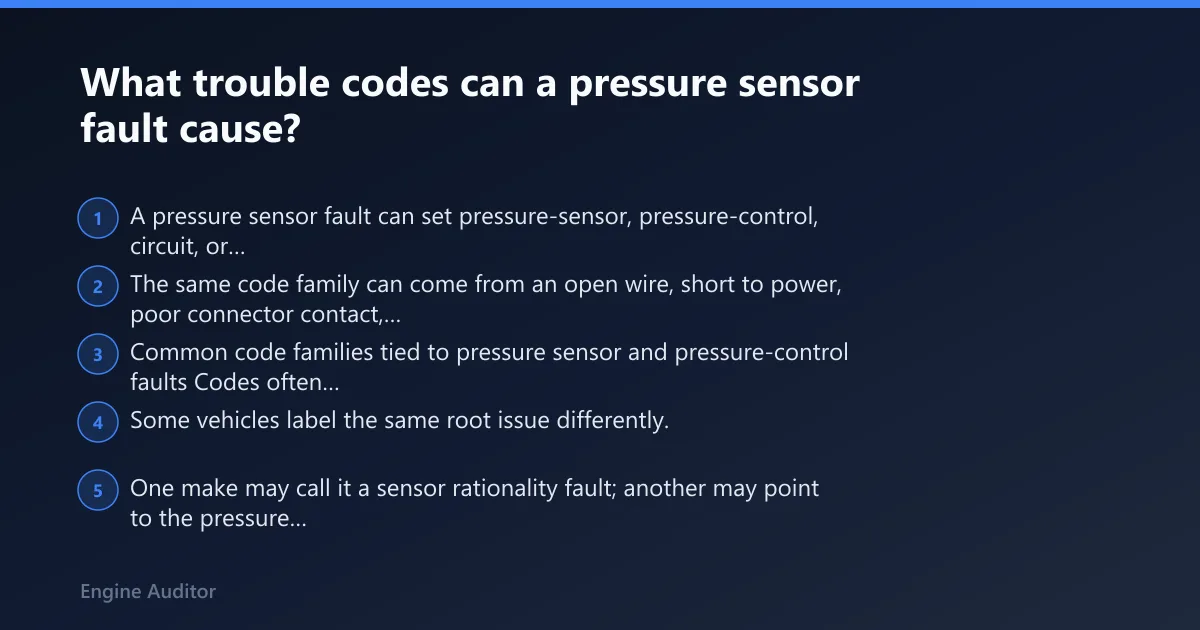
A pressure sensor fault can set pressure-sensor, pressure-control, circuit, or plausibility codes, but the code alone does not prove the sensor failed. The same code family can come from an open wire, short to power, poor connector contact, low battery voltage, valve body trouble, or a TCM logic fault.
Common code families tied to pressure sensor and pressure-control faults
Codes often point to pressure sensor range/performance, pressure control solenoid performance, or circuit fault conditions. Some vehicles label the same root issue differently. One make may call it a sensor rationality fault; another may point to the pressure control system or line pressure monitoring circuit.
Why a code does not prove the sensor is failed
A code only tells you what the TCM disliked. It does not tell you why. If the sensor output is frozen, the connector is corroded, or voltage dropped during cranking, the code can still look like a bad sensor. That is why replacing the sensor on code alone often misses the real fault.
How freeze-frame data helps narrow the fault
Freeze-frame data shows the conditions when the code set: engine speed, load, temperature, and sometimes commanded gear or pressure state. If the fault appears only cold, only hot, or during a shift, that narrows the path. A code that appears with low voltage or low fluid pressure points elsewhere.
Sensor, wiring, valve body, or TCM: how to tell which one is bad
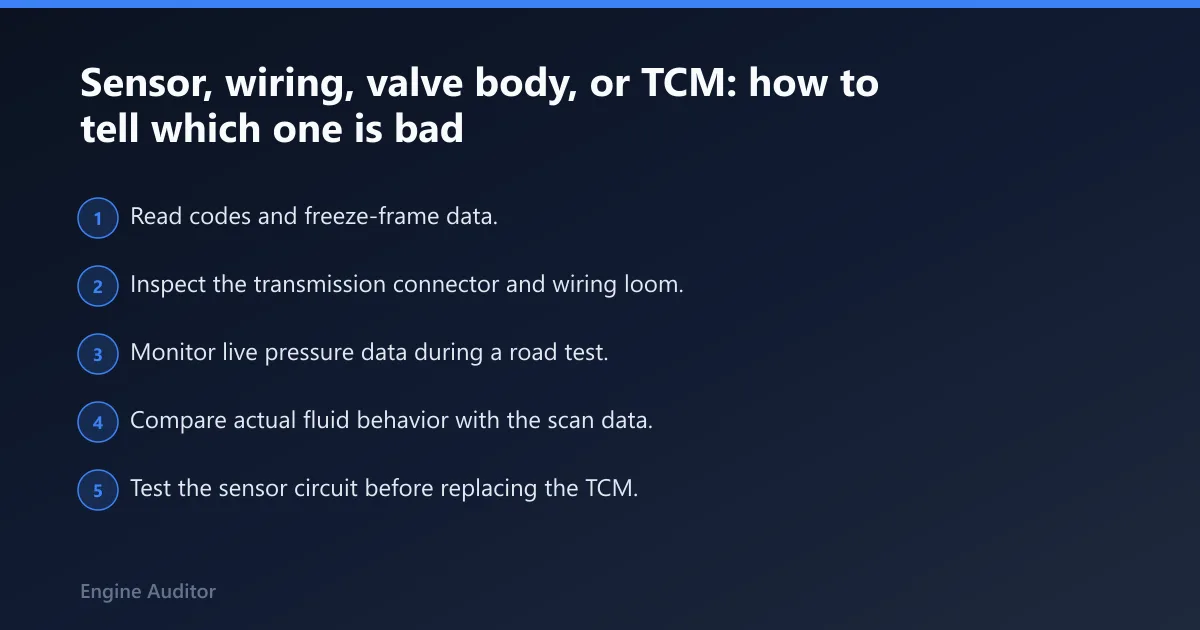
The fastest way to separate the fault is to work outward from the sensor connector. Start with the wiring loom and transmission connector, then watch live data, then compare the pressure reading with the shift complaint. The TCM is usually the last part to condemn, not the first.
Start with the wiring harness and transmission connector
Inspect the transmission connector for fluid intrusion, bent pins, corrosion, loose terminals, and broken locks. Check the loom for rub-through near brackets and heat damage near the case. An open or short circuit here can make a good sensor look dead or create a phantom pressure reading.
Use live data to spot bad readings, dropouts, or impossible pressure values
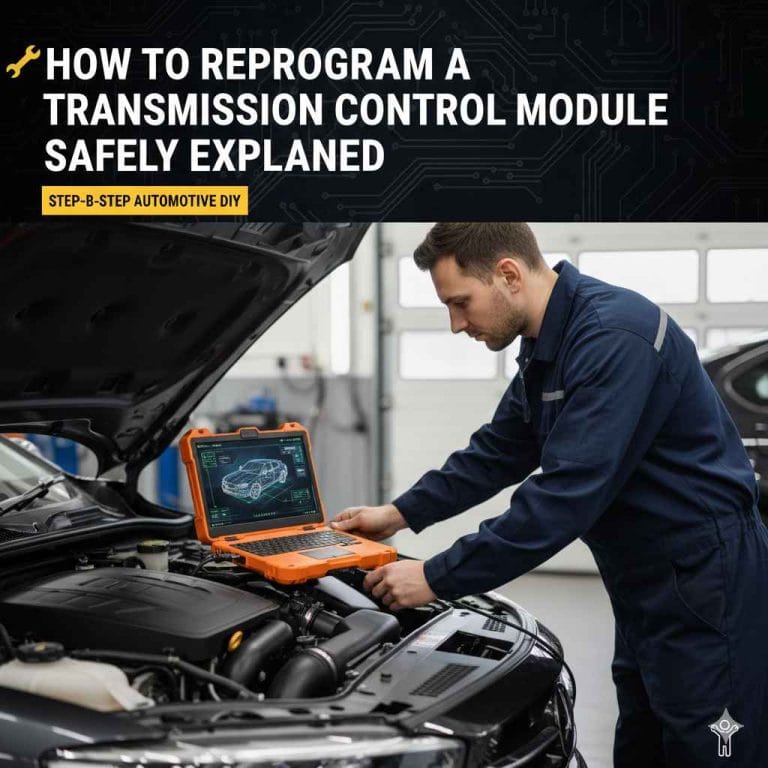
An OBD2 scanner with live data is the main tool here. Watch commanded pressure, actual pressure, shift timing, and sensor voltage or signal, if the scan tool exposes it. A signal that jumps to zero, flat-lines, or shows an impossible value during vibration often points to wiring, not the sensor body.
Check whether valve body and solenoid faults match the symptom pattern
The valve body is a common confusion point because it controls fluid paths and solenoids that affect line pressure. A sticky valve or weak solenoid can cause the same harsh or delayed shift that people blame on the sensor. If actual hydraulic pressure is wrong, the sensor may be reporting the truth.
When the TCM is the last thing to condemn
The TCM can fail, but it is less common than corrosion, connector damage, or a bad sensor circuit. If the scan tool shows stable input voltage, correct wiring, and pressure readings that disagree with mechanical reality, then the module becomes more suspect. Even then, network faults should be checked first.
- Read codes and freeze-frame data.
- Inspect the transmission connector and wiring loom.
- Monitor live pressure data during a road test.
- Compare actual fluid behavior with the scan data.
- Test the sensor circuit before replacing the TCM.
| Symptom pattern | Likely cause | Test to confirm | Typical repair path |
|---|---|---|---|
| Hard shifts with stable engine operation | Valve body sticking or high line pressure | Live data shows pressure mismatch under load | Valve body service, solenoid check, fluid inspection |
| Intermittent limp mode after bumps or heat soak | Wiring loom or connector fault | Wiggle test, pin inspection, continuity test | Repair connector, replace pigtail, fix wiring damage |
| Pressure reading flat-lines or drops to zero | Sensor failure or open circuit | Sensor signal and reference voltage test | Replace sensor after circuit checks pass |
| Multiple transmission codes after low voltage event | Battery or charging fault affecting TCM input | Battery and charging system test | Repair voltage issue, clear codes, retest |
| Codes return after sensor replacement | TCM logic fault or unresolved hydraulic problem | Compare live data and mechanical pressure | Further diagnosis, then module or hydraulic repair |
Can low battery voltage cause pressure sensor codes?
Low battery voltage can distort sensor readings, upset the TCM, and set transmission sensor codes that can look like a bad part. Before replacing anything, check battery health, charging voltage, ground integrity, and whether the code appeared after a jump start, crank event, or weak-battery start.
How low voltage can distort sensor readings and set false codes
Sensor signals depend on clean power and ground. If voltage sags, the TCM may see a noisy, implausible, or out-of-range pressure signal. That can trigger codes even when the pressure sensor itself is fine. Low voltage also makes intermittent faults harder to catch on a short test drive.
What to check in charging and battery health before parts replacement
Check the battery, alternator output, and main grounds. Look for loose terminals, corrosion, and voltage drop under load. If the fault appeared after the battery was weak, the scan tool may show transmission codes that disappear after the electrical system is restored and the car is retested.
When a voltage event creates an intermittent transmission fault
A low-voltage event can leave a history code without a true hard failure. The transmission may drive normally after the battery is charged, which tempts people to blame the sensor. That is when freeze-frame and live data matter most, because the code timing tells the real story.
How much does it cost to replace a transmission pressure sensor?
Repair cost depends on whether the issue is the sensor, the connector, the wiring loom, the valve body, or the TCM. A diagnostic fee often comes first, then parts and labor. The sensor itself is usually the cheapest piece, but labor and access can push the bill far higher.
Diagnostic fee versus repair cost
A scan and inspection charge is often the best money spent on this problem. It can prevent a wrong-part replacement. If the shop needs live data, a road test, connector inspection, and circuit checks, that diagnostic step usually costs less than swapping a valve body or module blind.
Typical sensor, wiring, valve body, and TCM cost bands
The sensor part often costs roughly in the tens to low hundreds of dollars. Wiring repairs can range from a connector repair to a loom section replacement, depending on corrosion or damage. Valve body work usually costs more because the part and labor are higher. TCM replacement can move the repair into a much larger bill.
Dealer pricing versus independent shop pricing
Dealer pricing often runs higher because of labor rates and any module programming steps. Independent shops often cost less for a sensor, connector repair, or fluid-related diagnosis. If programming is required after a TCM or some sensor repairs, that added step can narrow the price gap fast.
| Repair path | Typical cost driver | Common shop outcome |
|---|---|---|
| Diagnostic only | Scan time, road test, connector inspection | Find root cause before parts |
| Sensor replacement | Part price plus labor access | Best when wiring tests pass |
| Wiring repair | Connector, pigtail, or loom labor | Best when code returns on movement or heat |
| Valve body service | Fluid control hardware and labor | Best when hydraulic readings do not match |
| TCM repair or replacement | Module cost, programming, relearn | Only after input and hydraulic checks |
Why labor can matter more than the part
Many pressure sensors are buried in the transmission, so access drives the bill. A cheap part with high labor can cost more than a pricier external sensor that takes little time. That is why the repair path matters more than the name of the failed component.
Fault-tree repair checklist: symptoms, test, and likely fix
Use a fault-tree approach: start with the symptom pattern, then choose the test that best separates sensor, wiring, valve body, and TCM issues. Hard failures usually show up every time. Intermittent failures need live data, freeze-frame data, and connector inspection to catch the fault while it happens.
Hard failure path
When the code returns immediately and live data stays stuck or implausible, begin with power, ground, reference voltage, and continuity checks. If those pass, the sensor becomes the main suspect. If hydraulic pressure readings are wrong too, the valve body or pump side of the system moves up the list.
Intermittent failure path
If the complaint happens hot, wet, after bumps, or only once in a while, inspect the wiring loom and connector first. Wiggle the loom while watching the scan tool. A sudden drop or spike in pressure data points to an electrical break, not an internal sensor failure.
Symptom-to-test-to-repair table
| Symptom | Best next test | Likely repair |
|---|---|---|
| Harsh shifts with normal engine running | Live line pressure data versus commanded pressure | Valve body or solenoid repair |
| Delayed engagement after start | Fluid level, pressure data, connector inspection | Sensor, wiring, or fluid-pressure repair |
| Limp mode after rain or wash | Connector corrosion and wiring loom check | Connector repair or loom replacement |
| Code returns after battery went dead | Battery and charging test, then clear and retest | Electrical correction before parts |
| Pressure signal looks dead on scan tool | Reference voltage, ground, and signal continuity test | Sensor or circuit repair |
| Sensor code with wrong actual hydraulic behavior | Mechanical pressure comparison | Valve body or internal hydraulic repair |
Where is the transmission pressure sensor located?
The transmission pressure sensor is usually mounted on or inside the transmission case, valve body, or internal control assembly, depending on the design. Its location matters because access can require fluid draining, pan removal, or partial disassembly. The exact spot varies by transmission family and model year.
Some vehicles place the sensor where it is easy to replace. Others bury it inside the unit with the valve body. That difference is why one car gets a modest sensor bill while another needs far more labor for the same fault code.
Frequently asked questions
What are the signs of a bad transmission pressure sensor?
Common signs include harsh shifts, delayed engagement, flare between gears, erratic shift timing, warning lights, and limp mode. The clue is inconsistency. If the symptom changes with heat, bumps, or battery voltage, wiring or connector trouble may be more likely than the sensor itself.
Can a bad transmission pressure sensor put my car in limp mode?
Yes. If the TCM sees implausible pressure data, it may enter limp mode to protect the transmission. That usually means one-gear behavior or limited shifting. Limp mode does not prove the sensor failed; it means the control system no longer trusts the pressure input.
What trouble codes can a transmission pressure sensor cause?
Pressure sensor range, performance, and circuit codes are common, along with pressure-control and solenoid-related codes. Code wording varies by vehicle. The same code can come from a sensor fault, a wiring issue, low voltage, or a hydraulic problem inside the transmission.
How much does it cost to replace a transmission pressure sensor?
The sensor itself often costs $40-$180, but the total bill depends on access, labor, and whether other faults are present. A simple sensor swap is far cheaper than valve body work or a TCM replacement. Diagnostic time is often the best value in the repair.
Is a pressure sensor problem the same as a valve body problem?
No. A pressure sensor reports line pressure, while the valve body controls fluid routing and solenoid action. Either one can create similar symptoms. If live data and mechanical pressure do not match, the valve body may be the real fault, not the sensor.
How do I tell if the sensor, wiring, or module is the real fault?
Start with live data, freeze-frame data, and connector inspection. If the signal drops out when the loom moves, suspect wiring. If the data is stable but wrong, compare it with actual hydraulic behavior. Only after those checks should the TCM be blamed or replaced.
Products related to this article
Sponsored / affiliate links. As an Amazon Associate I earn from qualifying purchases. I may earn additional commission from eligible campaigns.