Transmission Control Module Replacement Cost by Car Model
In many cases, transmission control module replacement costs about $250 to $1,200 when the TCM is a separate part, and it can be higher on vehicles that need dealer programming or a mechatronic unit. A bad diagnosis means you pay for a module that doesn’t fix the shift fault, or you replace a part that only needed calibration. This guide maps costs by model, splits part price from programming and labor, and shows when the TCM is not sold separately.
Transmission control module replacement cost by car model
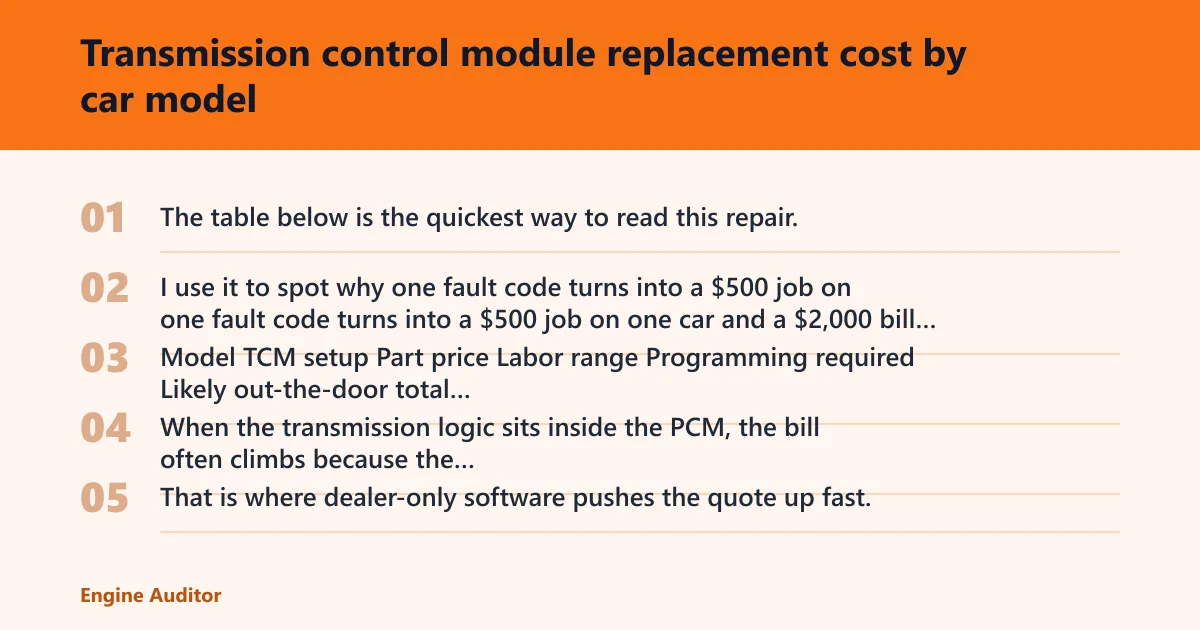
The table below is the quickest way to read this repair. I use it to spot why one fault code turns into a $500 job on one car and a $2,000 bill on another, because some vehicles use a separate TCM, some use a PCM, and some need module coding after installation.
| Model | TCM setup | Part price | Labor range | Programming required | Likely out-the-door total |
|---|---|---|---|---|---|
| Honda Civic | Separate TCM | $250-$450 | $120-$220 | Often yes | $450-$900 |
| Toyota Camry | Separate TCM on many trims | $300-$500 | $140-$240 | Often yes | $500-$1,000 |
| Ford Escape | PCM-integrated on many versions | $400-$900 | $180-$300 | Yes | $750-$1,500 |
| Chevrolet Malibu | Separate or PCM-linked by year | $300-$650 | $140-$250 | Often yes | $550-$1,150 |
| Nissan Altima | PCM-integrated on many models | $450-$850 | $180-$320 | Yes | $800-$1,500 |
| Jeep Grand Cherokee | Separate or mechatronic depending on transmission | $400-$900 | $220-$400 | Yes | $900-$1,800 |
| Ram 1500 | PCM-integrated on many trucks | $500-$1,100 | $200-$350 | Yes | $900-$1,700 |
| BMW 3 Series | Often dealer-coded module or integrated control | $700-$1,400 | $250-$450 | Yes, dealer-level on many cases | $1,200-$2,200 |
| Mercedes-Benz C-Class | Integrated control or conductor-style module | $800-$1,500 | $300-$500 | Yes | $1,500-$2,500 |
| Volkswagen Passat | Mechatronic or integrated control path | $600-$1,300 | $250-$450 | Yes | $1,100-$2,000 |
| Hyundai Elantra | Separate TCM on some years, PCM on others | $250-$550 | $130-$230 | Often yes | $450-$1,000 |
| Subaru Outback | PCM-integrated on many CVT applications | $450-$950 | $180-$320 | Yes | $800-$1,500 |
Separate TCM versus PCM-integrated systems
Cars with a separate module usually stay cheaper because the failed part is easier to isolate and swap. When the transmission logic sits inside the PCM, the bill often climbs because the engine and transmission controller get priced and programmed as one unit. That is where dealer-only software pushes the quote up fast.
What the table shows at a glance
The low end is usually an economy car with a separate module and broad parts supply. The middle is a common family car with programming and moderate access time. The top end is usually a European or luxury car, or any vehicle where the control unit is tied to security coding or a mechatronic assembly.
According to How Much Is A Transmission Control Module Replacement: Essential — Typical transmission control module replacement ranges from $500 to $1,500 or more. (source)
What a TCM does, and when it is not a separate part
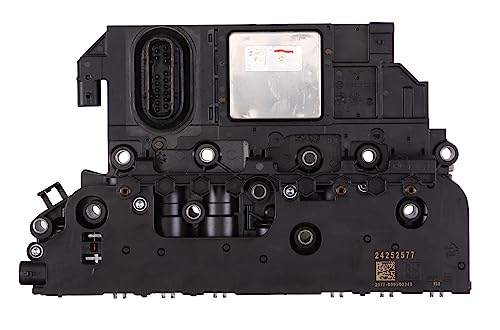
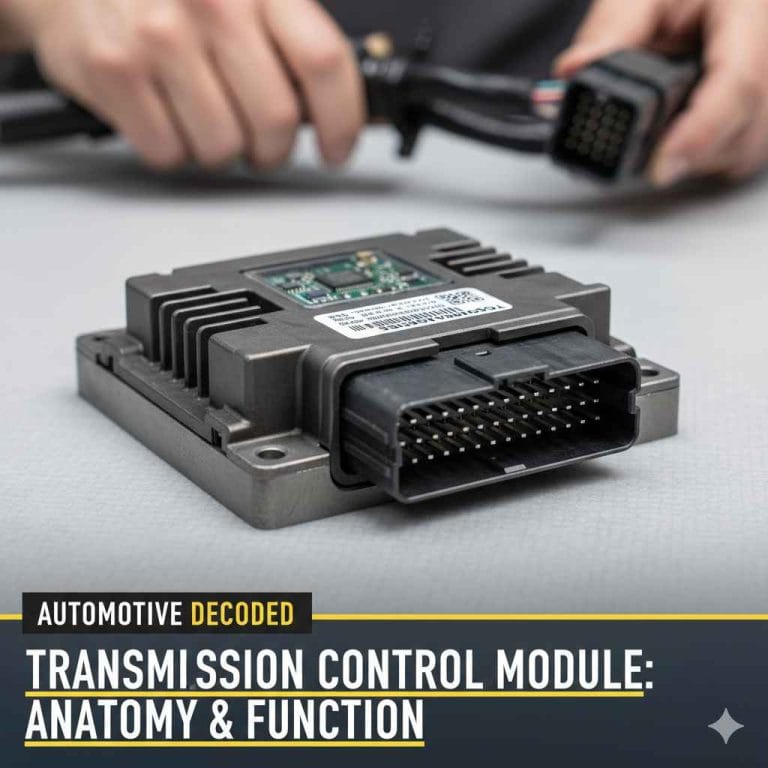
A Transmission Control Module (TCM) is the automatic-transmission computer that controls shift timing and solenoids. On many newer cars, that job sits inside a Powertrain Control Module (PCM), which is the engine-and-transmission computer. That difference changes the repair path before a single bolt comes out.
TCM basics: shift timing, solenoids, and fault control
The TCM watches sensor inputs, then commands line pressure, clutch apply timing, and shift behavior. When it fails, the car may slip, bang into gear, or drop into limp mode. A check-engine light with transmission codes is common, but those codes do not prove the module itself is dead.
How PCM-integrated systems change the repair bill
Many newer cars use a PCM that handles both engine and transmission. In those cases, replacing one control unit can mean replacing the whole module, then flashing it with vehicle-specific data. The part itself is only one piece of the cost; coding can matter more than the hardware.
Why the housing location matters for labor time
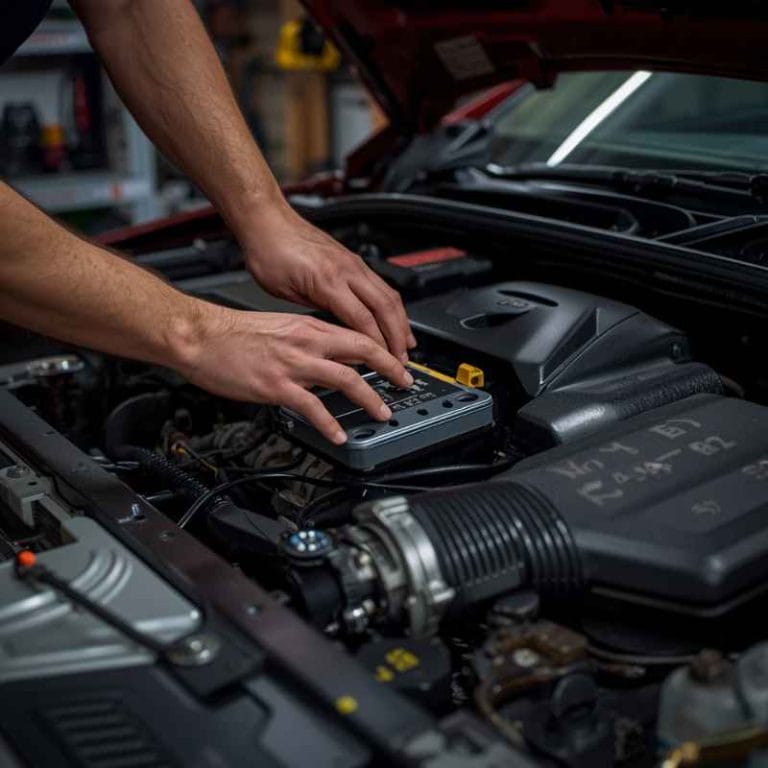
A TCM under a hood panel or behind a battery tray is quicker to swap than one buried under intake parts, battery hardware, or inside a transmission case. When the module sits inside the transmission assembly, the job can turn into fluid drain, pan removal, relearn, and post-repair adaptation work.
How much of the bill is part price versus programming?

The bill is often split three ways: module price, labor, and programming or flashing. For many vehicles, the part is not the whole story. An inexpensive module can still lead to a high total if the car needs dealer-level coding, security pairing, or a relearn procedure after installation.
OEM, aftermarket, remanufactured, and used price bands
OEM dealer TCM parts are estimated at $500 to $1,200+, and OEM TCM parts are estimated at $400 to $900+ in the other guide. Aftermarket/direct replacement TCMs are estimated at $250 to $500. Remanufactured or rebuilt TCMs are estimated at $300 to $700, while used or salvage-yard TCMs are estimated at $50 to $250.
There is also a narrower estimate for remanufactured/used with warranty at $150 to $350. That spread shows why quotes can look inconsistent. One shop may be pricing a dealer part. Another may be pricing a reman unit with a short warranty and preloaded programming.
Programming and flashing costs by vehicle type
Programming / flashing is frequently required after installation on many vehicles. It adds cost beyond part and labor, and it may require shop-level tools or dealer equipment. On simple domestic applications, flashing may be a modest line item. On European and luxury cars, it can be the line item that shifts the repair from affordable to painful.
Labor ranges for easy access versus buried modules
Labor stays lower when the module is external and easy to reach. Labor rises when the battery has to come out, the intake has to come apart, or the unit is built into the transmission package. A quote that looks high may be normal if access and programming are both involved.
Which car models cost the most to replace a TCM?
European and luxury cars tend to cost the most because they often need dealer coding, security pairing, or a control module that is not sold as a simple bolt-in part. Dealer-only modules on European or luxury cars can exceed $1,500. That is true even when the module itself is not physically hard to swap.
European and luxury models with dealer-only coding
BMW, Mercedes-Benz, Audi, Volkswagen, and similar platforms often ask for manufacturer-level software. The labor itself may not be extreme, but the programming step is. A shop can install the part quickly and still spend more time getting it accepted by the car than by removing the old module.
Trucks and SUVs with accessible modules versus integrated units
Some trucks and SUVs stay in the middle because the module is easy to reach, but the PCM still needs flashing. Others are higher because the control logic is tied to larger powertrain electronics. A Ram or Ford truck can look straightforward until the quote adds calibration and security programming.
Why some common platforms still cost more than expected
Common cars are not always cheap. A widespread platform can still require a matched module, software relearn, and a scan-tool procedure after installation. When the car refuses a junkyard unit or needs VIN coding, the bill stops tracking with the part price alone.
Which car models usually cost less?
Cheaper repairs usually show up on economy cars and older common platforms with a separate TCM and wide parts supply. When the module is common, used or reman parts are easier to find, and labor is usually more predictable. That is where the repair can stay near the lower end of the national range.
Economy cars with wide parts supply
Honda Civic, Toyota Camry, Hyundai Elantra, and similar cars often have better parts availability. If the module is separate and the car accepts an aftermarket or reman unit, the quote can stay near the middle of the range instead of jumping into dealer-only territory.
Common domestic models with separate modules
Some Chevrolet, Ford, and Jeep applications still use accessible modules on certain years and trims. Those are often the best candidates for a fair-priced repair, provided the codes point to the module and not to a sensor, harness, or voltage problem.
When an aftermarket or remanufactured part makes sense
Aftermarket TCMs are a better fit for common vehicles than rare models. Remanufactured units make sense when the car is older, the mileage is high, and the owner wants a lower spend without going straight to a used part with unknown history. For many drivers, that is the middle ground worth paying for.
What symptoms should make me confirm the TCM before paying for replacement?
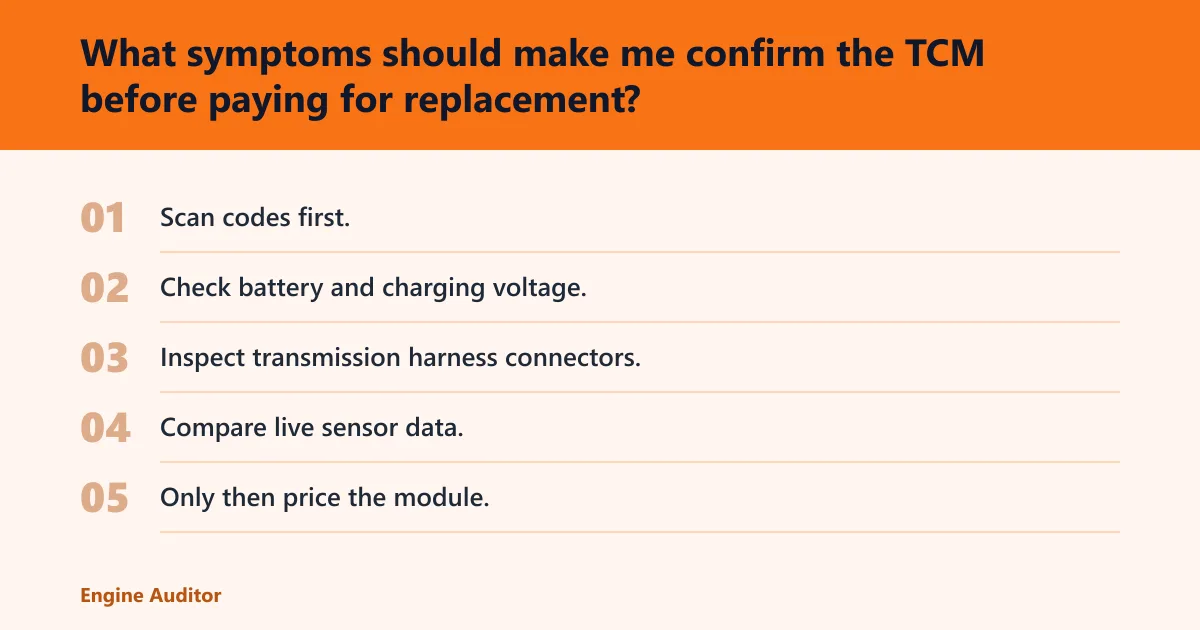
Harsh shifting, slipping, delayed engagement, limp mode, and a transmission warning light can point toward TCM trouble, but they do not prove it. A cheap first check with a diagnostic scan / OBD2 reader is worth it before any replacement. Many shift complaints come from wiring, voltage, or sensor faults instead.
Symptoms that point toward TCM failure
A module gets more suspicious when the symptoms are intermittent, gear changes are erratic, or the transmission behaves differently after a restart. If the car drives fine cold and then drops into fault mode hot, the diagnosis still has to be tested, not assumed.
Codes and scan data that matter
Code history matters more than the dash light alone. Look for transmission-specific fault codes, gear-ratio errors, communication faults, and voltage-related codes. If the scan data shows sensor disagreement, line-pressure oddities, or communication loss, the TCM may be blamed when another fault started the chain.
Wiring, battery voltage, and sensor faults that mimic a bad module
Low battery voltage, corroded grounds, damaged harnesses, and bad range or speed sensors can all look like a failed module. A shop that skips this step may quote a TCM when the car really needs electrical repair first. That is the most common way the bill gets inflated by misdiagnosis.
- Scan codes first.
- Check battery and charging voltage.
- Inspect transmission harness connectors.
- Compare live sensor data.
- Only then price the module.
When should a PCM be replaced instead of a separate TCM?
A PCM gets replaced instead of a separate TCM when the car uses one integrated engine-and-transmission controller or when the transmission logic is built into a combined module. That is common in newer cars. The repair is normal for the platform, but it often looks expensive because one module handles more than one job.
Vehicles with integrated engine and transmission control
Many newer cars use a PCM that handles both engine and transmission. In those cases, a separate TCM may not exist at all. If the quote is for a PCM, the owner should expect higher parts cost, coding steps, and a longer relearn after installation.
What that changes for parts and labor
Integrated systems reduce parts flexibility. A used module may need pairing, and a reman unit may need professional setup. Labor can also include adaptation runs and verification drive cycles. The shop is not padding the job if those steps are required by the vehicle architecture.
Why some quotes look high even when the repair is normal
A high quote is not always inflated. If the car needs dealer flashing, immobilizer pairing, and a drive-cycle relearn, the number can rise for legitimate reasons. The better question is whether every listed step matches the car’s actual control system, not whether the total sounds high at first glance.
Do European or luxury cars cost more for TCM replacement?
Yes. European and luxury cars often cost more because the modules are pricier, the coding is tighter, and dealer-only software is more common. Dealer-only modules on European or luxury cars can exceed $1,500. The work may be ordinary, but the software gate is not.
Why dealer programming pushes the quote up
These cars often need factory-level programming after installation. That can mean higher diagnostic time, subscription access, or a shop that can only complete the job through the dealer. The part price is only part of the pain.
Why a cheaper used module can backfire here
Used modules are the lowest upfront price, but history is unknown and warranty is often short or absent. On higher-end cars, a used module may not accept the right coding, may carry mismatched software, or may leave the car stuck until the correct unit is sourced. Cheap can turn expensive fast.
Frequently asked questions
How much does transmission control module replacement cost by car model?
For many common cars, the job lands around $500 to $1,200. Simpler economy models can come in lower, while luxury imports and dealer-programmed systems can go higher. The biggest swing usually comes from whether the module is separate, integrated into a PCM, or tied to dealer-only coding.
Is a transmission control module part price different from programming cost?
Yes. The part price and programming cost are separate charges on many vehicles. A module may be affordable on its own, then the final bill rises because the car needs flashing, VIN coding, or a relearn procedure. That is why one quote can look cheap until the labor line is added.
Can a used or remanufactured TCM save money?
Yes, especially on older or common cars. Remanufactured or rebuilt TCMs are estimated at $300 to $700, and used or salvage-yard TCMs are estimated at $50 to $250. The tradeoff is fitment risk, coding issues, and weak warranty coverage, so the savings are not automatic.
What symptoms should make me confirm the TCM before paying for replacement?
Harsh shifting, slipping, limp mode, delayed engagement, and a transmission warning light are the main clues, but they are not proof. A scan with an OBD2 reader can separate module faults from wiring, voltage, or sensor problems. That first check is cheap compared with an unnecessary module swap.
When does a PCM get replaced instead of a separate TCM?
A PCM gets replaced when the car’s transmission control is built into the engine controller or when the platform does not use a stand-alone TCM. Many newer cars use a PCM that handles both engine and transmission. That setup raises the programming burden and can make the repair cost look higher.
How much of the bill is labor versus the module itself?
On easy-access cars, the module often drives most of the bill. On integrated or dealer-coded systems, programming and labor can rival the part price. A quote is worth checking line by line if the shop charges heavily for scan time, flashing, or relearn steps that the car may not actually need.
Products related to this article
Sponsored / affiliate links. As an Amazon Associate I earn from qualifying purchases. I may earn additional commission from eligible campaigns.