Transmission control module failure vs bad trans symptoms
Use a 3-part rule: multiple electrical or communication codes, erratic shifting that changes with voltage, and a clean fluid sample point more toward TCM or wiring; hard slipping, burned fluid, metal, or no-move in every gear point toward internal transmission damage. Guessing wrong burns time and money on parts that do nothing, and can let a failing unit eat itself. This guide gives a symptom-by-symptom decision tree, likely fault paths, and the first tests to run.
This guide is part of our Transmission control module basics series.
| Decision factor | Transmission control module failure symptoms | Bad transmission symptoms | Winner |
|---|---|---|---|
| What is failing | Controller, communication, sensor input, or power supply | Mechanical and hydraulic parts inside the automatic transmission | Tie |
| Typical clue | Intermittent or erratic shifts, limp mode, code-heavy faults | Slipping, harsh engagement, refusal to shift, debris, burnt fluid | Tie |
| First test | OBD2 scan, battery voltage, wiring and connector inspection | Fluid level, condition, leak check, then pressure or pan inspection | Tie |
| Repair risk if guessed wrong | High if a controller is replaced before checking power and wiring | High if the gearbox is opened when the fault is electrical | Tie |
| Best fit use case | Codes, limp mode, and symptoms that change with electrical faults | Stable slipping, burnt fluid, leak, metal, or no movement under load | Tie |
Transmission control module vs transmission failure: what each one does


What the transmission control module controls
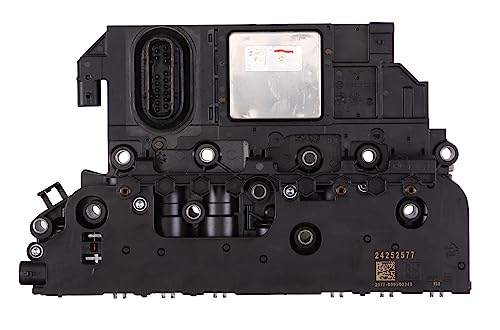
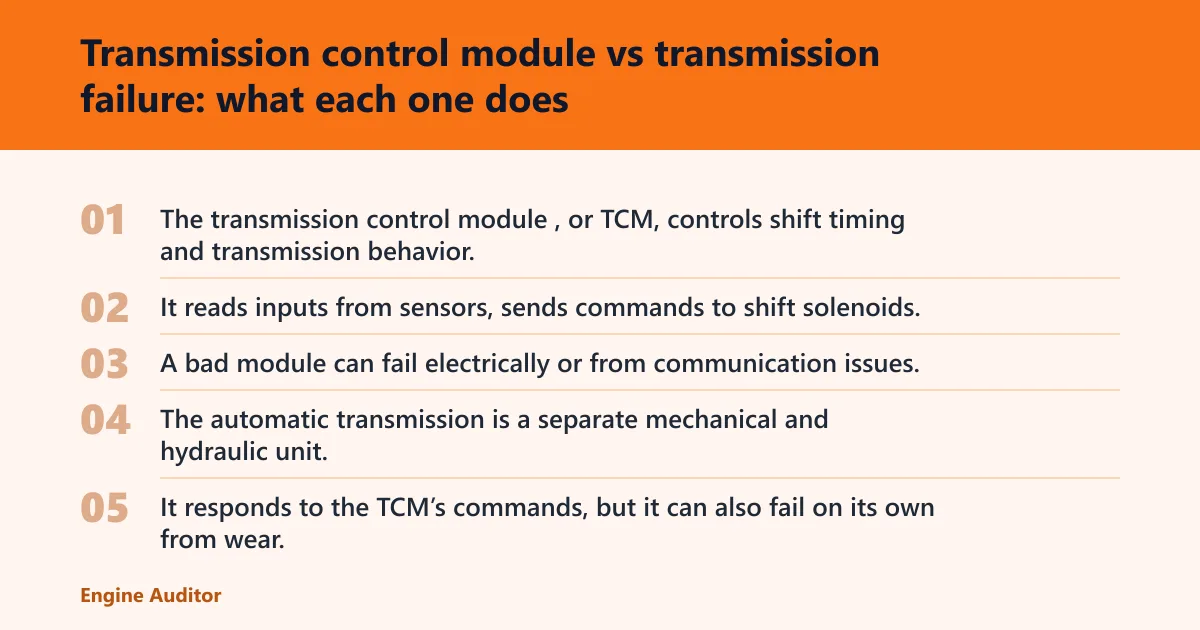
The transmission control module, or TCM, controls shift timing and transmission behavior. It reads inputs from sensors, sends commands to shift solenoids, and may put the car into limp mode when it sees a fault it cannot trust. A bad module can fail electrically or from communication issues.
How the automatic transmission responds to control commands
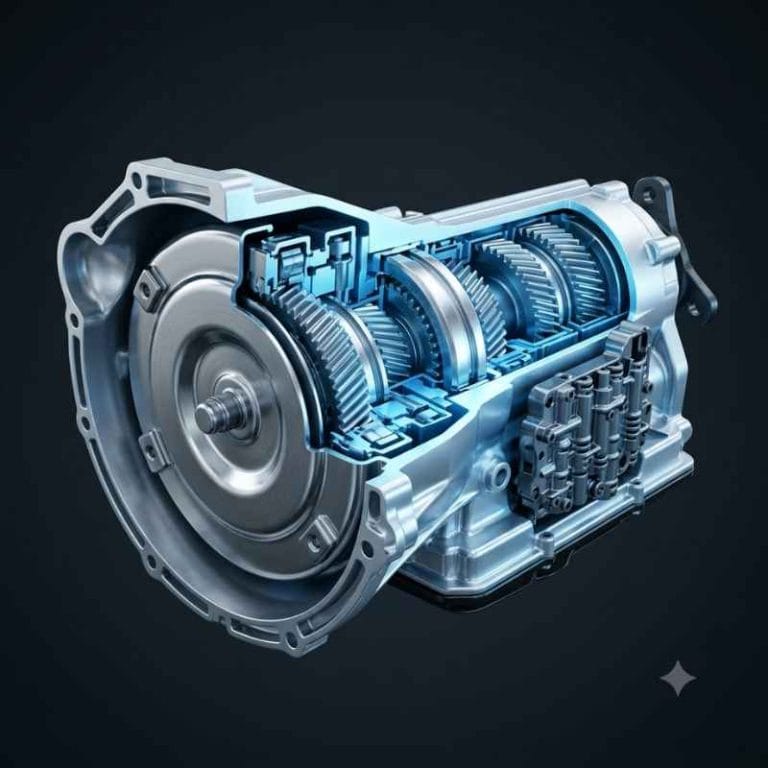
The automatic transmission is a separate mechanical and hydraulic unit. It responds to the TCM’s commands, but it can also fail on its own from wear, fluid problems, or valve body trouble. Many passenger cars use several forward gear ratios, and a large share of new cars in the US use automatic transmissions.
Why controller faults and gearbox faults overlap
Overlap is the trap. Both a bad TCM and a bad transmission can cause harsh shifting, and a warning light by itself does not tell you which part failed. Slipping gears alone do not identify the failed part either.
Which symptoms point more toward a bad TCM?
Symptoms that point more toward a bad TCM are limp mode, intermittent shifting problems that come and go, and erratic shift timing without obvious slip or flare. A warning light with communication or sensor-related codes also leans electronic, especially when fluid looks normal and the fault changes with voltage or key cycles.
Stuck in limp mode
Limp mode is a fail-safe that can limit available gears and reduce power. It can be caused by the module, a sensor, wiring, or a transmission fault, but when the car suddenly locks into one gear and the codes point to communication or control faults, the TCM branch moves up the list fast.
Intermittent shifting problems that come and go
An intermittent fault that disappears after a restart, bump, or battery disconnect can point to the control side. Loose pins, corrosion, internal module faults, or weak supply voltage can make a healthy transmission look bad for minutes at a time.
Erratic shift timing without obvious slip or flare
If the shift points wander, the gear changes feel random, and the engine speed does not flare like a slipping clutch pack, the TCM, sensor inputs, or wiring deserve first attention. That pattern fits confused control logic, not a gearbox that is already destroyed.
Warning light with communication or sensor-related codes
The transmission warning light often accompanies stored codes or failsafe operation, but it is not specific enough to identify the failed part. Codes that mention communication loss, invalid sensor data, or power supply faults are more useful than the lamp itself.
Which symptoms point more toward a bad transmission?
Symptoms that point more toward a bad transmission are slipping under load, harsh engagement or bang shifts, refusal to change gears, and burnt fluid, leaks, or debris in the pan. The likely diagnosis for stubborn gears can be low transmission fluid or the wrong kind of fluid, so fluid checks come before teardown.
Slipping under load
Slipping under acceleration, on hills, or while towing usually means the transmission cannot hold torque. That can happen from internal wear, low fluid, or a valve body problem, but it is a stronger mechanical warning than a simple controller fault.
Harsh engagement or bang shifts
Hard engagement can come from TCM commands, a stuck solenoid, or line pressure control trouble, but repeated banging shifts with burnt fluid or debris push the diagnosis toward internal hydraulic damage. Transmission warning signs can include shaking and jerking, and those symptoms are never safe to ignore.
Refusal to change gears
A bad transmission can cause gears that don’t switch. If the scan tool shows the TCM is commanding shifts but the unit stays in one gear or misses a gear repeatedly, the valve body, solenoid pack, or internal wear becomes more likely than a lone module failure.
Burnt fluid, leaks, or debris in the pan
Leaking transmission fluid is a warning sign of transmission trouble. Fresh transmission fluid may appear red or pink, while old transmission fluid may appear dark brown or black. Burnt smell, dark color, and metal or clutch debris point away from the controller and toward damage inside the automatic transmission. (wikihow.com)
Can a bad TCM cause slipping or harsh shifting?
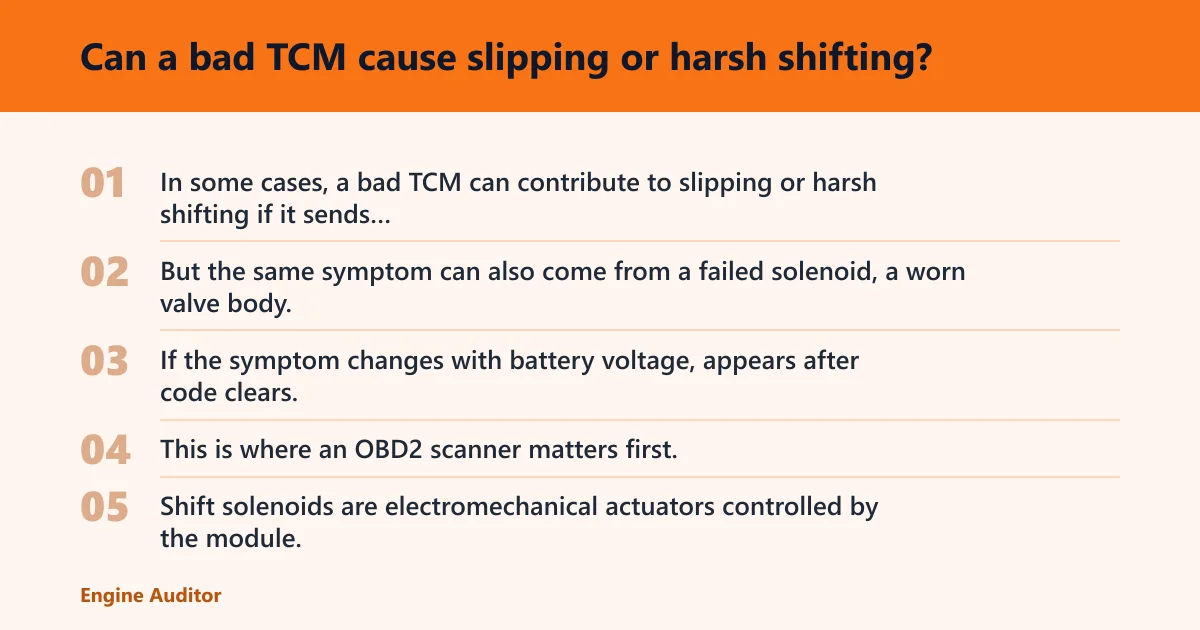
Yes. In some cases, a bad TCM can contribute to slipping or harsh shifting if it sends incorrect commands, loses sensor input, or loses communication with the transmission. But the same symptom can also come from a failed solenoid, a worn valve body, or an already damaged gearbox, so the symptom alone is not proof.
When the controller is the root cause
If the symptom changes with battery voltage, appears after code clears, or comes with communication faults, the controller side is a stronger suspect. This is where an OBD2 scanner matters first, because it turns a vague complaint into a fault path.
When the symptom is really a solenoid or valve body issue
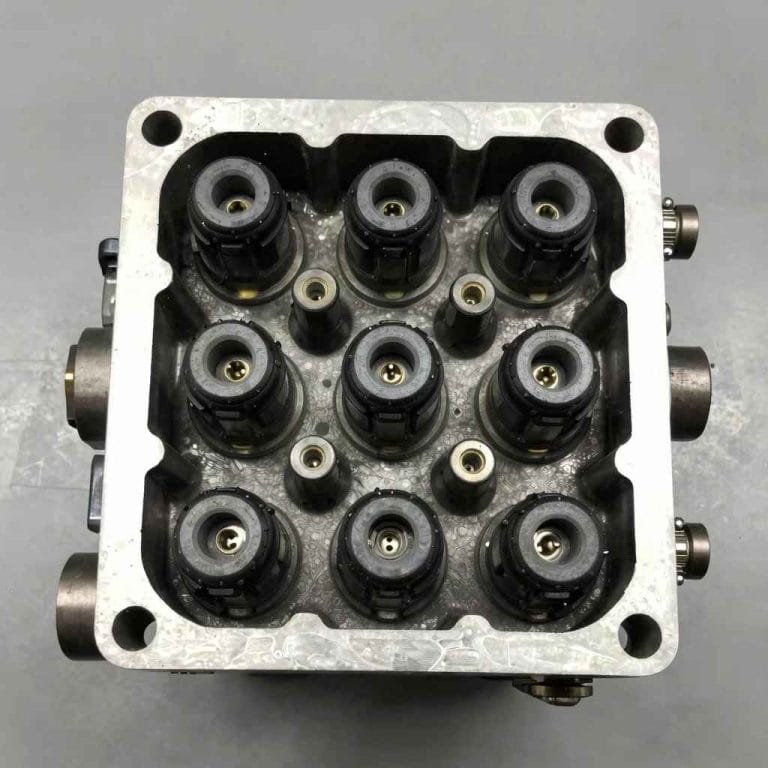
Shift solenoids are electromechanical actuators controlled by the module. A stuck or failed solenoid can look exactly like TCM failure. The valve body can also mimic control faults because it routes hydraulic pressure and shift timing inside many automatics.
When the transmission itself is already damaged
If the fluid is burnt, the pan has debris, and the unit slips in every drive range, the problem is usually beyond the controller. At that point, replacing the TCM will not stop clutch wear, seal leakage, or hydraulic loss.
The diagnosis matrix: symptom, likely cause, confidence, first test
| Row | Symptom pattern | Likely cause | Confidence | First test |
|---|---|---|---|---|
| TCM | Limp mode, erratic timing, codes for control or communication | Failed module, bad software logic, lost sensor input | Medium to high | OBD2 scan for transmission-related codes, then battery voltage check |
| Wiring and connectors | Intermittent fault, warning light, symptoms that change with bumps or weather | Corrosion, loose pins, damaged wiring, poor ground, power loss | High | Inspect connectors and wiring, wiggle test, check supply and ground |
| Shift solenoid | Wrong shift, harsh shift, stuck gear, code for a specific solenoid circuit | Solenoid stuck open or closed, electrical failure, varnish buildup | Medium | Scan live data and command test, then resistance or activation test |
| Valve body | Delayed shifts, flare, harsh engagement, repeat shift complaints after warm-up | Sticky valves, worn bores, hydraulic cross-leak, pressure loss | Medium | Check fluid condition, then line-pressure or pan inspection |
| Fluid | Slip, stumble, stubborn gears, noise after leak or service | Low level, wrong type, burnt fluid, aeration, leak | High | Check level, smell, color, and leak points first |
| Internal wear | Slip under load, no-move in multiple ranges, burnt smell, metal debris | Clutch wear, band failure, pump wear, seal failure, hard part damage | High | Pan inspection, pressure test, then teardown decision |
What to check before replacing the TCM
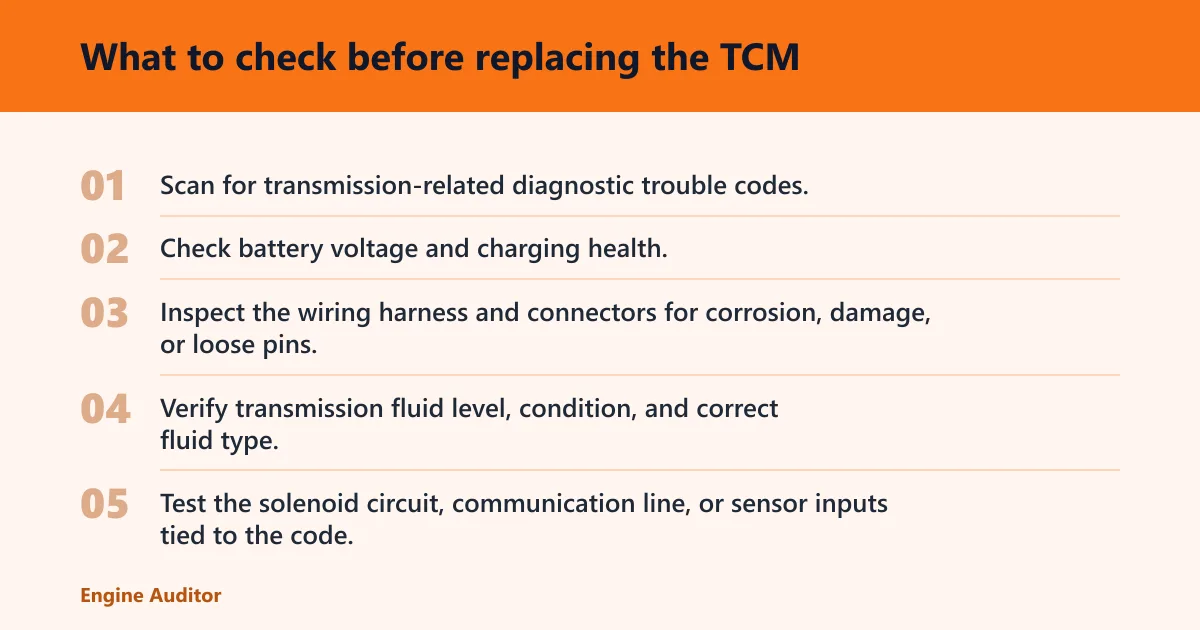
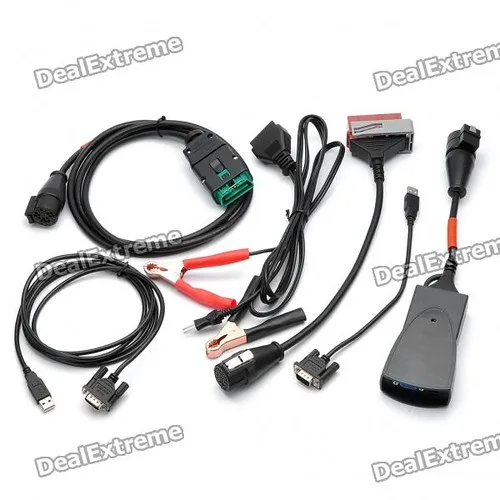
Before replacing the TCM, read transmission codes with an OBD2 scanner, inspect battery voltage and charging health, check wiring and connectors, verify fluid level, condition, and type, and test likely solenoid or communication faults first. A controller should be the conclusion, not the starting assumption.
- Scan for transmission-related diagnostic trouble codes.
- Check battery voltage and charging health.
- Inspect the wiring harness and connectors for corrosion, damage, or loose pins.
- Verify transmission fluid level, condition, and correct fluid type.
- Test the solenoid circuit, communication line, or sensor inputs tied to the code.
- Only then consider module replacement.
Read transmission codes with an OBD2 scanner
An OBD2 scanner is often the first practical diagnostic tool. It separates a generic warning light from actual data and lets the diagnosis branch toward module, wiring, solenoid, valve body, fluid, or internal wear.
Inspect battery voltage and charging health
Low voltage can create false positives. A weak battery or charging problem can make a healthy transmission act haunted, especially when the fault appears after starting or during low-speed operation.
Check wiring harness and connectors
Wiring and connectors matter because corrosion, damaged insulation, or loose pins can create communication errors. This is one of the most common reasons a controller looks guilty when it is not.
Verify fluid level, condition, and type
Low fluid, burnt fluid, leaking fluid, or the wrong fluid type can mimic module symptoms. For stubborn gears, low transmission fluid or the wrong kind of fluid is often the first mechanical explanation to rule out.
Test likely solenoid or communication faults first
If the code names a specific solenoid or circuit, test that circuit before buying a module. The same applies to communication faults; a broken wire can cost less than a controller and is more likely than a failed transmission.
Should you keep driving if the car is in limp mode?
Limited driving in limp mode is risky when the car cannot hold normal speed, cannot shift out of one gear, or shows heat, slip, or noise. Stop and tow it if the car loses drive, starts jerking badly, or the fluid is burnt or leaking, because limp mode is trying to protect the unit from further damage.
When limited driving is risky
If the car can barely move, shifts are violent, or the warning light returns immediately after a restart, the safest choice is to stop. Limp mode is a failsafe, not permission to keep driving until the problem gets worse.
When to stop and tow it
Tow it if there is no movement in several gears, the fluid looks dark or burnt, or the transmission slips badly enough that engine speed rises without the vehicle speed following. Those signs point more toward damage than a temporary control fault.
What limp mode is trying to protect
Limp mode limits gears and power to reduce heat and prevent further clutch, band, or hydraulic damage. It can be triggered by the module, sensor, wiring, solenoid, or gearbox fault, so it is a warning state, not a diagnosis.
How much does it cost to diagnose a TCM versus a transmission problem?
Diagnostic cost is usually lower for a TCM path because the first pass is scan data, voltage checks, and wiring inspection. Transmission diagnosis costs more when the fault requires fluid inspection, pressure testing, pan removal, or teardown, especially if the unit has slip, debris, or no-move symptoms.
Basic scan and inspection cost range
A basic scan and inspection is the cheapest step because it focuses on codes, connector condition, and visible fluid issues. That is the right first move when the fault looks electrical or intermittent.
Electrical diagnosis cost range
Electrical diagnosis costs more when the fault needs wiring repair, circuit tracing, or live-data verification. It is still usually far cheaper than opening a transmission, and it often prevents an unnecessary controller purchase.
Transmission teardown or rebuild cost range
Teardown or rebuild work is the expensive branch because it involves internal inspection and hard-part repair. That path is justified when the unit slips hard, leaves debris, or refuses to move despite correct voltage, correct fluid, and no convincing control-side fault.
Verdict: Transmission control module failure symptoms or bad transmission symptoms?
Choose Transmission control module failure symptoms if the article’s concrete use case matches codes, limp mode, and symptoms that change with electrical faults, like erratic shifting that comes and goes after a restart or when battery voltage changes.
Choose bad transmission symptoms if the article’s concrete use case matches stable slipping under load, burnt fluid, debris or metal in the pan, or a unit that refuses to move in every gear range.
Frequently asked questions
How do I tell if my transmission control module is bad or my transmission is failing?
Use the code pattern, fluid condition, and symptom behavior. Multiple electrical or communication codes, limp mode, and erratic shifting that changes with voltage point toward control-side trouble. Hard slip, burnt fluid, debris, and no movement in every gear point more toward internal transmission damage.
What are the symptoms of a bad transmission control module?
Common signs include limp mode, delayed or erratic shifts, random gear behavior, and a warning light with communication-related codes. The key clue is inconsistency: the problem may appear, disappear, and return with key cycles, bumps, or voltage changes.
What are the symptoms of a bad transmission?
A bad transmission often slips, bangs into gear, refuses to change gears, or leaks fluid. Burnt or dark fluid, metal in the pan, and shaking or jerking make internal damage more likely than a simple controller fault.
Can a bad TCM cause slipping or harsh shifting?
Yes, a bad TCM can command the wrong shift timing or lose correct pressure control signals. That said, the same symptom can come from a solenoid, valve body, or worn clutch pack, so the shift feel alone cannot close the case.
Can low fluid cause the same symptoms as a bad module?
Yes. Low fluid can cause slipping, harsh shifts, delayed engagement, and even limp mode if the transmission cannot build stable hydraulic pressure. Leaks, wrong fluid type, and burnt fluid should be checked before the TCM is replaced.
What codes point to a transmission control module problem?
Codes that point toward TCM trouble often involve communication loss, internal controller faults, sensor plausibility, or power supply issues. The exact code matters more than the warning lamp, because the lamp only tells you the system has stored a fault.
Products related to this article
Sponsored / affiliate links. As an Amazon Associate I earn from qualifying purchases. I may earn additional commission from eligible campaigns.