Transmission Control Module Reset: When It Works
A transmission control module reset is worth trying once if the symptoms are shift flare, harsh shifts, or wrong shift timing after a battery disconnect, but it will not fix slipping, burned fluid, or codes that return immediately. A bad reset can waste time and hide a failing solenoid, wiring fault, or valve-body issue. This guide shows what a reset can change, what it cannot, and what to check before and after you clear learned data.
What a TCM reset can change
The transmission control module controls shift timing, shift feel, and module-to-module communication. It may store adaptive shift data that changes how the transmission applies clutches over time. A reset clears some of that learned behavior. It does not repair damaged wiring, a failed sensor, a sticking solenoid, or a worn valve body.
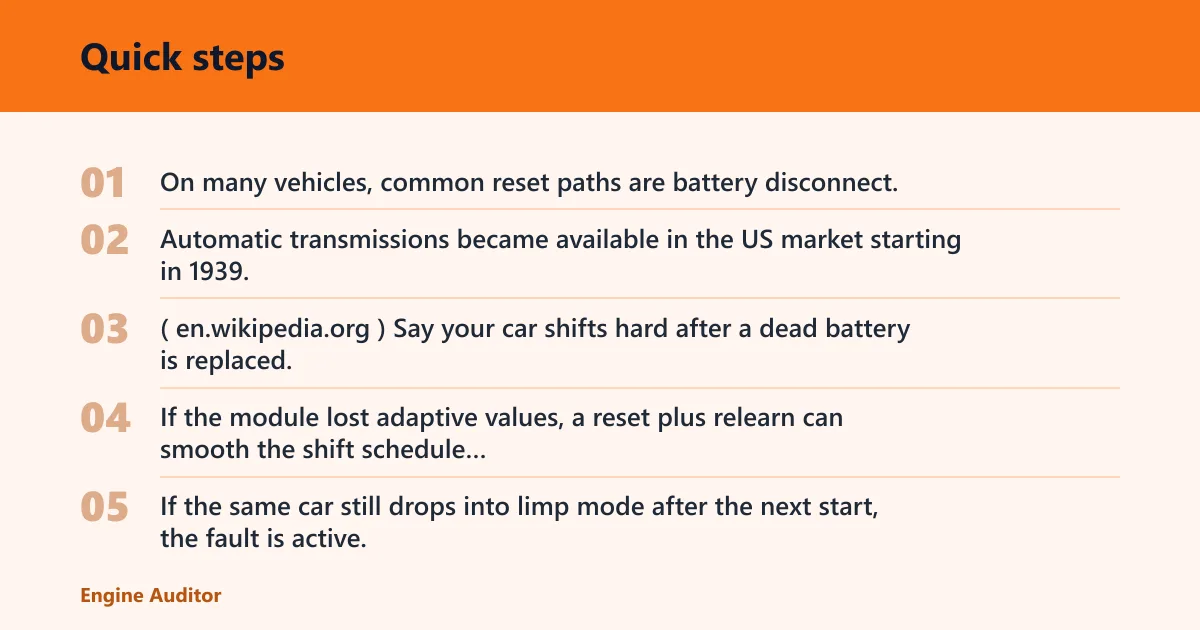
On many vehicles, common reset paths are battery disconnect, code clearing with an OBD2 scanner, or a built-in scan-tool function. Which one works depends on the design. Automatic transmissions became available in the US market starting in 1939, and most passenger cars now use transmissions with 4–10 forward gear ratios, so the number of shift events a relearn needs can vary a lot. (Wikipedia)
Say your car shifts hard after a dead battery is replaced. If the module lost adaptive values, a reset plus relearn can smooth the shift schedule again. If the same car still drops into limp mode after the next start, the fault is active, not stored memory.
What battery disconnect or code clearing actually removes
Battery disconnect can erase learned values on some vehicles, though vehicles do not all treat it the same way. Clearing codes with an OBD2 scanner removes stored fault codes from memory, but it does not repair the underlying cause. If the fault is still present, the code usually comes back as soon as the module runs its checks again.
Why a reset can help after voltage loss or repairs
Low battery voltage, a jump-start, battery replacement, or some repair jobs can leave the TCM with stale adaptation. If the transmission itself is healthy, the module may simply be reacting to old learned pressure and timing values. A reset can give the TCM a clean starting point so it can relearn normal shift behavior.
📊 Automatic transmissions became available in the US market starting in 1939. Source: Transmission (mechanical device).
When a reset is worth trying
A reset is worth trying when the problem looks like bad adaptation, not a hard electrical or mechanical fault. That means the transmission shifts oddly after a voltage event, but the fluid level is correct, the battery system is healthy, and codes do not point to a failed circuit or a missing signal. The symptom should improve during relearn, not return at once.
Symptoms that fit adaptive-memory problems
Harsh upshifts, a flare between gears, delayed engagement after selecting Drive, or odd shift timing after battery service can fit adaptive memory loss. The key clue is that the problem may be inconsistent and may improve over a few miles. If the behavior changes with each drive cycle, relearn is more plausible than a failed hard part.
Battery replacement, jump-starts, and low-voltage events
Battery voltage matters before any reset attempt. Low voltage can mimic module faults, and battery disconnect may erase learned values. If the charging system is weak, the reset can fail or the symptom can return right away. Use a charger or a known-stable power supply first, then clear codes and watch live data with a scanner if possible.
Harsh shifts, flare, or delayed shifts with no hard fault
When harsh shifting appears with no obvious hard code, a reset is a reasonable first branch. Do not confuse “no code shown on the dash” with no fault stored in the TCM. An OBD2 scanner can read transmission-related codes and live data that help separate adaptive issues from a circuit problem.
Transmission control module reset decision table
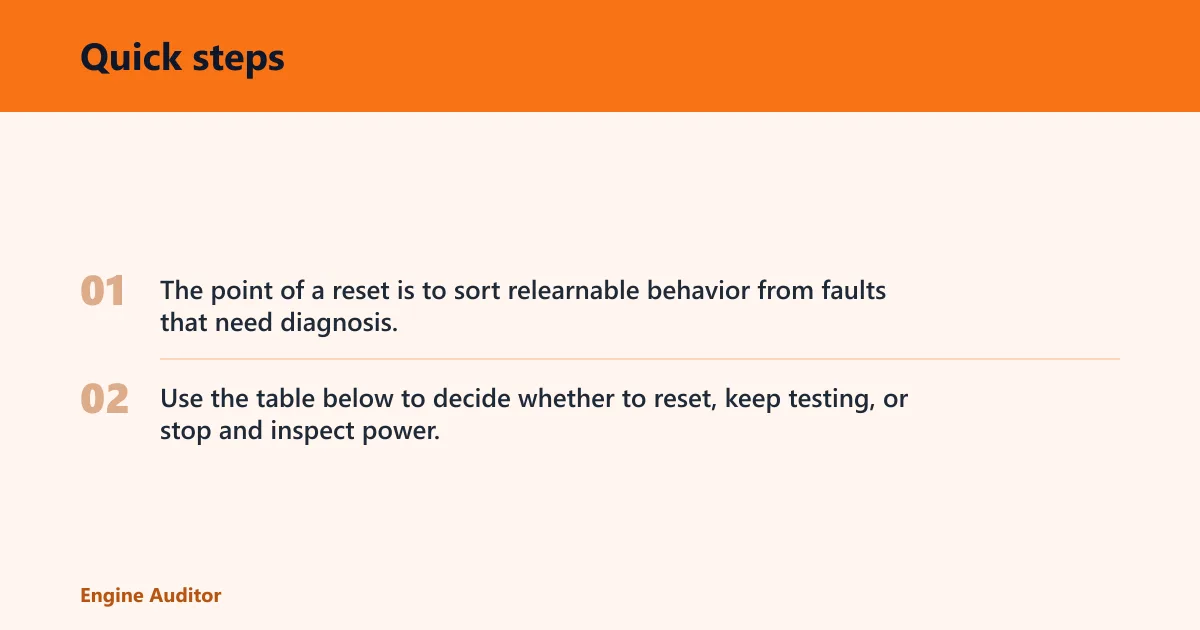
The point of a reset is to sort relearnable behavior from faults that need diagnosis. Use the table below to decide whether to reset, keep testing, or stop and inspect power, wiring, or the transmission hardware.
| Symptom | Likely cause | Reset success odds | Next test | Stop point |
|---|---|---|---|---|
| Limp mode after battery replacement | Lost adaptation or low-voltage event | Medium to high | Check battery voltage, clear codes, drive relearn | Stop if limp mode returns on first key cycle |
| Harsh shifting with no codes | Adaptive data out of range | Medium | Reset, then verify shift quality over several drive cycles | Stop if the same gear change remains harsh |
| No-communication fault | Power, ground, network, or module failure | Low | Check fuse, grounds, connector pins, scan tool communication | Stop before module replacement if power or ground is missing |
| Intermittent shift flare | Adaptation issue or slipping clutch pack | Low to medium | Read live data and monitor slip-related codes | Stop if flare repeats under the same load |
| Delayed engagement into Drive | Low line pressure, valve body, or learned data | Low to medium | Inspect fluid condition and scan for pressure codes | Stop if delay lasts more than one or two cycles |
| Repeated fuse blow | Shorted solenoid, wiring rub-through, or module short | Very low | Find the short before any reset | Stop immediately; do not keep replacing fuses |
| Voltage drop while cranking | Weak battery or charging fault | Medium | Load-test battery and check charging output | Stop until system voltage is stable |
| Communication code with other modules | Network fault, power issue, or poor ground | Low | Inspect wiring and connector corrosion | Stop if the code returns right away |
| Post-repair adaptation issue | TCM needs relearn after service | High | Run the vehicle-specific relearn | Stop if the relearn does not complete |
| Transmission fault after jump-start | Voltage spike or erased learn values | Medium | Clear codes, inspect battery health, relearn | Stop if electrical codes persist |
How do you reset a transmission control module?
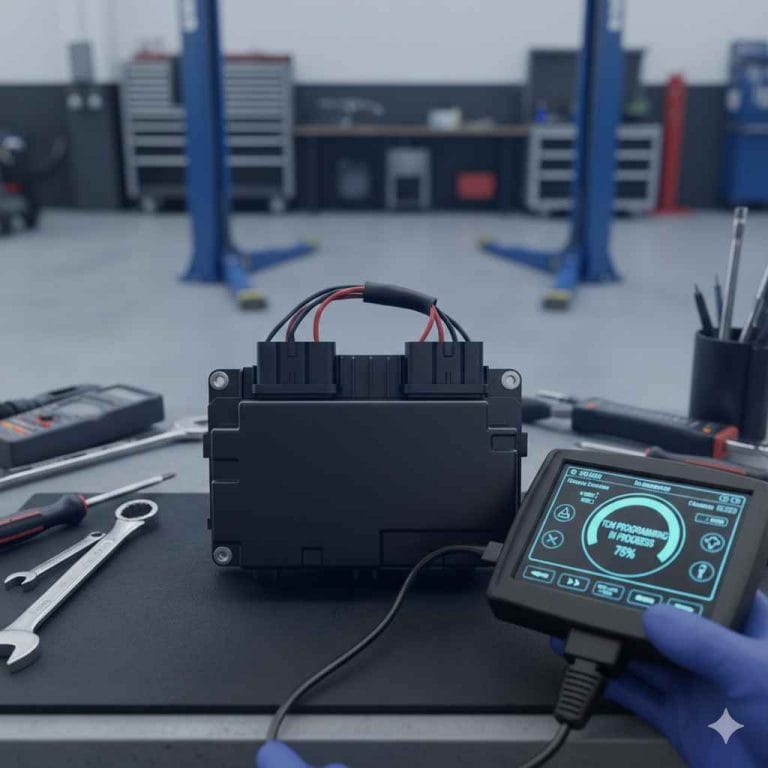
You usually reset a TCM by disconnecting battery power, clearing codes with an OBD2 scanner, or using a scan-tool function that commands a reset or adaptation clear. The correct method depends on the vehicle. After the reset, some vehicles need a relearn drive cycle, and some need a scan-tool procedure before shifting returns to normal.
Battery disconnect method
- Save radio and security settings if the vehicle needs them.
- Turn the ignition off and follow the maker’s battery disconnect procedure.
- Wait long enough for retained power to drain, if the vehicle allows that method.
- Reconnect the battery, then start the engine and check for warning lights.
- Road test only after confirming charging voltage and no active electrical fault.
Do not assume battery disconnect is enough. Some cars keep learned values in nonvolatile memory, and some transmit reset data only through a scan tool. A reset that does nothing is a clue, not a failure of the method.
OBD2 scanner code clearing
An OBD2 scanner reads transmission-related codes, clears fault codes, and can show live data before and after a reset. That matters because a code clear is useful only if the fault is gone. If live data still shows an implausible sensor value, a missing range signal, or a pressure control issue, the reset will not cure it.
Vehicle-specific relearn steps after reset
Many vehicles need a relearn after the TCM memory is cleared. That may be a simple drive cycle or a scan-tool adaptation routine. Expect a few miles or multiple shift events before judging the result. A reset that seems weak on the first trip can still be working if the transmission is in the relearn window.
What should you check before resetting?
Check battery voltage, charging output, fuses, grounds, and codes before you clear anything. A weak power supply can imitate a bad module. A blown transmission fuse, loose ground, or corroded connector can block communication and make a reset appear ineffective. If you clear first, you can erase the clue that points to the real fault.
Battery voltage and charging system checks
Battery voltage should be stable before a reset attempt. If the battery is weak or the alternator output is poor, the TCM may fail again the moment the engine starts. That is why a charging-system check comes first. If the voltage is unstable, fix that before chasing learned data.
Transmission fuses, grounds, and connector condition
Inspect the transmission fuse and related grounds before any module diagnosis. Power or ground loss can look like a bad TCM. Harness damage can prevent a reset from working at all. Connector corrosion, spread terminals, and rubbed-through wiring are common reasons a code keeps returning after a clear.
Read live data and stored codes before clearing anything
Use the scanner to read stored and pending transmission control codes first. Some codes point to hard faults, not learned-data problems. A range sensor code, solenoid circuit code, or communication code changes the plan immediately. If the same code returns at once after clearing, the reset was not the fix.
When won’t a TCM reset work?
A TCM reset will not work when the fault is hard and active. That includes limp mode that returns immediately, no-communication faults, missing power or ground, and hardware problems in the solenoids or valve body. It also will not help if the transmission is slipping or the fluid is burned. Those are not adaptive-data problems.
Limp mode that returns right away
Transmission limp mode often limits gears after a fault, and it can be triggered by communication or sensor issues. If limp mode returns on the next key cycle, the underlying cause may still be present. A reset may clear the warning for a moment, but the module sees the same fault again and re-enters protection.
No-communication faults and power or ground loss
No-communication faults usually mean the module is not powered, not grounded, or cannot talk on the network. In that case, a reset is the wrong branch. Check the fuse, ground path, and connector pins first. Replacing the TCM before confirming power and ground risks buying a part that cannot communicate for the same reason.
Sensor, solenoid, and valve body faults that mimic module failure
Transmission solenoids and valve body faults can look like a bad module because the symptoms overlap. So can a faulty speed sensor or pressure sensor. If shift problems stay the same after a reset, the next step is not another reset. It is electrical testing of the circuit and mechanical testing of the transmission controls.
Do you need a relearn or programming after reset?
Many vehicles need a relearn after reset, and replacement modules often need programming or coding. A reset clears adaptive data; programming sets the replacement module to the vehicle. If the wrong software, calibration, or coding is loaded, the car may still shift badly even though the module is new.
When adaptation is required
Adaptation is required after battery disconnect on some vehicles, after a TCM reset, and after certain transmission repairs. The relearn may involve a specific drive route, throttle positions, or repeated shifts. Do not judge the repair after one short block. Give the module enough shift events to rebuild its learned values.
When replacement modules need coding or programming
Do transmission control modules need programming after replacement? Often, yes. Many replacement modules need coding, calibration, or software setup so they match the vehicle’s engine, transmission, and options. A plain swap without coding can leave the car in limp mode or create new shift faults that a reset cannot solve.
How long to drive before judging the result
A few miles may not be enough. A useful check is to watch whether the same shift fault repeats over multiple warm-up and gear-change events. If the complaint fades, the reset may have helped. If the complaint returns during the same drive, the underlying fault still needs diagnosis.
Why does my car still shift badly after a reset?

If the car still shifts badly after a reset, the symptom usually points to a real fault that the reset could not hide for long. Common causes include a bad sensor, a shorted solenoid, low system voltage, wiring damage, or valve-body wear. The next step is diagnosis, not repeated clearing.
What returning symptoms usually mean
Returning symptoms mean the TCM is seeing the same failed input or output again. If the transmission slips, bangs into gear, or drops into limp mode right after relearn, the issue is not old memory. That is the module responding to a current problem.
Next diagnostic tests after a failed reset
Start with a fresh code scan, then check battery voltage, charging output, fuses, grounds, and connector condition. Review live data for sensor plausibility and solenoid commands. If the codes suggest internal transmission control issues, inspect the solenoids and valve body before replacing the TCM.
Do not confuse “reset” with “repaired.” There is a file-sharing app named Transmission that says it is a free BitTorrent client for multiple operating systems, emphasizes low resource use, and lists Windows 10 or later for one installer package and macOS 11.0 or later for its Apple Silicon native build. That is a software name, not a transmission module fix. It matters only so the search term does not send you to the wrong place.
Frequently, the stop point is simple: if the same fault returns immediately, stop resetting and move to a deeper diagnosis. A TCM can fail electronically, but it can also appear bad because it cannot communicate through a power, ground, or network problem. Clear codes only after you know what they mean.
Frequently asked questions
When does a TCM reset actually fix shifting problems?
A reset helps when the problem comes from lost adaptive data, usually after a battery disconnect, jump-start, or transmission repair. It can also help when shift timing drifted over time. It will not help a slipping transmission, burned fluid, repeated fuse failure, or any code that comes back immediately.
Do I need to disconnect the battery to reset the TCM?
Not always. Battery disconnect is one common reset method, but some vehicles keep learned data in memory and require a scan tool or a specific relearn procedure. If you do disconnect the battery, make sure the charging system is healthy first so you do not repeat the same voltage problem.
Will clearing codes reset the transmission control module?
Clearing codes can erase stored fault codes and, on some vehicles, may clear some learned values. It does not repair the problem that set the code. If the same transmission control code returns after the clear, the fault is still present and needs diagnosis.
Can low battery voltage cause transmission control problems?
Yes. Low battery voltage can mimic a bad module, upset shift quality, and trigger limp mode or communication faults. Before any reset, check battery condition, cranking voltage, and charging output. If power is unstable, the TCM may keep relearning bad data or lose communication again.
Do transmission control modules need programming after replacement?
Often they do. Many replacement TCMs need coding, calibration, or programming so they match the vehicle’s transmission, engine, and options. A reset alone will not set up a replacement module. If the unit is installed without the right software, shift problems or no-communication faults can continue.
Products related to this article
Sponsored / affiliate links. As an Amazon Associate I earn from qualifying purchases. I may earn additional commission from eligible campaigns.