Transmission Control Wiring Problems: Signs of Damaged Harnesses
Modern vehicles rely on a transmission wiring loom as a critical bridge. The loom routes power and high-speed data between the TCM and transmission components, so a broken wire, weak terminal, or corroded connector can cause erratic shifting, warning lights, communication loss, or limp mode before a mechanical fault is proven.
Transmission harness damage changes
Power and signal paths in the harness
The transmission loom usually carries two different jobs at once. Some circuits feed voltage to shift solenoids and other transmission loads, while low-voltage sensor lines send back speed, temperature, and pressure data to the control module. Those sensor circuits are easier to disturb with corrosion, abrasion, or a loose terminal.
That difference matters because the failure pattern changes. A damaged feed wire may kill a solenoid outright, while a noisy sensor wire may create a false gear ratio, an implausible temperature reading, or a code that looks like a bad transmission control module. The same loom can affect both sides at once.
Why low-voltage sensor lines fail differently from solenoid feeds
Low-voltage sensor circuits can fail intermittently long before a wire opens completely. A rubbed spot, fluid-soaked splice, or loose pin can add resistance or drop the signal just enough to confuse the TCM. That can trigger shift flare, late shifts, or a ratio code without a hard mechanical fault.
Solenoid feeds are more likely to produce direct actuation problems when power or ground is lost. If the TCM cannot energize a shift solenoid, hydraulic pressure control changes immediately. The driver may feel a harsh shift, a stuck gear, or limp mode, but the root cause may still be wiring.
How a bad connection turns into shift faults
A loose terminal can cut data flow at once. That is why a loom problem may appear only on bumps, during heat soak, or when the engine and transmission move under load. Modern transmissions depend on steady communication; without it, the vehicle cannot function correctly.
Loom wear often starts with intermittent shifting issues and can progress to total communication loss. Once the TCM sees missing signals, implausible readings, or a failed power feed, it may default to a protective strategy that feels like a major transmission problem even when the geartrain is intact.
What signs point to damaged wiring?
Damaged transmission wiring usually announces itself through changing behavior, not a single obvious failure. Watch for shifting that comes and goes, warning lights that return after clearing, communication codes, limp mode, or symptoms that change when the loom is moved by hand. Those patterns point to wiring before major parts.
Intermittent shifting and delayed gear changes
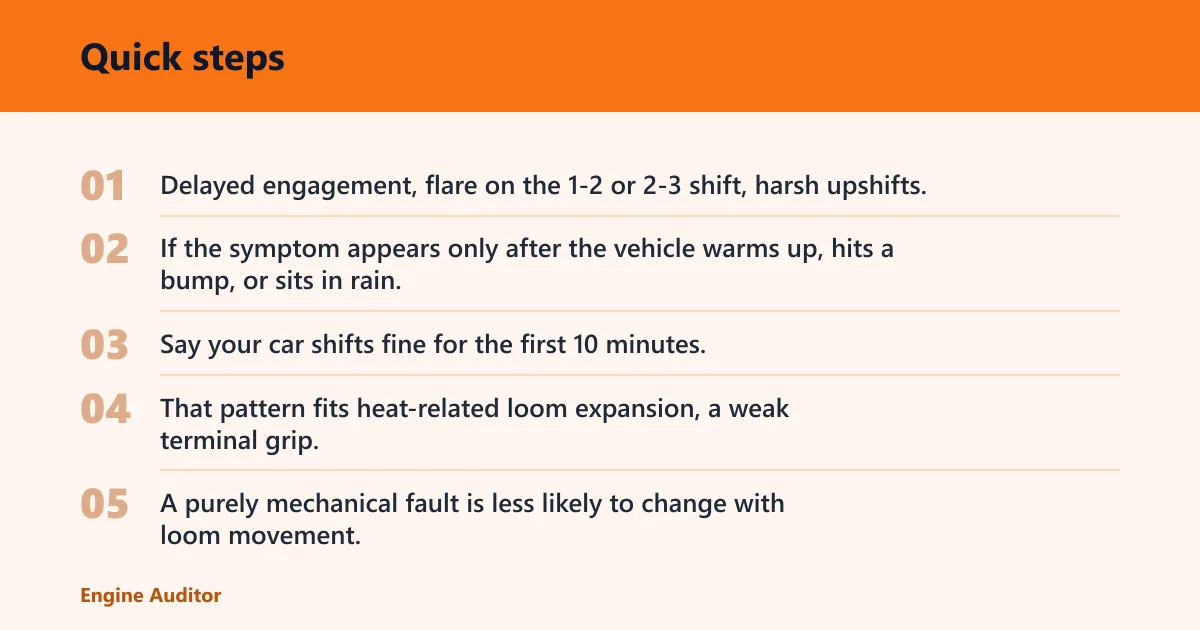
Delayed engagement, flare on the 1-2 or 2-3 shift, harsh upshifts, or a refusal to downshift can all come from a loom fault. If the symptom appears only after the vehicle warms up, hits a bump, or sits in rain, suspect a wire, terminal, or connector before condemning the transmission.
Say your car shifts fine for the first 10 minutes, then starts hunting between gears on a warm commute. That pattern fits heat-related loom expansion, a weak terminal grip, or insulation that opens when soft. A purely mechanical fault is less likely to change with loom movement.
Warning lights, communication codes, and limp mode
Can a bad transmission loom cause limp mode? Yes. Loss of communication or a corrupted signal can put the transmission into limp mode, and that can be mistaken for a failed gearbox. A code that names the TCM, solenoid, or sensor is not proof that the part itself is bad.
Communication loss can also create drivability issues outside the transmission. Engine warning lights, impossible gear displays, or a no-start complaint can all appear when power or signal through the loom is interrupted. The loom is the first place to verify before replacing a module.
Symptoms that change when the harness moves
The wiggle test and tug test are especially useful when the complaint is intermittent. If shifting changes while you move the loom near the transmission case connector, the bellhousing, or the battery-side routing, that is strong evidence of an open, short, or poor terminal contact in the loom.
Picture a van that drops into limp mode only when turning left into a parking space. That kind of side-load clue often points to a loom that flexes and loses contact at a connector backshell or a rub point against a bracket. Mechanical failures rarely behave that way.
Transmission harness checklist table
This checklist maps the symptom to the likely loom location, likely cause, and the next test. Use it as a decision path. Start with the symptom you can reproduce, then inspect the matching circuit area before assuming the TCM, solenoid, sensor, fuse feed, or ground has failed.
| Symptom | Likely harness location | Likely cause | Test method | Next action |
|---|---|---|---|---|
| Intermittent shifting | Transmission case connector, loom near exhaust or crossmember | Heat damage, rubbed insulation, loose terminal | Wiggle test, visual inspection, continuity check | Repair terminal or damaged section first |
| Limp mode | TCM feed, sensor branch, main transmission connector | Signal loss, open circuit, poor ground | Scan codes, then voltage drop and continuity testing | Check loom and grounds before replacing the TCM |
| Communication codes | TCM connector, backshell, pin cavities | Corrosion, bent pins, loose lock tab | Inspect terminals, tug test, continuity test each wire | Clean or replace terminals, then retest |
| Blown fuse recurrence | Power feed to solenoids or module supply | Short-to-power, short-to-ground, cooked insulation | Locate the fused circuit, check resistance to ground | Repair the short before fitting another fuse |
| Symptoms change when loom is flexed | Section near clamp points, routing bends, or connector backshell | Intermittent open, broken conductor, weak crimp | Wiggle test while watching live data or symptom response | Open the loom and inspect the exact flex point |
Read the next action column as a sequence, not a verdict. If the table points you to continuity testing, that means you have enough evidence to stop guessing. If it points to a connector, inspect the backshell and pin cavities before swapping parts.
Which connector areas fail first?
Common failure-prone spots are the transmission case connector, the loom backshell, and the pin cavities where terminals lock in. Those areas see heat, vibration, moisture, road spray, and sometimes transmission fluid wicking. Corrosion, bent pins, and loose connector locks can interrupt communication immediately.
Transmission case connectors and backshells
Start where the loom enters or exits the transmission. Check the case connector for oil saturation, cracked seals, loose retainers, and a backshell that no longer holds the loom straight. If the connector body moves too easily, the terminals may be losing contact under vibration.
A damaged Deutsch connector loom should be checked for corrosion or bent pins. The same applies to other sealed connectors: look at the pin faces, the terminal shoulders, and the lock tab. A connector can look seated while a backing issue still breaks the circuit under load.
Pin cavities, terminal tension, and lock tabs
Connector terminals can be loose, corroded, bent, or damaged. A poor terminal fit can open and close with slight movement, which is why a loom may test fine at rest and fail on the road. Inspect the cavity, not just the plastic shell.
Check for spread terminals, pushed-back pins, and damaged secondary locks. A pin that sits lower than the others often indicates partial disengagement. That can affect the TCM, a solenoid feed, or a sensor return without leaving a dramatic visual clue.
Heat, fluid, and road spray exposure
Heat and vibration can damage wiring over time. Wires can be rubbed, corroded, pinched, or cooked. On a transmission, the usual weak points are the sections near the exhaust, bellhousing, subframe, and any spot where the loom is clipped tight against a bracket or shield.
Oil-soaked tape, swollen insulation, and heat-shrink that has split at the ends are clues to contamination and age. Rodent damage can leave chewed insulation and scattered debris. Fluid contamination can soften tape and let moisture reach the conductor, which leads to intermittent faults later.
How do you test the harness?
Start with the scan tool, then inspect, wiggle, and measure. Do not unplug random connectors before reading codes and live data. The practical sequence is to scan codes, inspect, perform a wiggle test, check continuity and voltage drop, then confirm the fault under load. That path separates wiring faults from parts failures.
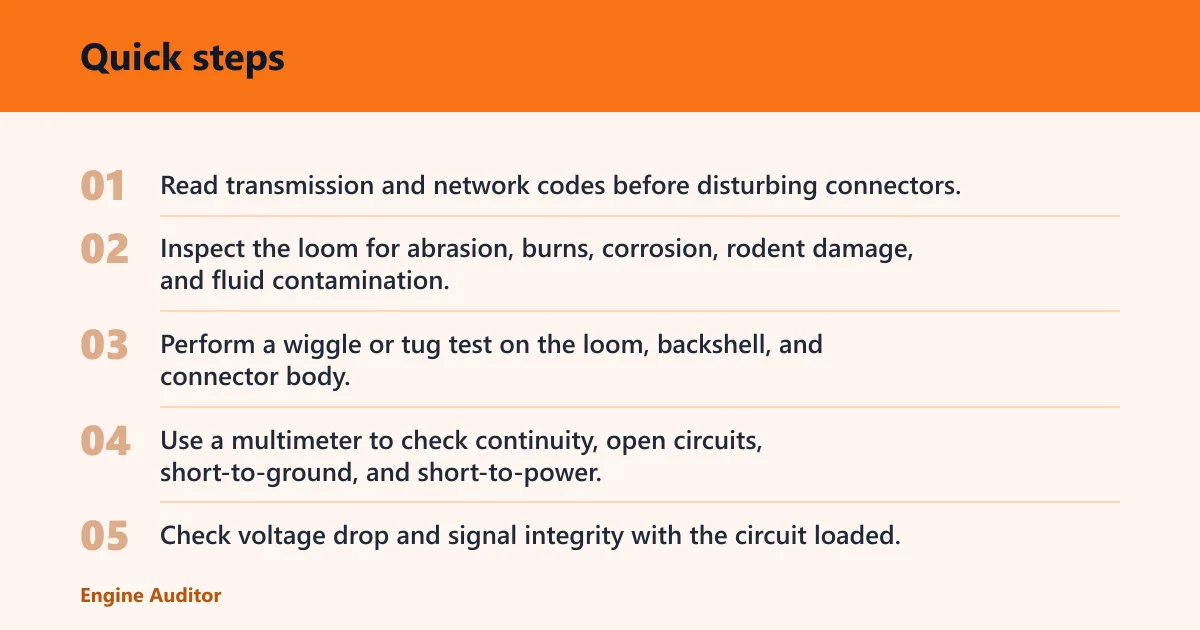
- Read transmission and network codes before disturbing connectors.
- Inspect the loom for abrasion, burns, corrosion, rodent damage, and fluid contamination.
- Perform a wiggle or tug test on the loom, backshell, and connector body.
- Use a multimeter to check continuity, open circuits, short-to-ground, and short-to-power.
- Check voltage drop and signal integrity with the circuit loaded.
Scan codes before unplugging anything
Record the code set and freeze-frame data first. A solenoid code, sensor code, or communication code gives you a target circuit. That matters because a loom fault can create the same code set that a bad TCM or failed solenoid would create.
If the codes return after clearing and the complaint stays the same, move to the loom and connectors. A repeated code with no change in symptoms after a connector is moved is more likely to be a hard electrical problem than a random software glitch.
Visual inspection for abrasion, burns, corrosion, and rodent damage
Look for frayed insulation, rubbed-through sections, burnt spots, loose connector locks, corrosion at the terminals, and damaged heat-shrink. Check the loom where it crosses brackets, bellhousings, shields, and sharp edges. Also inspect for rodent-chewed sections and nesting material around the loom path.
Transmission fluid contamination deserves attention too. Fluid can wick into tape and connectors, then attract dirt and soften insulation. A loom that looks merely dirty may actually have a compromised seal and a damaged conductor under the wrap.
Wiggle test and tug test for intermittent faults
The wiggle test and tug test help expose intermittent opens and poor terminal contact. Move the loom gently at the connector backshell, at the transmission case, and at any repaired section while watching live data or trying to reproduce the symptom. If the fault appears or disappears, you have a location.
Keep the movement controlled. A hard yank can create damage that was not there before. The point is to reveal a weak terminal, broken strand, or cracked conductor that only fails when the loom flexes.
Multimeter checks for continuity and shorts
A multimeter is used to check continuity and to detect opens and shorts. Test each suspect wire end to end, then check for short-to-ground and short-to-power. Continuity testing is recommended for each wire in a damaged loom, not just the one that seems likely.
Do not stop at a beep test alone. A wire can show continuity and still fail under load if the conductor is partly broken or corroded inside the insulation. That is why voltage drop and live-circuit checks matter when the symptom is intermittent or heat-related.
Voltage drop checks under load
Voltage drop tells you whether a circuit can carry current, not just whether it touches both ends. A feed wire with excessive drop may still pass a static continuity test. Under load, however, it may starve a solenoid or pull the TCM reference voltage out of range.
Use this step when a circuit looks intact but the symptom remains. It is especially useful on ground paths, power feeds, and sensor returns that feed the transmission control module. Poor contact often reveals itself only when the circuit is actually working.
How do you separate a harness fault from a bad TCM?
Start with communication and power integrity, not module replacement. A bad TCM is possible, but loom damage often creates the same codes, the same limp mode, and the same no-communication complaint. If the loom fails a wiggle test or a continuity check, the module is not the first suspect.
Communication loss versus hard electrical failure
When communication drops in and out, suspect the loom, connector terminals, or grounds before the TCM itself. A hard module failure usually does not change when the loom is flexed. A wiring problem often does, especially if the fault is heat-sensitive or vibration-sensitive.
If the module loses power or ground, it may look dead. That can happen because of a corroded fuse feed, a loose terminal, or a damaged ground splice. Verify supply and ground before calling the module bad.
When a solenoid or sensor code still points to wiring
Shift solenoids receive voltage through the loom, and transmission sensors send low-voltage signals back to control modules. A code naming one of those parts may still trace to an open wire, shorted wire, or weak connector contact. The code identifies the circuit, not always the failed component.
That distinction prevents unnecessary parts replacement. If the code returns only when the loom is flexed, or if the sensor signal drops out under vibration, the wiring path is more suspect than the solenoid or sensor itself.
Ground faults that mimic module failure
Bad grounds can imitate a failed TCM very closely. A poor ground can distort sensor readings, weaken solenoid operation, and trigger communication faults. Check ground continuity and voltage drop at the module and transmission ground points before condemning electronics.
If the ground path is clean and the loom still fails under movement, the fault is likely local to the loom or connector. If the ground is poor, repair it first and then recheck the transmission symptoms and codes.
Repair or replace the harness?
Repair the smallest proven fault first. A terminal repair is enough when the problem is a loose pin, a single corroded cavity, or a short damaged section. Replace a sub-harness when the fault is localized but the branch is too damaged for a reliable splice. Replace the full harness when damage is widespread or repeated.
When a terminal repair is enough
If the problem is limited to bent pins, loose terminal tension, or corrosion in one connector cavity, terminal repair may be the right call. Replacing the terminal and restoring correct pin fit is often better than changing a whole loom for a one-point contact fault.
That said, a terminal repair only makes sense if the wire itself tests clean and the connector body is intact. If the plastic is heat-cracked or the seal is compromised, the repair may not last.
When a sub-harness makes sense
A sub-harness is a good middle ground when the damage sits in one branch near the transmission case or along a short routed section. This option can reduce cost and labor compared with a full loom, while still restoring reliability where the conductors were actually damaged.
Use this option when the main trunk is sound and the fault is easy to isolate. It is often the best answer for rubbed sections, a damaged branch near the exhaust, or a connector lead that has been cooked by heat.
When full harness replacement is the safer call
Choose full harness replacement when damage is spread across multiple branches, there is extensive rodent chewing, or the loom has repeated heat and fluid damage. A loom that has failed in several places may keep generating new faults even after a partial repair.
That choice also makes sense when the loom has already been patched several times and the symptom keeps returning. Repeated limp mode, recurring communication loss, and multiple failed continuity checks usually mean the wiring itself has reached the end of service life.
Frequently asked questions
What are the signs of a damaged transmission wiring harness?
The most common signs are intermittent shifting, warning lights, communication codes, limp mode, and symptoms that change when the loom is moved. Visible clues include frayed insulation, rubbed-through sections, corrosion, burnt spots, loose connectors, and rodent damage. If the fault comes and goes, wiring rises to the top of the list.
Can a bad transmission harness cause limp mode?
Yes. Limp mode often appears when communication or signal integrity fails, and a wiring fault can trigger that response. A damaged loom can interrupt power, ground, or data between the TCM and transmission components. That can feel like a major mechanical failure even when the underlying issue is electrical.
How do I tell wiring problems from a bad transmission control module?
Check whether the symptom changes with loom movement, connector pressure, or heat. If it does, suspect wiring first. Then verify power, ground, continuity, and voltage drop before condemning the TCM. A module can appear faulty when the loom is actually open, shorted, corroded, or losing contact at a terminal.
What does transmission wiring harness damage look like on a car?
It can look like a loom with rubbed insulation, oily tape, heat-browned spots, melted sections near the exhaust, chewed wires from rodents, or corroded pins at the transmission connector. Sometimes the damage is subtle: a loose lock tab, a backed-out terminal, or a cracked backshell that opens under vibration.
Can rodents or heat damage transmission harness wiring?
Yes. Rodents can chew insulation and expose conductors, while heat and vibration can cook, harden, or crack the loom over time. Moisture, transmission fluid, and road spray add corrosion and seal failure. Those conditions can create intermittent faults that only show up after the vehicle warms up or moves.
What tests can confirm a transmission harness fault?
Use a scan tool first, then inspect, wiggle, and test. Confirm continuity on each suspect wire, check for open circuits and shorts to ground or power, and perform voltage drop tests under load. If the symptom appears when the loom is flexed, that strongly supports a loom or connector fault.
Products related to this article
Sponsored / affiliate links. As an Amazon Associate I earn from qualifying purchases. I may earn additional commission from eligible campaigns.