Transmission Control System Won’t Go Into Overdrive: What to Know
If a transmission control system won’t go into overdrive, start with codes, live data, and stop-command checks. If the TCM requests overdrive but line pressure or solenoid response never changes, suspect electrical or hydraulic faults before internal wear. Skip that order, and you can waste parts, repeat limp mode, or tear down a transmission that was still serviceable. This guide shows the fault patterns, scan data, and decision points that separate wiring, solenoid, valve-body, and internal failures.
What overdrive does
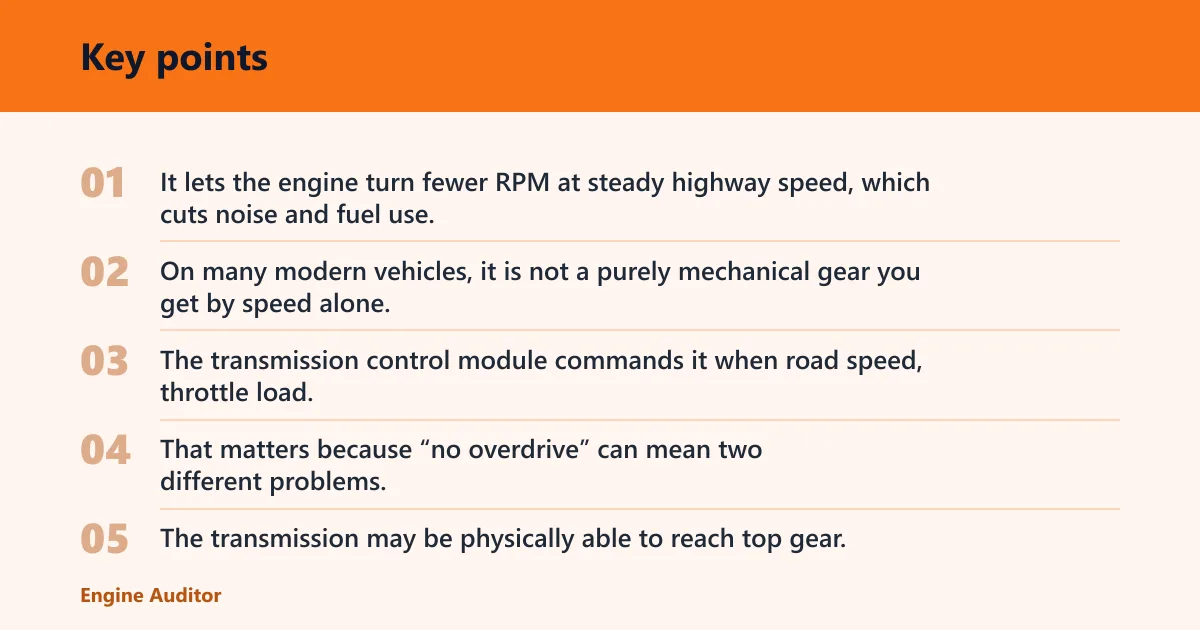


Overdrive is the highest cruising gear. It lets the engine turn fewer RPM at steady highway speed, which cuts noise and fuel use. On many modern vehicles, it is not a purely mechanical gear you get by speed alone. The transmission control module commands it when road speed, throttle load, fluid temperature, and shift logic all line up.
That matters because “no overdrive” can mean two different problems. The transmission may be physically able to reach top gear, but the TCM may be withholding the command. Or the TCM may request it and the transmission may fail to apply it.
How electronic control affects engagement
The TCM controls shift timing and often torque-converter behavior too. It stores codes, watches sensor input, and may enter fail-safe strategy if it sees a fault. In that state, overdrive may be disabled on purpose to protect the unit.
On older or simpler setups, overdrive may depend more on hydraulic and governor behavior. On many newer vehicles, the command path is electronic first, hydraulic second. That is why live scan data matters. It tells you whether the TCM asked for overdrive at all.
When the top gear is disabled
Overdrive may be blocked during cold operation, heavy throttle, overheating, limp mode, or when the TCM sees speed-sensor or ratio errors. A car can still drive normally in lower gears and never enter top gear. That pattern often points to command or control logic, not a fully failed transmission.
Why won’t my transmission go into overdrive?
Start with the symptom pattern, not a parts list. If the vehicle cruises in the lower gears, shifts cleanly up to the last normal gear, and simply never settles into overdrive, the most likely causes are fluid problems, a sensor fault, a solenoid issue, wiring trouble, or a TCM strategy that is blocking the shift. If it slips, flares, or bangs when trying to upshift, internal wear moves higher on the list.
What a normal lower-gear drive can hide
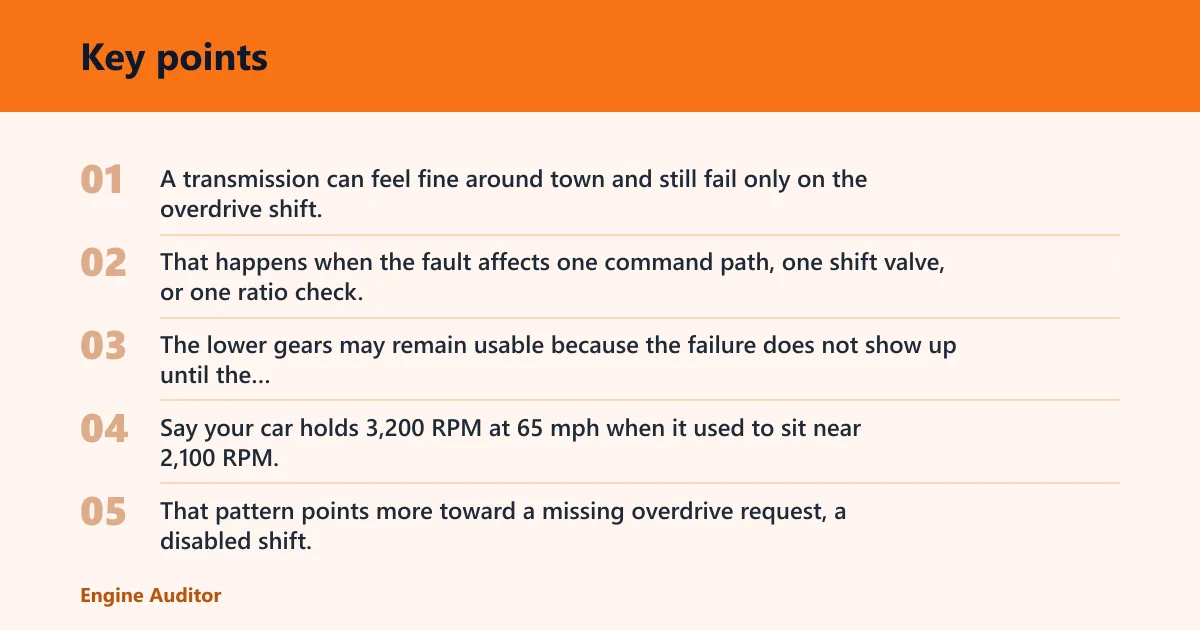
A transmission can feel fine around town and still fail only on the overdrive shift. That happens when the fault affects one command path, one shift valve, or one ratio check. The lower gears may remain usable because the failure does not show up until the top-gear request is made.
Say your car holds 3,200 RPM at 65 mph when it used to sit near 2,100 RPM, yet the rest of the shifting feels normal. That pattern points more toward a missing overdrive request, a disabled shift, or a ratio problem than a whole-unit failure.
How fail-safe mode changes shift behavior
Fail-safe, or limp mode, is a protective strategy. It may limit gear changes, command a default gear, and turn off overdrive. Warning lights or restricted performance often come with it. If the TCM sees a fault that could damage the transmission, it may refuse normal top-gear operation until the root issue is found.
Overdrive symptom table
This decision table helps separate a simple electrical issue from a real internal transmission problem. Use the cruising pattern, RPM change, and scan data together. One clue alone is rarely enough.
| Cruising behavior | RPM at highway speed | DTC examples | Scan-tool clue | First test to run |
|---|---|---|---|---|
| Shifts normally through lower gears, but never drops into top gear | Higher than expected, often steady and not flaring | P0700, pending transmission codes | TCM requests overdrive never appears, or command shows blocked | Scan for TCM codes and live data, then check fluid level and condition |
| Overdrive comes and goes, especially after bumps or rain | RPM rises and falls with intermittent shift loss | P0700, sensor or circuit codes | Command status changes when the wiring is moved or the fault appears | Inspect connectors, grounds, and wiring routing for opens or corrosion |
| Upshifts are delayed or gear ratio seems wrong | RPM may flare before settling | P0715, P0730 | Input speed data drops out or ratio does not match commanded gear | Test the input speed sensor and compare live speed readings |
| Vehicle drives in lower gears but refuses overdrive under load | Higher RPM only at highway speed or climbing grades | P0730, manufacturer-specific shift codes | TCM may command overdrive, then cancel it under slip detection | Check fluid condition, then look for slip, burnt fluid, or pressure loss |
| Only one gear range feels missing, with warning light on | RPM stays elevated and vehicle feels restricted | P0700 plus other transmission codes | Limp mode or fail-safe flag is active | Read the TCM directly with an OBD-II scan tool that supports transmission data |
Can low transmission fluid stop overdrive from engaging?
Yes. Low fluid can keep overdrive from engaging because the hydraulic system may not have enough pressure to apply clutch packs and valves properly. Burnt or contaminated fluid can do the same thing by upsetting hydraulic control. If the level is wrong, fix that first before chasing sensors or modules.
Level checks that matter
Check fluid the way the vehicle maker specifies: hot or warm, engine running if required, on level ground, and in the proper gear position. A low reading is more than a maintenance issue. It can cause delayed shifts, slip, and a missing top gear.
Burnt or contaminated fluid clues
Dark fluid, a burnt smell, or visible debris point toward overheating or wear inside the transmission. Fresh fluid will not repair worn clutches, but the fluid condition helps separate hydraulic damage from an electrical problem. If the fluid is badly burnt, the overdrive failure may be a symptom of deeper wear.
Suppose the dipstick shows low fluid and the vehicle only loses overdrive after a long drive on the highway. That pattern suggests a pressure or heat issue, not a random code problem. A leak or aeration issue becomes more likely than a bad TCM.
Leak signs that point to hydraulic loss
Wet pan seams, line-fittings, cooler lines, axle seals, or transmission case residue can all point to fluid loss. Repair leaks promptly. Driving low on fluid can turn a simple seal issue into clutch and band damage.
Can a bad speed sensor cause no overdrive?
Yes. A faulty vehicle speed sensor can interfere with correct shift scheduling, and a faulty input speed sensor can disrupt gear-ratio calculation. Either fault can keep overdrive from engaging when the TCM cannot trust the data it uses to decide when to shift.
Vehicle speed sensor faults
The VSS tells the transmission computer how fast the vehicle is moving. If that signal is wrong, the TCM may shift late, shift early, or refuse overdrive. Erratic shifting, dead speedometer behavior on some vehicles, and missing top gear are common clues.
Input speed sensor faults
The input speed sensor monitors the transmission input shaft. The TCM uses it to calculate gear ratio and confirm that the requested gear actually happened. If the signal is missing or implausible, the TCM may flag a ratio error and cancel overdrive.
A common first-timer mistake is replacing a solenoid because the vehicle will not upshift, then finding that the input speed sensor signal was dropping out only at highway speed. Live data would have shown the bad reading before any part was removed.
What codes point to overdrive failure?
Codes help narrow the fault class, but they do not tell the whole story. P0700 usually means the TCM saw a transmission-related problem and wants the scan tool to look deeper. P0730 points to an incorrect gear ratio. P0715 often points to an input speed sensor circuit fault. Each one changes the diagnosis path.
P0700 and what it usually means
P0700 is a generic transmission control system fault code. It usually means the TCM detected another issue, often one stored only in the transmission controller itself. The engine light may be on, but the real clue is often inside the TCM, not the engine computer.
P0730 and gear-ratio faults
P0730 typically indicates that the ratio between input and output does not match the selected gear. That can come from slip, sensor error, or hydraulic trouble. If overdrive is missing and P0730 is present, look for a failed shift, wrong pressure, or ratio data that does not match the gear the TCM commanded.
P0715 and input sensor circuit faults
P0715 points to the input speed sensor circuit. That can cause delayed or missing shifts and can make the TCM refuse overdrive because it cannot verify the transmission’s actual behavior. Circuit checks matter here, not just code clearing.
How do you separate the TCM, solenoid, or wiring?
Use the command path. If the TCM requests overdrive and the command does not reach the transmission, suspect wiring, connectors, power, ground, or the solenoid circuit. If the command reaches the unit but the gear does not apply, suspect a stuck solenoid, valve-body problem, low fluid, or internal wear. If the TCM never requests overdrive, look at inputs, strategy, and fail-safe status first.
TCM command versus hardware failure
A scan tool with live transmission data is the fastest separator. Better tools can show shift request, actual gear, input speed, output speed, and sometimes solenoid state. If overdrive is commanded but never achieved, the fault is downstream of the request.
Solenoid resistance and actuation checks
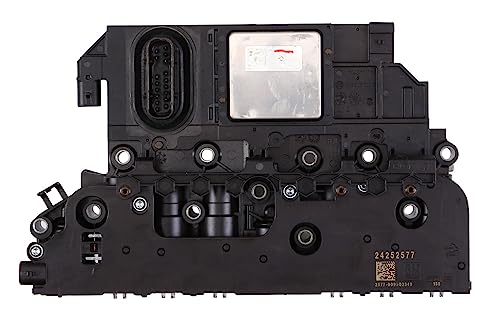
A transmission solenoid is an electrically controlled hydraulic valve. If it is stuck or electrically open, it can block overdrive engagement. Resistance checks, scanner command tests, and bi-directional actuation can help confirm whether the solenoid responds when told to move.
Fuses, connectors, and wiring faults
Check fuse power, transmission connectors, corrosion, chafed wires, and poor grounds. A broken wire can look like a bad solenoid. A poor connector can look like a bad module. If the fault changes when the wiring is moved, the wiring path deserves attention before parts replacement.
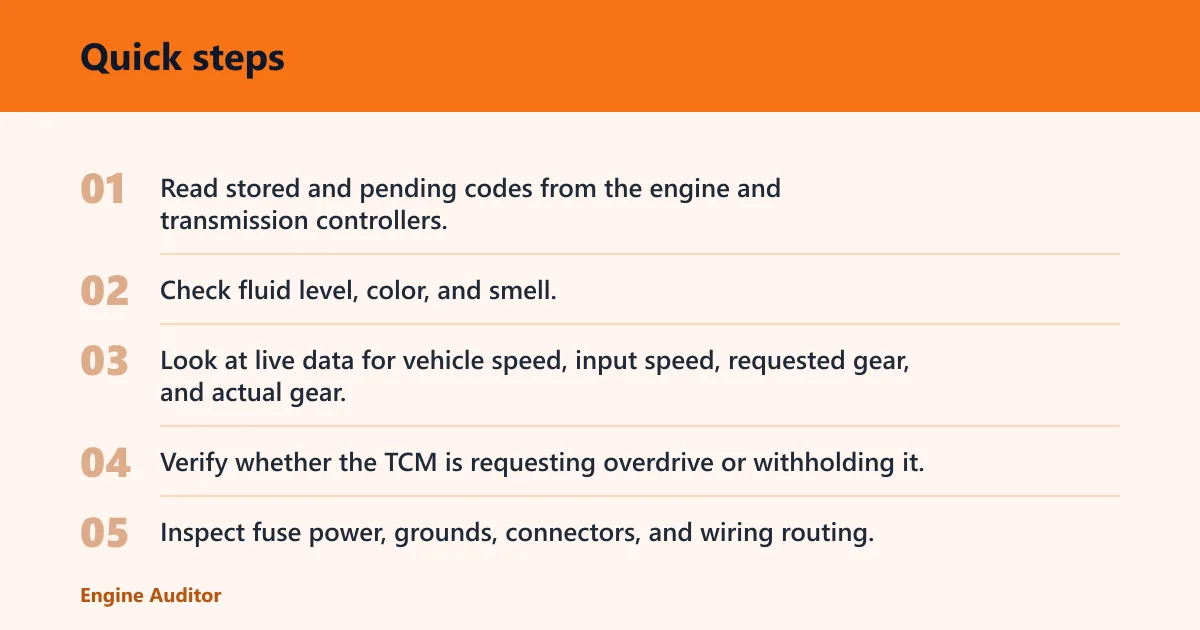
- Read stored and pending codes from the engine and transmission controllers.
- Check fluid level, color, and smell.
- Look at live data for vehicle speed, input speed, requested gear, and actual gear.
- Verify whether the TCM is requesting overdrive or withholding it.
- Inspect fuse power, grounds, connectors, and wiring routing.
- Run solenoid tests if the scanner supports them.
- Only then consider internal transmission damage if slip, ratio errors, or burnt fluid point that way.
Can the battery reset fix an overdrive problem?
Usually not. A battery reset may clear temporary memory, but it does not repair a faulty sensor, solenoid, wiring issue, low fluid condition, or internal slip. If the TCM sees the same fault again, the problem returns. Clearing power without fixing the cause is a short pause, not a repair.
It can be useful only as a way to see whether a temporary glitch returns. If the transmission resumes no-overdrive behavior after relearn, the root cause is still present.
What should I check before replacing the transmission?
Check fluid, codes, live data, fuse power, grounds, and command status first. If the transmission still drives well in lower gears and the evidence points to one sensor, one solenoid, or a wiring fault, replacement may be unnecessary. A complete unit swap should come after fault isolation, not before it.
Look for the difference between a code being stored and the TCM actively withholding overdrive for protection. That distinction prevents expensive guesswork. A scan tool that can read transmission data is far more useful here than clearing codes and hoping the problem disappears.
When does no overdrive mean internal transmission damage?
Internal damage becomes more likely when no-overdrive comes with slip, flare, burnt fluid, repeated P0730 ratio faults, or a gear that will not apply even though the TCM commands it. If the transmission has proper fluid, the electronics check out, and the ratio still never matches, internal wear or clutch failure moves to the top of the list.
A direct hydraulic failure can still leave the vehicle drivable in lower gears. That is why a normal around-town drive does not rule out serious wear. It only means the problem may be limited to one clutch circuit, valve, or pressure path.
Frequently asked questions
Is it safe to drive if overdrive doesn’t work?
Sometimes, for a short time and with light use, but only if the transmission shifts normally otherwise and there are no slip, flare, or overheating symptoms. Higher RPM at highway speed can raise heat and fuel use. If warning lights, limp mode, or harsh shifts are present, limit driving and diagnose it soon.
Will resetting the battery fix an overdrive problem?
Usually no. A battery reset may clear stored memory, but it does not repair a failed sensor, solenoid, wiring fault, fluid problem, or worn clutch. If the transmission works again only briefly after a reset, the fault is still present and likely to return.
How do I know if it’s the TCM, solenoid, or wiring?
Use live data and command checks. If the TCM requests overdrive but the transmission never responds, suspect wiring, connectors, fuse power, grounds, or the solenoid. If the TCM never requests overdrive and limp mode is active, the module is reacting to a fault or bad input.
Products related to this article
Sponsored / affiliate links. As an Amazon Associate I earn from qualifying purchases. I may earn additional commission from eligible campaigns.