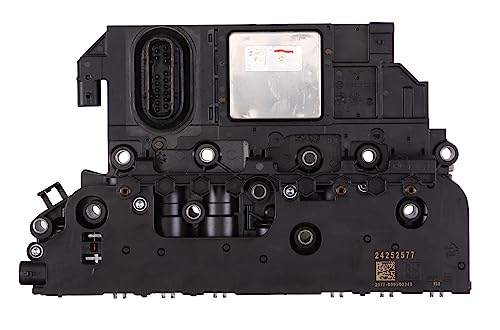
Transmission control module programming cost explained
Transmission control module programming often runs about $80-$250 for programming only, and roughly $400-$1,200 when a replacement module is involved, with more added if the quote includes diagnosis or relearn work. A bad quote can turn a simple reflash into an unnecessary module sale, extra labor, or a second tow when the car still won’t shift right. I break down module, programming, adaptation, diagnostics, shipping, and relearn charges so you can compare dealer, independent, and mail-in bench estimates line by line.
How much does transmission control module programming cost?
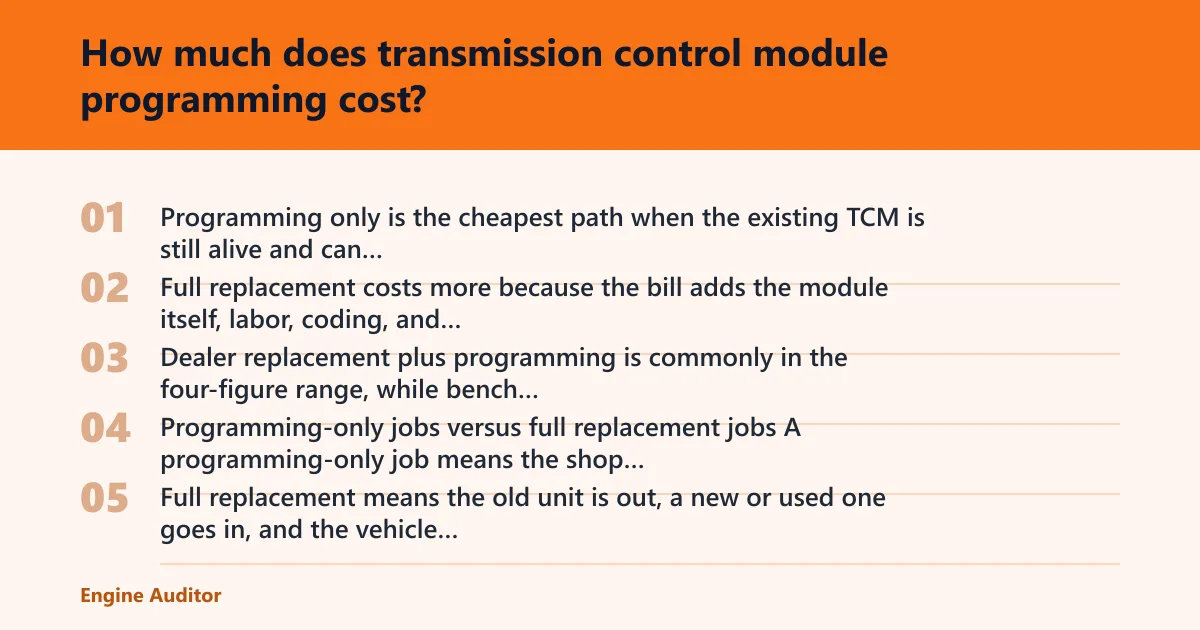


Programming only is the cheapest path when the existing TCM is still alive and can accept software. Full replacement costs more because the bill adds the module itself, labor, coding, and sometimes relearn work after installation. Dealer replacement plus programming is commonly in the four-figure range, while bench programming is often a flat-rate alternative for the programming portion.
Programming-only jobs versus full replacement jobs
A programming-only job means the shop is reloading software, matching calibration, or clearing a module that still communicates. Full replacement means the old unit is out, a new or used one goes in, and the vehicle has to accept it. Those are different jobs, and they should not be priced as one lump sum.
What drivers usually see on a dealer quote
Dealer quotes often bundle parts, labor, diagnostic time, and programming into one number. That is why the final figure feels high. The quote may also include VIN coding, security pairing, and adaptation after install, depending on the vehicle and the shop. If the estimate does not break those items out, ask for the line-by-line version before authorizing anything.
What changes the price by vehicle make and region
Vehicle brand matters because some modules are simple flash jobs while others need special access, cloning, or immobilizer work. Region matters because labor rates, supply, and diagnostic time vary by market. European platforms and late-model transmissions usually land higher than basic domestic programming-only work.
According to TCM Replacement & Programming Cost (2026) – automodulelab.com — Mail-in bench programming is flat-rate at $250 for most makes.
What a transmission control module does
The TCM handles shift scheduling, pressure control, adaptive learning, and limp mode. It is the computer that tells the transmission when to shift and how firmly to apply clutches and hydraulic pressure. If the module sees a fault it cannot manage, it can command limp mode to protect the drivetrain.
Shift scheduling and pressure control
The module runs closed-loop control on hydraulics in real time, adjusting pressure and shift timing as load, speed, and temperature change. That is why a bad calibration can cause harsh shifts, flares, or delayed engagement. When the module is replaced, the new unit has to match the vehicle’s transmission setup.
Adaptive learning and limp mode
Adaptive learning stores learned shift pressures and clutch fill times. Some late-model platforms may need that data relearned after programming, or shift quality can suffer. Limp mode matters too: a fault that the TCM cannot manage can push the vehicle into a reduced-function state, which is often what drivers notice first.
Why replacement modules are not universal
Replacement TCMs usually need vehicle-specific programming. They often need the VIN, the correct calibration for the transmission and axle ratio, and security pairing before they work. A used module pulled from another car may look identical and still refuse to communicate.

Why dealer TCM quotes run so high
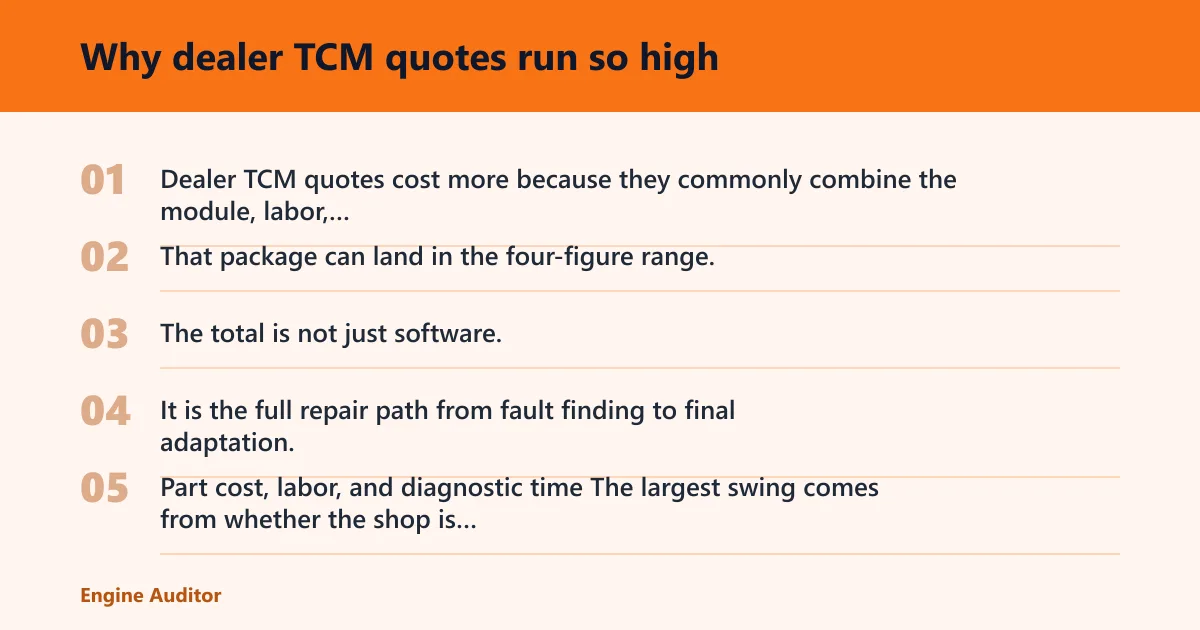
Dealer TCM quotes cost more because they commonly combine the module, labor, programming, diagnostic time, and sometimes relearn work. That package can land in the four-figure range. The total is not just software. It is the full repair path from fault finding to final adaptation.
Part cost, labor, and diagnostic time
The largest swing comes from whether the shop is selling only programming or a complete module replacement. If the technician spends time proving the fault, tracing wiring, and confirming the part failed, that time gets billed. Bad diagnosis can push the estimate up fast, especially when a problem is misread as a dead TCM.
VIN coding, calibration, and security pairing
A TCM often needs to be given the vehicle VIN after replacement. It must also be matched to the correct calibration, and the vehicle security system may need to authorize the swap. On some platforms, that pairing is what blocks a plug-and-play used module from working.
When the estimate includes adaptation or relearn
Some quotes include a post-install relearn because shift quality can be poor without it. That is normal on many late-model vehicles. If the estimate mentions adaptation data, clutch fill times, or relearn, that is a sign the shop expects the module to need a setup process after installation.
What else gets charged besides TCM programming?
Drivers often pay for more than programming. Mail-in and dealer jobs can add shipping, removal and installation labor, bench evaluation, cloning, security matching, and return shipping. Those items may be legitimate, but they should be visible on the estimate. Hidden extras are where a fair quote turns hard to defend.
Shipping and return shipping for mail-in service
Bench programming is a flat-rate option at $250 for most makes, but shipping is usually extra. Return shipping starts at $29.95 in the competitor’s mail-in service. If the module has to be sent out, the quote should show outbound shipping, return shipping, and any packaging or handling charge.
Bench programming, cloning, or security matching
A mail-in service can program a module, clone an existing one, or prepare a donor unit so it can be reused. A GM T87A clone or security-match job may be priced around that level, depending on the job and vehicle. A BMW EGS ZF 8HP module with ISN is priced at $300. Those are not generic reflashes; they are platform-specific jobs.
Removal and installation labor
Programming and installation are separate labor buckets. If the TCM is buried in the transmission case, under the car, or inside a mechatronic assembly, removal is slower and the labor line should reflect that. Ask whether the quote assumes the module is already on the bench or still in the vehicle.
Can a used transmission control module be programmed to my car?
A used donor TCM may work, but it often needs coding, cloning, or security matching first. Some vehicles will accept a donor module after proper programming. Others block it because the immobilizer pairing, VIN data, or calibration does not match the car it came from.
When a donor module will work
A donor module is most likely to work when the platform allows matching through normal programming and the replacement part is the correct hardware revision. If the original module died electrically but the transmission is sound, a properly prepared donor unit can be a practical repair path.
When security pairing blocks a swap
Vehicle security and immobilizer pairing can stop a cross-vehicle swap even when the connector fits. The car may reject the module, set communication faults, or drop into limp mode. That is why “used and cheap” is not the same as “ready to install.”
Why cloning can matter on some platforms
Cloning copies the needed data from the old unit to the replacement. That matters when the vehicle expects old adaptation data, security data, or module identity to remain consistent. On some jobs, cloning is the difference between a quick return to service and a no-start or no-shift problem.
How to read a TCM quote line by line
A clean quote separates the module, programming, diagnostics, labor, shipping, and relearn items. The table below shows what each line covers, whether it is mandatory, what drives the price, and the red flags that usually mean padding or a weak diagnosis. Use it before approving dealer, independent, or mail-in work.
| Line item | What it covers | Mandatory? | Common price drivers | Red flags |
|---|---|---|---|---|
| Module cost | New, remanufactured, or used TCM hardware | Only if the old module is failed | Brand, platform, new versus used, mechatronic design | Replacement sold before testing power, grounds, wiring, or communication |
| Programming or coding | VIN write, calibration load, software setup | Usually yes on replacement | Vehicle make, security access, special functions | “Plug-and-play” claim on a module that normally needs coding |
| Diagnostics | Fault tracing, scan data, circuit checks | Often yes | Time spent confirming whether the TCM is actually bad | Charge for a module without documented fault isolation |
| Labor | Removal and installation | Yes if the module is replaced | Location of the TCM, accessibility, mechatronic assembly | High labor with no explanation of access difficulty |
| Shipping | Outbound mailing for bench work | Only for mail-in service | Carrier choice, packaging, distance | No shipping line on a mail-in quote |
| Return shipping | Shipping the programmed module back | Only for mail-in service | Service tier, destination, handling | Omitted return shipping that appears later as a surprise |
| Adaptation or relearn | Shift pressure and clutch fill relearn | Sometimes | Late-model strategy, transmission design, repair history | Skipping relearn when the vehicle is known to need it |
| Bench evaluation | Testing when failure is uncertain | Only if diagnosis is unclear | Unknown fault, intermittent communication, damaged module | Charging evaluation and replacement before proof of failure |
Why TCMs fail and when the problem is not the module
Many failures blamed on the TCM are really wiring, voltage, connector, or transmission hardware problems. That matters because a bad diagnosis can turn a repair into an unnecessary module sale. If the root cause is elsewhere, programming a new unit will not fix the vehicle.
Voltage, wiring, and connector damage
Low voltage, poor grounds, water intrusion, and connector corrosion can all look like module failure. A TCM can lose communication because the power feed is weak, not because the computer is dead. Those checks belong early in the diagnostic process, before any replacement order is written.
Transmission hardware faults
Internal transmission faults, valve body problems, pressure issues, and sensor failures can trigger the same symptoms people blame on the module. When that happens, the TCM may be reacting correctly to a real mechanical fault. Replacing the computer first only inflates the bill.
How poor diagnosis inflates repair bills
If a shop skips scan data, power tests, or circuit checks, it may sell a module that was never the problem. Then the car still shifts badly, and the customer pays again. That is the repair path that ends with a second tow and a second estimate.
Is bench programming cheaper than dealer programming?
Bench programming is usually cheaper than dealer replacement because it is a flat-rate service and does not include a full dealership parts-and-labor package. It works best when the module is repairable or cloneable. It does not fix wiring faults, failed transmissions, or every security-pairing problem.
What bench service can and cannot fix
Bench service can program, clone, or prepare a module on the bench. It can also be useful when the vehicle will not accept in-car flashing. It cannot repair a bad harness, correct low voltage, or save a module that has the wrong hardware for the vehicle.
When shipping time changes the total cost
Mail-in work often looks cheaper until downtime is counted. Shipping both ways adds time, and the car may sit while the module is away. If the vehicle is the daily driver, the cheapest invoice is not always the cheapest repair path.
Special cases: BMW EGS ZF 8HP and GM T87A
Some platforms carry special programming requirements that push the price higher than a generic TCM flash. BMW EGS ZF 8HP modules can require ISN handling. GM T87A modules often show up as clone or security-match jobs. These are specialized cases, not standard reprogramming.
BMW EGS ZF 8HP modules and ISN handling
A BMW EGS ZF 8HP module with ISN is priced at $300 in the competitor example. The extra work reflects the platform’s identity and security requirements. That is why BMW quotes often look different from domestic programming-only estimates.
GM T87A clone and security-match jobs
A GM T87A clone or security-match job is priced at $250. That type of work is common when the original module is damaged and the replacement must be prepared to match the vehicle. It is not the same as a simple software update.
Why platform-specific modules cost more
Special handling costs more because the job is not just loading calibration. It may involve security pairing, identity transfer, or workaround steps to make the module accepted by the vehicle. The more the platform resists a straight flash, the more the quote usually grows.
What should I ask before paying for TCM programming?
Ask what part of the quote is the module, what part is programming, and what part is labor or diagnostics. Also ask whether the vehicle needs VIN coding, calibration matching, security pairing, adaptation, or return shipping. A complete answer tells you whether the estimate is fair or padded.
Checklist before you approve the repair
- Ask whether the quote is programming only or full replacement.
- Ask whether the estimate includes diagnostics and what tests were done.
- Ask if the module needs VIN coding, calibration, or security pairing.
- Ask whether adaptation or relearn is required after install.
- Ask if shipping and return shipping are included for mail-in work.
- Ask whether a used donor module can work on your platform.
- Ask what evidence points to the TCM instead of wiring, voltage, or transmission hardware.
Frequently asked questions
How much does transmission control module programming cost?
Programming only is usually the lowest-cost path when the existing module still works. Full replacement is much higher because it adds the part, labor, and setup steps. Dealer replacement plus programming is commonly in the four-figure range, while flat-rate bench programming is priced separately.
Why do dealer TCM quotes cost so much more than programming alone?
Dealer quotes often include the module, installation labor, diagnostics, VIN coding, calibration, security pairing, and sometimes adaptation. Programming alone is just one step. Once the module is replaced, the job expands into a full repair, not a software-only service.
Can a used transmission control module be programmed to my car?
Sometimes, yes. But a used module may still need coding, cloning, or security matching before it will work. Some vehicles reject donor units because the immobilizer pairing, VIN data, or calibration does not match. The platform decides how easy the swap will be.
What else gets charged besides TCM programming?
Shipping, return shipping, diagnostics, removal and installation labor, cloning, security matching, and relearn work can all appear on the bill. Those charges are not always bad, but they should be stated up front. If they are missing from the quote, ask before approving the job.
Does a TCM need VIN coding and adaptation after replacement?
Often, yes. The module may need the vehicle VIN after replacement, and late-model platforms may also need adaptation data or relearn work. Without those steps, the vehicle can shift poorly, set faults, or stay in a reduced-function mode even though the new module is installed.
When is the problem not the TCM but wiring, voltage, or a bad transmission?
When power, grounds, or connectors are damaged, the module may only look failed. The same is true when the transmission itself has hydraulic or internal faults. A good quote should mention tests that ruled those out before it recommends a new TCM.
Products related to this article
Sponsored / affiliate links. As an Amazon Associate I earn from qualifying purchases. I may earn additional commission from eligible campaigns.