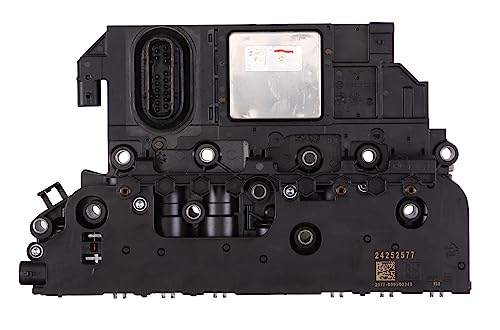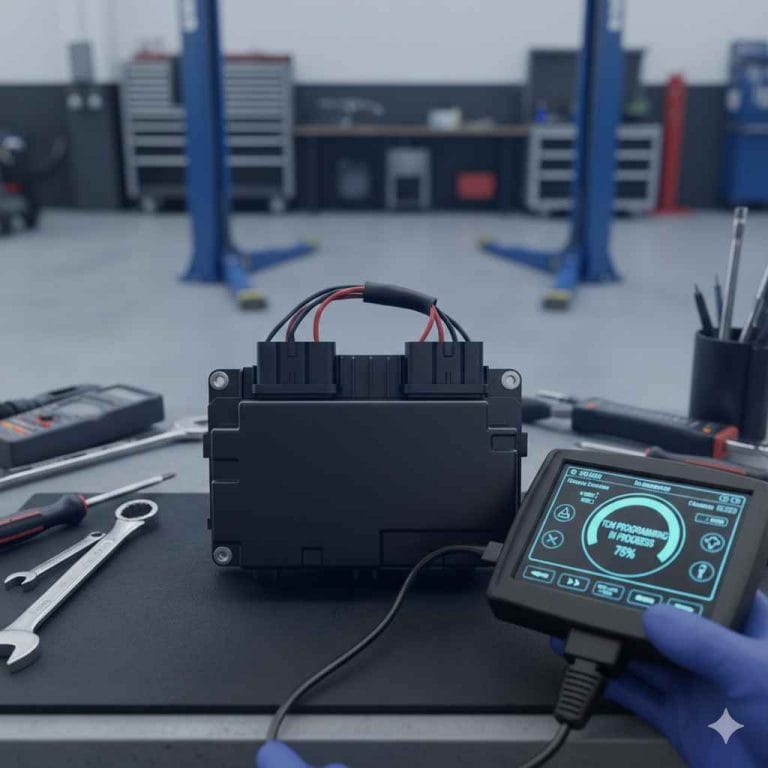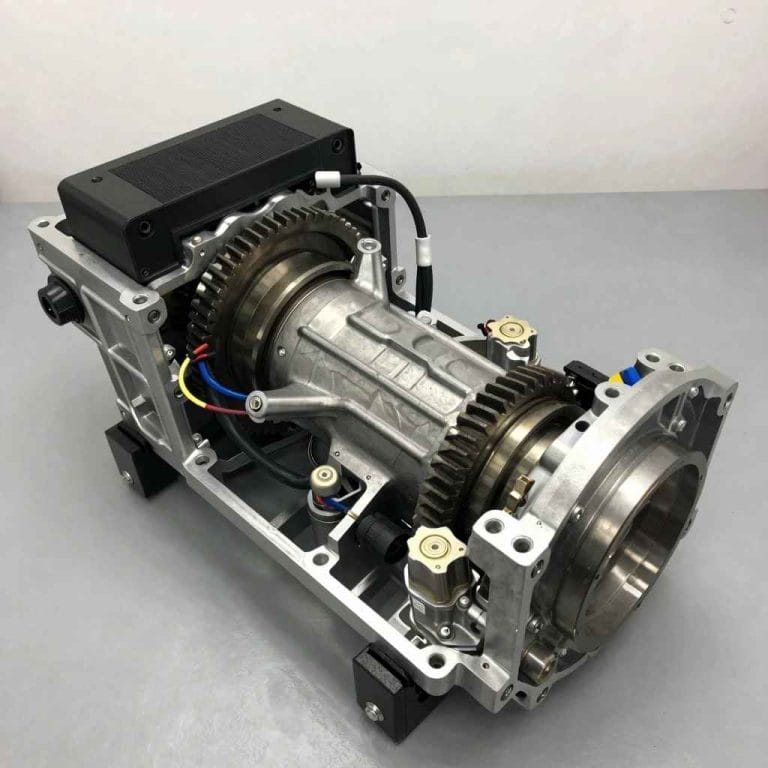
Transmission Control Unit vs TCM: What’s the Difference?
TCU and TCM usually mean the same transmission controller; the real question is whether the fault sits in the module, its inputs, or the vehicle’s control architecture. I have seen plenty of bad parts replaced for the wrong reason, then the car still shifts badly. This guide breaks down the naming, where each term shows up, and a practical test path to find the actual fault.
This guide is part of our Transmission control module basics series.
Transmission control unit vs TCM: what’s the real difference?
In practice, there often is no hardware difference at all. A transmission control unit is also known as a transmission control module, and both labels usually point to the same automatic-transmission computer. The useful split is diagnostic: is the problem inside the controller, in the sensor inputs, or in the power, ground, or communication path feeding it? (en.wikipedia.org)
| Decision factor | Transmission control unit | TCM: what’s the difference | Winner |
|---|---|---|---|
| Name clarity | Can be clear in service literature, but “TCU” may also mean telematics control unit. | Directly asks the naming question and usually maps to the same transmission controller. | TCM: what’s the difference |
| Diagnostic usefulness | Useful once the exact module is identified on the vehicle. | Better starting point for separating module fault, sensor fault, or network fault. | TCM: what’s the difference |
| Fit for DIY diagnosis | Can mislead if the label is treated as a unique part on its own. | Better for matching scan data to the actual control path. | TCM: what’s the difference |
| Parts-order risk | Higher if the acronym is assumed without checking the vehicle diagram. | Lower when the scan result and wiring path are verified first. | TCM: what’s the difference |
Name clarity
“Transmission control unit” is an alternate label used in many contexts, and [F1] says it is also known as a transmission control module. “TCU” can also mean telematics control unit. That is why I trust the vehicle diagram more than the acronym alone.
Diagnostic usefulness
The phrase “TCM” is better for diagnosis because it points you toward the automatic-transmission controller and the data around it. A scan tool can then separate a bad controller from a missing sensor signal, low voltage, or a network fault. The label itself does not prove the module is bad.
Fit for DIY diagnosis
For a DIY owner, the words on the part catalog matter less than the scan results. If the controller has power, ground, and valid sensor input, yet the transmission still loses shifts or sets internal module codes, the module climbs the list. If those basics are missing, replacement is often wasted money.
Parts-order risk
Ordering by acronym alone is a common mistake. A vehicle may have a separate TCM, a combined PCM, or a module that is built into another control unit. The right next step is always to match the part name to the exact vehicle architecture.
What does the TCM do in an automatic transmission?
The TCM typically controls automatic shifting and related transmission functions. [F12] says it permits shifting of gears in automatic vehicles, and [F10] adds that it controls gear shifting based on inputs like vehicle speed, throttle position, and engine load. It also controls torque converter lockup [F11] and may store diagnostic trouble codes when something falls out of range.
Shift scheduling and solenoid control
The controller decides when and how the transmission shifts. It does that by commanding solenoids and watching the response, then adjusting if the timing, pressure, or gear ratio does not match its target. A harsh or late shift can come from bad input data just as easily as a failed controller.
Inputs the module watches
Modern TCUs generally use signals from engine sensors and automatic transmission sensors. [F5] identifies throttle position sensor and vehicle speed sensor as the two main inputs for most TCUs. [F6] notes the turbine speed sensor is also called an input speed sensor, and [F7] says the transmission fluid temperature sensor may also be called transmission oil temperature.
Fault codes and limp mode
When the TCM sees a problem it cannot reconcile, it may store codes and command a fail-safe or limp strategy. That can limit gears, raise line pressure, or hold a single gear to protect the transmission. Limp mode is a warning sign, not the fault itself.

When is a TCU actually a TCM?
A TCU is usually a TCM when the vehicle documentation is talking about the transmission controller. [F1] states that a transmission control unit is also known as a transmission control module, and [F13] says the TCM can also be called a TCU. The only caution is that TCU can mean telematics control unit in other systems, so context decides the meaning.
TCU as alternate naming
Service manuals, scan tools, and parts catalogs often use the terms interchangeably. That does not mean the module is different. It means the manufacturer chose a different label for the same control job.
TCU as telematics control unit
Some vehicles and documents use TCU for telematics instead of transmission. That is where mistakes start. If the scan menu shows transmission data, shift codes, or gear ratios, the word TCU is being used for the transmission controller, not the communication unit.
How to verify the exact module
- Check the wiring diagram for the transmission controller location.
- Look for power, ground, CAN, and sensor pins on that module.
- Compare scan-tool module names with the vehicle’s actual network layout.
- Confirm whether the car uses a separate TCM or a PCM that includes transmission control.
What modules work with the transmission control module?
The TCM does not work alone. It communicates with the ECM or ECU, and in some vehicles those engine-management labels are treated as synonymous [F8]. [F9] says the TCM works with the ECU/ECM using a high-speed data bus. On some vehicles, the PCM combines engine and transmission control [F2].
PCM and combined control
When a vehicle uses a PCM, the engine and transmission functions are handled in one computer case or one integrated control path. [F2] says some vehicles combine the TCM and ECM into a PCM. That matters because a shift complaint may come from the shared control logic rather than a separate transmission box.
ECM or ECU communication
The ECM or ECU supplies engine data the TCM needs, including load and throttle information. If that data is missing or corrupt, the TCM may command the wrong shift timing. A transmission complaint can begin in the engine side and still set transmission codes.
Network messages and shared sensor inputs
Modern vehicles often share information across modules rather than hard-wiring every signal. Wheel speed, throttle position, and engine load can travel over the data bus. If the network drops those messages, the transmission controller may act as if the sensor failed even when the sensor itself is fine.
Side-by-side: TCM, TCU, PCM, ECM, and ECU
The main difference is not the acronym but the control architecture. TCM and TCU usually point to the same transmission controller. PCM means the engine and transmission functions are combined in one unit on some vehicles. ECM and ECU usually point to the engine-management side, and they often share data with the transmission controller.
| Name | Main function | Common vehicle setup | Can it replace a separate TCM? |
|---|---|---|---|
| TCM | Controls automatic shifting and related transmission functions | Often separate on older vehicles | No, it is the separate transmission controller |
| TCU | Usually the same job as TCM | Used as alternate wording in manuals and parts lists | Sometimes the same unit, depending on labeling |
| PCM | Combines engine and transmission control | Common in newer models | Yes, in vehicles built that way |
| ECM / ECU | Engine-management computer | Often communicates with TCM or is integrated into PCM | Not usually, unless part of a combined control unit |
Can transmission control problems be caused by sensors instead of the module?
Yes. Many shift complaints come from sensor data, not the controller itself. [F4] says vehicle speed sensor data helps the TCU decide when a gear change should take place. [F14] lists wheel speed sensors, turbine speed sensor, transmission fluid temperature sensors, vehicle speed sensor, and throttle position sensor as TCM inputs. Bad data here can look exactly like a failed module.
Vehicle speed sensor and wheel speed sensor
The vehicle speed sensor, or VSS, tells the controller how fast the vehicle is moving. Wheel speed sensor data can also matter, especially when the transmission strategy uses ABS or stability information. If speed data drops out, the controller may hold a gear, command a harsh shift, or log a ratio code.
Turbine speed sensor and input speed sensor
[F6] says the turbine speed sensor is also known as an input speed sensor, or ISS. This input tells the controller how fast the transmission internals are turning. If the signal is erratic, the TCM may think the gear change failed even when the clutch or band is fine.
Throttle position sensor
The TPS is a shared engine/transmission input. It helps estimate load and shift timing. A bad TPS signal can make the transmission shift late, shift early, or hunt between gears because the controller is reading the wrong driver demand.
Transmission fluid temperature sensor
The TFT changes shift logic when the fluid is cold or hot. [F7] says it may also be called transmission oil temperature. If the reading is implausible, the controller may protect the transmission with altered shift timing or line pressure.
Name-to-diagnosis decision table: what the scan data means
This is the practical split that matters. The wording on the module label is less important than the symptom pattern and the scan result. Use the table below to map what you see to the most likely fault path, then verify that path first.
| Wording or scan clue | Common symptom pattern | Most likely fault path | What to verify first |
|---|---|---|---|
| TCM, TCU, or transmission control unit named in codes | Harsh shifts, limp mode, or no upshift with other systems normal | Module, power/ground, or communication | Battery voltage, fuses, grounds, CAN communication, and module codes |
| VSS, TSS/ISS, or WSS data missing or implausible | Wrong shift timing, stuck gear, ratio codes, speedometer issues | Sensor or wiring | Live data for each speed signal, connector condition, and wiring continuity |
| TPS data jumps, flats out, or disagrees with engine load | Late shifts, flare, gear hunting | Sensor, shared engine input, or communication | TPS live data, engine codes, and the data bus path to the transmission controller |
| TFT reading is very low, very high, or fixed | Cold-only or hot-only shift problems | Sensor or wiring | Temperature reading versus ambient and inspection near the transmission |
| U-codes with transmission complaints | Intermittent failure, multiple modules unhappy at once | Communication | CAN wiring, battery state, module wake-up, and network faults before replacement |
| Internal TCM codes after all inputs check out | Repeat failure, no response from module, verified power and ground | Module or calibration | Part number match, software level, programming requirements, and known-good power supply |
Choose TCM replacement if… / choose sensor or wiring repair if…
Pick replacement only after the basics are proven. Many apparent TCM failures are really low voltage, bad grounds, CAN issues, sensor faults, or calibration problems. The diagnosis should follow the data, not the other way around.
Choose TCM replacement if…
- The module has correct power and ground at the connector.
- The scan tool can talk to the module, but it stores repeated internal faults.
- Live data from speed sensors, TPS, and TFT is believable, yet shift control is still wrong.
- The vehicle requires programming, and the old module fails after all external checks pass.
Choose sensor or wiring repair if…
- VSS, TSS/ISS, WSS, TPS, or TFT data is missing, erratic, or stuck.
- The fault changes when the wiring is moved or heated.
- Codes point to a sensor circuit, open, short, or signal range problem.
- The transmission acts up only under specific heat or vibration conditions.
Choose power, ground, or communication repair if…
- The module is offline or only wakes up intermittently.
- There are low-voltage codes, blown fuses, or poor ground readings.
- Multiple modules set U-codes at the same time.
- The complaint started after battery work, jump-starting, or water intrusion.
Frequently asked questions
Is transmission control unit the same as TCM?
Usually, yes. [F1] states that a transmission control unit is also known as a transmission control module. In vehicle diagnosis, the two labels normally refer to the same automatic-transmission controller. The important check is whether the document is actually talking about transmission control or some other type of TCU.
What is the difference between TCU and TCM?
In most automotive use, there is no practical hardware difference. TCU is often just another name for TCM. The real difference is context: some sources use TCU for telematics control unit, so the acronym alone is not enough. The wiring diagram and scan data tell you which module is meant.
Do all automatic cars have a TCM?
No. Some automatic vehicles have a separate TCM, while others use a PCM that combines engine and transmission control [F2]. Older cars are more likely to have separate modules. Newer ones often move the transmission logic into a shared powertrain computer.
Can a TCM be called a transmission control unit?
Yes. That is one of the common alternate names. [F13] says the TCM can also be called a TCU. The label on a parts catalog or scan tool may change, but the function is usually the same: control of automatic shift logic and related transmission actions.
What modules work with the transmission control module?
The TCM commonly works with the ECM or ECU, and [F8] says ECU and ECM are essentially the same thing. [F9] says the TCM works with the ECU/ECM using a high-speed data bus. In many vehicles, the PCM may integrate those functions instead of keeping them separate.
How do I tell if my transmission control module is bad?
Start with power, ground, network communication, and sensor inputs. If the module has solid supply voltage, good grounds, valid VSS, TPS, and TFT data, and it still stores internal module faults or loses communication, the controller moves to the top of the list. Do not replace it before checking the rest of the circuit.
Products related to this article
Sponsored / affiliate links. As an Amazon Associate I earn from qualifying purchases. I may earn additional commission from eligible campaigns.