Why Does My Clutch Pedal Stick Down? Causes and Fixes
If your clutch pedal sticks down, check the pedal return spring and pivot first. If it rises by hand but not on its own, suspect hydraulics. Ignoring it can leave you unable to shift, or it may damage the clutch. This guide separates pedal faults from master/slave cylinder and release-system problems, then shows the right test order.
What a clutch pedal that sticks down usually means
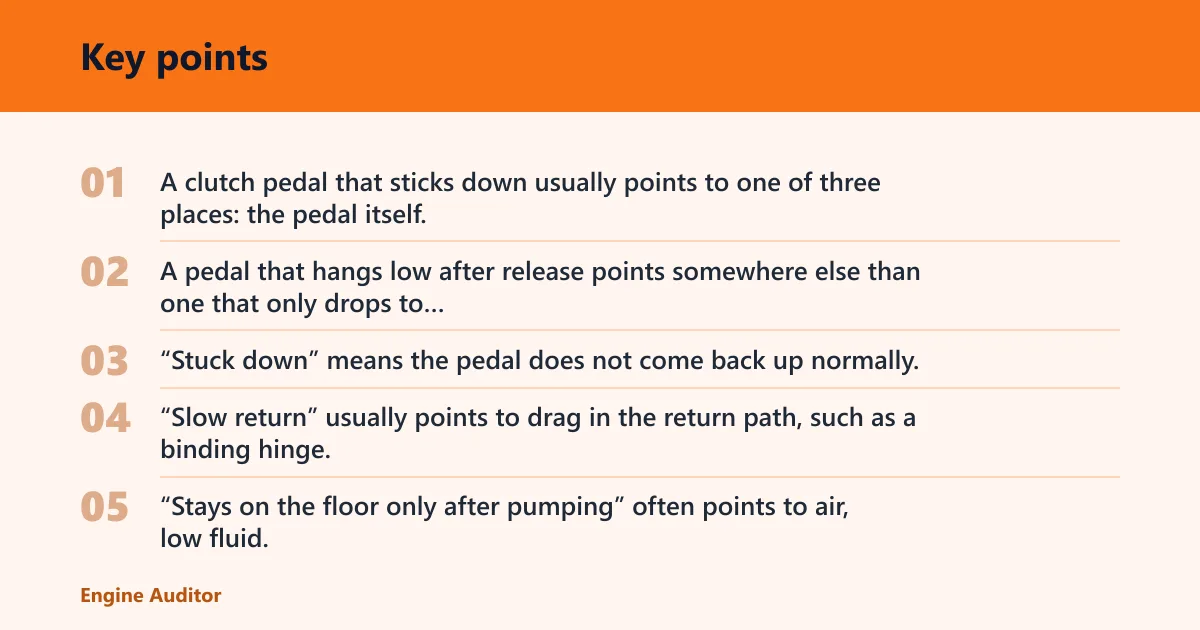


A clutch pedal that sticks down usually points to one of three places: the pedal itself, the hydraulic or cable drive, or the clutch release hardware inside the bellhousing. The pattern matters. A pedal that hangs low after release points somewhere else than one that only drops to the floor after pumping.
Stuck down, slow return, and floor-only after pumping
“Stuck down” means the pedal does not come back up normally. “Slow return” usually points to drag in the return path, such as a binding hinge, a weak return mechanism, or a hydraulic restriction. “Stays on the floor only after pumping” often points to air, low fluid, or a master cylinder that cannot hold pressure.
Hydraulic, cable, and pedal-mechanism branches
Hydraulic systems typically use a master cylinder, a slave cylinder, and a flexible clutch hydraulic hose. Mechanical systems may use a clutch cable and a clutch linkage instead of hydraulics. That split matters because a free-play check belongs early on cable and linkage setups, while a hydraulic system needs pressure and leak checks sooner.
Why does my clutch pedal stick down?
Most sticking-pedal problems start with something simple under the dash: a blocked pedal area, a mat, trim, or debris. If the pedal path is clear, check the pedal hinge, pivot ball, return mechanism, and free play or adjustment next. Only after that should you move to hydraulics or release parts.
Objects, mats, and debris under the pedal
A blocked pedal area can stop normal pedal movement. A floor mat that slides forward, a coin near the hinge, or broken trim can keep the pedal from returning. Look for anything that touches the pedal arm or gets in the way of the travel arc.
Pedal hinge, pivot ball, and return mechanism binding
The clutch pedal return mechanism must bring the pedal back to the top position. If the hinge is dry, bent, or packed with debris, the pedal can feel sticky even when the hydraulic side is fine. A worn pivot ball can raise pedal effort and alter movement.
Free play or adjustment out of spec
A clutch adjustment check is an early troubleshooting step. Too little free play can hold pressure on the release system, while too much slack can make engagement and return feel wrong. This check matters most on cable and linkage systems, but it is still worth confirming on any vehicle with changing pedal feel.
How to tell which system is failing
Start by separating hydraulic clutch setups from cable-operated clutch setups. Mechanical clutch systems can use a clutch cable instead of hydraulics, and the failure pattern is different. If the pedal rises when you pull it up by hand, the pedal mechanism may be sticking; if it only behaves after pumping, the hydraulic side moves higher on the list.
Hydraulic clutch versus cable-operated clutch
A hydraulic clutch uses fluid to transfer pedal motion. A cable system uses direct mechanical pull. A changing pedal feel, such as a pedal that gets stiffer before it sticks, fits a defect in the master cylinder or slave cylinder, both of which can fail in ways that affect shifting.
What a changing pedal feel tells you
A pedal that is hard to press, then slowly returns, can point to a return-path issue or a restriction. A pedal that sinks and comes back only after pumping points more toward hydraulics. A pedal that feels normal but does not release the clutch cleanly suggests the problem may be farther inside the release system.
When the problem points past the pedal
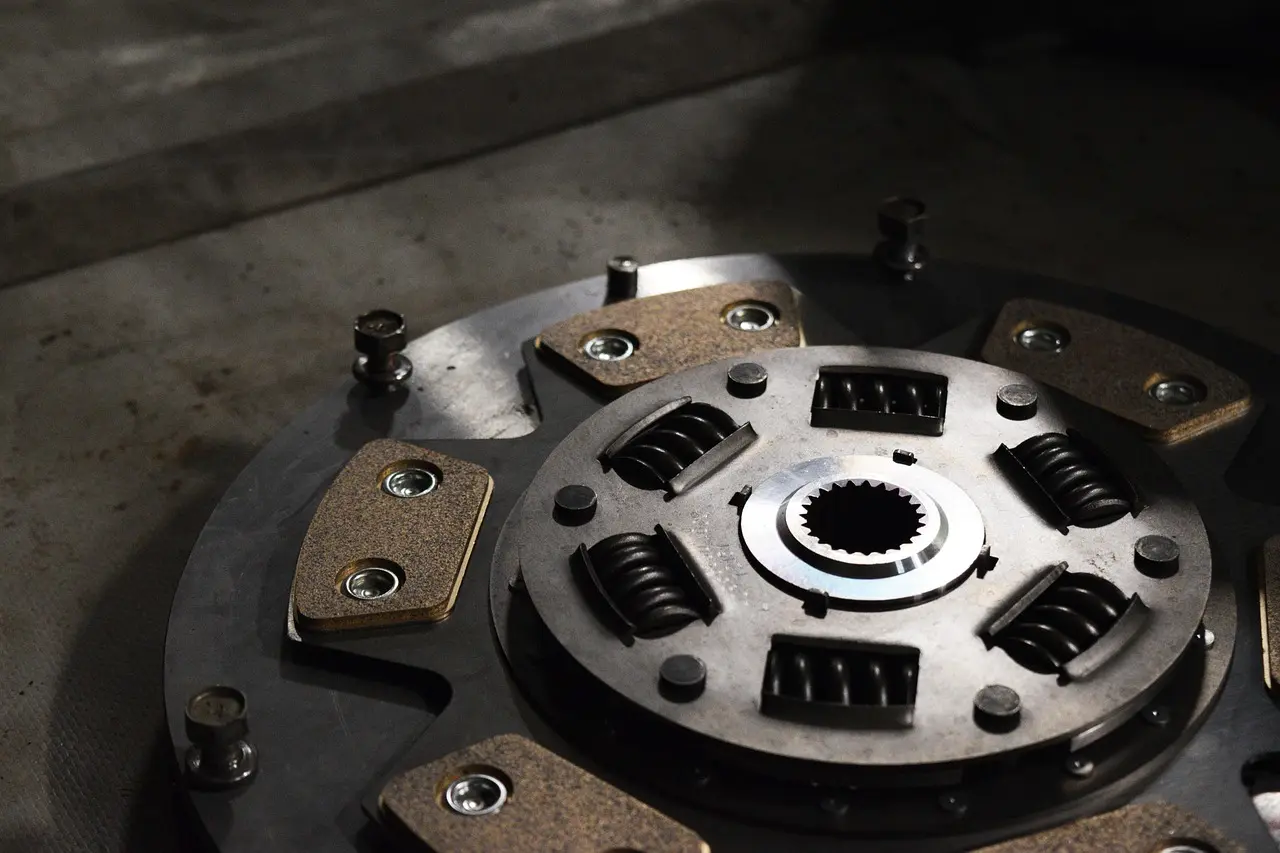
If the pedal moves freely by hand and the return spring is intact, the fault may sit in the cross shaft, pressure plate, or slave side of the release system. The cross shaft sits inside the transmission and transfers pedal pressure to the clutch release bearing. That makes it a deeper fault than a blocked mat or worn hinge.
What hydraulic faults can hold the pedal down?
Hydraulic faults can hold the pedal down by losing pressure, trapping pressure, or restricting fluid movement. The clutch master cylinder and clutch slave cylinder are the main failure points. A clutch hydraulic hose can also be pinched or blocked, which can change pedal feel without an obvious leak.
Clutch master cylinder symptoms
A defective master or slave cylinder can first show up as pedal stiffness. With the master cylinder, the pedal may sink, return slowly, or feel inconsistent from one press to the next. If the reservoir level is low or the pedal improves after pumping, suspect pressure loss or internal bypass.
Clutch slave cylinder symptoms
The slave cylinder works with the master cylinder to move the release mechanism. If it leaks, binds, or fails to travel fully, disengagement can become weak or inconsistent. A slave-side issue often shows up as hard shifting, creeping, or a pedal that does not return with the same speed every time.
Pinched or blocked hydraulic hose
The clutch hose is a flexible component found in hydraulic systems. A pinched hose can change pedal feel and restrict fluid or pressure flow. A hose crushed by a bracket, kinked during a previous repair, or blocked internally can mimic a bad cylinder, so the line deserves a close visual check.
What mechanical clutch faults can cause the same symptom?
Mechanical faults can make a clutch pedal stick down even without hydraulics. The usual suspects are a worn clutch cable, worn linkage, pivot wear, and deeper release faults such as cross shaft or pressure plate problems. In these systems, free play and return action matter a lot.
Worn clutch cable
Mechanical clutch systems can use a clutch cable instead of hydraulics. A worn cable can stretch, fray, drag in its sheath, or bind near its ends. That can change pedal effort and return, and it can make the pedal feel sticky before the cable gives a full failure warning.
Worn linkage and cross shaft wear
The clutch linkage includes rods and arms that transfer movement from the pedal to the release hardware. Wear at a clevis pin, bushings, or an arm pivot can add drag. The cross shaft sits inside the transmission, and failure there can make the pedal hard to move while affecting release bearing action.
Pressure plate and release-side faults
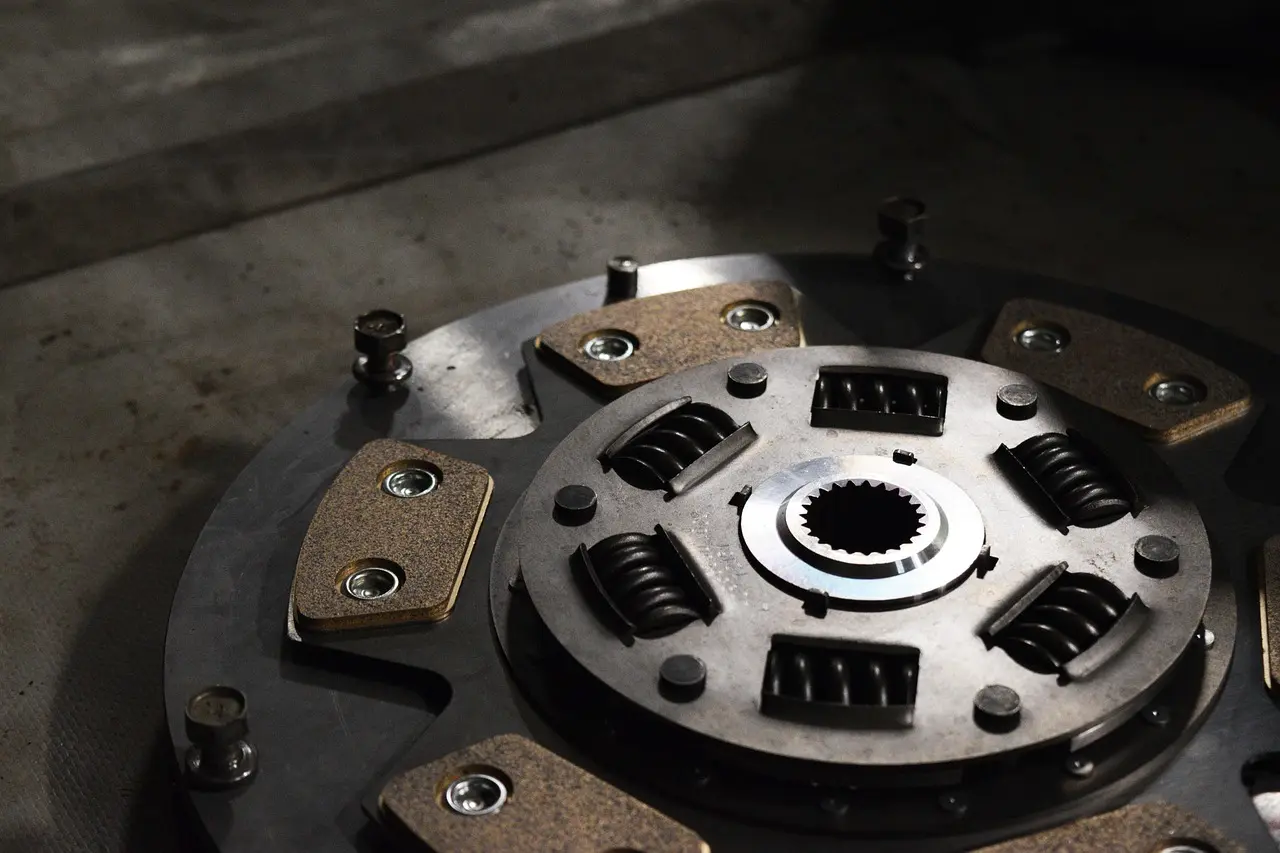
The pressure plate is a high-friction, high-pressure component in the clutch assembly. If it warps, breaks, or binds, the pedal can feel wrong and shifting can suffer. Release-side faults are harder to confirm from the driver’s seat, so treat them as deeper faults after the external checks are clean.
Which checks should you do first?
Use symptom pattern, then check the simplest branch first. The order is: pedal area, free play or adjustment, then hydraulic or cable checks based on system type. The matrix below ties that order to a no-start test and a stop-driving threshold so you do not replace parts blindly.
| Symptom pattern | Likely subsystem, DIY check, no-start test, stop-driving threshold |
|---|---|
| Pedal will not return at all | Likely pedal mechanism or return spring. Check for mats, trim, debris, and hinge bind. No-start test: press and lift the pedal by hand with the engine off; if it frees up, the pedal side is suspect. Stop driving if the pedal stays on the floor. |
| Pedal rises slowly after each press | Likely hydraulic restriction or weak return path. Check fluid level, hose routing, and pedal pivot. No-start test: pump the pedal several times with the engine off; if feel changes, the master cylinder or hose is high on the list. Stop driving if shifting becomes difficult. |
| Pedal sticks down only after pumping | Likely master cylinder, slave cylinder, or trapped air. Check for leaks, wet fittings, and low fluid. No-start test: hold the pedal down for a short time; if it slowly sinks, suspect hydraulic bypass. Stop driving if the clutch will not disengage cleanly. |
| Pedal feels heavy and does not return with normal force | Likely worn cable, linkage bind, or pivot ball wear. Check clutch adjustment or free play first, then inspect rods, arms, and cable routing. No-start test: turn the engine off and move the pedal by hand; binding points to a mechanical fault. Stop driving if the pedal effort keeps increasing. |
| Pedal feels normal but gears resist selection | Likely release-side or pressure-plate issue. Check for full slave travel, cross shaft movement, and abnormal noises. No-start test: select reverse with the engine running; grinding or creeping means release is incomplete. Stop driving if gear changes grind or the car creeps with the clutch down. |
Step-by-step check sequence
- Remove loose mats and clear the pedal area.
- Press the pedal by hand and watch the return path.
- Check clutch free play or adjustment, especially on cable and linkage systems.
- Inspect the clutch cable, linkage, and pivot points for wear or binding.
- On hydraulic systems, check fluid level, leaks, hose routing, and cylinder condition.
- Confirm whether the pedal improves after pumping or stays abnormal.
When is it unsafe to keep driving?
If the pedal stays on the floor, the clutch will not release, or the car grinds into gear, stop driving. A short move to a repair shop may be reasonable only if the pedal still returns, shifts remain clean, and the fault is limited to slight heaviness or slow return. If not, the risk rises fast.
Signs that call for stopping now
Stop driving if the pedal no longer comes back, the vehicle creeps with the clutch depressed, the gearbox grinds on shifts, or fluid loss appears under the car. Those signs point to a failure that can leave you stranded or make shifting impossible.
Why some failures need a mechanic
Some repairs are complicated and may need a mechanic, especially when the fault sits in the cross shaft, pressure plate, slave cylinder mount, or internal linkage. Those parts often require transmission-side access, special bleeding steps, or careful adjustment that is hard to judge from outside.
Frequently asked questions
why does my clutch pedal stuck down
Start with the pedal area, then the return spring, pivot, and free play. If the pedal rises by hand but not on its own, the hydraulic side moves up the list. If it binds even with the engine off, the fault is more likely in the pedal mechanism or linkage.
why does my clutch pedal stuck down sometimes
Intermittent sticking usually points to a part that binds only under certain pedal angles or temperature changes. That can be a cable, a pedal pivot, or a master cylinder that starts to bypass after repeated use. A loose mat or trim piece can also cause a random catch.
why does my clutch pedal keep getting stuck down
If the pedal keeps sticking down, treat it as a progressing fault, not a minor annoyance. Repeated sticking can come from a worn cable, air or fluid loss, or a return mechanism that is failing more each day. The longer it continues, the more likely shifting problems become.
why does my clutch pedal get stuck when i press down on it
A pedal that binds on the downstroke often points to friction in the hinge, a misrouted cable, or a hydraulic restriction that is resisting movement. Check for blocked pedal travel first. If the pedal also feels heavier than normal, the release system may be adding load.
what does it mean when your clutch pedal stays down
A pedal that stays down usually means the return path is failing or hydraulic pressure is not recovering. That can involve the master cylinder, slave cylinder, hose restriction, or a pedal spring and pivot problem. It is not a symptom to ignore, because shifting can fail suddenly.
is it safe to drive if the clutch pedal stays down
No, not in normal traffic. A pedal that stays down can leave you unable to disengage the clutch, which makes starting, stopping, and shifting hazardous. If the pedal will not return or the car grinds into gear, the safe move is to stop driving and arrange repair.
Products related to this article
Sponsored / affiliate links. As an Amazon Associate I earn from qualifying purchases. I may earn additional commission from eligible campaigns.