How to Adjust Clutch Pedal Free Play Correctly
Set clutch pedal free play to the service-spec value, commonly about 10–25 mm at the pedal, and stop adjusting if the pedal still slips, drags, or stays noisy. Too much or too little travel can burn the clutch, prevent full disengagement, or hide a failing cable, master cylinder, slave cylinder, or release bearing. This guide shows how to measure free play, adjust cable or hydraulic systems, and tell a normal setting problem from a repair issue.
What you’ll need

- Owner’s manual or factory service data for the exact model
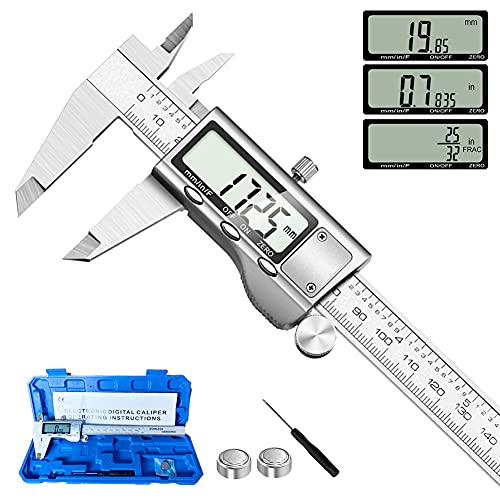
- Ruler or vernier caliper marked in mm and inches
- Wrench set for the cable adjuster, locknut, or pedal stop bolt
- Pliers for clips, cotter pins, or return spring hardware
- Flashlight or inspection light
- Wheel chocks
- Gloves
- Shop rag
How do you measure free play?
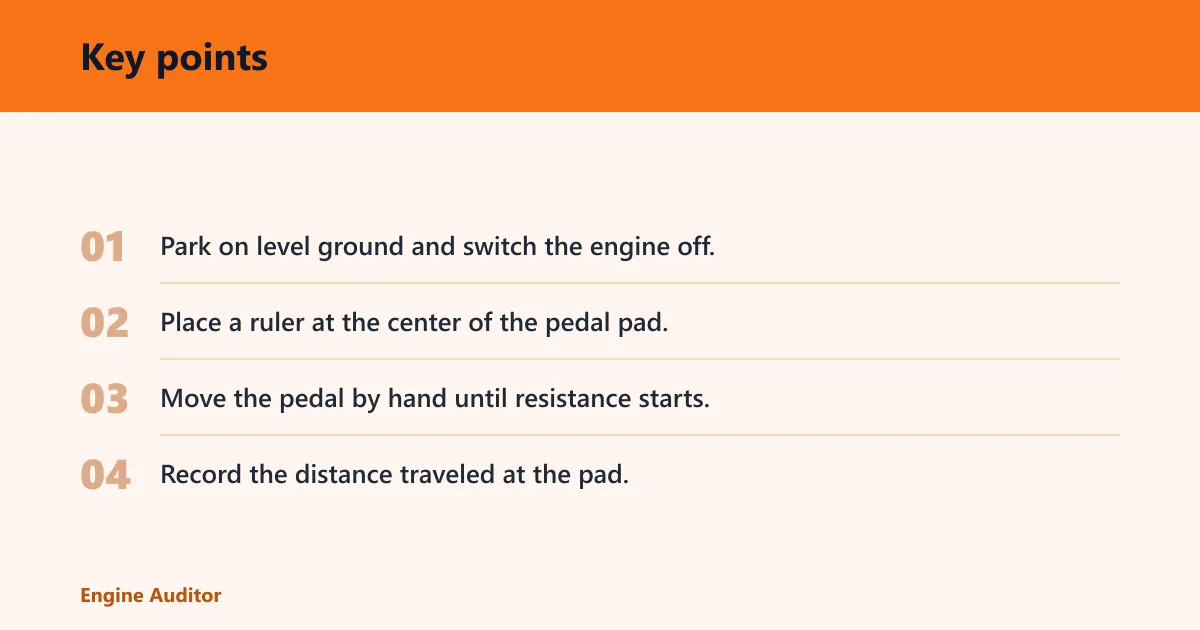
Measure the first movement at the pedal pad before the clutch starts to load. Park on level ground, switch the engine off, and press the pedal by hand until you first feel resistance. That top-of-travel movement is free play. Compare that reading with the service manual, because the correct value commonly varies by make and model.
Measure at the pedal pad
- Park on level ground and switch the engine off.
- Place a ruler at the center of the pedal pad.
- Move the pedal by hand until resistance starts.
- Record the distance traveled at the pad.
That number is not the engagement point. Engagement is where the clutch begins to drive the transmission under power; free play is the unused travel at the top of the pedal stroke before the release system starts moving.
Compare the reading to factory spec
Most manufacturers list free play in mm or inches in the service manual, often with an acceptable range rather than a single number. Use that range, not a universal figure. If the reading is outside spec, the pedal may need cable, pushrod, or stop-bolt adjustment, or the issue may be wear that adjustment cannot fix.
Locate the adjustment point
Find the hardware that actually changes the setting before you turn anything. Cable systems usually use a threaded cable adjuster at the pedal end or transmission bracket. Hydraulic systems may have a pushrod, clevis, and locknut at the pedal or master cylinder, and some have a pedal stop bolt that sets height rather than release travel.
Cable adjuster location
Look near the clutch cable sheath where it attaches to the clutch fork or bellhousing bracket. A cable adjuster may use a threaded sleeve and locknut, sometimes with a return spring on the fork. Turning that adjuster changes cable tension and therefore free play.
Pushrod, clevis, or pedal stop
On hydraulic systems, look at the pedal-to-master-cylinder pushrod, clevis pin, yoke, and locknut, or at a stop bolt near the pedal arm. A pedal stop changes height; a pushrod changes the rest position of the master cylinder piston. Those are different settings.
Can a hydraulic clutch be adjusted?
Sometimes, but not in the same way as a cable clutch. Many hydraulic systems allow pedal-height or pushrod adjustment only, while free play is often determined by the master cylinder, slave cylinder, and release bearing geometry. If the pedal has no meaningful adjustment, bleeding or repair may be the correct next step, not more tightening.
What hydraulic systems can and cannot change
- Check the service manual for a pedal free-play or pushrod spec.
- Inspect the master cylinder pushrod, clevis, and locknut.
- Adjust only within the specified range, usually by turning the clevis or pushrod end.
- Stop if the pedal loses return, the release point rises too high, or the clutch starts to slip.
Signs of air, wear, or a faulty cylinder
Spongy pedal feel, a changing engagement point, fluid loss, or a pedal that slowly sinks points away from simple adjustment. Air in the system, worn seals, or a weak slave cylinder can change release travel without changing pedal stop position. Repeated adjustment will not cure that.
Adjust pedal height and free play
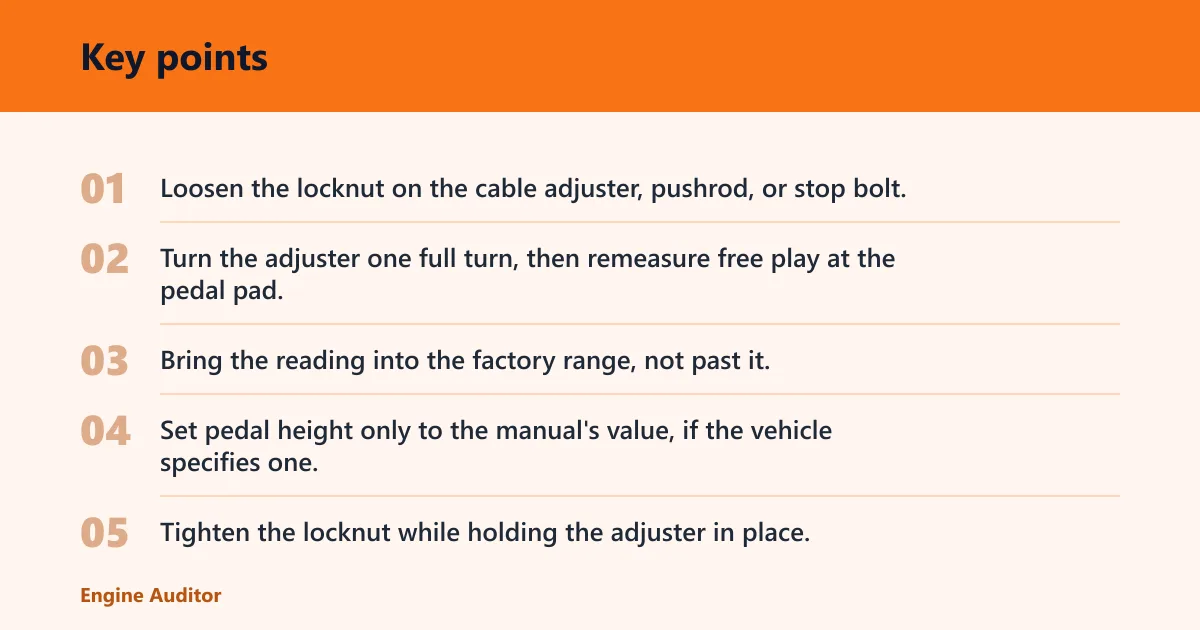
Set free play and pedal height separately, then recheck both. Pedal height sets where the pedal rests. Free play sets when the release system begins to move. Make changes in small steps, then confirm the clutch fully disengages in first and reverse before driving normally.
Step-by-step adjustment
- Loosen the locknut on the cable adjuster, pushrod, or stop bolt.
- Turn the adjuster one full turn, then remeasure free play at the pedal pad.
- Bring the reading into the factory range, not past it.
- Set pedal height only to the manual’s value, if the vehicle specifies one.
- Tighten the locknut while holding the adjuster in place.
- Recheck free play after tightening, because the setting can shift.
For many cable systems, one full turn is a practical increment. For a hydraulic pushrod, a half-turn may change pedal height and release point noticeably. If the pedal now sits higher but the clutch still drags, stop chasing the pedal and inspect the release system.
Say the cable-clutch pedal has about 35 mm of free play and the manual calls for about 15 to 20 mm. Back the adjuster in one-turn steps, then confirm that reverse engages cleanly. If the pedal returns slowly or the release fork stays partly loaded, the return spring or cable may be binding.
Clutch adjustment decision table
| Symptom | Likely cause | Adjustment point | Cable clutch | Hydraulic clutch | Outcome |
|---|---|---|---|---|---|
| Hard shifting, gear grinding, reverse clash | Too much free play, incomplete release | Cable adjuster or pushrod | Usually adjustable | Sometimes adjustable; may need bleed or repair | Adjustable or inspectable |
| Clutch slips under load | Too little free play, release bearing preload, worn disc | Cable adjuster or pushrod | Adjustable if only slight over-tightening | Often inspectable; can be master/slave or disc wear | Adjustable at first, then repair if slip remains |
| High engagement point | Worn disc, misadjusted pedal stop, hydraulic wear | Pedal stop or pushrod | Adjustable or inspectable | Inspectable first | May require repair |
| Pedal does not return fully | Sticking cable, weak return spring, internal cylinder drag | Return spring, cable routing, pedal pivot | Inspectable; sometimes replace cable | Inspectable; may require master or slave repair | Usually repair |
| Clutch drag after correct setting | Warped disc, air in hydraulic system, release fork wear | None | Inspectable | Inspectable | Repair-only |
What if adjustment does not help?
If the pedal is in spec and the clutch still grinds, slips, or drags, stop adjusting. That points to the release system rather than the pedal setting. Check the release fork, throwout bearing, master cylinder, slave cylinder, pedal bushings, and cable routing before assuming the clutch disc itself is at fault.
If that didn’t work, inspect the release system
- With the engine off, press the pedal and feel for roughness or binding.
- Inspect the return spring, fork pivot, cable ends, and pedal bushings.
- Check hydraulic fluid level and look for wet seals at the master and slave cylinders.
- Have the system bled if the pedal feels spongy or the bite point changes day to day.
Suppose a hydraulic car still grinds reverse after the pushrod is set to the manual spec. That points away from pedal height and toward trapped air, a leaking seal, or a worn release bearing. More adjustment will not restore the missing travel.
Common mistakes
Overtightening the adjuster is the fastest way to create clutch slip. Too little free play can keep the release bearing loaded and may prevent full clamp force at the pressure plate. Too much free play can do the opposite: the clutch may not release far enough, so gears may grind and shifts can feel heavy.
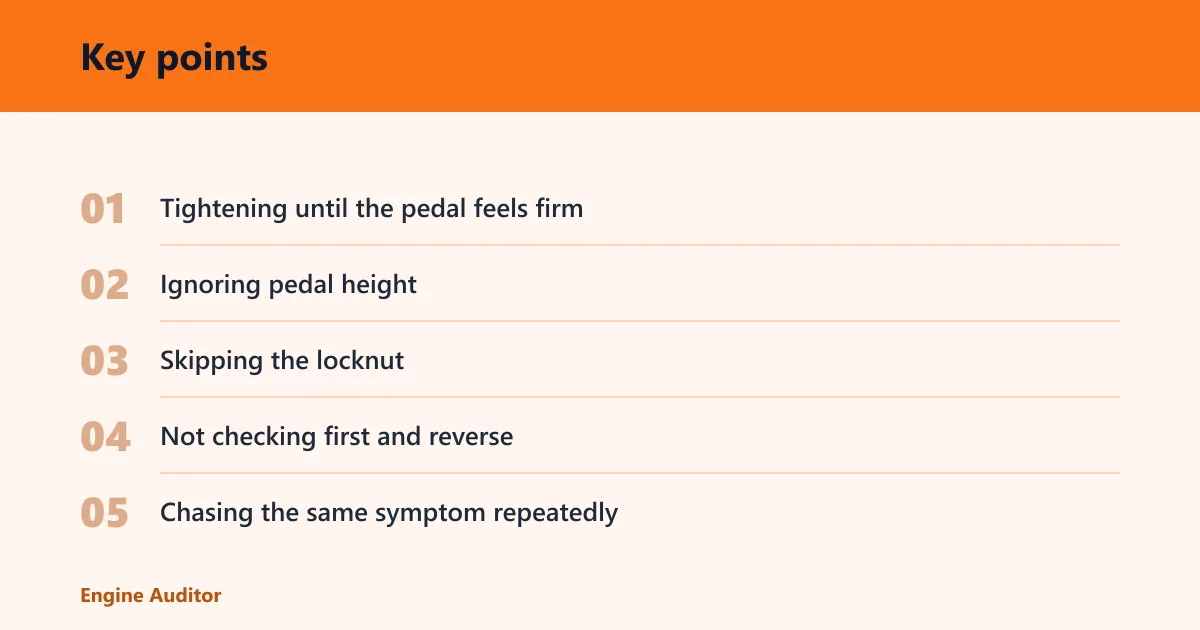
- Tightening until the pedal feels firm: that can leave the release bearing riding the clutch.
- Ignoring pedal height: a correct free-play value can still leave the pedal too high or too low.
- Skipping the locknut: the setting can drift after the first drive.
- Not checking first and reverse: those gears reveal incomplete disengagement fast.
- Chasing the same symptom repeatedly: a worn disc, fork, cable, or cylinder will not improve with endless adjustment.
After every change, tighten the locknut, then recheck the measurement at the pedal pad. Road test only after the clutch fully disengages with the engine running and the car on level ground. That final check catches drag before it becomes synchro damage.
Frequently asked questions
How do I adjust clutch pedal free play correctly?
Measure the top-of-travel movement at the pedal pad, compare it with the service manual, and adjust only the cable, pushrod, or stop bolt that the manual names. Recheck after tightening the locknut, then verify clean shifts into first and reverse with the engine running.
How much free play should a clutch pedal have?
There is no universal number. Most service manuals list a specific range in mm or inches, often around 10 to 25 mm at the pedal pad, but the correct value depends on the vehicle. Use the factory spec, not a rule of thumb.
Can the clutch pedal be adjusted on a hydraulic clutch?
Sometimes. Some hydraulic systems allow pushrod or pedal-height adjustment, while others need inspection or bleeding instead. If the manual gives no adjustment procedure, look for air, worn seals, or a failing master or slave cylinder instead of forcing a setting.
How do I adjust clutch pedal height?
Use the pedal stop bolt or the pushrod/clevis setting if the service manual specifies one. Height is not free play. Set the pedal to the factory value first, then confirm that free play still falls within spec and that the clutch fully releases.
What happens if clutch free play is too little?
Too little free play can keep the release bearing loaded and prevent the clutch from clamping fully. The usual result is slip under load, a burning smell, or a higher-than-normal engagement point. Back the adjuster off and recheck the pedal at the pad.
What happens if clutch free play is too much?
Too much free play means the release system does not move far enough when you press the pedal. That causes hard shifting, gear grinding, or a clutch that drags in first or reverse. If adjustment cannot bring it back into spec, inspect the cable or hydraulic system.
Products related to this article
Sponsored / affiliate links. As an Amazon Associate I earn from qualifying purchases. I may earn additional commission from eligible campaigns.