Can a Bad Brake Booster Make the Pedal Hard?
Yes. A bad brake booster can make the pedal hard, especially when vacuum assist is missing at startup or after a few presses. This guide shows the fastest checks for the booster, hose, check valve, vacuum pump, calipers, master cylinder, and alternate assist systems.
Brake booster basics
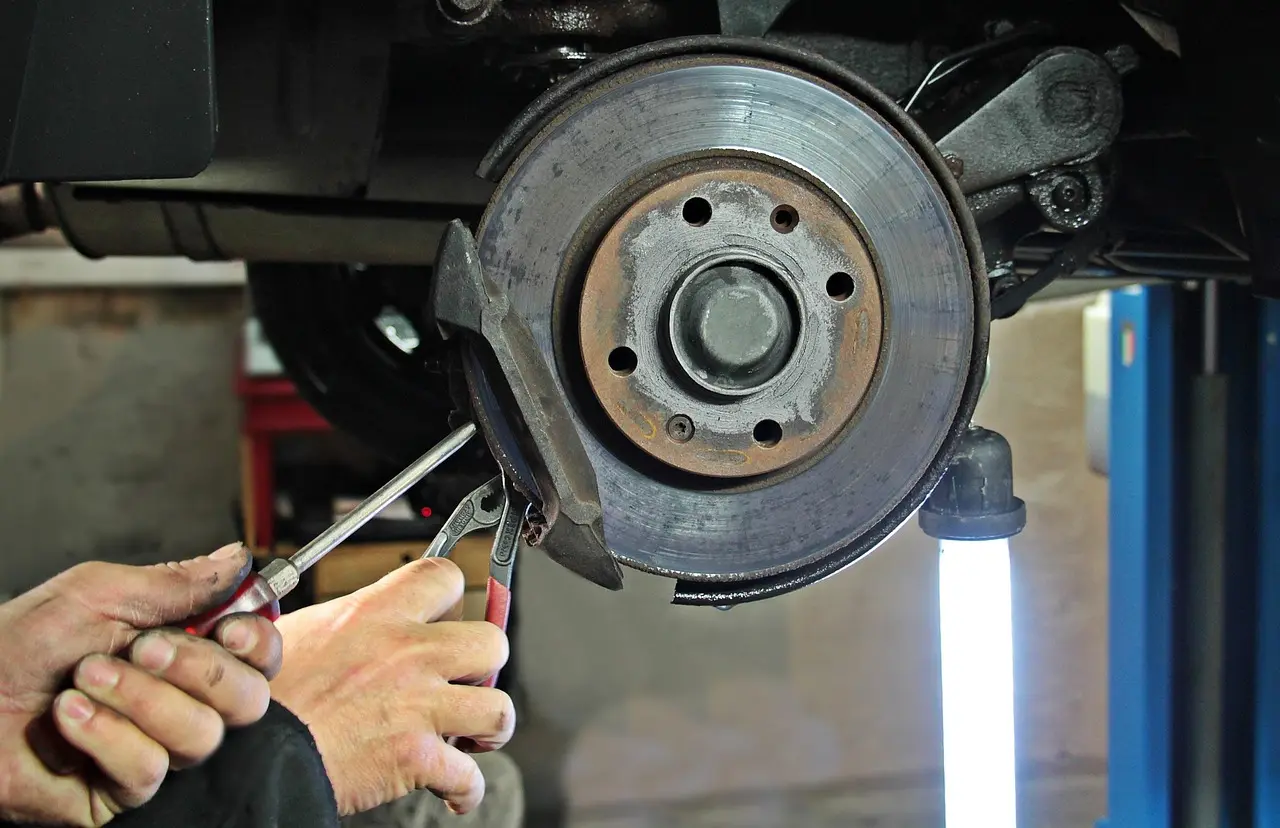


A hard brake pedal usually means lost power assist, not a fluid-pressure problem. The vacuum brake booster sits between the brake pedal and master cylinder, and it uses engine vacuum to multiply pedal force. On many systems, that assist can reduce the effort needed at the pedal by roughly a few times compared with manual brakes. For a general overview of how vacuum boosters work, see Brake Booster Basics and brake booster diagnosis guidance.
When vacuum assist disappears, the pedal still moves the brakes, but it takes far more leg force. That is why a hard pedal often feels sudden and unfamiliar. It is the opposite of a soft or sinking pedal, which points more toward hydraulic trouble. OEM and high-authority service references such as Honda/Acura service information and Toyota owner/service resources describe vacuum-assisted brake systems and their fault patterns similarly.
Where the booster sits and what can fail
The booster is mounted between the pedal linkage and the master cylinder. If its diaphragm fails, or if vacuum supply is lost, the pedal may feel hard all the time or become hard after a few presses. The usual suspects are the booster itself, the vacuum hose, the check valve, or the vacuum source. NHTSA also notes that power-brake assistance loss can significantly increase stopping effort and stopping distance; see NHTSA brake equipment guidance.
Most hard-pedal complaints are booster or vacuum related. That does not mean the booster is always bad. It means the first job is to separate lost assist from a hydraulic fault, a stuck caliper, or a vehicle with a different assist system.
Can a bad brake booster make the pedal hard?
Yes. A failed booster diaphragm or lost vacuum can make the pedal hard because the assist that multiplies your foot force is gone. If the booster cannot store or apply vacuum, the pedal may be hard from the first press, or it may feel normal once and then get stiffer with repeated presses.
Why lost vacuum changes pedal effort
The booster depends on a vacuum difference to help push the master cylinder. If that vacuum supply is missing, the pedal still works hydraulically, but your foot now supplies nearly all the force. That is why the pedal can feel suddenly heavy without any change in brake fluid level. In service literature, this is the same basic vacuum-reserve principle used across many light-duty power brake systems.
Say your sedan idles fine, but the brake pedal is stiff every time you stop. If the engine-off test also shows no pedal drop at startup, the pattern points more toward lost assist than toward the master cylinder or a caliper issue.
Hard brake pedal: What the test result means
| Symptom/test result | Likely cause | What to inspect next | What to rule out |
|---|---|---|---|
| Hard all the time | Total loss of vacuum supply or failed booster diaphragm | Vacuum hose, check valve, booster, vacuum source | Master cylinder as the main cause of a hard pedal |
| Hard only after repeated presses | Vacuum reserve depletion | Check valve, hose leaks, booster reserve function | Soft or sinking pedal faults |
| Hard after sitting overnight | Vacuum bleed-down while parked | Check valve and booster leak-down behavior | A full-time hydraulic failure |
| Hard with hissing | Booster diaphragm leak or hose leak | Listen near the firewall, inspect hose connections | A quiet, sealed assist system |
| Hard with idle change | Vacuum leak affecting engine idle | Vacuum hose, booster grommet, intake connection | A purely hydraulic problem |
| Hard plus one hot wheel or pulling | Seized brake caliper or stuck slide | Wheel heat, brake drag, caliper movement | Booster failure as the only fault |
| Hard only engine off | Normal loss of assist after vacuum is used up | Compare with engine-on feel and pedal drop test | Booster failure by itself |
| Hard on a hybrid or diesel | Vacuum pump, hydroboost, or electronic brake assist issue | Pump output, assist system type, electrical faults | An intake-manifold vacuum diagnosis that does not fit the vehicle |
| Hard pedal with poor engine idle only at stop | Vacuum leak that affects both idle and booster assist | Booster hose, check valve, grommet, intake connection | A master cylinder fault that would usually change pedal feel, not idle quality |
| No pedal drop but hose tests good | Booster internal failure or non-vacuum assist problem | Booster diaphragm, vacuum reserve, assist type, pump output on equipped vehicles | The hose as the only fault |
What the pattern usually means
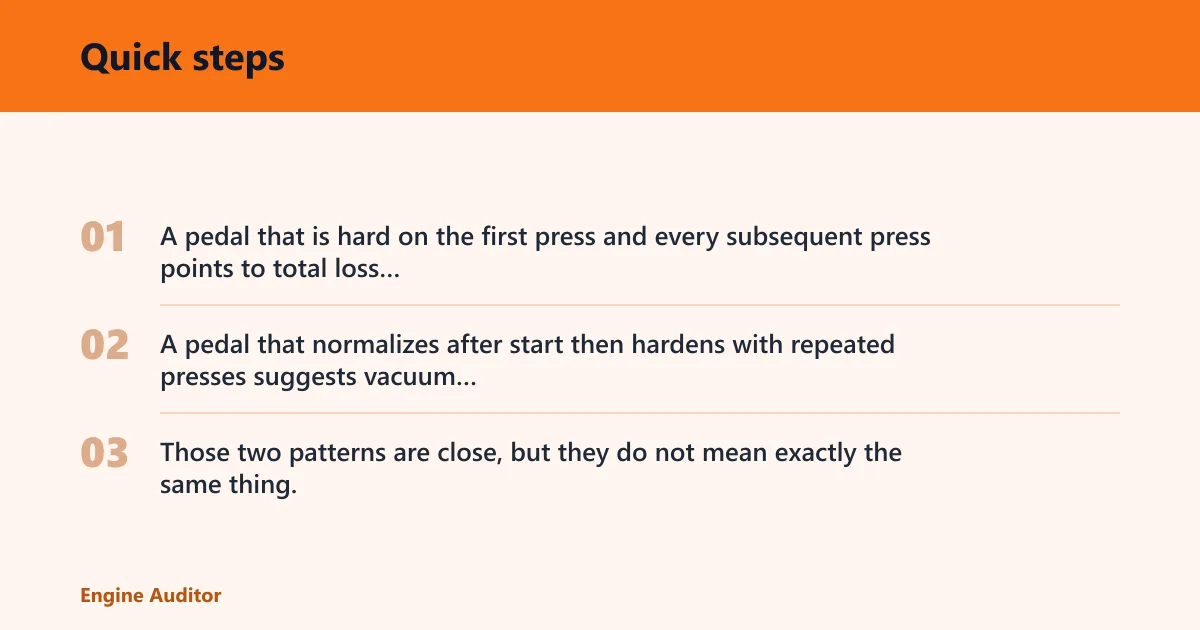
A pedal that is hard on the first press and every subsequent press points to total loss of vacuum supply. A pedal that normalizes after start then hardens with repeated presses suggests vacuum reserve depletion. Those two patterns are close, but they do not mean exactly the same thing.
The driveway test is quick and clear if you follow the steps in order. Pump the brake pedal with the engine off, hold steady pressure on the pedal, then start the engine while keeping your foot on the pedal. A pedal drop suggests the booster is fine. A pedal that stays hard suggests booster failure or no vacuum assist.
Step by step
- Turn the engine off.
- Press the brake pedal several times to remove stored assist.
- Hold moderate pressure on the pedal.
- Start the engine while keeping pressure on the pedal.
- Watch and feel for a pedal drop.
- Listen for hissing and note any idle change.
If the pedal drops when the engine starts, vacuum assist is reaching the booster. If it stays hard, the problem is usually upstream in the vacuum supply or inside the booster itself. That result does not prove the master cylinder is bad.
What else can make the pedal hard?
Several faults can mimic booster failure. The vacuum hose can crack, split, collapse, or disconnect, and that is a cheaper first check than replacing the booster. A bad check valve can also make subsequent quick stops progressively stiffer because stored vacuum bleeds off between presses.
Vacuum hose problems
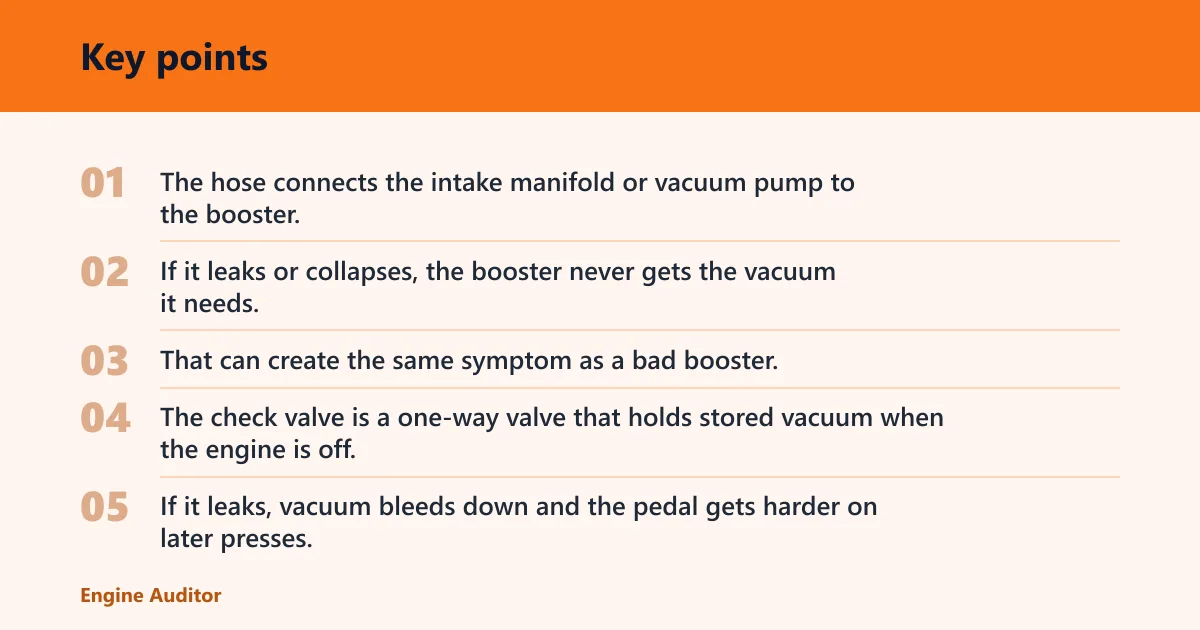
The hose connects the intake manifold or vacuum pump to the booster. If it leaks or collapses, the booster never gets the vacuum it needs. That can create the same symptom as a bad booster, so inspect the hose before assuming the booster has failed.
Brake booster check valve failure
The check valve is a one-way valve that holds stored vacuum when the engine is off. If it leaks, vacuum bleeds down and the pedal gets harder on later presses. On many vehicles, the valve sits on the booster or in the vacuum hose.
Vacuum pump failure
Some turbocharged engines, diesels, hybrids, and electric or modern assist setups do not rely on intake-manifold vacuum alone. A weak or failed vacuum pump can create the same hard-pedal symptom. On those vehicles, a booster test that assumes manifold vacuum can send you in the wrong direction.
Picture a diesel pickup with a pedal that feels normal at first, then gets stiff after a few stops in traffic. That pattern can fit a weak vacuum pump just as well as a booster problem, so the assist source matters before any parts are replaced.
Seized brake caliper
A seized caliper can create unusual braking effort and usually brings side-pull or hot-wheel symptoms. It does not usually make the pedal hard in the same way a lost-booster system does, but it can make the vehicle feel difficult to stop because one wheel is dragging.
Master cylinder problems
A bad master cylinder often causes a sinking or spongy pedal rather than a hard pedal. That makes it an important differential diagnosis. If the pedal is firm but hard, the first suspicion stays with assist loss. If the pedal sinks at a stop, the master cylinder moves higher on the list. If the pedal feel changes under steady pressure, that also leans hydraulic rather than vacuum assist.
What should I check first when the brake pedal goes hard?
Start with the easiest checks: the vacuum hose, the check valve, and the engine-off/engine-on pedal test. Those checks can separate a cheap hose fault from a booster or vacuum source problem before any parts are replaced. If the vehicle uses a pump, hydroboost, or electronic assist, confirm the assist type first.
- Inspect the vacuum hose for cracks, splits, collapse, or disconnection.
- Check the one-way valve for bleed-down.
- Run the pump-then-hold startup test.
- Listen for hissing near the booster and firewall.
- Check for hot-wheel or pull symptoms that point to a caliper.
- Confirm whether the vehicle uses a vacuum booster, hydroboost, or electronic assist.
A common first-timer mistake is blaming the brake booster when the stiff pedal is really caused by a cracked vacuum line at the intake manifold. If the hose is split near a clamp, the symptom can look exactly like booster failure, but the fix is far cheaper.
Is it safe to drive with a hard brake pedal?
A sudden hard brake pedal is unsafe and should be treated urgently. Stopping distance can increase quickly when the booster is not helping. If the pedal is unexpectedly hard, reduce driving and arrange inspection as soon as possible.
When to stop driving
Stop driving if the pedal is extremely hard, the vehicle needs much more leg effort than normal, or the braking feel changes sharply after startup or repeated stops. Also stop if the hard pedal comes with a hot wheel, burning smell, or strong pull to one side.
What to avoid before repair
Do not keep cycling the pedal just to see if the feel changes. That can drain the remaining vacuum reserve and make diagnosis harder. If the vehicle has a vacuum pump, hydroboost, or electronic brake assist, do not assume a standard booster replacement will solve it.
Frequently asked questions
What can cause a hard brake pedal?
The most common cause is lost power assist from the booster circuit. Start with the vacuum hose, check valve, and booster, then consider a weak vacuum pump or an alternate assist fault on diesel, hybrid, or electronic systems. A seized caliper can add drag, but it is less common.
What causes a extremely hard brake pedal?
An extremely hard pedal usually means the assist is gone almost completely. That can happen with total vacuum loss, a failed booster diaphragm, a bad check valve that bleeds off stored vacuum, or a failed vacuum pump. If the pedal is hard from the first press, treat it as urgent.
Why is my brake pedal hard when the engine is off?
That can be normal after the stored vacuum is used up. The booster only helps while it has vacuum reserve. If the pedal is hard only with the engine off but softens after startup and drops during the test, the assist system is likely working.
Can a bad check valve make the brake pedal hard?
Yes. The check valve keeps stored vacuum from bleeding away when the engine is off. If it leaks, the next stop can feel stiffer, especially after the vehicle sits or after a few quick presses. That is why repeated-stop stiffness often points to the valve or a leak.
How do I tell if it’s the booster or the vacuum hose?
Check the hose first because it is the cheaper failure. Look for cracks, splits, collapse, or a loose connection, then run the engine-off pump-then-hold test. If the pedal drops at startup, vacuum assist is reaching the booster. If it stays hard, inspect the hose, valve, and booster again.
Can a hard brake pedal be caused by the master cylinder?
Usually not. A master cylinder problem more often causes a sinking, spongy, or inconsistent pedal than a hard one. If the pedal is firm but difficult to press, the assist system is the better place to start. If the pedal sinks under pressure, the master cylinder moves higher on the list.
Products related to this article
Sponsored / affiliate links. As an Amazon Associate I earn from qualifying purchases. I may earn additional commission from eligible campaigns.