Why Does My Gas Pedal Lag When I Press It?
A gas pedal lag usually means the throttle, fuel, ignition, transmission, or traction-control system is delaying torque; if the delay is sudden, worsening, or paired with a flashing check-engine light, stop driving. Ignoring it can turn a simple sensor fault into a stall, limp mode, or unsafe merge. This guide helps you match the lag pattern to the likely subsystem and separate safe DIY checks from failures that need towing.
What pedal lag feels like
Throttle lag is the gap between pressing the accelerator and getting engine response. That is different from broad power loss, limp mode, and a loose or sticking pedal. The symptom pattern matters, because a delayed tip-in can point to one subsystem, while no response or sustained weakness points to another.
Lag versus power loss
Lag is usually a pause before the engine reacts. Power loss is different: the engine responds, but weakly, and the car stays slow through the pull. A clogged fuel filter, weak fuel pump, restricted catalytic converter, or misfire can all feel like power loss rather than a brief delay.
Lag versus limp mode
Limp mode is commonly reported to come with limited throttle opening, reduced RPM, and a stored fault code. The car may move, but the ECU has reduced engine output to protect hardware. That is not the same as a one-second pause from a dirty throttle body or a contaminated MAF sensor.
Lag versus a loose or sticking pedal
A loose-feeling pedal can mean excess play in the pedal assembly, a floor mat issue, or a worn hinge point. A sticking pedal feels physically resisted or slow to return. By contrast, electronic lag feels normal underfoot but slow at the engine. Modern cars use drive-by-wire electronic throttle control, so the pedal is an input device, not a direct throttle cable.
Why does my gas pedal lag when I press it?
Lag often shows up in specific situations, and those situations point to different faults. Launch hesitation, warm-only hesitation, and uphill lag are not the same complaint. If the delay happens only under load, the fuel system or exhaust restriction rises on the list. If it happens at idle or light tip-in, throttle or airflow faults move up.
Launch hesitation
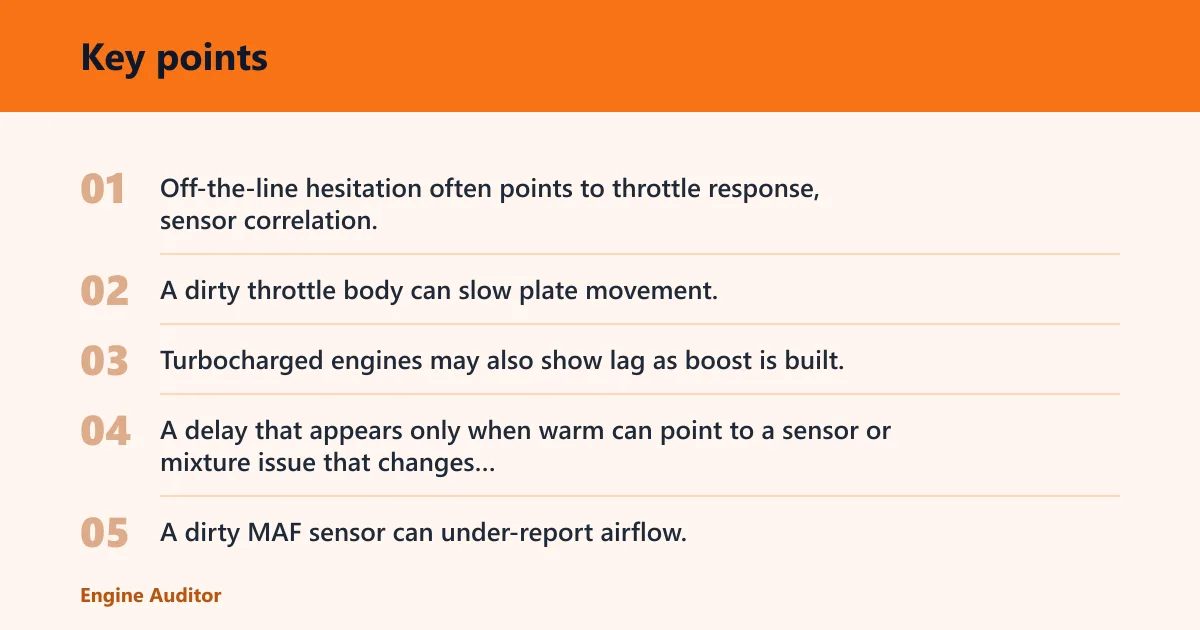
Off-the-line hesitation often points to throttle response, sensor correlation, or fuel delivery. A dirty throttle body can slow plate movement, and a weak fuel pump can fall short just as load rises. Turbocharged engines may also show lag as boost is built, which can feel normal unless the delay becomes excessive or inconsistent.
Warm-only hesitation
A delay that appears only when warm can point to a sensor or mixture issue that changes with heat. A dirty MAF sensor can under-report airflow, and a weak fuel pump may lose output when hot. A catalytic converter that is starting to restrict flow can also feel worse after the exhaust heats up.
Uphill lag and passing-lane lag
Load-related lag is a warning sign. A car that feels fine on flat roads but falls flat on a hill often has a fuel-pressure, exhaust, or ignition problem. A passing-lane delay is more serious, because it can leave you waiting for torque when you need it immediately.
Say your sedan pulls cleanly at 30 mph on level streets, then hesitates for two seconds when you merge uphill. That pattern is more useful than a vague “it feels slow,” because it points toward load-sensitive faults such as weak fuel pressure, a misfire under load, or exhaust restriction.
Pedal lag symptom table
This table matches the driving situation to the most likely subsystem, the part to inspect first, the fastest check, and the point where driving becomes unsafe. Use it to narrow the problem before replacing parts.
| Driving situation | Likely subsystem | Likely part | Fastest check | Stop-driving warning |
|---|---|---|---|---|
| Launch hesitation from a stop | ETC or fuel delivery | APPS, throttle body, fuel pump | Read OBD-II codes first, then watch pedal-to-throttle live data on the scanner | Stop if the car surges, stalls, or barely moves |
| Warm-only hesitation after 15 to 20 minutes | Fuel or airflow | MAF sensor, fuel pump, catalytic converter | Check live MAF readings and fuel trims | Stop if power drops sharply as speed rises |
| Uphill lag under steady throttle | Fuel, exhaust, ignition | Fuel pump, spark plugs, catalytic converter | Look for lean or misfire codes and load-related dropoff | Stop if the engine cannot maintain speed |
| Passing-lane lag at highway speed | ETC or exhaust restriction | Throttle actuator, catalytic converter | Check for delayed throttle angle or high-RPM sluggishness | Stop if response is delayed in traffic |
| Intermittent lag on bumps or turns | Wiring or sensor correlation | APPS connector, throttle connector | Wiggle-test harnesses and inspect plugs for looseness | Stop if throttle response cuts in and out |
| No response after pedal input | ETC failure | APPS, throttle actuator, ECU logic | Read codes and verify pedal signal on the scanner | Stop immediately; do not keep driving |
| Hesitation with hissing sound | Vacuum leak | Cracked hose, intake gasket | Listen near the intake and inspect for unmetered air | Stop if the idle is unstable or power is erratic |
| Misfire feel under load | Ignition | Spark plugs | Inspect plug wear, fouling, and gap condition | Stop if the check engine light flashes |
How electronic throttle control fails
Modern cars use drive-by-wire electronic throttle control, so your foot sends a signal instead of pulling a cable. The accelerator pedal position sensor reads pedal travel, the ECU compares that input with other data, and the throttle actuator opens the plate. If any part of that chain disagrees, delay or dead-pedal feel can follow.
Accelerator pedal position sensor input
The APPS must agree with ECU expectations across pedal travel. If the signal is noisy, mismatched, or drops out for a split second, the ECU may delay response or limit throttle opening. That can create intermittent lag patterns, especially if the fault appears only when the harness moves or warms up.
Throttle actuator response
The throttle body contains an electric actuator that moves the throttle plate. Carbon deposits can make the plate stick or return slowly, and a dirty throttle body can be cleaned with throttle-body cleaner. After service, many vehicles need a calibration or relearn so the ECU can remap closed and open positions.
Calibration and reset after service
If the throttle body or battery has been serviced, a relearn may be needed before the idle and tip-in settle correctly. A failure to recalibrate can feel like hesitation even when the hardware is clean. If the problem began right after a cleaning, the service step itself may be incomplete rather than the wrong part being replaced.
Which engine faults are most likely?
After ETC faults, the most common causes are airflow, fuel, ignition, and exhaust problems. Fuel delivery issues are often the leading cause of lag. A clogged fuel filter can restrict flow, a weak fuel pump can cause inadequate fuel pressure, and a dirty MAF sensor can send incorrect air measurements. The first job is to separate short hesitation from true power loss.
Throttle body and MAF sensor checks
A dirty throttle body can cause gas pedal lag, especially if carbon builds at the edge of the plate. Inspect the bore and plate for deposits and check whether the plate moves freely. A dirty MAF sensor under-reports airflow, which can make the engine run lean and hesitate during acceleration. Clean it only with sensor-safe cleaner, then verify the live data looks plausible.
Fuel pump and injector checks
Could a bad fuel pump make the accelerator lag? Yes. Weak pump output can show up first under load, when fuel pressure falls behind demand. Fuel injectors can also clog or stick, which distorts spray pattern and can create lean misfire symptoms. Pressure testing and flow testing separate a weak supply from a delivery problem at one cylinder bank or one injector.
Vacuum leaks, spark plugs, and catalytic converter restriction
Vacuum leaks from cracked hoses or intake gasket leaks add unmetered air, which often shows up as a lean condition and a hissing sound clue. Worn or fouled spark plugs can misfire under load, especially if the gap has widened. A restricted catalytic converter creates exhaust backpressure, which tends to feel like high-RPM sluggishness and broad power loss.
A common first-timer mistake is replacing a throttle body because the pedal feels slow, then ignoring a lean code that points to a vacuum leak or fuel issue. Another mistake is calling every stumble a “bad sensor” without checking whether the problem only appears uphill or only after the engine warms up.
What does the OBD-II scanner tell you?
A check engine light should trigger OBD-II code retrieval. The scanner helps you sort throttle, airflow, fuel, ignition, and exhaust faults before you buy parts. It also shows live data, which can reveal whether the pedal signal, throttle command, or airflow reading is the odd one out.
Useful trouble code families
Throttle and pedal codes often point toward APPS or ETC disagreement. MAF-related codes suggest airflow measurement trouble. Lean codes can come from vacuum leaks, fuel delivery problems, or a dirty MAF sensor. Misfire codes point more toward spark plugs, injectors, or fuel pressure. Catalyst-efficiency codes raise suspicion of restriction or a failing converter.
Live-data clues
Watch whether pedal input changes smoothly, whether throttle angle follows it, and whether airflow and fuel trim react as expected. If the pedal signal jumps but throttle angle lags, the ETC path deserves attention. If airflow reads low and fuel trims climb positive, the MAF or a vacuum leak moves up the list.
How to prioritize the next check
- Read codes and freeze-frame data.
- Look at live pedal, throttle, airflow, and fuel-trim data.
- Basic inspection of hoses, filters, and fluid levels is recommended, then inspect the air intake, vacuum hoses, and throttle body.
- Test fuel pressure if the symptom worsens under load.
- A dirty air filter can reduce throttle response, so check plugs, injectors, and exhaust restriction if the first checks do not explain the lag.
Can you keep driving it?
Delayed throttle response is dangerous when the vehicle stops responding under load, the throttle signal is intermittent, or the check engine light is flashing. A brief, mild hesitation with no warning lights may allow a short trip to a nearby shop, but a no-response event or repeated stall risk should end the drive.
When a DIY check is reasonable
Reasonable DIY checks include code reading, intake inspection, throttle-body inspection, and checking for loose connectors or cracked hoses. These are low-cost, low-risk steps. They are useful when the car still responds predictably and the symptom is mild, brief, and repeatable.
When a shop diagnosis is safer
If the lag is worsening, if the pedal feels normal but the car will not accelerate, or if the symptom appears in traffic at speed, a shop diagnosis is the safer move. Fuel-pressure testing, backpressure testing, flow testing, and ECU-level diagnostics are better left to equipment that can measure the system under load.
Frequently asked questions
Why does my gas pedal feel loose?
A loose pedal feel usually points to the pedal assembly, floor-mat interference, or wear at the hinge and pivot, not throttle lag itself. If the pedal moves normally but the engine responds late, the fault is more likely in the APPS, ETC system, or throttle body than in the pedal pad or return spring.
Why is my gas pedal not working?
If pressing the pedal produces little or no response, treat it as a drive-by-wire fault until proven otherwise. APPS failure, throttle actuator failure, connector damage, or ECU limp mode can all block response. If the car will not accelerate, stop driving and read codes before restarting the engine again.
Why is my gas pedal sticking?
A sticking pedal usually means mechanical binding at the pedal assembly or carpet interference, not a sensor fault. If the pedal returns slowly or catches partway, inspect the floor area first. If the pedal feels normal but the engine hesitates, the issue is more likely throttle body, fuel, or airflow related.
Can a dirty throttle body cause gas pedal lag?
Yes. Carbon deposits can slow throttle-plate movement and change how quickly airflow enters the engine. That can create a delayed tip-in or rough idle. Cleaning the bore and plate with throttle-body cleaner helps, but the ECU may also need a relearn afterward so the throttle angle matches the new clean position.
Could a bad fuel pump make the accelerator lag?
Yes. A weak fuel pump can cause inadequate fuel pressure, and the symptom often shows up first under load, uphill, or during passing. The engine may feel normal at light throttle but fall flat when demand rises. Pressure testing tells you whether the pump is out of spec before replacement.
Is delayed throttle response dangerous to drive with?
It can be. Delayed response is a safety issue if the car hesitates in traffic, will not merge cleanly, or cuts out intermittently when you press the pedal. A mild, steady hesitation may allow a short trip to a shop, but no-response events or flashing warning lights call for stopping the drive.
Products related to this article
Sponsored / affiliate links. As an Amazon Associate I earn from qualifying purchases. I may earn additional commission from eligible campaigns.