What Does an Engine Block Heater Do and Do You Need One?
A block heater warms the engine coolant and nearby metal so an engine can crank easier, start faster, and reach usable heat sooner; it is often useful when winter lows stay near 0°F (-18°C) or the vehicle is parked outside for long periods. Transport Canada, the CAA, and many OEM owner’s manuals frame the same basic rule: the colder the weather, the longer the outdoor exposure, and the older the battery, the more a heater can help. Skipped in those conditions, cold starts can drain the battery, thicken oil, and make wear and cabin heat worse. This guide explains what a block heater changes, when climate and parking make it worth installing, and when you can skip it.
This guide is part of our Cold Weather Car Battery Guide: Why It Dies, How to Test It and How to Keep It Alive series.
What a block heater changes


A block heater cuts the resistance your starter and battery face at startup. Cold oil gets thicker, so the engine turns over harder, and the battery has to supply more current just to move the crankshaft. OEM service literature and heater manufacturers consistently describe the same benefit: pre-warming the engine lowers cranking effort and improves start quality in subfreezing weather.
That is the main change. A warmer engine also reaches usable cabin heat sooner, and the first few minutes of running are less punishing on bearings, rings, and other moving parts. The benefit is biggest when the engine has sat long enough to fully cool.
Cold oil and startup strain
Cold engine oil does not flow as freely, so the starter works against more drag. That extra load matters most in extreme cold, where even a healthy battery can lose some of its output and a weak battery can fall short altogether. Battery performance loss in cold weather is widely documented in OEM manuals and battery manufacturer guidance, which is why a block heater and battery warmer are often paired in severe climates.
A block heater raises the temperature of the engine block, coolant, and, depending on the design, nearby oil. The goal is not to make the engine hot. It is to make the first crank less harsh.
What changes by heater type
Not every block heater warms the same part of the engine. Some warm coolant, some warm oil, and some warm the block or the space under the hood. That difference matters when you choose one for a specific vehicle and climate, because OEM manuals often specify the intended heater style and plug-in time for a given engine family.
A battery blanket or warmer is a separate accessory. It can help the battery hold performance in cold weather, but it does not replace an engine heater if the engine itself is the cold-start problem.
📊 Some sources recommend a block heater if temperatures regularly drop below 10 degrees Fahrenheit. Source: Thedrive.
Block heater types and what they do
The main types differ in what they heat and how much installation work they require. Some are simple plug-in add-ons. Others require access to factory openings or coolant hoses and are best left to a shop if you do not already know the vehicle layout. Manufacturer instructions matter here: heater brands usually list wattage, fitment, and minimum clearances, while OEM manuals specify where the heater belongs and how long it should run.
Core, frost, and freeze plug heaters
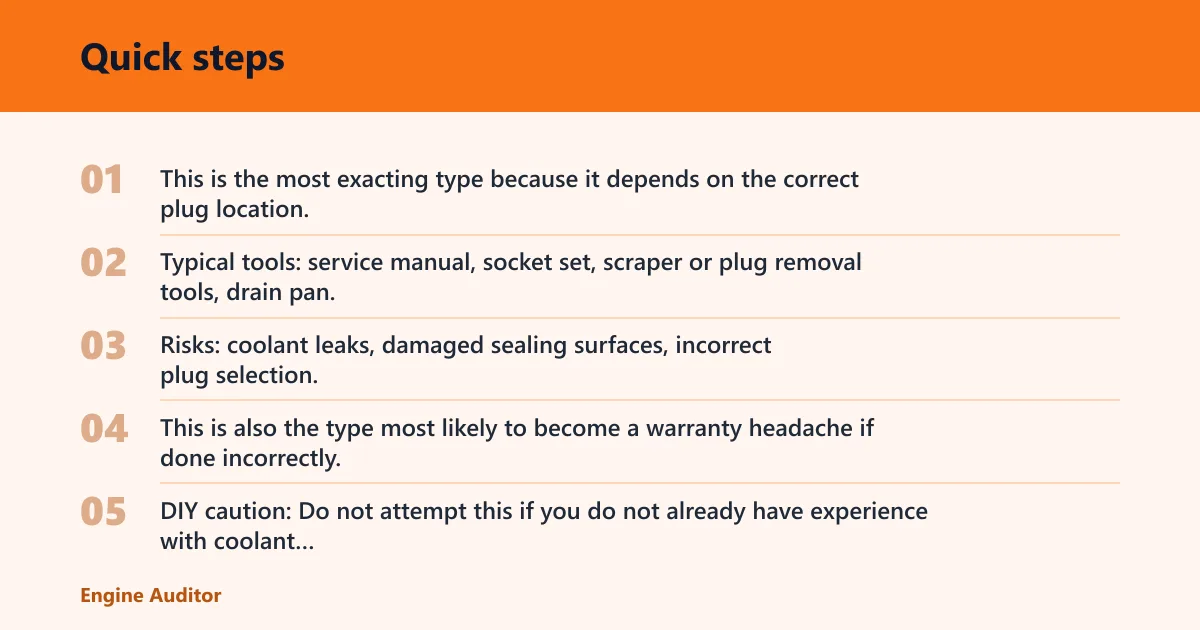
A freeze-plug style heater replaces an existing core plug and heats coolant directly. It is a more involved installation because you have to locate the correct plug in the service manual and work around the engine’s cast passages.
This style is common when you want direct coolant heating. It is not the easiest option to add after the fact, because the right plug location and sealing method must match the engine exactly.
Oil pan heaters
An oil pan heater attaches to the oil pan and warms the oil so it flows better at startup. The practical payoff is smoother cranking and less cold-start wear, especially in engines that sit outside overnight.
Installation varies by model. Some use a bonded pad; others use mounting hardware. Do not assume one oil pan heater is the same as another. Check the manufacturer listing for the exact mounting method.
Inline coolant heaters
An inline coolant heater is spliced into a coolant hose. Some models circulate coolant with the pump, while non-circulating versions rely on heat movement through the system. They are effective, but they often need professional installation because the hose routing and sealing matter.
This style is a good fit when you want a hardwired solution and the vehicle layout supports it. It is less attractive if access is tight or the cooling system is difficult to service.
Dipstick heaters
A dipstick heater replaces the dipstick and heats the oil directly. It is often easier to use than many hardwired options, but its heating capacity is lower than some alternatives, so it suits milder cold more than deep winter.
Think of it as a simpler, lower-output choice. It may help a vehicle that only sees moderate cold, but it is not the strongest answer for outdoor parking in severe weather.
Engine-warming blankets
An engine-warming blanket sits on top of the engine or under the hood and spreads heat across the engine block area. It can be easier to install than hardwired options because it does not need a coolant splice or a freeze plug swap.
That convenience comes with tradeoffs. It may be easier to add, but it is still a heater for a specific use case, not a cure-all for every winter start problem.
Battery blankets and warmers
A battery blanket wraps around the battery and insulates it overnight. It helps the battery tolerate cold-weather weakness, which matters because even a good engine heater cannot fix a weak battery on its own.
Use it as a support item, not the main solution. If the engine itself is the hard-start problem, a battery blanket alone will not do enough.
When do you need a block heater?
You usually need a block heater when winter starts become unreliable, especially if temperatures regularly drop below 10 degrees Fahrenheit or you live where some heaters kick in below -15 C. The strongest use case is generally extreme cold, not ordinary cool weather. Transport Canada-style advice, CAA guidance, and OEM manuals all point the same direction: the decision changes with temperature, parking exposure, battery condition, and how often the vehicle has to start cold.
Parking matters as much as temperature. A vehicle that sleeps outside in wind and snow needs more help than one that stays in a garage. Commute length also matters, because a short trip may never let a very cold engine recover the heat it lost overnight.
Temperature bands that matter
Below about 10 degrees Fahrenheit is a common point where a heater may start to pay off. Below about -15 C, the case for a block heater becomes stronger still. At that point, the issue is not comfort. It is whether the engine starts without excessive strain. Heater manufacturers often rate their products for these subfreezing conditions, and OEM manuals commonly recommend preheating windows of roughly 3 to 4 hours rather than leaving the heater on all night.
Between those bands, the answer depends on the vehicle and parking setup. A newer car with a healthy battery and a garage space may not need one at all. A truck parked outside may still benefit.
Vehicle type and engine size
Modern cars do not automatically need block heaters. Many will start reliably in winter if the battery is healthy, the oil viscosity matches the climate, and the car stays parked indoors or in a sheltered spot. OEM guidance increasingly treats block heaters as climate tools rather than universal necessities for every modern gasoline car.
Gasoline engines can start in very cold weather, but that does not mean they start well every day without help. Diesel engines are more likely to benefit because cold fuel and high compression make cold starts harder; a diesel parked outside is generally the strongest yes-case in this guide.
Parking outside versus in a garage
Outside parking increases the value of a block heater because the engine loses heat faster. A garage reduces the need, especially if the space stays only mildly cold instead of fully exposed to night air.
Suppose your sedan sits outside at -12 C and the battery is three winters old. A heater becomes more attractive. If the same sedan spends the night in a heated garage, the need drops sharply.
Block heater decision table
Use this table as a quick filter. The plug-in window is a practical estimate, not a fixed rule, and the best answer still depends on your owner’s manual and the heater type.
| Temperature range | Vehicle type | Overnight parking | Battery age / condition | Recommendation |
|---|---|---|---|---|
| Above 10°F / above -12°C | Modern gasoline car | Garage or sheltered parking | Under 3 years, starts normally | No. Plug in only if the OEM manual specifically recommends it. Window: 0-3 hours if used. |
| Above 10°F / above -12°C | Diesel or older high-mileage vehicle | Outside | 3+ years or weak winter cranking | Optional. Use if starts are slow or the manual suggests it. Window: 3-4 hours before driving. |
| 0°F to 10°F / -18°C to -12°C | Gasoline daily driver | Outside | Healthy battery, but not new | Yes. Strongly consider it for regular winter use. Window: 3-4 hours before departure. |
| 0°F to 10°F / -18°C to -12°C | Diesel, truck, SUV, or large engine | Outside | Any battery over 2 winters old | Yes. Use a timer; pair with a battery warmer if recommended. Window: 3-4 hours. |
| Below 0°F / below -18°C | Any vehicle with cold-start history | Outside or unheated driveway | Weak, old, or recently replaced battery | Yes. Block heater is strongly recommended; a battery warmer may also be needed. Window: 3-4 hours, per manual. |
| Below 0°F / below -18°C | Any vehicle | Heated garage | Healthy battery, easy starts | Optional. Often unnecessary unless OEM guidance says otherwise. Window: 0-3 hours only if needed. |
How long should you plug it in?
Most drivers do not need to leave a block heater on all night. A timer that starts the heater 3-4 hours before driving is usually the better choice, because it avoids wasting electricity while still giving the engine time to warm. That 3-4 hour window is also the most common timing called out in owner’s manuals and heater instructions for everyday winter use.
A short plug-in window often works for a short commute. A longer window may help on extremely cold mornings, but there is no reason to run the heater for hours longer than needed unless the manufacturer says otherwise.
Timer use versus all-night use
An extension cord and timer are common parts of the setup. The timer lets you delay power until just before departure, which is the cleanest way to avoid all-night operation.
All-night use is usually unnecessary. The heater is meant to precondition the engine, not keep it warm for half a day.
What to do if the outlet is hard to reach
If the outlet is far from the parking spot, do not stretch cords across walkways or through areas where they can be pinched or damaged. A damaged cord can fail to power the heater, trip protection devices, or create a shock hazard.
A common first-timer mistake is plugging the heater into a damaged extension cord instead of a properly rated, grounded outlet. Check that the outlet is protected, that the cord is rated for the environment, and that the connection stays clear of snow, slush, and tire paths.
Can you add one to a modern car?
Yes, many modern cars can accept an aftermarket block heater, but the right type depends on the engine and cooling layout. Some vehicles come with a factory-installed or dealer-installed heater option, and some do not need one unless the climate is severe.
Before adding anything, confirm the engine code, the available mounting points, and whether the vehicle already has a heater port or plug provision. The owner’s manual should come first, and if the manual explicitly excludes aftermarket installation for a given engine family, follow that guidance.
Factory-installed versus aftermarket
A factory-installed heater is usually the simplest path because the vehicle was designed for it. Aftermarket parts can work well too, but the fit, output, and installation method must match the engine.
If the manual lists an optional heater, use that specification rather than guessing from a similar model. Small differences in engine family can change the correct part.
When professional installation makes sense
Professional installation is sensible for freeze-plug heaters and many inline coolant heaters because the work involves coolant routing, sealing, and access to parts that are not easy to reach. That is especially true if the vehicle is under warranty or the cooling system is already due for service.
Follow the vehicle and product manual. Never work under a vehicle held only by a jack, and never improvise a procedure that the manufacturer does not authorize.
Installation depends on heater type. The safest rule is simple: choose the type that matches the engine, then follow the OEM service procedure and the heater manufacturer instructions exactly. If the vehicle has a warranty concern, or the install requires draining coolant, removing plugs, or splicing hoses near tight engine packaging, a shop is usually the better choice.
When a heater is worth it
A block heater is worth it when extreme cold, outdoor parking, and repeated cold starts combine. It is also worth considering if the battery struggles in winter, because a colder engine asks more from an already weaker battery.
Remote start and synthetic oil help, but they do not erase the need for preheating in severe weather. Remote start idles the engine after startup; it does not reduce the strain of the first crank the way a block heater does.
Picture a pickup parked in an open driveway where winter lows sit below 10 degrees Fahrenheit. A block heater, possibly paired with a battery warmer, is a practical choice. The payoff is better starting and less strain when the morning is coldest.
By contrast, a compact car in a covered garage with a fresh battery may not need anything beyond the right winter oil grade and a healthy charging system. In that case, the heater is optional, not essential.
How do you use an engine block heater?
Using a block heater is straightforward once it is installed. Plug the cord into a suitable outlet, set a timer if you have one, and energize it for the short window before departure. The goal is to warm the engine enough for easier starting, not to leave it on all day.
Make sure the cord is undamaged and routed safely. If the plug does not fit cleanly, or the heater trips repeatedly, stop using it until the problem is diagnosed.
- Check the owner’s manual for the correct heater type and plug location.
- Inspect the cord, plug, and outlet for wear or damage.
- Connect the heater to the extension cord if the setup requires one.
- Set the timer for about 3-4 hours before you plan to drive.
- Verify that the cord will stay clear of the tires, doors, and snow buildup.
Frequently asked questions
What’s an engine block heater?
An engine block heater is a pre-start warming device for cold weather. Depending on the design, it heats the engine block, coolant, nearby oil, or the underhood area so the engine turns over more easily and starts with less strain. It is mainly useful in cold climates.
What does an engine block heater do?
It raises the temperature of the engine before startup, which reduces how thick the oil feels and lowers the effort needed to crank the engine. That helps the battery, starter, and moving parts during the first few seconds after ignition, especially in severe cold.
Is an engine block heater worth it?
It is worth it if you regularly face deep cold and your vehicle sits outside. It is less useful in mild winters or for cars that already start easily in a garage. The better the shelter and battery health, the smaller the payoff becomes.
Do modern cars need block heaters?
Not always. Many modern cars start fine without one unless the climate is extreme or the parking setup is harsh. If the vehicle is new, the battery is healthy, and the manual does not recommend one, you can often skip it.
How long should you plug in a block heater?
A timer set for 3-4 hours before driving is a common approach. Leaving it on all night is usually unnecessary. If temperatures are only moderately cold, a shorter window may be enough; if they are severe, follow the manual and your starting results.
Products related to this article
Sponsored / affiliate links. As an Amazon Associate I earn from qualifying purchases. I may earn additional commission from eligible campaigns.