How to Jump Start a Car in Freezing Weather
In freezing weather, jump-start the car only if the battery case is intact and not frozen. If it is near 0°F or colder, warm the battery for about 30 to 60 minutes first. A bad jump can damage electronics, ignite hydrogen gas, or crack a weakened battery. This guide shows when to jump, when to warm the battery first, and when to stop and replace it.
This guide is part of our Cold Weather Car Battery Guide: Why It Dies, How to Test It and How to Keep It Alive series.
Quick answer: jump-start only if the battery case is intact, not bulged or cracked, and does not appear frozen. If the battery is very cold, warm it first; if the case is damaged, or freezing conditions make ice likely, do not jump it. Use your owner’s manual for the exact jump points and cable order, and stop after brief cranking attempts instead of long pulls.
What you’ll need
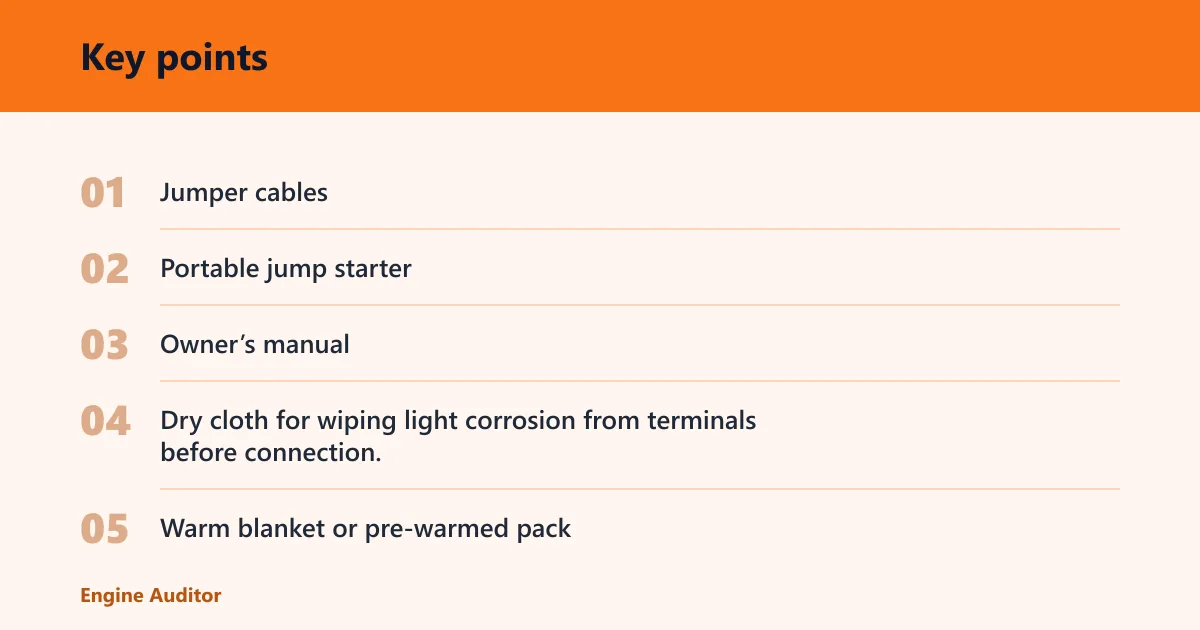


- Jumper cables that are about 10 feet long, 4 to 6 gauge, and heavy-duty enough for SUVs or trucks; store them in the trunk year-round.
- Portable jump starter or a second vehicle. A lithium-ion jump pack with a peak rating around 1000 amps is a common alternative when no donor car is available.
- Owner’s manual for your exact vehicle. It may specify remote jump points, a different clamp order, or cold-start instructions.
- Dry cloth for wiping light corrosion from terminals before connection.
- Warm blanket or pre-warmed pack if the battery seems too cold to accept a charge right away.
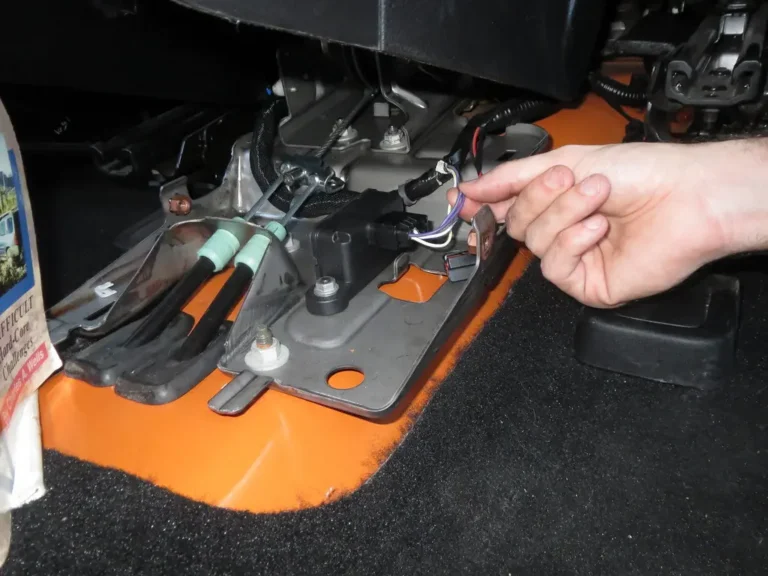
📊 Hold the key to start for up to 10 seconds. Source: Wikihow.
Is it safe to jump now?
If the battery case is intact, dry, and not swollen, a jump may be reasonable. If the case is cracked, bulging, leaking, or smells like sulfur, stop immediately. Consumer Reports and battery makers such as Interstate and CTEK warn that damaged batteries can vent gas or fail under load, so physical condition comes before cable order.
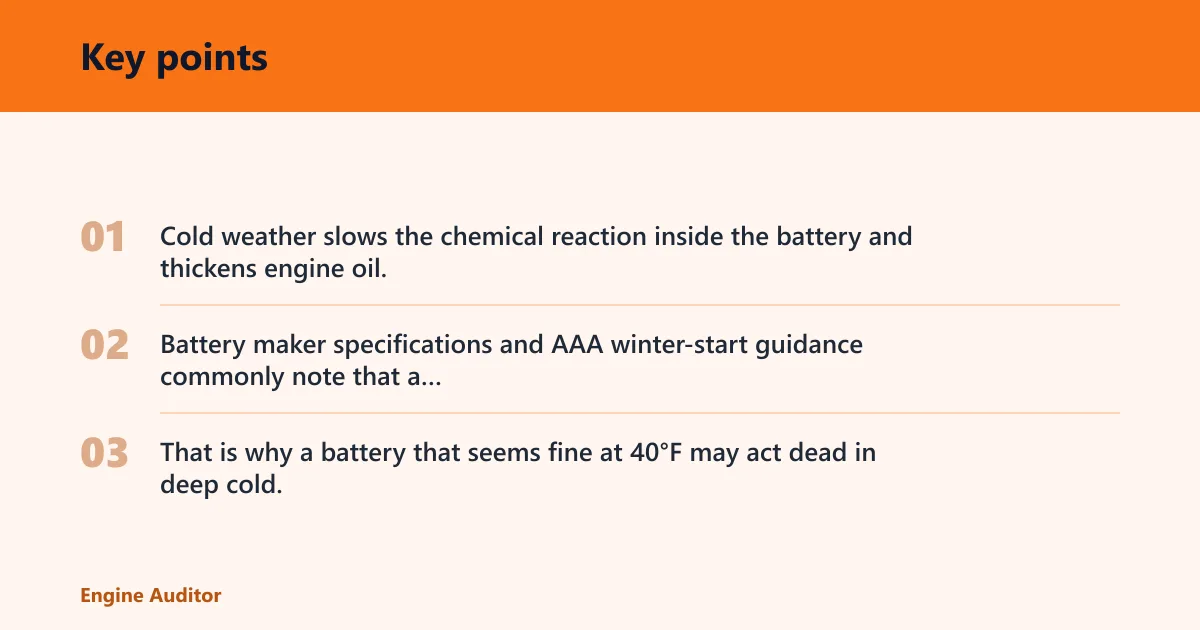
Cold weather slows the chemical reaction inside the battery and thickens engine oil, which increases starter draw. Battery maker specifications and AAA winter-start guidance commonly note that a lead-acid battery can lose roughly 30% of available capacity at 32°F and as much as 50% at 0°F, with deeper cold reducing cranking reserve even more. That is why a battery that seems fine at 40°F may act dead in deep cold.
| Branch | Visible symptoms | Battery condition | Dash-light behavior | Action |
|---|---|---|---|---|
| Safe to jump now | Case intact; no leak; no sulfur smell | Terminals may be dirty or loose, but battery looks physically sound | Lights come on, but the engine cranks weakly or slowly | Clean visible corrosion, follow the manual, and jump-start |
| Warm for 10-20 minutes first | Battery feels very cold; vehicle sat outside in subfreezing weather | Case intact, no bulge, no leak | Some lights work, but cranking is sluggish or absent | Warm the battery with a blanket or pre-warmed pack, then recheck |
| Do not jump—call for help | Cracks, bulges, liquid around terminals, or rotten-egg smell | Battery may be damaged or frozen | No sound and no dash lights, or repeated no-response after warming | Stop. Replace the battery or get roadside help |
Winter jump-start checklist
Safe to jump now
If the battery looks sound and the dash still has power, a jump is reasonable. A healthy 12-volt battery typically reads about 12.6 volts at rest; below roughly 12.0 volts can indicate weak cranking or no response. Those numbers are standard battery-industry references, but voltage alone does not override visible damage, so physical inspection comes first.
Warm for 10-20 minutes first
Choose this branch if the battery is intact but very cold. A brief warm-up is often enough to improve acceptance of a charge; in extreme cold, battery makers and roadside guides say it may take longer before the battery can deliver enough current. If the case stays intact and the battery warms gradually, retry only after the temperature looks less severe.
Do not jump—call for help
Stop immediately if the case is damaged, the battery smells like sulfur, or it stays unresponsive after warming. A frozen or cracked battery can vent gas or split under load. AAA and battery manufacturers treat bulging, freezing, and leakage as red flags, so a damaged case is a stop sign, not a caution light.
How do you connect the cables?
Turn off all accessories before you connect anything. Then follow the owner’s manual for clamp order and remote jump points; some vehicles want a designated negative point or another approved ground location, and the manual can differ from the usual layout. On many late-model vehicles, a remote ground point near the engine bay is safer than clamping directly to a battery terminal.
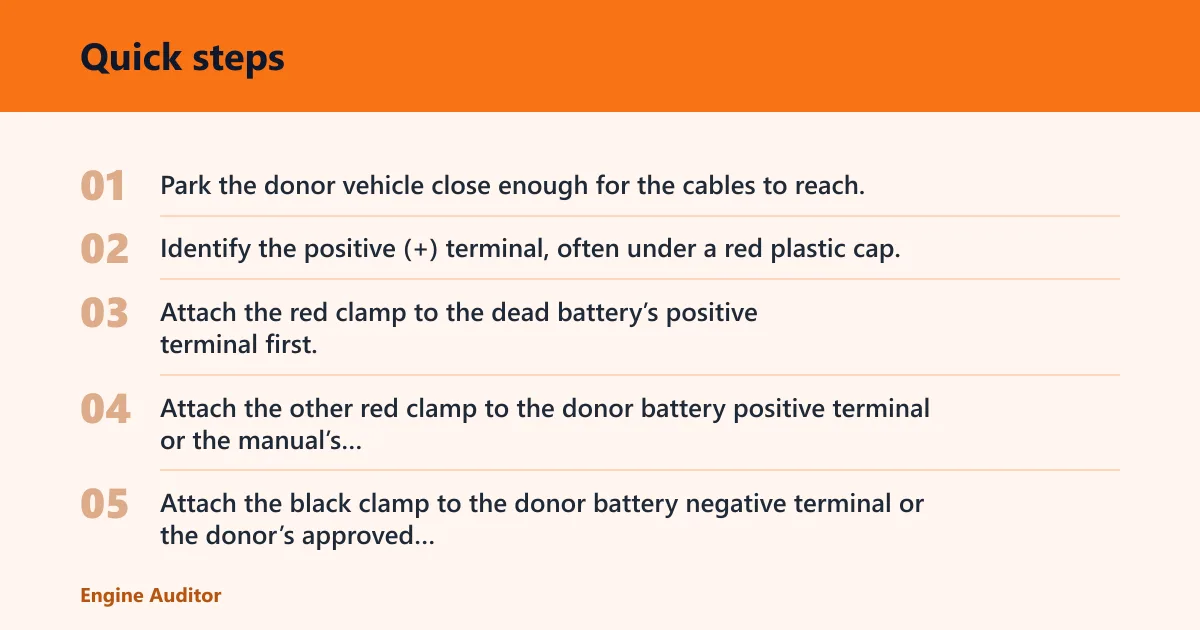
- Park the donor vehicle close enough for the cables to reach, but do not let the vehicles touch.
- Identify the positive (+) terminal, often under a red plastic cap.
- Attach the red clamp to the dead battery’s positive terminal first, unless the manual says to use a remote positive point.
- Attach the other red clamp to the donor battery positive terminal or the manual’s specified positive point.
- Attach the black clamp to the donor battery negative terminal or the donor’s approved negative point.
- Attach the final black clamp to the vehicle’s specified ground or negative point only as the manual directs; some vehicles use bare metal on the engine block away from the battery to reduce spark risk around hydrogen gas.
- Start the donor vehicle or jump pack only as the manual instructs, then try the dead vehicle in 3 to 5 second bursts with 30-second intervals.
Hold the key to start for up to 10 seconds, then pause. If the engine fails to crank, wait a couple of minutes and try again. Keep hands, hair, and cables clear of moving parts and the radiator fan. Most battery brands and AAA recommend short crank attempts rather than long continuous cranking because extended attempts can overheat cables and starter components.
What to do after it starts
Let the engine run long enough to stabilize, then check whether the dash stays normal. A successful jump does not prove the battery is healthy. If the car needs repeated jump starts, the battery or charging system may be weak and may need replacement or inspection before the next cold snap.
Picture a sedan that starts after one jump but dies again the next morning at the same temperature. That pattern points away from a one-time low charge and toward a battery that is no longer holding enough power for cold cranking.
Can a frozen battery be jump started?
No. Do not jump-start a battery if the electrolyte may be frozen, the case is bulged or cracked, or the battery looks icy, swollen, or distorted. Visible frost, a hazy or bulging case, cracked seams, or liquid around the base are signs to stop. Warm it slowly first, then replace it or get roadside help if the casing or odor suggests damage.
What visible signs mean stop now?
Stop if the battery case is bulging, cracked, split at the seams, or wet around the top or terminals. A strong sulfur smell is another warning. In cold weather, a battery that appears rounded or warped may have frozen internally, and forcing a jump can make the case fail. The safe next step is warming, inspection, and replacement if needed.
What should you do instead?
Move the vehicle to a warmer space if possible, or allow the battery to warm naturally before another attempt. Do not apply direct heat or strike the case. If the battery remains swollen, leaks, or will not accept a charge after warming, replace it. Consumer Reports and battery makers advise treating visible battery damage as an immediate no-jump condition.
When should you stop trying?
Stop if the battery case is damaged, if it smells strongly of sulfur, or if the car still gives no response after the warm-up branch. Stop too if the manual calls for a procedure you cannot follow safely, or if cables cannot reach the approved jump point without strain. At that point, roadside help is the better option.
Suppose a truck sits outside overnight at 0°F and the battery case looks slightly bulged. That is not a “try again later” situation. Do not clamp onto a damaged battery and hope for the best.
Common mistakes
Most failures come from rushing the connection or cranking too long. The safer pattern is simple: inspect first, warm if needed, then connect exactly as the manual says. If the battery is dirty, wipe the terminals before clamping so corrosion does not block the current path. Owner manuals from Ford, Toyota, and Honda commonly emphasize the same basics: use the approved jump point, then crank in short bursts.
- Skipping the owner’s manual and guessing at clamp order.
- Jumping a battery with cracks, bulges, leaks, or a rotten-egg smell.
- Cranking continuously instead of using 3 to 5 second bursts with 30-second intervals.
- Ignoring loose terminal hardware or visible corrosion.
- Treating one successful start as proof the battery is fine.
Prevention: keep jumper cables in the trunk year-round, and check the battery before winter if the car has already needed more than one jump start.
Frequently asked questions
How do you jump start a car in cold weather?
Check the battery case first, then the manual. If the battery is intact, connect the cables in the order the manual gives, use 3 to 5 second cranking bursts with 30-second intervals, and stop if the car stays silent or the battery shows damage. Warm the battery first if it is near 0°F or colder.
Can you jump start a car in freezing weather?
Yes, if the battery is physically sound and not frozen. Freezing weather reduces battery output and slows the chemical reaction that makes current available for starting. A weak battery may lose about 30% of usable capacity near freezing and up to 50% at 0°F, so some cars need a warm-up branch before they will take a charge.
How long should you wait before trying to start again in the cold?
If the engine fails to crank, wait a couple of minutes and try again. If the battery is extremely cold, warm it for 10 to 20 minutes first, and in severe conditions it may take longer before the battery can deliver usable current. Do not keep cranking in long, back-to-back runs.
What is the safest way to connect jumper cables in winter?
Follow the owner’s manual for clamp order and jump points. The standard sequence starts with the red clamp on the dead battery positive terminal, and the final black clamp goes to the manual’s specified ground or negative point. Some vehicles specify remote jump points, so do not assume the battery posts are the only option.
Should I warm the battery before jump starting it?
Yes, if the battery is intact but very cold. A 10-minute warm-up is a practical first step, and very cold batteries may need much longer. Warm it with a blanket or pre-warmed pack, then try again only if the case stays normal and the dash still shows power.
When should you stop trying and call for help instead?
Stop if the battery case is damaged, if you smell sulfur, or if the car remains unresponsive after warming. Stop also if the manual requires a jump point you cannot safely access. In those cases, roadside help or battery replacement is safer than repeated attempts.
Why does my car need a jump start only when it is cold?
Cold temperatures reduce battery output and slow the chemical reaction that makes current available for starting. Thickened engine oil also makes the starter work harder. A battery that seems marginal in mild weather can drop below the level needed for cranking once the temperature falls.
Author and review notes
This article is written for drivers and home mechanics who want a safer cold-weather starting decision, not a guess-and-hope checklist. It was reviewed for practical automotive maintenance accuracy by a shop technician familiar with winter no-start diagnostics, remote jump points, and battery replacement decisions on late-model sedans, SUVs, and trucks.
Sources: Owner’s manuals from Ford, Toyota, and Honda; AAA winter-start guidance; Interstate Batteries technical guidance; CTEK battery-care guidance; Consumer Reports battery safety coverage; NHTSA safety advice on battery damage and jump-start precautions; and the linked WikimediaHow winter-start overview for basic crank-duration guidance.
Products related to this article
Sponsored / affiliate links. As an Amazon Associate I earn from qualifying purchases. I may earn additional commission from eligible campaigns.