Can a Car Battery Freeze and Crack?
Yes. A car battery can freeze and crack; a fully charged lead-acid battery resists freezing until about -76°F (-60°C), while a low-charge battery can freeze near -20°F (-29°C). A frozen battery can split its case, leak acid, and fail dangerously if jump-started or charged too soon. This guide shows how to tell a weak cold battery from a frozen one, how to thaw it safely, and when to replace or test it.
Can a car battery freeze and crack?


What freezing can do to the case and internals
Most starting batteries in gas and diesel vehicles are 12-volt lead-acid batteries. Inside, the electrolyte is a sulfuric acid and water mix. When charge falls, that mix becomes more water-like, and the water portion freezes sooner. As it freezes, it expands. That expansion can bulge the battery case, open cracks, or push electrolyte out through seams and vents.
Damage is not always visible right away. A battery may look normal after thawing and still have internal plate damage, a weak cell, or reduced reserve capacity. That is why a battery that froze once is not automatically safe to keep using.
Why charge level changes freeze risk
Charge level is the main factor that changes freeze risk. A battery charged above 75% has a lower risk of freezing, while a discharged battery can freeze at ordinary severe winter temperatures. A fully charged lead-acid battery has a stronger mix of acid and water inside, so it can tolerate far colder weather than a weak battery.
State of charge examples
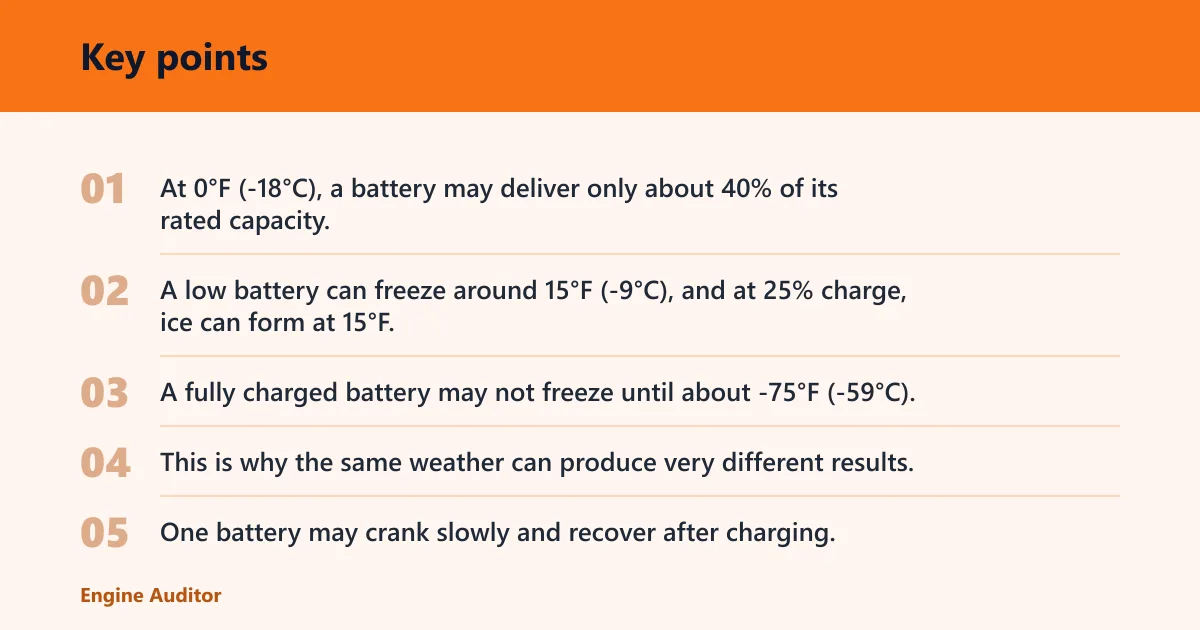
At 0°F (-18°C), a battery may deliver only about 40% of its rated capacity, so a battery that seems merely sluggish can act much weaker than it would at room temperature. A low battery can freeze around 15°F (-9°C), and at 25% charge, ice can form at 15°F. A fully charged battery may not freeze until about -75°F (-59°C).
This is why the same weather can produce very different results. One battery may crank slowly and recover after charging. Another, with lower state of charge, may already be frozen internally.
How cold weather affects starting power
Cold weather reduces cranking power even when a battery is not frozen. Chemical reactions slow down, so starting output drops. The result can look like a frozen battery: slow cranking, repeated clicking, or no crank at all. Those symptoms overlap, so the battery’s physical condition matters more than the symptom alone.
Symptoms that overlap with cold-related battery loss
A weak battery can show a slow crank after an overnight freeze, then seem a little better after sitting in a warmer garage. That does not prove it was frozen. It may simply have been cold, undercharged, or both.
Suppose a 12-volt battery in a sedan clicks once and will not turn the starter at 8°F. If the case is flat and dry, the battery may be weak rather than frozen. If the case is bulging or wet, treat it as damaged until proven otherwise.
Winter battery triage table
| Symptom | Likely condition | Safe next step | No-go actions |
|---|---|---|---|
| Slow crank | Cold battery, low state of charge, or aging battery | Check for visible swelling or leaks. If the case is normal, move the battery to a warmer place and test voltage after thawing. | Do not assume it is frozen. Do not jump-start if the case is bulging, cracked, or wet. |
| Clicking with no crank | Weak battery, poor connection, or starter demand too high for cold conditions | Inspect terminals, then test the battery after it warms. A load test is the next useful check if it survives thawing. | Do not charge a battery that is visibly frozen. Do not keep repeated-cranking it. |
| Bulging case or leaked fluid | Freeze damage likely | Stop using it, keep it upright if you move it, and replace it after safe removal and inspection. | Do not jump-start, charge, or poke at the case. Do not cap leaks with tape or rags. |
| Visible ice on the battery | Frozen electrolyte or moisture on the exterior with a frozen battery underneath | Leave it alone until fully thawed in a ventilated, non-heated-but-warm enough space away from sparks. | Do not jump-start or connect a charger. Do not strike or heat the case directly. |
| Post-thaw no-start | Internal damage, low charge, or failed cell | Check voltage, then get a load test. Replace if it fails under load or will not hold charge. | Do not assume thawing fixed it. Do not keep charging a battery that heats, vents, or swells. |
| Battery froze once but now seems normal | Possible hidden plate damage or reduced reserve capacity | Test it under load and watch for fast self-discharge over the next few days. | Do not trust appearance alone. Do not skip replacement if it fails a load test. |
What to do with a frozen battery
If you suspect a battery is frozen, do not jump-start it. Do not charge it. Move the vehicle to a warmer area and let it thaw naturally. Keep it upright so leaked electrolyte does not spread, and keep sparks and open flames away from the area.
Safe thawing steps
- Turn the ignition off and stop all load on the battery.
- Inspect the case for bulging, cracks, or wet spots.
- If the case is visibly damaged, leave the battery alone and plan for replacement.
- If the case looks intact, let the battery warm to room temperature or near-room temperature on its own.
- After thawing, inspect the battery and then perform a load test if the battery appears physically sound.
What not to do before the battery is fully thawed
Do not use a battery charger or maintainer on a suspected frozen battery. A smart or multi-stage charger is the preferred charging method for winter battery care, but it should only be used after the battery is fully thawed and inspected. Do not use heat guns, space heaters, or direct flame. A cracked case can vent acid or ignite from sparks.
Can you charge or jump-start it?
You should not charge or jump-start a battery that is visibly frozen, bulging, leaking, or cracked. Once the battery has fully thawed and passed a careful inspection, charging may be possible if the case is intact and the battery does not show signs of internal failure. A jump start is still a poor choice if freeze damage is suspected.
AGM versus flooded battery caution
Conventional flooded batteries have liquid electrolyte, so freeze damage is often easier to spot through venting, leakage, or a bulged case. Sealed AGM batteries can be harder to judge because they may hide internal damage longer. Treat either type with the same rule: if it looks swollen, wet, or distorted, do not charge it.
Suppose an AGM battery in an SUV sits at 12.1 volts after a cold night and starts only after a boost. That does not clear it. A battery can have hidden internal damage even if the outside looks fine after it thaws, so a load test matters more than a quick voltage check.
When to replace after freezing
Replace the battery if it fails a load test after thawing, will not hold charge, leaks fluid, has cracks or bulges, or shows repeat-freeze symptoms. A battery that froze once may still start the engine for a while, but hidden plate damage can shorten life and reduce reserve capacity. That is common after a freeze event.
Why a load test matters after thawing
A load test checks how well the battery holds voltage under demand, which is closer to real starting conditions than a resting voltage reading. That matters because a battery can look acceptable at rest and still collapse under starter load. Many mechanics and auto parts stores can perform this check.
Repeat-freeze damage and reduced reserve capacity
Freezing can weaken the battery even when the case survives. The plates may shed active material, and the battery may lose reserve capacity before it fails completely. If the same battery freezes again after a mild winter charge history, replacement is the safer choice.
How to prevent freezing in winter
Keep the battery charged. A fuller battery resists freezing far better than a weak one, and that matters more than most drivers expect. A battery charger or maintainer can help maintain charge in storage or short-trip use, but a smart, multi-stage unit is the better choice because it reduces overcharge risk.
Garage parking or battery insulation can cut freeze risk in severe cold. A battery blanket or heater helps most when the battery is already charged and the vehicle sees long cold nights. Those tools do not rescue a battery that is already discharged.
Frequently asked questions
Can a battery freeze?
Yes. A lead-acid car battery can freeze when the electrolyte is weak enough, and the risk rises as state of charge falls. A fully charged battery tolerates much colder conditions than a discharged one. If the case is swollen, cracked, or wet, treat it as freeze-damaged.
Will a fully charged car battery freeze?
A fully charged lead-acid battery may not freeze until about -75°F (-59°C), so it is far less vulnerable than a weak battery. In normal winter weather, that means a healthy, charged battery is usually not the frozen one. Cold still cuts cranking power, though.
Will a dead car battery freeze?
Yes. A dead or highly discharged battery can freeze at ordinary severe winter temperatures, and a low battery can freeze around 15°F (-9°C). That is why a no-start after a cold night is not always just a cold-weather problem. Low charge can be the root cause.
What temperature will a car battery freeze
There is no single temperature for every battery. Lead-acid batteries can freeze near -20°F (-29°C) when charge is low, and a fully charged battery resists freezing until about -76°F (-60°C). The lower the charge, the warmer the freezing point becomes.
Can a frozen battery be recharged?
Not until it has fully thawed and been inspected. Charging a frozen battery is unsafe because expansion may have cracked the case or damaged the plates. If the battery is intact after thawing, a smart charger can be used carefully, followed by a load test.
Products related to this article
Sponsored / affiliate links. As an Amazon Associate I earn from qualifying purchases. I may earn additional commission from eligible campaigns.