How Cold Is Too Cold for a Car Battery?
A 12-volt car battery becomes a cold-weather problem when its state of charge is low; a partly charged battery is more vulnerable to freezing and slow cranking, while a fully charged battery tolerates much lower temperatures. Ignore that, and you can get slow cranking, a no-start, or a battery case split by ice. This guide gives simple temperature thresholds, charge checks, and clear next steps for charging, testing, or replacing it.
Battery freeze risk depends on charge level


There is no single air temperature that is always too cold for every battery. State of charge matters more than the thermometer: a fully charged lead-acid battery can handle far colder conditions than a partly charged one, while a weak battery may struggle at temperatures that a healthy one still manages.
Battery freeze risk decision table
Use temperature bands with charge level, not temperature alone. The same outside temperature can be manageable for one battery and risky for another, especially if the car has sat for days, the terminals are dirty, or the battery is already old.
| Battery charge level | Temperature band | Freeze risk | Startability | Recommended next step |
|---|---|---|---|---|
| Fully charged | Above 32°F | Low | Usually starts normally, though performance still drops in cold weather | Keep it charged and verify terminals are clean and tight |
| Fully charged | 0°F to 32°F | Low to moderate | Slow cranking may appear on older batteries or short-trip vehicles | Test the battery if cranking sounds weak |
| Fully charged | Below 0°F | Still lower than a partly charged battery, but performance can fall sharply | Starting becomes harder, especially with high electrical loads | Charge fully before deep cold and consider a load test |
| 80% charged | Around 32°F to 0°F | Moderate to high | May crank slowly or need a jump after sitting overnight | Charge soon; do not let it sit partially charged |
| 80% charged | -20°F | High | Hard starts are likely | Recharge fully and test before more cold weather |
| Discharged | Around 30°F | High | May not start at all | Charge immediately; inspect for damage if it froze |
| Discharged | Below 32°F | Very high | Often no-start, with a strong chance of freeze damage | Do not try to jump a cracked, leaking, or frozen battery |
A common first-timer mistake is thinking 20°F is the cutoff. It is not. A fully charged battery can still work there, while a weak or discharged battery can become a problem sooner because the electrolyte may freeze before air temperature alone suggests it is cold enough.
Why cold hurts battery output
Lead-acid car batteries slow down in the cold because the electrochemical reaction inside them slows. As temperature falls, available cranking power drops, internal resistance rises, and the battery has a harder time delivering current for the starter motor.
That is why winter exposes batteries that were already marginal. Freezing temperatures can significantly reduce battery capacity, so a battery that seemed acceptable in mild weather may fail on the first cold morning.
Winter also makes the engine harder to turn. Oil thickens, the starter works harder, and accessories such as rear defrosters and blower motors add load right when the battery is least willing to give current.
What to do next
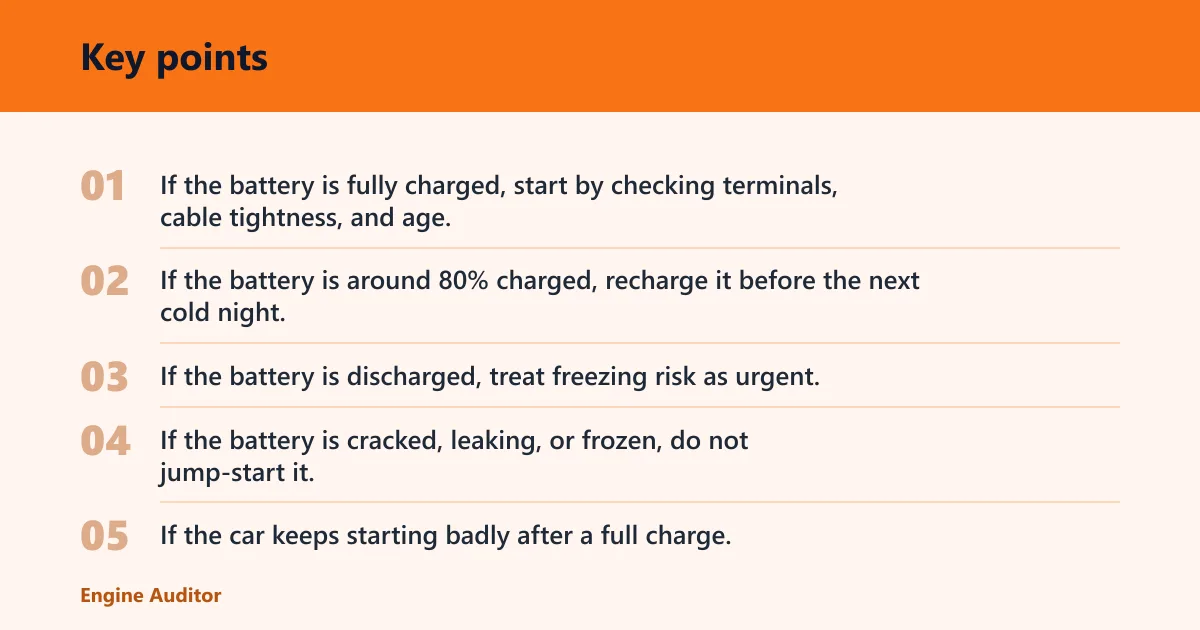
- If the battery is fully charged, start by checking terminals, cable tightness, and age.
- If the battery is around 80% charged, recharge it before the next cold night.
- If the battery is discharged, treat freezing risk as urgent.
- If the battery is cracked, leaking, or frozen, do not jump-start it.
- If the car keeps starting badly after a full charge, have the battery load tested and the charging system checked.
What temperature is too cold for a car battery?
For a healthy, fully charged battery, the air temperature has to drop much lower before freezing becomes a real threat. For a partly charged battery, cold becomes dangerous much sooner. A battery that is about 80% charged could freeze at -20 F, while a completely discharged battery can freeze at around 20 F.
Charge level changes the freezing point
The electrolyte freezing point changes with charge level, and a typical fully charged battery can tolerate much colder conditions than a weak one. The electrolyte is a water and sulfuric acid mixture, and its freeze point rises as charge falls. That is why a weak battery can freeze well before the electrolyte’s freeze point for a fully charged battery.
Freezing can crack the case because ice expands. If the case splits, acid can leak and the battery should not be jumped or reused without inspection.
Say your commuter sedan sits outside overnight at 25°F and the battery is only partly charged after a week of short trips. The next morning, the starter may turn slowly, and the battery can be at real freeze risk even though the temperature is nowhere near the freeze point of a fully charged battery.
Temperature bands that matter most
- Above 32°F: Most batteries will still start if they are healthy and charged.
- 32°F to 0°F: Weak batteries begin to show slow cranking and reduced reserve.
- 0°F to -20°F: A partially charged battery can freeze or fail to crank.
- Below -20°F: Even a decent battery needs to be fully charged and in good condition.
How cold is too cold to charge a car battery?
Cold weather is usually not the main limit for charging a lead-acid battery. The bigger issue is battery condition and whether the charger is designed for cold use. In practice, a maintainer or smart charger is useful during winter storage, but a frozen, cracked, or badly damaged battery should not be charged.
Charging limits for lead-acid batteries
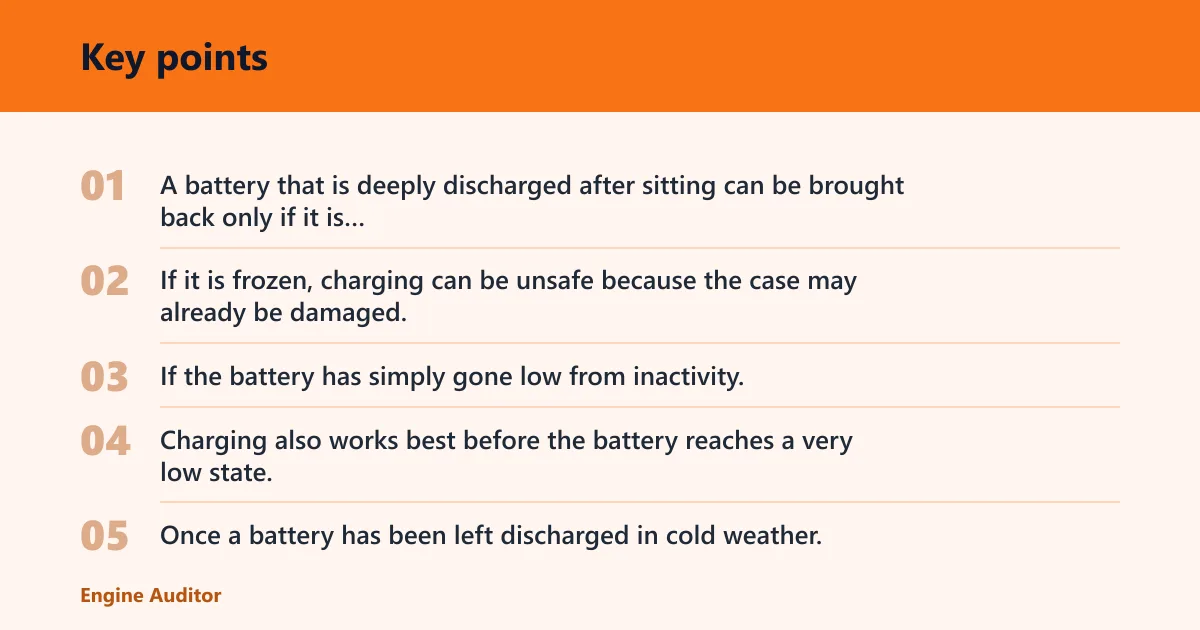
A battery that is deeply discharged after sitting can be brought back only if it is intact. If it is frozen, charging can be unsafe because the case may already be damaged. If the battery has simply gone low from inactivity, a maintainer can help keep it charged during a week or more of parking.
Charging also works best before the battery reaches a very low state. Once a battery has been left discharged in cold weather, the risk of sulfate buildup and freeze damage rises. That is why winter problems are easier to prevent than to fix.
When a maintainer helps and when it does not
A battery maintainer or trickle charger helps vehicles that sit unused for days or weeks. It is useful for infrequent drivers, seasonal vehicles, and cars with parasitic electrical draw that slowly drains the battery. It does not rescue a cracked case, and it should not be used on a frozen battery.
If a vehicle is parked outdoors for a week or more, a maintainer can reduce winter discharge. Garage parking or a battery blanket can also help keep the battery warmer, which lowers freeze risk and reduces starting strain, as long as the blanket is installed and used according to the product instructions and vehicle safety guidance.
How do you know if the battery is weak before winter?

Look for slow cranking, dim lights during startup, repeated jump-starts, or a battery that is over five years old. Those signs matter more than the calendar. A weak battery often shows up first on cold mornings, especially after short trips or long periods of sitting.
Signs before winter starts
Common warning signs include a slower-than-normal starter sound, dashboard lights that flicker when the engine cranks, and a battery that needs a jump after sitting only a day or two. If the battery is over five years old, it should be checked a couple of times per year.
Vehicles with high electrical loads need extra attention. Heated seats, big infotainment screens, rear defrost systems, and frequent short trips all leave less margin for a battery that is already aging.
Why load testing beats voltage alone
Voltage alone can mislead you. A battery may show decent voltage and still fail to deliver enough cranking amps under load. A load tester or conductance tester gives a better picture because it checks whether the battery can actually deliver current, not just hold surface charge.
Cold cranking amps, or CCA, is the winter rating to compare when buying or testing a battery. It is measured at 0 F for 30 seconds, and it must maintain a minimum voltage of 7.2V. Cranking amps, or CA, is measured at 32 F and is less useful for winter decisions.
When to inspect the alternator
If the car starts with a jump but dies again soon after, the alternator may be the problem. The battery may not be the only issue. Shops can check charging system output along with the battery, which is the right move when winter no-starts keep coming back.
How to keep a battery from failing in cold weather
Keep the battery charged during inactivity, check terminals and cable connections, and reduce needless discharge. Short trips, repeated accessory use with the engine off, and long parking periods all work against a winter battery. A healthy charging routine matters as much as the battery itself.
Practical prevention steps
- Drive long enough to recharge the battery after start-up, not just a few minutes.
- Use a maintainer if the vehicle sits for a week or more.
- Clean corrosion from terminals and tighten loose connections.
- Park in a garage when possible, or use a battery blanket in very cold weather.
- Test older batteries before the first hard freeze.
Suppose an older SUV with a high electrical load starts fine in October but needs a jump after two cold nights in November. That pattern points to a battery that is near the limit, not a random weather event. Charge it fully, test it under load, and then decide whether replacement makes more sense than another winter jump-start.
For commuters, the key issue is short-trip charging loss. For infrequent drivers, it is self-discharge while parked. For older vehicles, it is age plus reduced reserve. For high-load vehicles, it is the extra drain from winter accessories on top of lower battery output.
Frequently asked questions
How cold is too cold for a car battery?
There is no single cutoff that fits every battery. A fully charged lead-acid battery can tolerate much colder weather than a partly charged one. A battery that is low on charge may struggle in conditions that a fully charged battery handles without trouble.
At what temperature can a car battery freeze?
The electrolyte in a typical car battery freezes at a much lower temperature when the battery is fully charged, but a battery does not need to be that cold to fail. Charge level changes the freeze point. A weak battery can freeze well above that if it has lost charge, which is why winter no-starts often happen before extreme cold arrives.
How much does cold weather reduce car battery performance?
Cold weather can reduce a battery’s capacity and performance enough to make a marginal battery fail. Freezing temperatures can further drain your battery by up to 50% or more. The colder it gets, the less cranking power the battery can deliver, and the harder the engine becomes to start.
Should I charge or replace a battery that struggles in the cold?
Start with charging if the battery is simply low from inactivity. Replace it if it keeps struggling after a full charge, if it fails a load test, or if it is old and weak. If jump-starts work but the car dies again soon after, inspect the alternator and charging system too.
Products related to this article
Sponsored / affiliate links. As an Amazon Associate I earn from qualifying purchases. I may earn additional commission from eligible campaigns.