What is the Difference between Ev And Electric Car: Explained
Many people today are talking about electric vehicles, or EVs, as the future of transportation. But if you search online or speak with car enthusiasts, you’ll notice that some use EV and electric car as if they mean exactly the same thing, while others treat them as different. This confusion is common, especially for beginners or those who are not yet familiar with the world of modern vehicles. Understanding the difference between these terms is important if you want to make smart choices, follow the latest news, or simply have clear conversations about cars and the environment.
In this article, you’ll get a clear, complete explanation of what sets an EV apart from an electric car. We’ll explore their definitions, types, technologies, and even some surprising details that many overlook. Whether you’re considering buying your first electric vehicle, or just want to know what all the buzz is about, you’ll find everything you need here.
Understanding The Basics: Ev Vs. Electric Car
To start, let’s define the two terms clearly. EV stands for “electric vehicle,” but what does that actually include? Is an electric car the same as an EV? The answer is both simple and more complex than you might think.

PakWizz
2026 Upgraded 4-in-1 Lumbar Support Pillow Massager…
- [3-in-1 Lumbar Support Pillow with Remote Control] Equipped with a remote control, this 3-in-1 lumbar support pillow is simple to…
- [Triple Fusion Comfort for Daily Relaxation] This Back Massager provides a comfortable massage for daily lower back comfort and re…
- [Heat, Vibration & Stretching with Smart Modes] Includes stretching, vibration, and heating functions with manual and automatic mo…
As an Amazon Associate I earn from qualifying purchases.
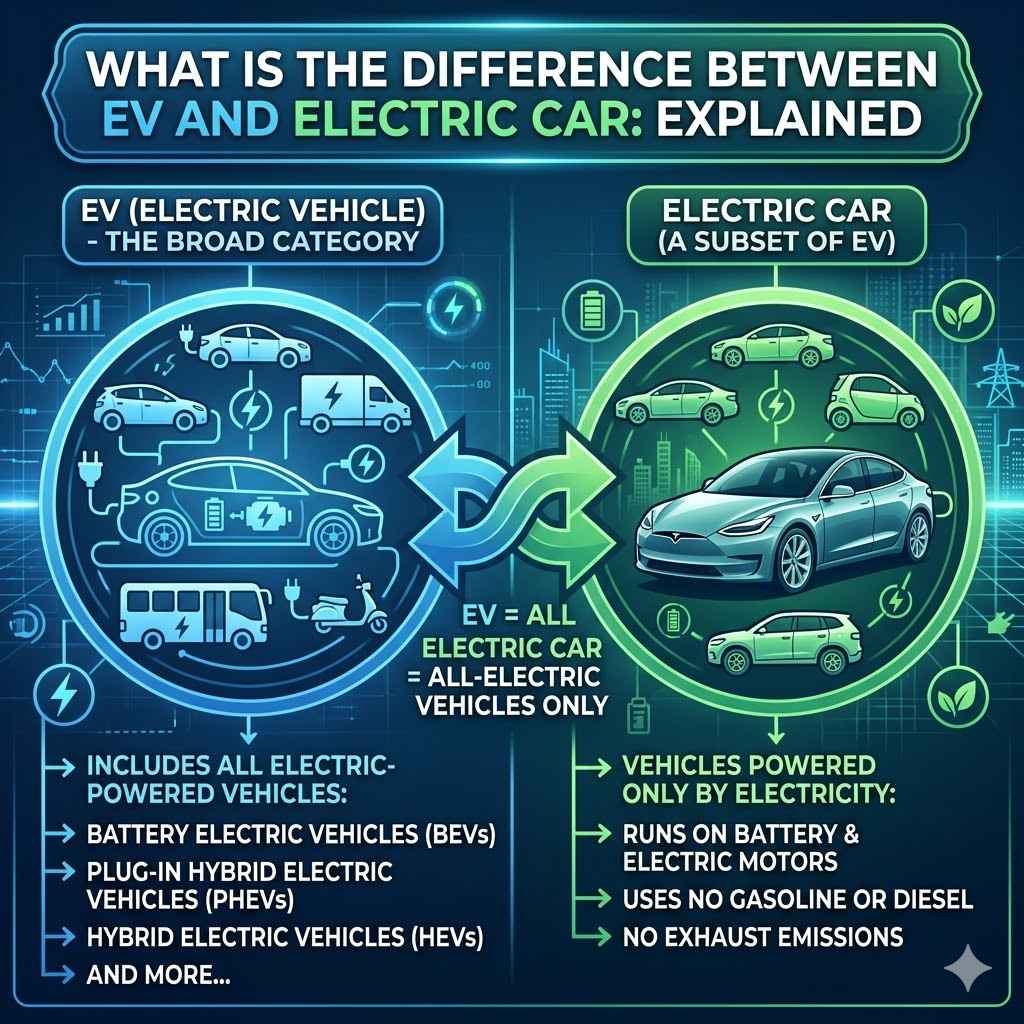
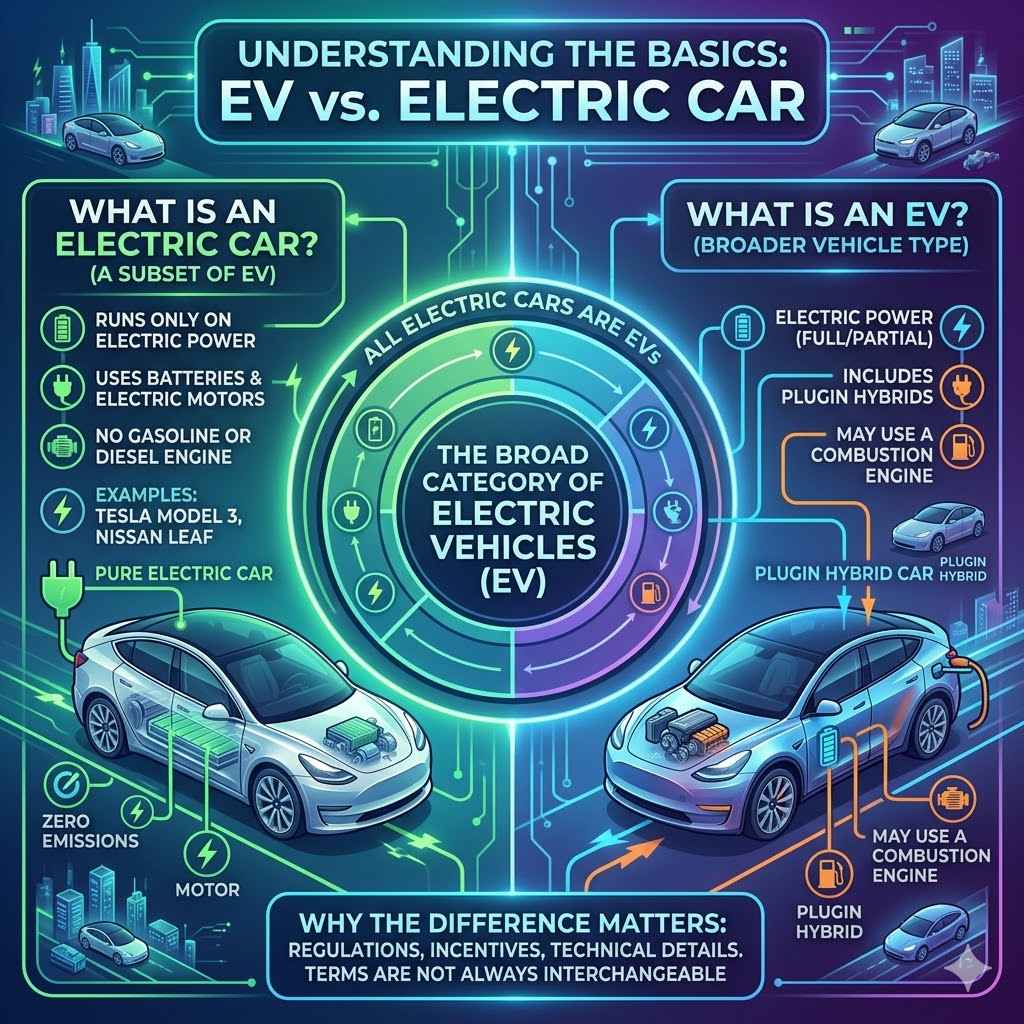
An electric car is a vehicle that runs only on electric power, using batteries and electric motors. It does not have a gasoline or diesel engine. A Tesla Model 3 or a Nissan Leaf are examples of electric cars.
An EV (electric vehicle) is a broader category. It includes any vehicle that uses electric power, fully or partly. This means that while all electric cars are EVs, not all EVs are electric cars.
Many beginners make the mistake of thinking the two terms are always interchangeable, but there are important differences. For example, a plug-in hybrid car is also an EV, but it is not a pure electric car. This difference matters when you’re reading about regulations, incentives, or technical details.
Types Of Evs: More Than Just Cars
To see why EV means more than just electric cars, let’s look at the different types of vehicles included in the EV family:
- Battery Electric Vehicles (BEVs): These are what most people think of as electric cars. They run only on electricity. No gasoline engine is present.
- Plug-in Hybrid Electric Vehicles (PHEVs): These vehicles have both a battery and an internal combustion engine. They can be driven with electricity or switch to gasoline/diesel when needed.
- Hybrid Electric Vehicles (HEVs): These cannot be plugged in. They have both engines, but the battery is charged by the engine or braking, not by plugging in.
- Fuel Cell Electric Vehicles (FCEVs): These use hydrogen to produce electricity in a fuel cell, powering the vehicle.
- Electric Buses, Trucks, and Motorcycles: The term EV also covers electric buses, trucks, vans, scooters, and motorcycles.
Here’s a simple comparison:
| Type | Main Power Source | Can Plug In? | Example |
|---|---|---|---|
| Electric Car (BEV) | Battery Only | Yes | Tesla Model 3 |
| Plug-in Hybrid (PHEV) | Battery + Gasoline | Yes | Toyota Prius Prime |
| Hybrid (HEV) | Battery + Gasoline | No | Toyota Prius |
| Fuel Cell (FCEV) | Hydrogen | No | Toyota Mirai |
| Electric Bus | Battery Only | Yes | BYD K9 |
As you can see, the world of EVs is much larger than just electric cars. Trucks, motorcycles, buses, and even some boats and trains fall under the EV category if they use electric power.
The Core Differences: Ev Vs. Electric Car
Now that you know the types, let’s focus on the main differences between EV and electric car:
1. Scope And Meaning
- EV includes all vehicles powered fully or partly by electricity.
- Electric car refers only to passenger vehicles powered 100% by electricity.
For example, an electric bus is an EV, but not an electric car. A hybrid car is an EV, but not a pure electric car.
2. Power Sources
- Electric cars rely only on batteries and electric motors.
- EVs may use batteries, fuel cells, or a mix with gasoline/diesel engines.
This is why plug-in hybrids and fuel cell vehicles are EVs, but not electric cars.
3. Vehicle Types
- Electric car is about standard passenger cars (sedans, hatchbacks, SUVs).
- EV covers cars, trucks, buses, motorcycles, and more.
4. Charging And Refueling
- Electric cars need to be plugged in to charge.
- Some EVs (like fuel cell vehicles) use hydrogen stations instead.
- Hybrids (HEVs) charge their batteries using the engine and cannot be plugged in.
5. Emissions And Environmental Impact
- Electric cars produce zero tailpipe emissions.
- Some EVs (like hybrids) still produce some emissions.
6. Regulations And Incentives
- Government policies often give special incentives to electric cars.
- Some rules and incentives apply only to pure electric cars, not all EVs.
For example, some cities allow only electric cars in certain zones, not hybrids.
Why The Difference Matters
Many people overlook why this difference is important. Here are some reasons:
- Buying Decisions: If you want zero emissions, an electric car is your goal. If you want flexibility, a plug-in hybrid (another type of EV) might work better.
- Regulations: Cities may ban gasoline cars but allow EVs, including hybrids, or only electric cars.
- Charging Infrastructure: Not all charging stations support every EV type (hydrogen stations are different from battery chargers).
- Incentives: Tax breaks, free parking, and other benefits may only apply to pure electric cars.
- Resale Value: Electric cars may hold value better in places with strong EV support.
Understanding these differences can save you money, time, and frustration.
Technology And Components
Batteries
The battery is the heart of any electric vehicle. Electric cars use large lithium-ion battery packs, similar to those in smartphones but much bigger and more powerful. Battery size is measured in kilowatt-hours (kWh). Most electric cars have batteries between 40 and 100 kWh.
EVs like plug-in hybrids use smaller batteries, often between 8 and 20 kWh, because they also have a gasoline engine. Fuel cell EVs, on the other hand, use hydrogen tanks instead of batteries for energy storage, though some also have small batteries.
Electric Motors
Both electric cars and other EVs use electric motors to drive the wheels. Pure electric cars may have one, two, or even three motors for better performance.
Charging Systems
- Electric cars use home chargers, public chargers, or fast chargers.
- Fuel cell EVs use hydrogen refueling stations, which are less common.
- Plug-in hybrids can charge at home or with public chargers, but also use gasoline when needed.
Regenerative Braking
Most EVs use regenerative braking, which turns braking energy back into battery power, improving efficiency.
Examples Of Evs And Electric Cars
To make things clearer, let’s look at some real-world examples.
Electric Cars (battery Electric Vehicles)
- Tesla Model 3
- Nissan Leaf
- Chevrolet Bolt
- Hyundai Kona Electric
- BYD Han EV
These vehicles use only electricity, produce zero tailpipe emissions, and need to be plugged in to recharge.
Other Evs
- Toyota Prius Prime (PHEV): Can run on battery for short trips, switches to gasoline for longer trips.
- Honda Clarity Fuel Cell (FCEV): Uses hydrogen to make electricity.
- Volvo XC90 Recharge (PHEV): Large SUV with plug-in hybrid system.
- BYD K9 Electric Bus: Used in public transport in many cities.
- Zero SR/F Electric Motorcycle: High-performance electric motorcycle.
These examples show the diversity within the EV category.
Key Advantages And Disadvantages
Understanding the pros and cons can help you make smarter choices.
Electric Car Advantages
- Zero emissions: Best for the environment.
- Lower running costs: Electricity is cheaper than gasoline.
- Quiet and smooth: Less vibration, noise, and fewer moving parts.
- High performance: Instant torque and fast acceleration.
Electric Car Disadvantages
- Range anxiety: Fear of running out of battery.
- Charging time: Takes longer to recharge compared to filling a gas tank.
- Higher upfront price: Though costs are falling, electric cars can be more expensive.
- Limited charging infrastructure: Not every location has enough chargers.
Ev (other Types) Advantages
- Flexibility: Plug-in hybrids can switch to gasoline when needed.
- Longer range: Hybrids and PHEVs can travel farther without stopping.
- More choices: EVs include buses, trucks, motorcycles, and more.
Ev (other Types) Disadvantages
- Some emissions: Hybrids and PHEVs still use gasoline, so not as clean as electric cars.
- Complexity: More parts mean higher maintenance in some cases.
- Not always eligible for incentives: Some government programs exclude non-electric cars.
Common Misunderstandings
Here are some things that often confuse people:
- All EVs are electric cars: Not true. EVs include more than just cars.
- Plug-in hybrid = electric car: Not true. Plug-in hybrids are EVs, but not pure electric cars.
- Hybrids can be plugged in: Regular hybrids cannot be plugged in; only PHEVs can.
- All EVs are zero emission: Only pure electric cars are zero emission at the tailpipe.
Ev Market Trends And Growth
The global market for EVs is growing fast. According to the International Energy Agency (IEA), there were over 26 million electric cars on the road worldwide by the end of 2022, a jump from just 10 million in 2020. China leads the world in electric car adoption, followed by Europe and the United States.
But the EV market is not just about cars. Electric buses, delivery vans, and trucks are becoming more popular, especially in cities. For example, in 2022, over 600,000 electric buses were running on global roads.
Here’s a quick look at EV sales growth:
| Year | Electric Cars Sold (Million) | Other EVs (Buses, Trucks, etc.) Sold (Thousand) |
|---|---|---|
| 2015 | 0.5 | 120 |
| 2020 | 10 | 350 |
| 2022 | 26 | 650 |
This rapid growth shows that EVs are not a trend—they are a major shift in transportation.
What To Consider When Choosing Between Ev And Electric Car
If you’re thinking about buying, leasing, or using an electric vehicle, here are some things to consider:
1. Your Driving Needs
- Short city trips: An electric car is often best.
- Long highway trips: A plug-in hybrid (another EV) might be more practical, unless you have easy access to fast chargers.
2. Charging Availability
- Home charging: If you can charge at home, an electric car is easy to own.
- No home charging: Consider a plug-in hybrid or another EV type for flexibility.
3. Environmental Impact
- Want zero tailpipe emissions: Only an electric car delivers this.
- Want to reduce, but not eliminate emissions: Hybrids and plug-in hybrids are an option.
4. Incentives
- Check local government websites to see which vehicles qualify for tax credits, rebates, or other benefits.
5. Budget
- Electric cars can be more expensive up front, but cost less to run.
- Plug-in hybrids and hybrids may cost less initially, but have higher fuel costs.
The Future Of Evs And Electric Cars
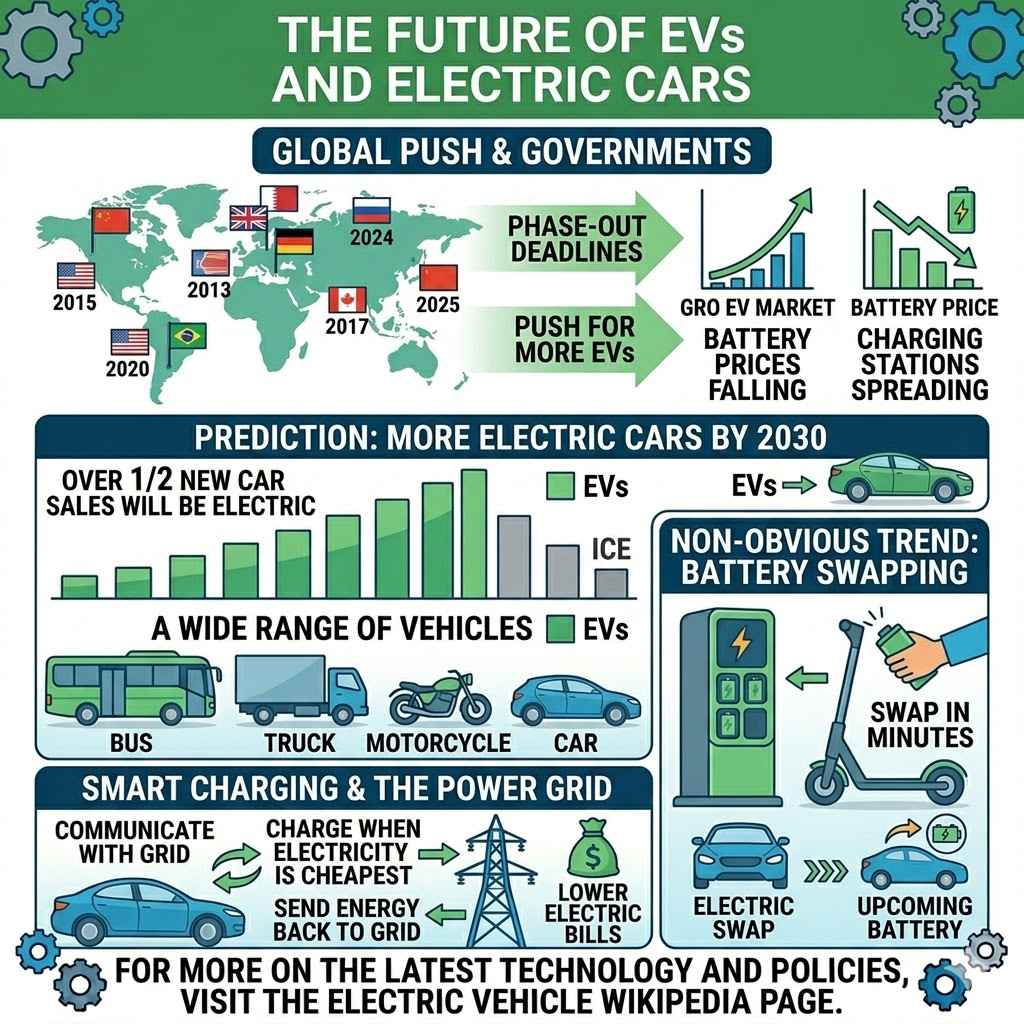
The technology behind EVs is advancing quickly. Battery prices are falling, charging stations are spreading, and new models are being released every year. Governments around the world are setting deadlines to phase out gasoline and diesel cars, pushing for more electric cars and EVs on the road.
Some experts predict that by 2030, more than half of all new cars sold will be electric. But the EV category will continue to include a wide range of vehicles—buses, trucks, motorcycles, and more.
One non-obvious trend: battery swapping is becoming more popular in some countries, especially for electric scooters and buses. Instead of waiting to charge, drivers can swap a used battery for a full one in minutes. This technology may spread to cars in the future.
Another detail many miss: smart charging. Some electric cars and EVs can communicate with the power grid, charging when electricity is cheapest or even sending energy back to the grid. This helps balance energy demand and can lower your electric bills.
For more on the latest technology and policies, visit the Electric Vehicle Wikipedia page.
Frequently Asked Questions
What Is The Main Difference Between An Ev And An Electric Car?
An EV is any vehicle powered by electricity, partly or fully. An electric car is a type of EV that runs only on battery power, with no gasoline or diesel engine. All electric cars are EVs, but not all EVs are electric cars.
Can A Hybrid Car Be Called An Ev?
Yes, but with limits. A hybrid car (HEV) is a type of EV because it uses electricity and a battery, but it cannot be plugged in. Plug-in hybrids (PHEVs) are also EVs, but not pure electric cars.
Are All Evs Zero Emission?
No. Only electric cars (battery electric vehicles) are zero emission at the tailpipe. Hybrids and plug-in hybrids still use gasoline and produce some emissions.
Is A Fuel Cell Vehicle An Electric Car?
A fuel cell vehicle (FCEV) is an EV because it uses electric motors, but it is not an electric car in the usual sense because it uses hydrogen instead of a battery for main power.
What Should I Choose: Electric Car Or Another Type Of Ev?
Choose an electric car if you want zero tailpipe emissions and can charge at home. Choose another EV (like a plug-in hybrid) if you need longer range or can’t always plug in. Consider your driving habits, local charging stations, and incentives.
The world of electric vehicles is evolving fast, and knowing the difference between an EV and an electric car can help you stay ahead. Whether you’re buying, learning, or just curious, this knowledge puts you in the driver’s seat for a cleaner, smarter future.
Related pick: Check today's price on Amazon