Which car battery is best for stop-start vehicles?
For many stop-start cars, AGM is often a safer default because it usually handles higher cycling better than a standard flooded battery. EFB is often the lower-cost fit for many factory stop-start systems, and lithium should be used only where the vehicle maker specifies it. Match chemistry, cycle rating, group size, and BMS support before you look at CCA. Fit the wrong battery and you can get warning lights, weak starts, short battery life, or charging-system faults.
Quick picks

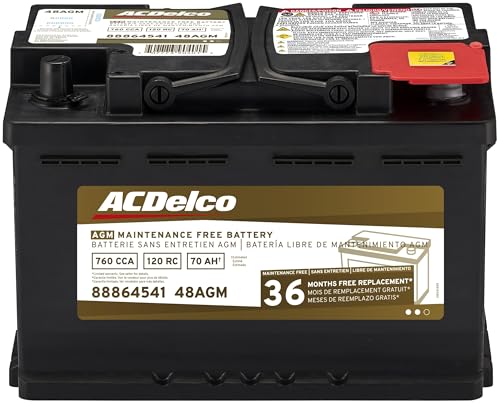
- Best for most stop-start cars: AGM, because its absorbed glass mat construction is sealed, spill-proof, and built for high cycle life and fast charge acceptance.
- Best value for many factory stop-start systems: EFB, because it is a better cycling choice than standard flooded lead-acid and often costs less than AGM.
- Best only in specialist conversions: LiFePO4, and only when the vehicle maker or conversion supplier says the charging system can support it.
- When a standard flooded battery is not acceptable: any vehicle with factory stop-start, repeated short trips, or a BMS that expects AGM or EFB charging behavior.
According to 10 Best Car Battery for Cars With Start Stop Technology Picks… — The ANCEL BS300 is described as a permanently connected start-assist system.
Why stop-start cars need a different battery
Stop-start systems restart the engine repeatedly during a trip, so the battery tends to see more partial discharge and quicker recharge than in a normal car. A standard flooded battery can work for a while, then fade early, trigger warnings, or fail under the repeated cycling load.
Repeated restart duty is harder on the battery
City traffic is the toughest pattern. The battery may be asked to restart the engine after only a short idle period, then support lights, infotainment, blowers, and control modules before the alternator has fully recovered the charge.
The charging system expects a specific charge profile
Modern stop-start vehicles often use a Battery Management System, or BMS, to help decide how aggressively to charge the battery. If the replacement chemistry does not match the original charging profile, the car may charge it poorly or treat it as a wrong target.
Which car battery is best for stop-start vehicles?
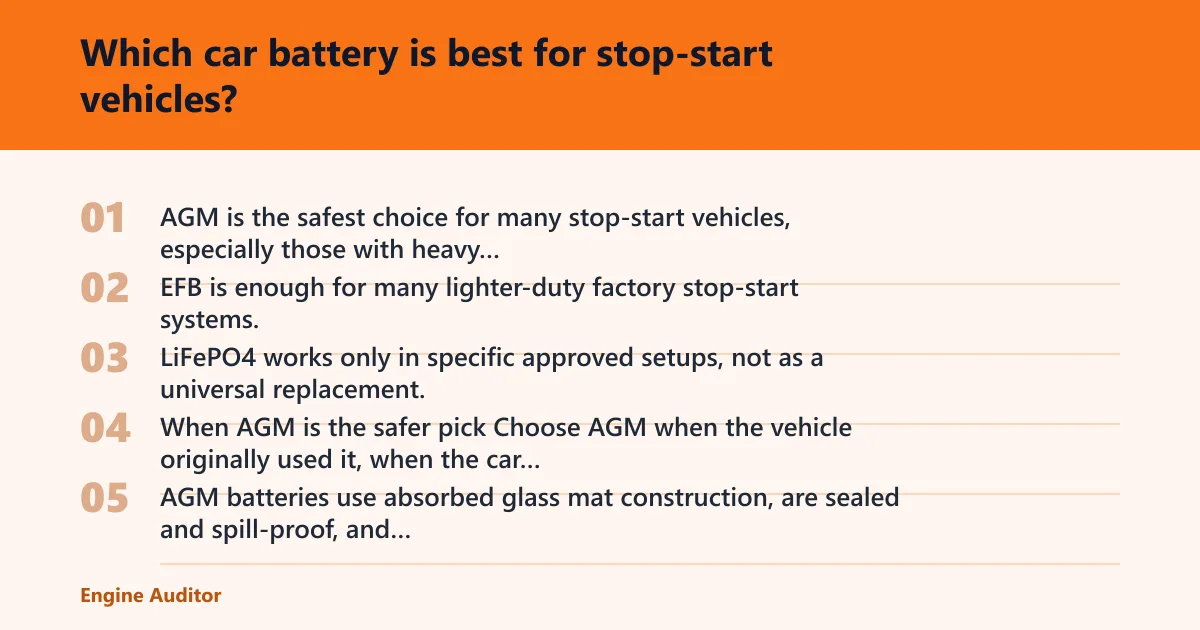
AGM is the safest choice for many stop-start vehicles, especially those with heavy cycling, larger electrical loads, or a manufacturer spec that already calls for AGM. EFB is enough for many lighter-duty factory stop-start systems. LiFePO4 works only in specific approved setups, not as a universal replacement.
When AGM is the safer pick
Choose AGM when the vehicle originally used it, when the car spends much of its life in short-trip city use, or when the electrical load is high. AGM batteries use absorbed glass mat construction, are sealed and spill-proof, and usually handle repeated cycling and fast recharge better than standard flooded batteries.
When EFB is enough
EFB, or enhanced flooded battery, fits many factory stop-start cars that do not require the higher cycling performance of AGM. It is usually the sensible value choice when the original spec lists EFB, because it gives better cycling than a standard flooded battery without paying for AGM features you may not need.
When LiFePO4 can work, and when it cannot
LiFePO4, or lithium iron phosphate, can be a good choice in a limited set of approved conversions, especially where weight matters and the charging system is designed for it. It is not a universal stop-start replacement. Many cars need lead-acid chemistry for proper charging, fault-free operation, and BMS compatibility.
Why the car’s original spec should win over marketing claims
The label on the old battery, the owner’s manual, and the vehicle’s battery registration data matter more than headline CCA. The wrong battery can cause weak starts, warning lights, and shorter battery life. That is established behavior, not a theory.
Use this decision matrix before you buy
This matrix is built around duty cycle, not sales copy. The right answer changes with commute length, electrical load, climate, and whether the car’s BMS expects AGM, EFB, or a lithium-approved setup.
| Buyer profile | Typical duty cycle | Recommended chemistry | Fitment checks | Compatibility note |
|---|---|---|---|---|
| Short-trip city driver | Frequent stops, many restarts, limited recharge time | AGM | Group size, terminal layout, hold-down, venting, polarity | Best choice when the battery sees heavy cycling and shallow recharge windows |
| Mixed driving | Some city use, some highway charging time | EFB or AGM, depending on original spec | Group size, case height, terminal position, BMS registration needs | EFB is often the value pick if the vehicle was built for it |
| Harsh climate | Cold starts, heat exposure, or both | AGM first, EFB only if specified | CCA, RC, venting, hold-downs, heat shielding if fitted | Temperature alone does not override chemistry or BMS requirements |
Checklist: AGM, EFB, or LiFePO4 compatibility and fitment checks
- Confirm the original battery chemistry from the label, manual, or registration record.
- Match group size so the tray, terminals, and hold-downs line up.
- Check terminal polarity and post style before ordering.
- Confirm venting requirements, especially if the battery sits in the cabin or boot.
- Check whether the vehicle needs battery coding or registration after replacement.
- For lithium, confirm the car maker or conversion supplier allows LiFePO4 in that model.
AGM vs EFB: what changes in real use
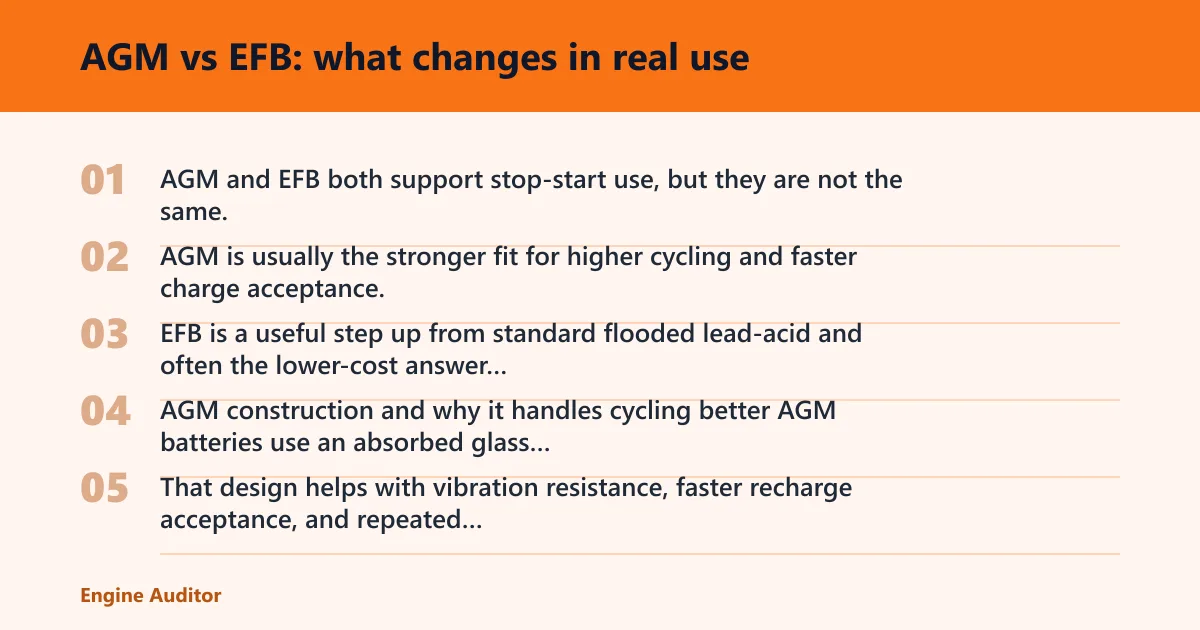
AGM and EFB both support stop-start use, but they are not the same. AGM is usually the stronger fit for higher cycling and faster charge acceptance. EFB is a useful step up from standard flooded lead-acid and often the lower-cost answer for factory stop-start cars.
AGM construction and why it handles cycling better
AGM batteries use an absorbed glass mat to hold the electrolyte in place. That design helps with vibration resistance, faster recharge acceptance, and repeated partial discharge. In plain terms, it suits a car that keeps switching off and back on all day.
EFB strengths and where it saves money
EFB batteries are enhanced flooded batteries. They are better at cycling than standard flooded lead-acid and often cost less than AGM in many applications. That makes them a practical choice where the factory fitted EFB and the electrical system was tuned for it.
How charging acceptance differs between the two
AGM typically accepts charge faster than a basic flooded battery and often better than EFB under repeated restart conditions. EFB still works well, but it is generally the lighter-duty option. If a car spends long periods in traffic, AGM is usually the safer match.
Which one to fit first on common stop-start cars
If the original battery was AGM, replace it with AGM. If the car was built for EFB and does not specify AGM, EFB is usually the smart spend. Swapping in a different chemistry because the price looks better is where owners get caught by early failure.
How important are CCA, RC, and group size?
CCA matters, but it does not decide the battery by itself. Reserve Capacity matters for stop-start loads and city driving. Group size is the fitment gatekeeper. If the chemistry and physical fit are wrong, a high CCA number will not rescue the installation.
Cold Cranking Amps and cold-weather starts
Cold Cranking Amps, or CCA, is a starting-power rating. It matters most in cold weather because a battery has to push harder to start a cold engine. For comparison shopping, CCA is useful after you have already matched chemistry and fitment.
Reserve Capacity and stop-start electrical loads
Reserve Capacity, or RC, tells you how long the battery can support electrical load. That matters in stop-start traffic, where accessories keep drawing power during idle periods. For city driving, RC can be more useful than chasing the highest CCA number on the shelf.
Group size, terminals, venting, and hold-downs
Group size is the physical battery fitment standard. It has to match the tray, terminals, and hold-downs. A battery that is electrically suitable but physically wrong is still the wrong battery. Venting and polarity also need to line up before installation.
Why the highest CCA battery can still be the wrong battery
A battery with a higher CCA rating can still fail in the car if the chemistry is wrong, the size is wrong, or the BMS expects different charging behavior. CCA helps starting confidence. It does not fix a bad chemistry match.
Do you need coding or battery registration after replacement?
Many modern stop-start cars may need battery registration or coding after a swap. The BMS uses that information to adjust charging strategy for the new battery. If the car still thinks the old battery is fitted, charging can be off and battery life can suffer.
What the BMS is doing in the background
The Battery Management System monitors battery condition and may adapt charging based on age, chemistry, and state of charge. In some cars, it also tracks replacement history. That is why registration matters on vehicles with intelligent charging control.
When registration matters after a swap
Registration matters most when the vehicle maker expects it, especially after moving from an old battery to a new AGM or EFB unit. Some models will run without it, but that does not mean they are charging the battery correctly.
What happens if the car still thinks the old battery is fitted
The car may undercharge or overcharge the replacement, disable stop-start, or flag battery-related warnings. The result is often premature failure, not an immediate no-start. That is one of the most common mistakes on late-model stop-start vehicles.
What happens if I fit the wrong battery in a start-stop car?
Fitting the wrong battery can lead to weak starts, warning lights, shortened battery life, and charging faults. On some cars, stop-start will stop working altogether. The problem may not appear on day one, but it often shows up after repeated short trips or a cold snap.
The failure mode depends on the mismatch. A standard flooded battery in a stop-start system can wear out quickly. A non-approved lithium battery can confuse charging logic. A wrong group size can create physical fitment problems before the car even leaves the driveway.
Can I replace a stop-start battery with a standard battery?
Usually no, not if the car was built for stop-start. A standard flooded battery is only suitable when the vehicle maker allows it, and that is often not the case on stop-start cars. The safer rule is simple: replace like for like unless the manufacturer says otherwise.
If the car originally used AGM or EFB, fitting a standard battery can shorten service life and create charging issues. The cost saved at purchase is often lost in early replacement, warning-light diagnosis, or reduced stop-start function.
Will a stop-start battery work in hot weather and cold weather?
Yes, if the battery type matches the vehicle and the BMS. Cold weather raises starting demand, so CCA matters more there. Hot weather is hard on battery life, especially when the battery is already cycling heavily. Chemistry and fitment still matter more than climate alone.
AGM is often the safer all-round choice when the car sees both seasonal extremes and repeated stop-start use. EFB can still be right for the vehicle if that is the original specification. Temperature does not change the need to match the charging system.
How long do stop-start car batteries last?
Service life depends on driving pattern, climate, battery chemistry, and whether the BMS is set up correctly. Short-trip use, high accessory loads, and missed registration can shorten life. A correctly matched AGM or EFB usually lasts longer than a standard flooded battery in stop-start service.
City commuting is harder on batteries than long highway runs because recharge time is limited. That is why the same battery can age quickly in one car and much more slowly in another that spends more time cruising.
Do I need coding or registration after replacing a stop-start battery?
Often yes. If the car uses a BMS, registration or coding may be needed so the system knows a new battery is fitted and can adjust charging correctly. Without it, the car may charge the battery as if it were old, which can shorten life.
Some vehicles are picky about battery type changes as well. Moving from EFB to AGM, or fitting LiFePO4 in an approved conversion, may need more than a simple swap. Check the service procedure before removing the old battery.
Frequently asked questions
Which battery is best for a stop-start car?
AGM is the best default for many stop-start cars because it handles repeated cycling, fast recharge, and higher electrical loads well. EFB is the right value choice on many factory stop-start systems. LiFePO4 belongs only in approved applications where the charging system is designed for it.
Do stop-start vehicles need AGM or EFB batteries?
Most stop-start vehicles need AGM or EFB, not a standard flooded battery. AGM is usually the safer fit for higher-demand systems, while EFB is common on lighter-duty factory stop-start cars. The original battery spec should guide the replacement choice.
Can I replace a stop-start battery with a standard battery?
Usually not. A standard battery is normally the wrong choice for a stop-start vehicle because it is not built for the same cycle load or charging pattern. That mismatch can cause weak starts, warning lights, charging faults, and shorter battery life.
What happens if I fit the wrong battery in a start-stop car?
The car may start poorly, disable stop-start, show warning lights, or charge the battery incorrectly. Over time, the battery can fail early because the BMS and charging system are working from the wrong chemistry assumption.
How do I know if my car needs AGM or EFB?
Check the old battery label, the owner’s manual, and the vehicle’s registration or service data. If the original battery was AGM, replace it with AGM. If it was EFB, that is usually the correct choice unless the maker specifically approves a different chemistry.
Are lithium batteries a good choice for stop-start vehicles?
Only in specific approved setups. LiFePO4 can suit some specialist conversions, but it is not a universal replacement for stop-start cars. Many vehicles expect lead-acid behavior, and the BMS may not charge lithium correctly unless the system is designed for it.
Products related to this article
Sponsored / affiliate links. As an Amazon Associate I earn from qualifying purchases. I may earn additional commission from eligible campaigns.