Car engine diagram explained: what each part does
A car engine diagram shows how air enters through the intake, gets compressed in the cylinder, ignites from the spark plug, and sends power out through the crankshaft and drivetrain. Read the parts in the wrong order, and you can miss the fault, replace the wrong component, and waste time and money. This guide maps each labeled part to the air-in, compression, spark, power-out flow so you can identify the main engine parts fast.
This guide is part of our Car engine components: parts, functions and diagrams series.
What a car engine does


A car engine is a machine that burns fuel and air inside cylinders to make rotary power. It uses controlled combustion, then turns the force into crankshaft rotation. Many engines use a four-stroke cycle: intake, compression, combustion, and exhaust.
The four-stroke cycle at a glance
Think of the engine as a flow path. Air and fuel enter. The piston rises and compresses that charge. A spark plug ignites it in gasoline engines. Expanding gas pushes the piston down, and the crankshaft turns that push into rotary motion. The exhaust stroke clears the burned gases out.
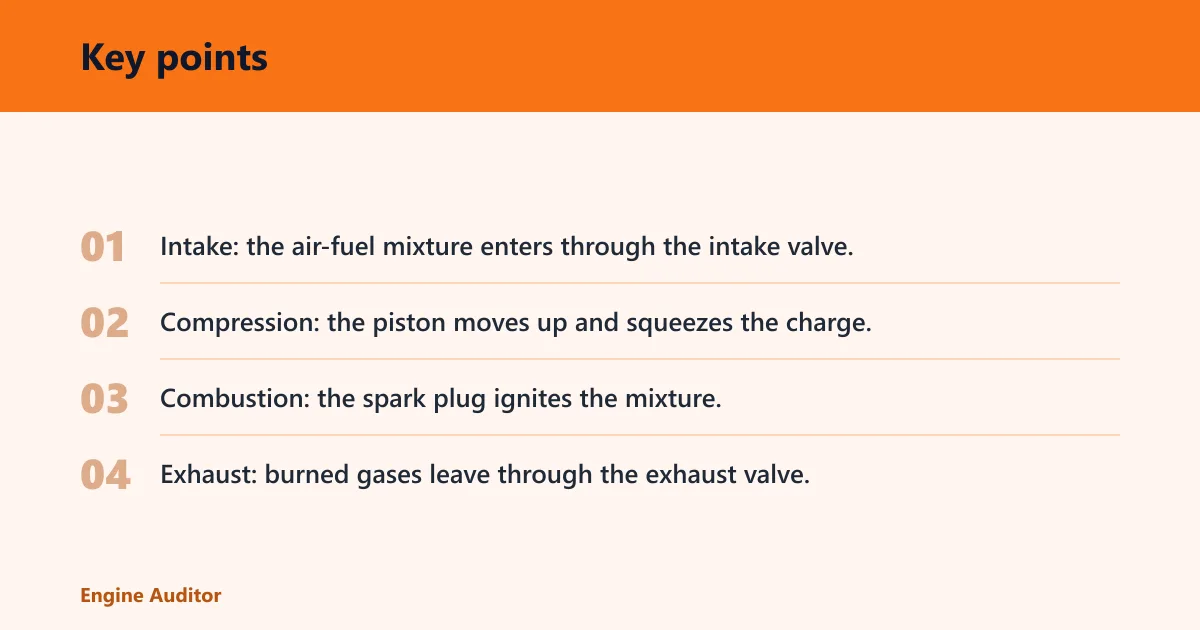
- Intake: the air-fuel mixture enters through the intake valve.
- Compression: the piston moves up and squeezes the charge.
- Combustion: the spark plug ignites the mixture.
- Exhaust: burned gases leave through the exhaust valve.
📊 A typical internal combustion engine has around 200 parts. Source: 40 Basic Parts of The Car Engine with Diagram.
How to read a car engine diagram
Start at the top of the diagram and follow the air path downward to the cylinders, then follow the motion path back out through the crankshaft. That order matches what the engine is doing: breathing in, compressing, firing, and sending force out. It also keeps you from mixing up the head, block, and rotating parts.
Top-to-bottom reading order
In many diagrams, the cylinder head is shown above the engine block, with the valves and spark plugs near the top and the pistons lower in the block. Below that sit the connecting rods, crankshaft, and oil pan. If a belt or chain is shown at one side, it usually links the camshaft to the crankshaft.
Front-to-back clues you can use under the hood
Front-to-back placement varies by engine layout, but the working logic stays the same. The belt or chain side is often the timing side. The intake side carries incoming air. The exhaust side carries burned gases out. If a diagram labels both sides, use the ports and valve locations to orient yourself.
What is the engine block?
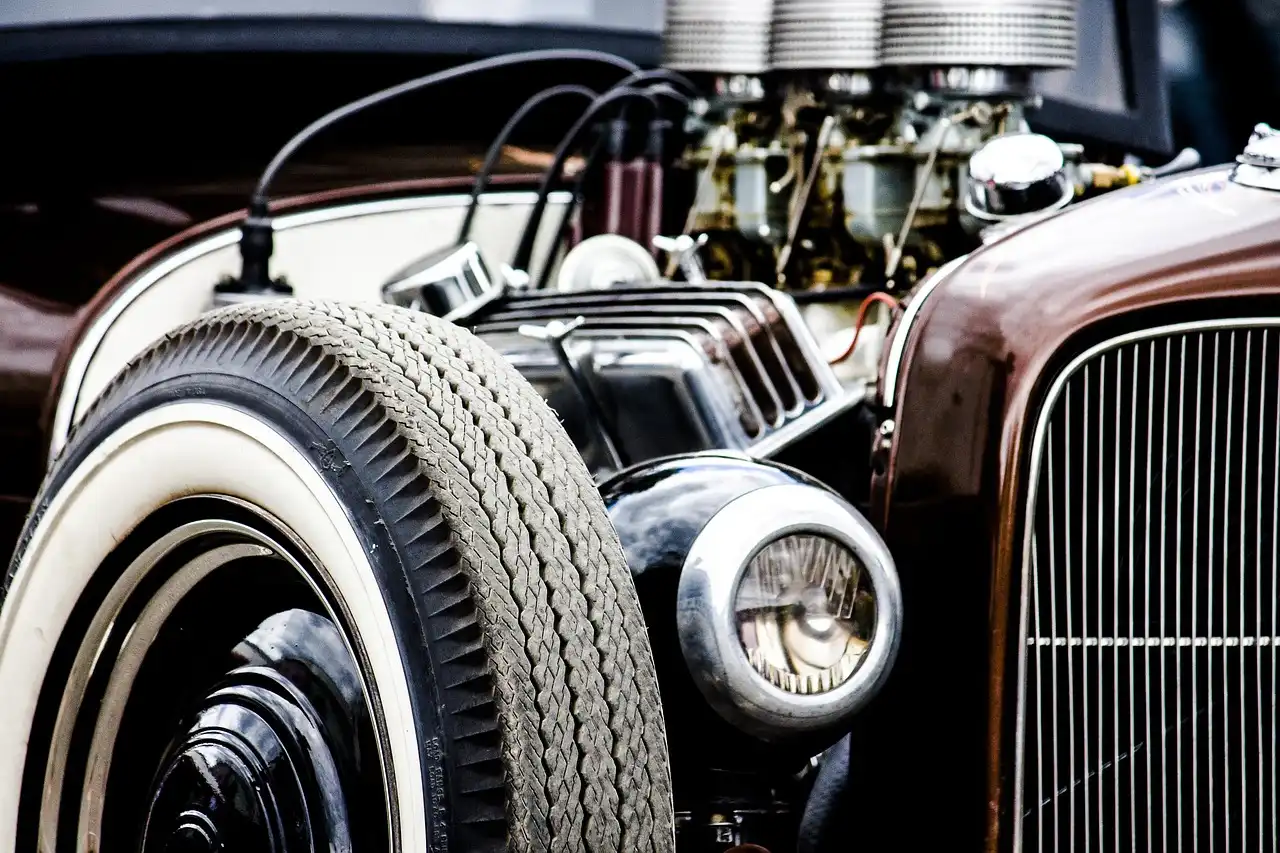
The engine block, also called the cylinder block, is the lower, heavier section of the engine. It contains the cylinders and most of the moving parts that turn combustion force into motion. In a diagram, this is the main body under the cylinder head, not the removable cover on top.
Cylinder block and cylinders
The cylinders are the round bores where the pistons move up and down. Each cylinder is part of the engine’s working chamber and guides piston motion in a straight line. If a diagram labels the block, that label usually points to the casting that holds those cylinders and internal passages.
Oil passages and the lower engine structure
The block also contains oil passages that feed moving parts with lubricant. At the bottom sits the oil pan, which stores engine oil after it drains down. That oil helps reduce wear on the crankshaft, connecting rods, and other parts that move under heavy load.
What does the cylinder head do?
The cylinder head is the detachable upper cover. It seals the top of the cylinders and carries the intake and exhaust passages, plus the valve hardware. In a diagram, the head sits above the block and forms the roof of the combustion chamber.
Intake and exhaust passages
Air and fuel enter through intake passages. Burned gases leave through exhaust passages. The valves open and close those passages in step with the piston’s movement. If the diagram shows ports on the side of the head, those are the flow routes for incoming charge and outgoing exhaust.
How the head seals the combustion chamber
The combustion chamber is the sealed space where combustion happens. During compression, the chamber closes off so the mixture can be squeezed before ignition. If sealing fails, compression falls and power drops. That is why the head, gasket area, valves, and piston crown all matter together.
How the moving parts create power
The moving parts turn straight-up-and-down piston travel into useful rotation. Pistons take the combustion force, connecting rods transmit that force, and the crankshaft converts reciprocating motion into rotary motion. That chain is the core of how the engine produces motion for the drivetrain.
Pistons, piston rings, and connecting rods
Pistons move up and down in the cylinders. Piston rings help seal the gap between the piston and cylinder wall, which supports efficiency and durability. Connecting rods link each piston to the crankshaft and transfer piston force into the rotating assembly.
Crankshaft and camshaft
The crankshaft is the part that turns the piston’s up-and-down motion into rotation. The camshaft is different. It opens and closes the valves. Depending on the design, the camshaft may sit in the block or the head, but its job stays the same: valve timing.
Timing belt or chain
The timing belt or chain connects the camshaft to the crankshaft and helps keep their timing aligned. That sync matters because the valves must open and close at the right moment relative to piston position. If timing slips, the engine can run poorly or not at all.
Which parts handle air, spark, and exhaust?
Air comes in through the intake side, spark starts combustion in gasoline engines, and exhaust leaves through the exhaust side. The key parts are the intake and exhaust valves, the spark plugs, and the combustion chamber. Together they control what enters the cylinder and what leaves it.
Valves and valve timing
Valves are the intake and exhaust gates. Intake valves open to let the air-fuel mixture enter. Exhaust valves open to release burned gases after combustion. Their timing is tied to the camshaft, which makes the opening and closing happen at the correct point in the cycle.
Spark plugs in gasoline engines
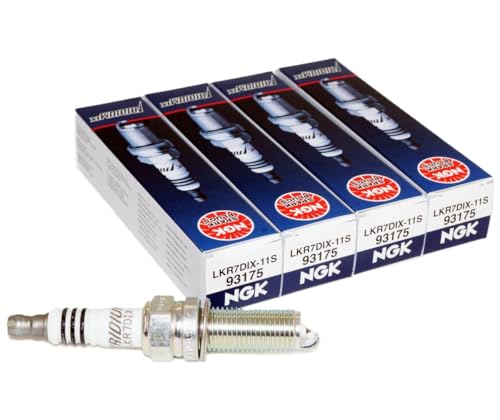
Spark plugs ignite the air-fuel mixture in gasoline engines and trigger the power stroke. They matter because combustion needs a reliable spark at the right time. A misfire often points toward a spark plug problem, ignition issue, or a fuel and air imbalance that keeps the charge from burning properly.
Combustion chamber
The combustion chamber is the space above the piston where the compressed mixture burns. It is sealed during compression so pressure can build before ignition. After the spark, expanding gases push the piston down and create the force that the crankshaft turns into rotation.
Diagram reading order table
Use this top-to-bottom reading order when a diagram feels crowded. It keeps the engine in sequence instead of as a random list of parts. The stroke column shows the exact part of the four-stroke cycle each item supports most directly.
| Reading order | Part | Job | Stroke it supports |
|---|---|---|---|
| 1 | Cylinder head | Upper cover that holds ports and valve hardware | All four strokes, as the top sealing and flow section |
| 2 | Valves | Open and close intake and exhaust flow paths | Intake and exhaust |
| 3 | Spark plugs | Ignite the air-fuel mixture in gasoline engines | Combustion |
| 4 | Combustion chamber | Sealed space where combustion happens | Compression and combustion |
| 5 | Pistons | Move up and down in the cylinders | Intake, compression, combustion, exhaust |
| 6 | Piston rings | Help seal the piston to the cylinder wall | Compression and combustion |
| 7 | Connecting rods | Link pistons to the crankshaft | Combustion and power output |
| 8 | Crankshaft | Converts reciprocating motion into rotary motion | Power output |
| 9 | Camshaft | Opens and closes valves | Intake and exhaust timing |
| 10 | Timing belt or chain | Syncs camshaft and crankshaft timing | All four strokes, by keeping timing aligned |
| 11 | Engine block | Lower structure that holds cylinders and moving parts | All four strokes, as the main body |
| 12 | Oil pan | Stores oil at the bottom of the engine | Support role across the full cycle |
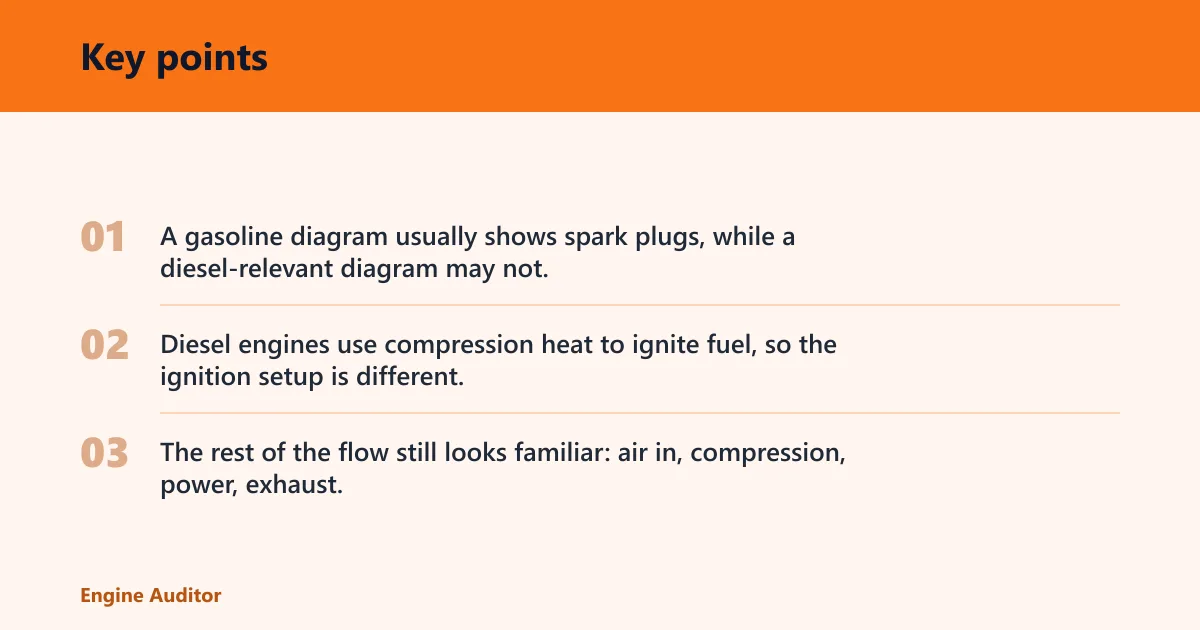
A gasoline diagram usually shows spark plugs, while a diesel-relevant diagram may not. Diesel engines use compression heat to ignite fuel, so the ignition setup is different. The rest of the flow still looks familiar: air in, compression, power, exhaust, with the same core block, head, pistons, rods, and crankshaft.
What are the main parts of a car engine?
The main parts are the engine block, cylinder head, pistons, crankshaft, camshaft, valves, spark plugs, timing belt or chain, connecting rods, piston rings, and oil pan. A diagram may show more parts, but these are the core pieces beginners should learn first because they explain the full flow.
What parts are usually shown in a car engine diagram?
Most diagrams show the engine block, cylinder head, pistons, crankshaft, camshaft, valves, timing belt or chain, and spark plugs. Many also include connecting rods, piston rings, the combustion chamber, and the oil pan. Those labels cover the path from air entry to power output.
Common symptoms by part
Failures often leave patterns you can tie back to the diagram. A misfire points toward spark plugs, coil issues, fuel delivery, or compression loss. Low compression often points to rings, valves, head sealing, or piston damage. Oil burning can point to worn rings or valve seal problems.
Noise or timing problems tied to belt, chain, or valve hardware
If the engine runs rough, lacks power, or makes unusual mechanical noise, check the timing belt or chain area and the valve train. When camshaft timing is off, valves open at the wrong moment. That can affect starting, idle quality, power, and exhaust flow all at once.
Two common beginner mistakes
Say your diagram shows a belt on the front cover and a beginner calls it “the accessory belt” without checking the label. If it is the timing belt, it controls valve timing, not just accessories. Suppose the engine starts but shakes at idle; that is a clue to inspect spark, air, or compression before blaming the block.
Frequently asked questions
What does each car engine part do?
The block holds the cylinders, the head carries the ports and valves, pistons move in the cylinders, rings help seal them, rods connect pistons to the crankshaft, and the crankshaft turns that motion into rotation. The camshaft times the valves, and spark plugs ignite gasoline engines.
How does a car engine work step by step?
First, air and fuel enter through the intake valves. Next, the piston rises and compresses the charge. Then the spark plug ignites it in a gasoline engine, and the expanding gases push the piston down. Finally, the exhaust valve opens and burned gases leave the cylinder.
Where are the engine block and cylinder head located?
The cylinder head sits on top as the detachable upper cover. The engine block is the lower, heavier section beneath it. In a diagram, the head forms the top of the combustion chamber, while the block contains the cylinders, pistons, and other moving parts below.
What is the difference between the crankshaft and camshaft?
The crankshaft converts reciprocating piston motion into rotary motion, which sends power toward the drivetrain. The camshaft does a different job: it opens and closes the valves at the right time. One turns motion into rotation; the other controls airflow timing.
Products related to this article
Sponsored / affiliate links. As an Amazon Associate I earn from qualifying purchases. I may earn additional commission from eligible campaigns.