Do Battery Blankets and Warmers Really Work?
Yes, battery blankets and warmers can help a marginal 12-volt battery crank in cold weather, especially when temperatures drop below 0°F. They are a fix for cold-soaked batteries, not a cure for a weak or failing one. Without one, slow cranking or no-starts can leave you stranded and can shorten battery life through repeated deep discharges. This guide explains how battery blankets work, when they are worth buying, and when you need a new battery instead.
What a battery blanket
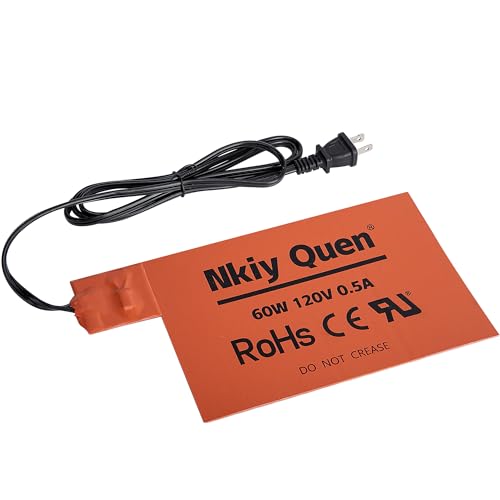

A car battery blanket is an insulated wrap that goes around the starter battery case. Powered versions plug into a standard wall outlet or other 120V source while the vehicle is parked. Unpowered versions rely on insulation only, so they slow heat loss rather than add heat.
Battery warmer is another name for the same product category. Some versions are electric, and some are passive insulation. The idea is simple: keep the battery warmer before startup so it can deliver more cranking current in cold weather.
How it fits around the battery
The wrap needs to match the battery size closely enough to stay in place without crushing cables or covering terminals. Leave clear space around the posts and clamps. If the blanket presses against exposed terminals, hold-down hardware, or sharp edges, it is the wrong fit.
Powered blankets also need a place to plug in. If the vehicle parks on the street or far from an outlet, a powered model may be useless even if the battery itself is the right candidate for one.
How cold weather hurts a lead-acid battery
Cold slows the chemical reaction inside a lead-acid car battery, so available capacity drops as temperatures fall. The effect gets worse below freezing and gets worse again as the battery ages. That is why a battery that felt fine in autumn can turn sluggish after the first hard freeze.
Competitor guidance puts the loss in plain terms: one source says freezing weather can drain battery power by 30-60%, another says a battery can lose 35% of its strength at 32 ℉, and at 0 ℉ one source says it can lose 60% of its strength. Battery efficiency drops from 64% to 40% between 30°F and 0°F.
Older batteries usually show the problem first. Internal wear leaves less reserve, so cold weather pushes them over the edge sooner. That matters on short trips, where the alternator has less time to recover charge after startup.
Do battery blankets actually work?
Yes, but only for the right problem. A battery blanket can help a weak but still usable starter battery stay warmer before startup, which can improve cranking on cold mornings. It does not repair battery wear, and it does not recharge a dead or deeply discharged battery.
The benefit becomes meaningful when temperatures regularly stay below freezing, and especially when they drop below 0°F. Battery blankets are most effective in that range, while another says they can be necessary in winters below 32 degrees Fahrenheit.
That matters because the blanket helps the battery start the day warmer than the air around it. It does not fix a weak alternator, a bad starter, or a battery that has reached end of life. If the battery cannot hold charge, no blanket can make it healthy again.
Say your 4-year-old sedan sits outside at 10°F and only gets a 6-minute commute each way. A blanket can reduce morning cranking drag, but if the battery already struggles after a normal drive, replacement is the better fix.
Battery blanket decision table
| Winter temperature band | Battery condition and trip pattern | Worth it or skip it | Better alternative action |
|---|---|---|---|
| 15°F to 32°F | Healthy battery, regular 20-minute-plus drives, outdoor parking | Usually skip it | Monitor battery health; replace only if testing shows weakness |
| 15°F to 32°F | Older battery, short trips, first slow crank of winter | Possibly worth it | Battery charger or battery test; replace if it fails the test |
| 0°F to 15°F | Marginal but usable starter battery, parked where 120V power is available | Often worth it | Use a plug-in warmer; consider a charger if charge level is low |
| Below 0°F | Frequent cold-soak, short trips, battery still starts but cranks slowly | Most likely worth it | Battery warmer plus charger; add a block heater if the engine is also hard to start |
| Any temperature | Dead or fully discharged battery | Skip it | Use a charger or jump-start, then test or replace the battery |
When a warmer is worth buying
A battery warmer is most useful when the battery is weak but still serviceable, the weather regularly drops below freezing, and the vehicle can park near power. If the battery only fails after cold overnight parking, a warmer may buy enough cranking margin to avoid repeated no-starts.
It also makes sense for vehicles that do a lot of short-trip driving. Short trips leave less time for charging, so the battery arrives at the next cold start with less reserve. A powered warmer can help keep more of that reserve overnight.
Electric versions like the Temro ZEROstart at 80 watts, and another says plug-in battery warmers can use 120V outlets. That means the car must be parked where a cord can reach safely. If the vehicle lives on the street, the product may not be practical.
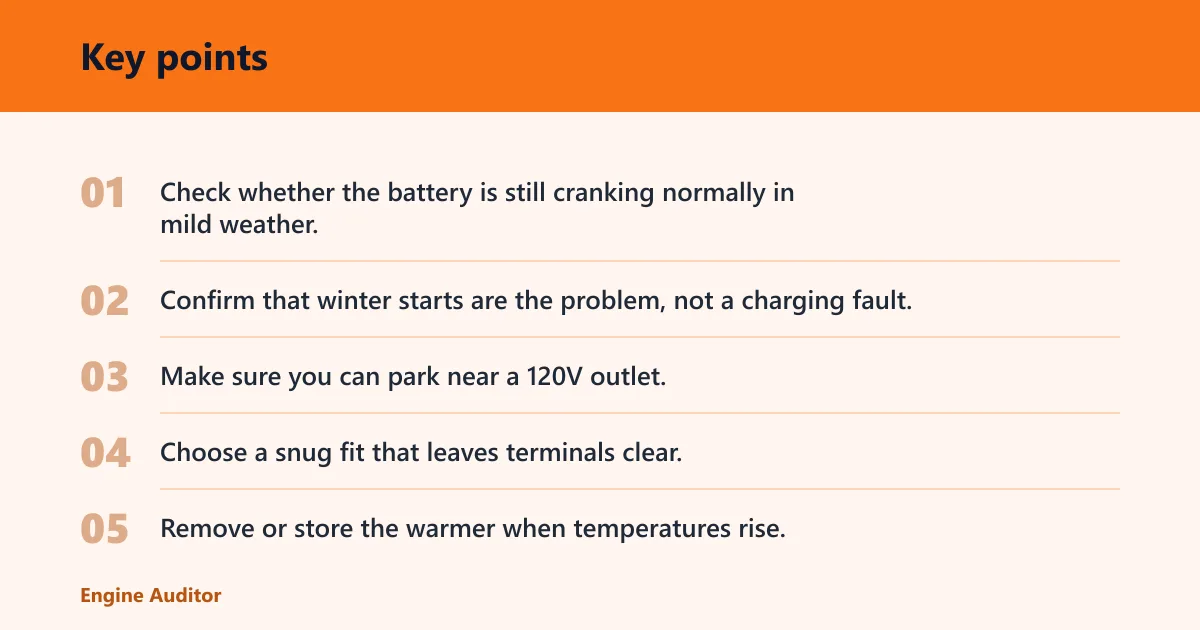
- Check whether the battery is still cranking normally in mild weather.
- Confirm that winter starts are the problem, not a charging fault.
- Make sure you can park near a 120V outlet.
- Choose a snug fit that leaves terminals clear.
- Remove or store the warmer when temperatures rise.
When you should skip one
Skip a battery blanket if the battery is dead, fully discharged, or near replacement age. The blanket does not recharge anything. It only helps a battery that still has usable charge but struggles in the cold.
Skip it in mild winters or if the car stays in a garage that rarely gets near freezing. A new battery in a sheltered parking space may not need extra warming at all. If the battery is already old, spending money on a warmer can be poor value compared with a replacement.
A common first-timer mistake is buying a blanket after a no-start, then finding the battery was already flat from a failed charging system. In that case, the right next step is diagnosis and charging, not insulation.
Also skip household heating pads. MotorBiscuit warns that they are not a good idea for car batteries, and that warning matters because home pads are not built for battery terminals, vibration, or underhood heat exposure.
Battery blanket vs engine block heater
A battery blanket and an engine block heater solve different problems. The blanket helps the battery stay warmer so it can deliver more cranking power. The block heater warms engine coolant or oil so the engine itself turns over more easily. They are related, but they are not the same tool.
Diesel vehicles often get the block heater first because diesel engines are harder to start in the cold. But the two products can work together. In severe winter, a warm battery and a warmer engine reduce two separate cold-start bottlenecks.
If the battery cranks slowly but the engine otherwise starts well, a blanket is the more targeted fix. If the engine is stiff, noisy, or slow to turn, a block heater may do more. If both problems show up below 0°F, pairing them can make sense.
When to use both
Use both when the battery is marginal, the engine is hard to spin in deep cold, and the vehicle parks where power is available. That combination is common in harsh winter climates, especially on diesel trucks and older vehicles.
Installation and safety
Proper fit matters more than people expect. The blanket should sit flat around the case without pinching cables or blocking hold-downs. Leave terminal clearance so the clamps stay visible and accessible. If the product must be removed to connect a charger, it is fitted too tightly or placed poorly.
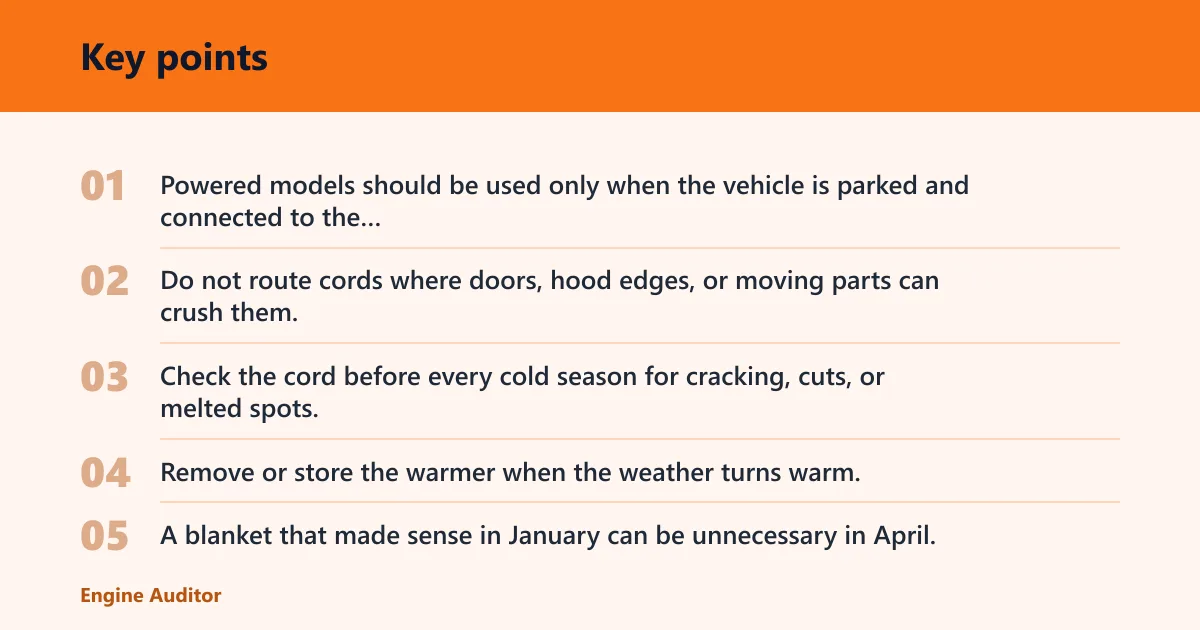
Powered models should be used only when the vehicle is parked and connected to the correct power source. Do not route cords where doors, hood edges, or moving parts can crush them. Check the cord before every cold season for cracking, cuts, or melted spots.
Remove or store the warmer when the weather turns warm. A blanket that made sense in January can be unnecessary in April, and a powered unit left in place through summer adds clutter without benefit. Passive wraps should also come off if they interfere with maintenance.
Short-trip, garage, and alternator edge cases
Short trips can make a blanket look better than it is. If the battery keeps getting undercharged, insulation only delays the next failure. A weak alternator output has the same effect. The system may start once and then fail again because the battery never recovers fully.
Garage parking changes the equation. If the battery never sees serious cold, the warmer will have little to do. In that case, a battery test and normal maintenance are the smarter buy.
Frequently asked questions
Do battery blankets work in cold weather?
Yes, but mainly in real winter, not mild chill. They help a starter battery hold more usable cranking power before startup, especially when temperatures drop below freezing. They do not fix a dead battery, a bad alternator, or a battery that is already near the end of its life.
Are battery warmers worth it for a car battery?
They are worth it when the battery is weak but still usable, the car sits outside, and winter starts are the problem. If your battery is new, your climate is mild, or the car is parked in a warm garage, a warmer is usually unnecessary.
How cold does it need to be for a battery blanket to help?
The benefit starts to matter around freezing and becomes clearer as temperatures fall. A battery blanket can be necessary below 32 degrees Fahrenheit, and another says the strongest value shows up when temperatures regularly drop below 0°F.
Do battery blankets work on a dead battery?
No. A blanket can keep a charged battery warmer, but it cannot recharge a dead or fully discharged one. If the battery will not hold charge, use a charger or jump-start it first, then test whether the battery or charging system needs replacement.
Can you leave a battery warmer on overnight?
Yes, that is the normal use case for many powered warmers. Manufacturers design battery warmers for overnight use. The key is safe installation, the correct power source, and a fit that keeps the terminals clear and the cord protected.
Do battery blankets work on EV batteries?
Not in the starter-battery sense. These products are for 12V starter batteries, not electric vehicle traction batteries. Do not confuse an EV’s high-voltage battery system with a conventional car battery blanket. They are different systems with different heating needs.
Are there battery operated heating blankets?
For this use, the common products are not battery operated in the sense of running from a small portable pack. Some are unpowered insulated wraps, and others plug into 120V power while parked. If you need heat without a wall outlet, a battery blanket is usually the wrong category.
Products related to this article
Sponsored / affiliate links. As an Amazon Associate I earn from qualifying purchases. I may earn additional commission from eligible campaigns.