Cold Weather Car Battery Guide: Test It and Keep It Alive
A winter battery can fail for several reasons: low state of charge, aging cells, bad cable connections, or a charging/starting load problem; if it is below about 12.4 volts at rest, charge it before judging battery health. Get the cause wrong and you can end up stranded, or pay for a battery, alternator, or starter you did not need. This guide explains how cold cuts cranking power, how to check voltage and connections, and how to separate low charge, weak battery capacity, and charging faults.
The useful split is straightforward: note when it fails, what the resting voltage says, how old the battery is, how cold it is, and whether the car has been driven enough to recharge. Those clues usually narrow the fix to five actions: recharge it, clean and tighten connections, load-test it, inspect the alternator or parasitic draw, or replace the battery.
Why cold weather exposes battery problems
What changes inside a 12-volt lead-acid battery as temperature drops
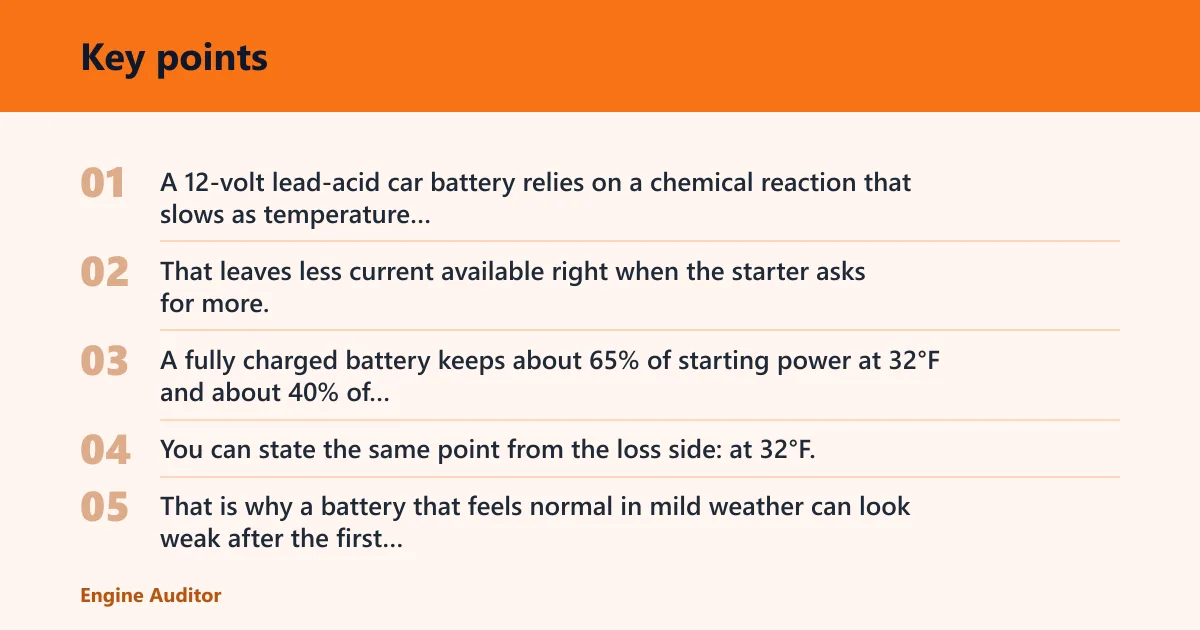
A 12-volt lead-acid car battery relies on a chemical reaction that slows as temperature falls. That leaves less current available right when the starter asks for more. A fully charged battery keeps about 65% of starting power at 32°F and about 40% of starting power at 0°F.
You can state the same point from the loss side: at 32°F, a battery loses roughly 35% of its cranking power, and at 0°F, a battery can lose 60% of its cranking power. That is why a battery that feels normal in mild weather can look weak after the first hard freeze.
Why cold engines need more current to crank
The battery is only half the winter story. Engine oil thickens in low temperatures, so the starter has to work harder to turn the engine. That raises starter current demand. Diesel engines also have higher compression and often extra cold-start demands, so they put more stress on battery reserve than many gasoline cars.
Start-stop systems and trucks carrying winter accessories add demand too. Rear defrosters, heated seats, blower motors, lights, wipers, and long idling periods all raise the chance that the battery starts the next trip less than fully charged.
How state of charge changes both starting power and freeze risk
Charge level affects two things at once: how hard the battery can crank and how well it resists freezing. A half-charged battery can freeze solid at 0°F. A fully discharged battery may freeze at 32°F. By contrast, a fully charged battery may not freeze until -76°F. (Batterytender)
That matters because a deeply discharged battery is weaker and more likely to crack its case after freezing. If the case is bulging, cracked, or leaking, do not try to charge it.
Why a battery can seem fine in summer and fail in winter
Summer often hides a marginal battery. Heat speeds the chemical reaction, warmer oil cuts cranking drag, and the starter needs less current to spin the engine. In winter, available battery output drops while engine demand rises. A battery that was already aging or undercharged gets exposed fast.
Picture an SUV that starts instantly in October but cranks slowly at 10°F after sitting overnight. Nothing major changed except temperature, oil drag, and the battery’s available current. That pattern points to a battery or charge issue well before it points to the starter.
Why a new battery can still die in winter
A battery that is new can still fail in cold weather when the real problem is not age but undercharging, the wrong size, a loose install, or a hidden electrical draw. The supporting article breaks down how winter temperatures reduce battery output and why that can expose weak charging or fitment issues that only show up once the weather drops.
It also explains what to check next so you do not keep replacing batteries that are not the root cause. If your car keeps going dead after a cold snap, new battery cold issues helps you separate normal cold-weather chemistry from a fixable charging, installation, or drain problem.
Safe Jump-Starts in Freezing Weather
When temperatures drop near or below 0°F, the main question is not just whether the car will start, but whether the battery is safe to jump. This guide explains when you can proceed, when the battery should be warmed first, and when a frozen or damaged case means you should stop and replace it instead. It also lays out the cable-connection order and the common mistakes that can damage electronics or trigger a battery failure. For the full step-by-step process, see freezing-weather jump starts.
That matters because cold batteries recover differently than warm ones, and a rushed jump can make a weak battery fail faster.
How an engine block heater affects winter starts
An engine block heater can reduce the strain of a cold start by warming the coolant and nearby engine metal before you turn the key. That matters because thick oil, slow cranking, and harder combustion all make a weak battery work even harder in freezing weather. The supporting guide explains when a heater is most useful, how different heater types work, and what conditions usually justify plugging one in.
If your vehicle lives outside, sits through very cold nights, or already shows slow winter cranking, this can be a practical prevention step rather than a repair. See the full engine block heater guide for the decision points, usage basics, and when the benefit is strong enough to matter.
Is the battery bad or just cold?
Cold alone can slow cranking, but it usually does not create a no-start in a healthy, fully charged battery with clean connections. The distinction comes from symptom timing, resting voltage, age, and test results: low charge can often be recovered, while weak capacity, repeated cold-only failures, or driving-related symptoms push the answer toward testing or replacement.
What symptom timing tells you before you touch a meter
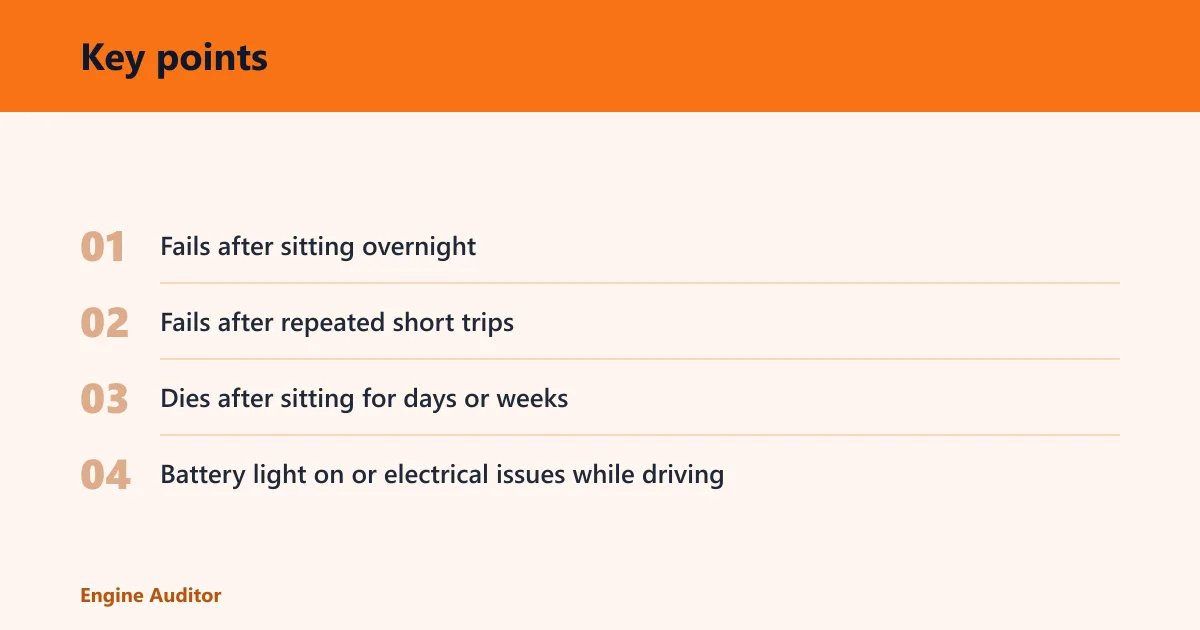
Timing gives you one of the clearest clues. A battery that fails after sitting overnight points you toward low state of charge, aging capacity, or poor connections. A battery that acts up after repeated short trips points more toward undercharging, and one that dies after sitting for days or weeks points more toward a parasitic draw or poor charge retention.
- Fails after sitting overnight: suspect low state of charge, aging capacity, or dirty and loose connections.
- Fails after repeated short trips: suspect undercharging from winter use patterns.
- Dies after sitting for days or weeks: suspect a parasitic draw or a battery that cannot hold charge.
- Battery light on or electrical issues while driving: suspect the charging system before blaming the battery.
Low charge, low capacity, and high starting load are different problems
A low-charge battery may show low resting voltage but recover after proper charging and then pass a load test. A low-capacity battery may charge up to a normal-looking voltage, then collapse under load in the cold. High starting load comes from thick oil, a stiff engine, or heavy accessory use, and it can expose a battery that is only marginal.
Voltage by itself cannot sort out those cases. It only tells you state of charge at that moment.
How battery age shifts the odds toward replacement
Age matters most when the symptoms show up only in winter and come back after charging. A several-year-old battery that shows normal voltage after a charger but still struggles on cold mornings is a stronger replacement candidate than a newer battery with the same voltage. The reason is simple: aging cells can still show charge but lose current-delivery ability.
That is especially true in diesel trucks, start-stop vehicles, and accessory-heavy winter use where reserve capacity gets worked harder.
When the problem is more likely the alternator, starter, or parasitic draw
If the battery dies after a drive, or the battery warning light comes on while driving, inspect the charging system first. The alternator recharges the battery and supports electrical loads once the engine is running. Short trips may not be enough, but a healthy charging system should not let a good battery go flat during normal driving.
If the battery is dead after sitting for days, then seems fine after charging, suspect a parasitic draw. If the engine cranks very slowly despite a confirmed healthy battery and clean tight cables, the starter or engine drag moves higher on the list.
What voltage should a car battery read in cold weather?
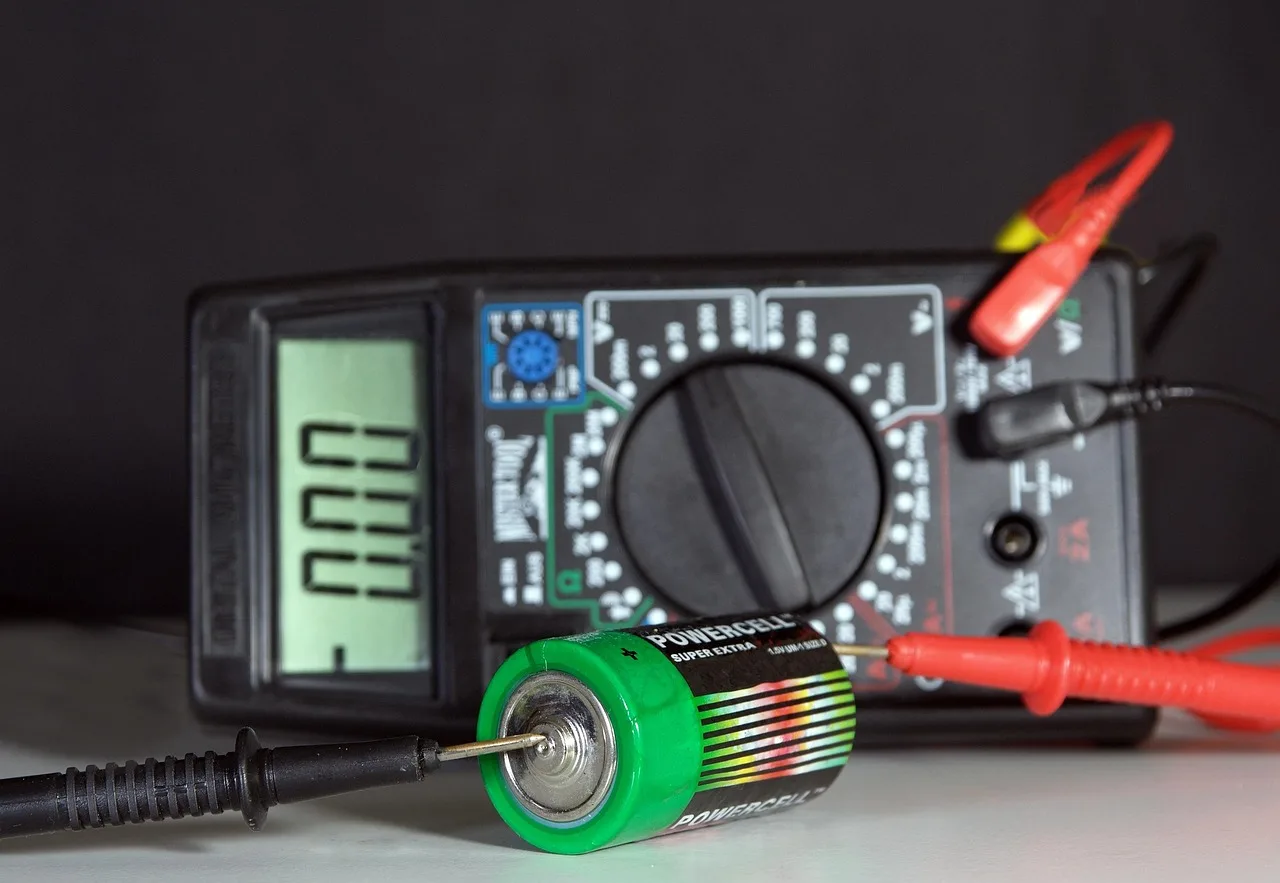
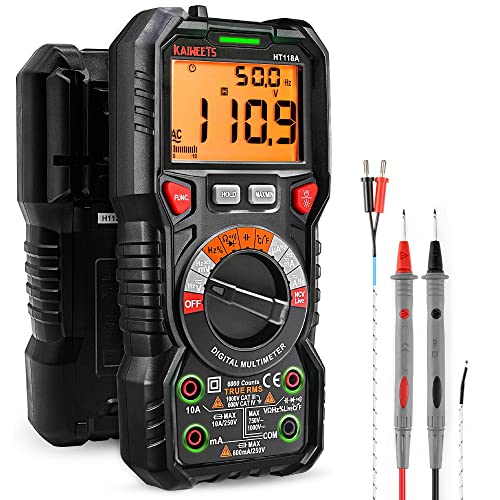
A cold-weather resting-voltage check should be done with the vehicle off, the meter placed on the battery posts, and surface charge removed or the battery allowed to rest first. As a guide, 12.6V or higher is fully charged, 12.4V is about 75%, 12.2V about 50%, and 12.0V or lower points to low charge. (Batterytender)
How to measure resting voltage the right way
- Turn the vehicle off.
- If it was just driven or charged, let the battery rest or remove surface charge by switching the headlights on briefly, then off.
- Set the multimeter to DC volts.
- Touch the probes directly to the battery posts, not the cable ends.
- Read the voltage and interpret it with recent charging, outside temperature, and the no-start timing in mind.
Testing at the posts matters because a corroded terminal can hide voltage drop if you check only the clamps.
Resting-voltage ranges that matter
| Resting voltage | What it usually means | Best next step |
|---|---|---|
| 12.6V or higher | Fully charged | If cold-start trouble remains, check connections and load-test the battery |
| 12.4V | About 75% charged | Charge first if symptoms are present, then retest |
| 12.2V | About 50% charged | Charge before judging battery health |
| 12.0V or lower | Low state of charge | Charge it, then test for health and for the reason it went low |
When a low reading points to charging first instead of replacing
If the battery is below 12.4V at rest, the first move is usually charging, not replacing. An undercharged battery can crank poorly in cold weather even if its cells are still healthy. Recharging also lowers freeze risk.
Suppose a crossover sits outside for four days at 15°F and reads 12.1V before the first start attempt. That is a charge problem until proven otherwise. Charge it fully, then check whether the voltage holds and whether it passes a load test.
Why voltage alone cannot confirm battery health
An aging battery can show 12.6V after charging and still fail under starter load. That is why resting voltage is step one, not the verdict. To choose between recharge and replacement, you need either a load test or a conductance test, along with the symptom pattern and battery age.
How do you test a battery before winter?
Start with damage and connection checks before touching a charger or buying parts. If the case is swollen, cracked, leaking, or possibly frozen, stop there. If the battery looks intact, clean and tighten the terminals, measure resting voltage, charge if needed, and then confirm capacity with a load or conductance test.
Start with a visual and safety check
Look for swelling, cracks, leaks, a bulged case, or obvious freeze damage. If a battery may be frozen, do not charge it. Charging a frozen, cracked, bulging, or leaking battery is unsafe and can make the damage worse.
Also inspect the hold-down, tray, and cables. A loose battery can damage plates internally and create intermittent cable contact.
Check, clean, and tighten the connections
Terminal corrosion and loose cable ends create voltage drop right where winter cranking current is highest. Even a decent battery will act weak if the current path is poor.
Remove corrosion, clean the contact surfaces, and tighten the clamps correctly. Check the ground connection to the chassis or engine as well, since a poor ground can mimic a weak battery.
Use a multimeter for resting voltage
Take the resting-voltage reading only after the battery has rested or surface charge has been removed. Then compare the result to the charge table above. A battery below 12.4V should be charged before any final decision about replacement.
Use a load test or conductance test to confirm capacity
A proper load test is still the cleanest way to confirm winter readiness. The standard method uses half the battery’s rated cold cranking amps for 15 seconds. A healthy 12-volt battery should generally hold at least about 9.6 V in a load test at 70°F and about 8.5 V in a load test at 0°F.
If the battery will not hold those temperature-corrected voltages after being fully charged, it is a replacement candidate. If it passes, the next suspects are recharge habits, cable condition, the alternator, or a parasitic draw.
How CCA and load testing decide replacement
What cold cranking amps measures at 0°F
CCA is the winter rating that matters most for starting. It is measured at 0°F for 30 seconds while maintaining at least 7.2 volts. That rating tells you how much current the battery can deliver in severe cold, which is why replacement should meet or exceed the vehicle’s factory specification.
Match the replacement battery to the vehicle spec
Do not drop below the factory CCA requirement to save money or make an available battery fit. Meet or exceed the vehicle spec, while also matching physical size, terminal layout, and hold-down design. A compact car typically uses 400-600 CCA, while a diesel engine typically needs 850-1000+ CCA.
Higher demand vehicles deserve extra caution. Diesels, start-stop systems, plow trucks, and SUVs loaded with heaters and defrosters have less margin for a weak battery.
How a proper load test works
The standard load test uses half the battery’s rated cold cranking amps for 15 seconds. The result has to be read against temperature, not against one fixed number year-round. A battery that passes in a warm shop can still be marginal for a cold morning if the tester does not apply the correct temperature benchmark.
How to read pass voltage by temperature
Use 9.6 V at 70°F as the common benchmark and 8.5 V at 0°F for severe winter conditions. Those figures let you separate a battery that is merely undercharged from one that lacks usable capacity.
Say your pickup has a battery rated at 800 CCA. A proper load test applies 400 amps for 15 seconds. If it cannot stay at the temperature-corrected pass voltage after a full charge, replacing it carries less roadside risk than trying to nurse it through a cold snap.
Battery triage decision table
Decision table
| Symptom timing | Resting voltage | Battery age clue | Temperature clue | Most likely fix |
|---|---|---|---|---|
| No-start after sitting overnight | 12.4V or lower | Any age | First hard freeze or subfreezing mornings | Charge the battery first, then retest; if voltage falls again, inspect charging habits or parasitic draw |
| No-start after sitting overnight | 12.6V or higher | Several-year-old battery | Only fails in the cold | Load-test it; replace if it fails the temperature-corrected load test |
| Slow crank with visible corrosion or loose clamps | Any reading | Any age | Worse in cold because current demand is higher | Clean terminals and tighten all battery and ground connections, then retest starting |
| Starts after a jump, then struggles again after several short trips | Often 12.2V to 12.4V | Any age | Heater, rear defroster, lights, blower, wipers in use | Recharge fully and change the use pattern; if it repeats, load-test the battery and inspect charging output |
| Dead after sitting for days or weeks | Low after parking, recovers after charging | Any age | Cold increases self-discharge impact on a weak battery | Use a maintainer for infrequent use and inspect for parasitic draw if the discharge repeats |
| Battery warning light on or electrical problems while driving | May vary | Any age | Can happen in any season | Inspect alternator and charging system before replacing the battery |
| Battery frozen, case cracked, bulging, or leaking | Do not judge by voltage alone | Any age | Deep discharge plus freezing exposure | Do not charge; replace the battery and inspect the charging reason afterward |
Checklist
- Note when it failed: overnight, after short trips, after sitting, or while driving.
- Inspect for damage: cracks, leaks, bulging, or signs of freezing.
- Inspect for connections: corrosion, loose clamps, loose grounds.
- Measure resting voltage at the posts.
- If below 12.4V, charge it before judging health.
- Factor in age: several-year-old batteries with cold-only failures are stronger replacement candidates.
- Confirm with a load test if voltage is acceptable but cold starts are still weak.
- If trouble appears while driving, inspect the alternator and charging system.
- If it goes flat while parked, inspect for parasitic draw.
Can short trips in winter kill a car battery?
Yes. Repeated short trips can leave a battery steadily undercharged in winter because a cold start takes a lot of energy and the alternator may not get enough running time to replace it. The pattern is common when low temperatures, slow warm-ups, and heavy accessory use stack on top of each other.
Why brief drives fall behind
The alternator recharges the battery while the engine runs, but winter loads are high. A short commute may have to cover the energy used by the starter, plus headlights, blower fan, heated seats, rear defroster, wipers, and cabin electronics. In that pattern, the battery can lose a little charge every day.
How repeated undercharging turns into battery damage
If that undercharged state lasts, sulfation becomes more likely. Once that happens, the battery may accept a surface charge yet deliver less current under load. That is when people replace a battery after one bad morning without noticing that the real cause was weeks of short-trip undercharging.
What to do if short-trip use is unavoidable
Use a smart maintainer if the vehicle sits for days or mostly makes brief winter trips. A battery maintainer or smart trickle charger is a good fit for infrequent drivers, seasonal cars, and vehicles parked for long stretches because it keeps the battery charged without overcharging it.
Keep the battery fully charged whenever possible
A full charge gives the battery more available starting power and a much lower freeze risk. That matters more than accessories or insulation. If the vehicle sees brief drives, long idle periods, or long parking stretches, periodic charging does more good than guessing from a single start that the battery is fine.
When a battery maintainer makes sense
A maintainer is worth using when the car sits for days or weeks, when winter driving is mostly short trips, or when the vehicle is seasonal. It is also a sensible choice for collector cars, spare trucks, and work vehicles that must start on demand after long parking periods.
Should you use a battery blanket or insulation kit?
A battery blanket or insulation kit can help in severe cold, but it is not a cure for a weak battery. It slows heat loss; it does not create heat or add charging capacity. It works best with a healthy, fully charged battery. Fit matters too, and many kits are sized around common groups such as 24, 27, and 31.
That makes blankets more useful in very cold climates, outdoor parking, and diesel or truck use where overnight cold soak is severe. They make less sense as the first purchase for a battery that already fails a load test.
Storage and infrequent-use habits that reduce no-starts
Keep the case clean and dry, the hold-down secure, and the connections tight. Avoid leaving the vehicle parked for long periods with a partly discharged battery. If it will sit, connect a maintainer rather than relying on occasional idling, which often does little to restore full charge.
When to charge, when to replace, and when to inspect the car
Charge it if low voltage is the main finding
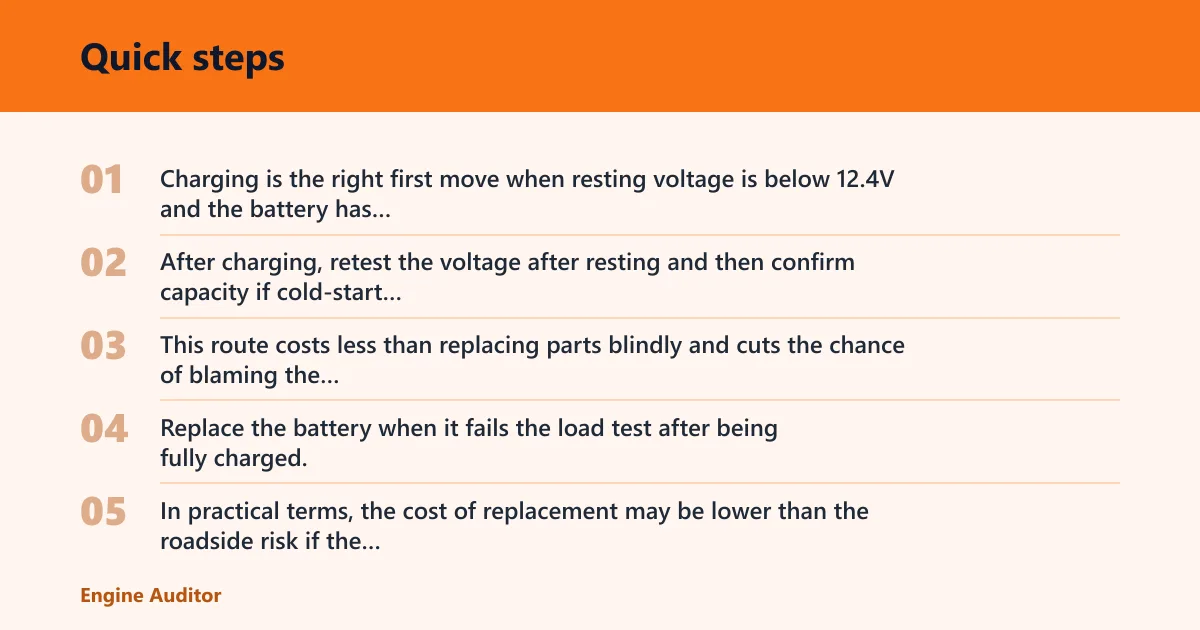
Charging is the right first move when resting voltage is below 12.4V and the battery has no physical damage. After charging, retest the voltage after resting and then confirm capacity if cold-start symptoms remain. This route costs less than replacing parts blindly and cuts the chance of blaming the wrong component.
Replace it if age, test failure, and symptoms line up
Replace the battery when it fails the load test after being fully charged, or when a several-year-old battery keeps showing cold-only no-starts despite normal charge and clean tight connections. In practical terms, the cost of replacement may be lower than the roadside risk if the battery has already shown a repeat pattern.
Inspect the charging system if the battery dies after driving
If the battery warning light appears, headlights dim while driving, or the battery goes flat after a normal drive, move the alternator and charging system to the top of the list. Replacing the battery first can leave the real fault untouched.
Inspect for parasitic draw if it goes flat while parked
A battery that repeatedly goes dead after sitting for days or a week, then acts normal after charging, deserves a parasitic draw check. That pattern can come from modules that stay awake, lights left on, power accessories, or added electronics. The battery may be a victim, not the root cause.
Frequently asked questions
Why does my car battery die in cold weather but work fine in summer?
Cold slows the lead-acid chemical reaction and cuts available starting power, while thicker oil raises cranking load. A fully charged battery keeps about 65% of starting power at 32°F and about 40% at 0°F, so a marginal battery that starts fine in summer can fail once temperatures drop.
How do I test a car battery before winter?
Check for swelling, cracks, leaks, and corrosion first. Clean and tighten the terminals, then measure resting voltage at the posts with the vehicle off and surface charge removed. If it is below 12.4V, charge it first. Then confirm battery condition with a load or conductance test.
Can a weak car battery freeze and crack in winter?
Yes. State of charge changes freeze risk sharply. A half-charged battery can freeze solid at 0°F, and a fully discharged battery may freeze at 32°F. A fully charged battery may not freeze until -76°F, which is why keeping charge up matters before and during cold weather.
Should I use a battery blanket or warmer?
A battery blanket is worth considering in severe cold, outdoor parking, diesel use, and truck duty where cold soak is long and repeated. It slows heat loss but does not create heat or repair weak cells. It works best on a healthy, fully charged battery sized correctly for the case.
When should I replace a winter battery instead of charging it?
Replace it when it fails a proper load test after being fully charged, when the case is cracked, bulging, frozen, or leaking, or when a several-year-old battery keeps failing on cold mornings even after charging and connection cleaning. Charge first when voltage is low; replace when capacity is gone.
Products related to this article
Sponsored / affiliate links. As an Amazon Associate I earn from qualifying purchases. I may earn additional commission from eligible campaigns.