Why Does My Car Struggle to Start When It Is Cold?
A cold-start struggle usually points to one of five faults: weak battery, high starter draw, poor fuel delivery, bad plugs or glow plugs, or a sensor telling the engine the wrong temperature. Pick the wrong one and you waste money, then risk a no-start in freezing weather. This guide shows the cold-start symptom pattern for petrol and diesel cars, then maps each pattern to the most likely system so you can test the right part first.
This guide is part of our Cold Weather Car Battery Guide: Why It Dies, How to Test It and How to Keep It Alive series.
Cold start diagnosis matrix
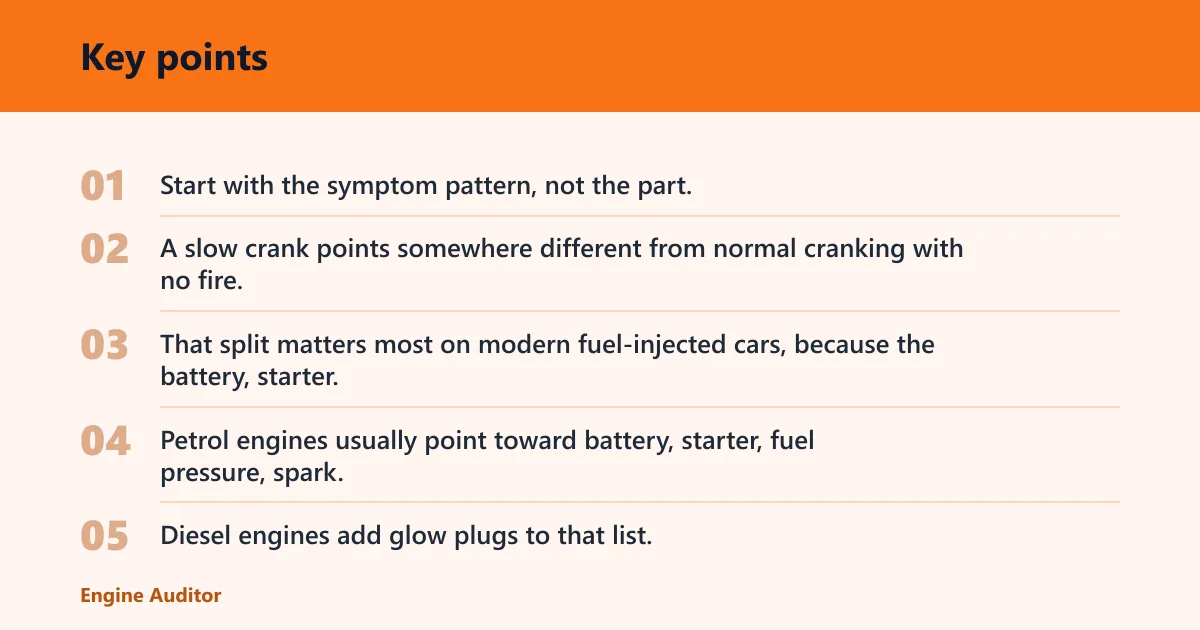


Start with the symptom pattern, not the part. A slow crank points somewhere different from normal cranking with no fire, and start-then-stall points somewhere else again. That split matters most on modern fuel-injected cars, because the battery, starter, fuel pressure, and engine temperature input all affect the first few seconds in different ways.
| Symptom pattern | Likely cause | First test | Normal reading | Next action |
|---|---|---|---|---|
| Slow crank, heavy or lazy rotation | Weak battery, poor terminal connection, starter drag, thick oil | Battery at rest, then voltage while cranking | About 12.6 volts at rest; stay above 9.6 volts while starting | Clean terminals, load-test battery, then check starter current draw |
| Clicking, no crank, or single heavy click | Battery too weak, bad connection, starter solenoid or motor fault | Turn on headlights, then try a crank | Lights should not collapse hard; cranking voltage should stay above 9.6 volts | If battery tests good, suspect starter or cable resistance |
| Normal crank speed, no fire | Fuel pressure loss, bad ECT reading, weak spark, diesel glow plug fault | Prime test, coolant temperature check, or spark/glow plug check | ECT should match ambient within a few degrees | Move to fuel, sensor, ignition, or glow plug diagnosis |
| Starts, then stalls after a few seconds | Fuel pressure bleed-down, sensor input error, air or fuel delivery fault | Cycle ignition three times, then retry | Fuel system should hold enough prime to start cleanly | Check pump check valve, regulator, injector leakage, or air leaks |
| Rough first minute, white or grey smoke on diesel | Glow plugs, injector issue, cold combustion chamber | Read glow plug faults or test resistance | All cylinders should heat evenly on cold start | Replace failed plugs or diagnose control circuit |
Petrol versus diesel readings
Petrol engines usually point toward battery, starter, fuel pressure, spark, or the coolant temperature input. Diesel engines add glow plugs to that list, and a failed plug can show up as rough first-minute running, white or grey smoke, or a start that improves as the engine warms. Use a different test order for each engine type.
A battery in good condition loses half its available power at 0 F, and cold starts can be affected by temperatures below freezing. Below -10°C / 14°F, move from mild slow-crank checks to severe cold-start checks. Weak batteries and tired glow plugs are far more likely to show up there.
Why does my car struggle to start when it is cold?
Cold weather lowers battery output, makes oil thicker, and can expose weak fuel or sensor control that the car masks in mild weather. A weak battery may still run accessories, but it may not spin the starter fast enough when the engine oil is thick and combustion needs a stronger first hit. That is why the same car can start fine later in the day.
Cold battery capacity loss
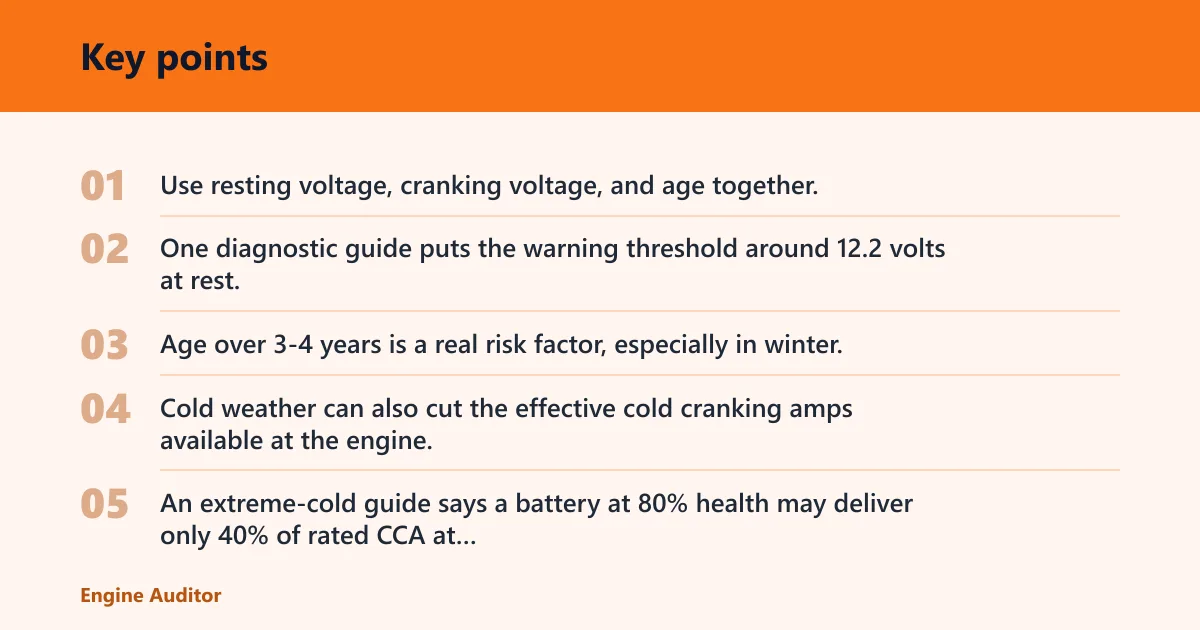
Battery health is not just voltage at rest. Use resting voltage, cranking voltage, and age together. One diagnostic guide puts the warning threshold around 12.2 volts at rest, while a healthy cranking battery should stay above 9.6 volts during starting. Age over 3-4 years is a real risk factor, especially in winter.
Cold weather can also cut the effective cold cranking amps available at the engine. A battery at 80% health may deliver only 40% of rated CCA at -18°C. That is why a battery that seems “okay” in warm weather can struggle once frost arrives.
Thick oil and harder cranking
Cold weather can make motor oil thicker and harder to push through the engine. SAE 5W-30 and SAE 10W-30 are the winter viscosities commonly mentioned because the lower winter rating flows better at low temperatures. If cranking slows only in cold weather, oil choice can be part of the fault, especially on older engines or engines already showing marginal battery health.
Fuel and sensor effects in low temperatures
Cold fuel does not vaporize as easily, which matters more on older carbureted vehicles than on modern fuel-injected ones. On fuel-injected cars, the problem usually shows up as weak fuel pressure, poor pump output, a clogged fuel filter, or a coolant temperature sensor that tells the engine it is warmer than it really is.
Say your petrol car cranks at normal speed on a frosty morning, but it fires only after several seconds and then settles. That pattern points away from the starter and toward fuel pressure, spark quality, or a coolant temperature input that is too warm for the actual outside air.
Is it the battery or the starter?
Use cranking speed, clicking, and voltage drop to separate the two. A weak battery usually makes the starter turn slowly or click once and stop. A failing starter often shows heavy current draw, grinding, or a motor that will not spin properly even when the battery and cables test well.
Resting voltage and cranking voltage
Check the battery with the car off, then again while cranking. Around 12.6 volts at rest suggests a fully charged battery, while a reading around 12.2 volts is already a warning sign in one diagnostic guide. During cranking, voltage should stay above 9.6 volts. If it drops below that, the battery or its connections are suspect before the starter is blamed.
Corroded or loose battery terminals matter because they can mimic a bad battery. Clean, tight connections are cheap to inspect. If the battery is more than 3-4 years old, a free battery test or proper load test is worth doing before any deeper diagnosis.
Crank speed, clicks, and grinding
Slow, labored cranking points first to battery condition or cable resistance. A rapid clicking sound often means the solenoid is trying to engage but the battery cannot supply enough current. Grinding points more toward starter drive or flywheel engagement trouble, which is usually a garage job rather than a driveway fix.
When the battery tests good but the crank remains weak, a garage can check starter current draw. High current draw with poor rotation points to starter failure or mechanical drag. Low current draw with no rotation often points to a bad connection or an open circuit in the starter path.
When current draw points to the starter
Starter diagnosis needs more than a battery voltage check. A starter that draws too much current can drain a healthy battery during one or two attempts, and repeated cranking only makes the problem worse. If you already see good resting voltage, good terminals, and strong battery test results, stop guessing and move to a shop test.
Does cold weather change fuel delivery?
Yes. Cold weather can make a marginal fuel system fail the first start of the day. The key question is whether the engine cranks normally but does not fire, or whether it starts and stalls after a brief run. Those two patterns often point to different fuel faults.
Overnight bleed-down checks
If a car starts after several cranks, then starts normally later in the day, suspect overnight fuel pressure bleed-down. The prime test cycles the ignition three times before starting. That builds pressure before the engine turns. If the car starts much better after the prime test, fuel pressure may be leaking down overnight.
- Turn the ignition on for a few seconds.
- Switch it off.
- Repeat that cycle three times.
- Try the start again.
- Note whether the engine fires faster than before.
Fuel pump check valve and regulator faults
A weak fuel pump check valve can let pressure bleed back into the tank while the car sits. A faulty fuel pressure regulator can do the same. Either fault leaves the rail under-pressurized at the next cold start, so the engine cranks normally but needs extra time to build usable pressure.
Injector leakage and primer tests
Leaking injectors can also bleed pressure down overnight. If the prime test helps, but the problem returns, the fuel system needs proper pressure testing rather than more blind parts replacement. On older vehicles, a fuel filter restriction can also lower pump output and make cold starts harder because cold fuel already vaporizes poorly.
A common first-timer mistake is replacing the battery after a normal-crank no-start, only to find the engine still takes several long cranks every cold morning. That pattern often points to lost fuel pressure, not battery weakness.
Cold start fuel and sensor faults
When the engine cranks at normal speed but does not fire cleanly, the fault often sits in mixture control. On petrol engines, that means spark and fuel delivery. On diesels, it means heat at the right cylinders. The coolant temperature input matters on both, because the engine uses it for cold-start enrichment and timing decisions.
ECT reading versus ambient temperature
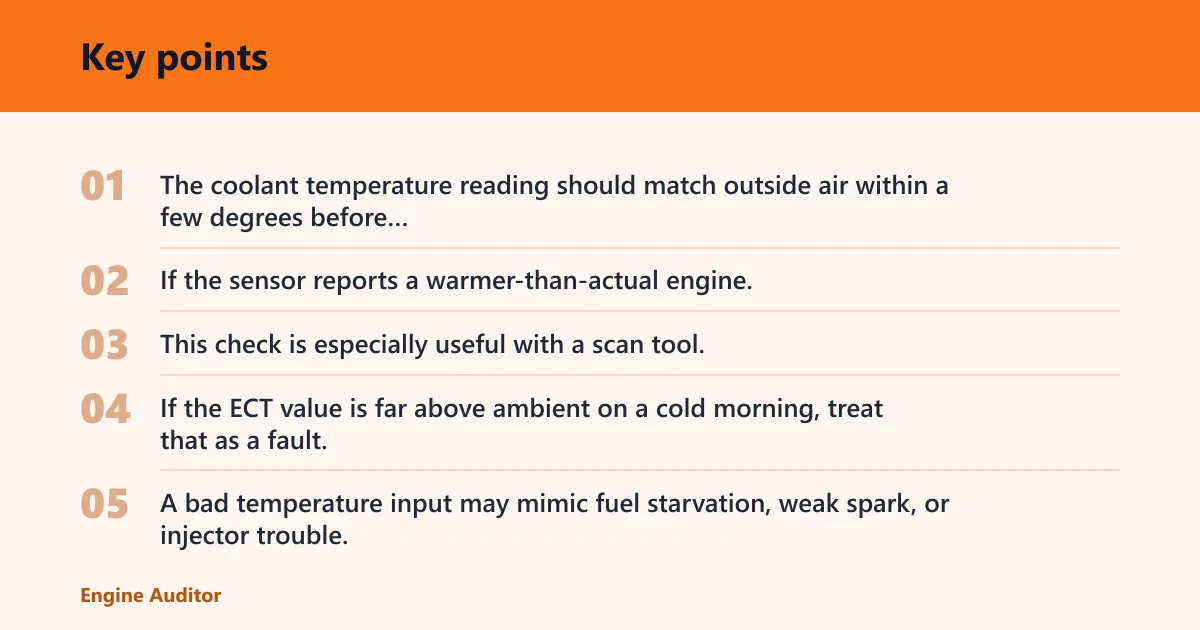
The coolant temperature reading should match outside air within a few degrees before startup. If the sensor reports a warmer-than-actual engine, the control unit may under-fuel a cold engine and make starting harder. This check is especially useful with a scan tool, but you can still compare the reading with outdoor temperature if the engine has sat overnight.
If the ECT value is far above ambient on a cold morning, treat that as a fault, not a minor drift. A bad temperature input may mimic fuel starvation, weak spark, or injector trouble.
Petrol spark plug wear and weak ignition
On petrol engines, worn spark plugs are a common cold-start weakness. Plug replacement is cheap and often the whole cure if plugs have not been changed in 40,000 to 50,000 km. A widened plug gap needs more voltage to fire, and that extra demand shows up first during cold starts, when battery output is already lower.
Picture a petrol hatchback that starts after two tries in summer but needs long cranking on a freezing morning and idles rough for the first minute. If the battery and fuel pressure check out, old plugs are a strong suspect.
Diesel glow plug failure patterns
Diesel engines rely on glow plugs for cold-start heat. They can fail one at a time, so the engine may still start, but with rough running, white or grey smoke, and a poor first thirty seconds. One tired plug may be subtle; two tired glow plugs can produce the smoke and roughness described by one guide.
Glow plugs can be tested with resistance or scan tools, depending on access. If one or more plugs fail, the cold start often improves as the engine warms, which can trick owners into blaming the battery alone.
Why does my diesel car struggle to start when it is cold?
Diesel cold-start trouble often comes from glow plug failure, weak battery output, or fuel system pressure issues. Unlike petrol engines, diesel combustion needs enough cylinder heat to ignite fuel at startup. If one or more glow plugs are weak, the engine may crank normally but start roughly, smoke white or grey, or take longer to catch in freezing weather.
Glow plug diagnosis before more cranking
Check for white or grey smoke during the first thirty seconds. That pattern, especially with rough first-minute running, fits glow plug trouble well. If the battery is already weak, do not keep cranking for long periods. That only lowers voltage further and can blur the diagnosis.
Diesel fuel delivery versus glow plugs
If the diesel starts better after cycling the ignition or after repeated attempts, fuel pressure and glow plug control both deserve attention. If the engine starts but stumbles and clears quickly, glow plug or injector pattern faults are more likely than a complete fuel supply failure. A scan tool helps, but resistance checks can still narrow the problem.
Oil and weather effects
Oil choice does not fix every cold-start problem, but it can change the symptom enough to matter. Thick oil increases starter load, slows cranking, and makes a marginal battery look worse than it is. If the engine only struggles in cold weather, oil viscosity belongs in the diagnosis.
Why winter viscosity matters
The lower winter rating helps oil flow more easily at low temperatures. SAE 5W-30 and SAE 10W-30 are the common winter grades mentioned in many guides. The goal is not magic starting power. It is to reduce drag so the starter and battery are not fighting thick oil on top of everything else.
When oil choice is part of the fault
If the battery passes a load test, the terminals are clean, and the starter is healthy, but cranking still feels heavy in freezing weather, oil may be contributing. That is especially true if the oil grade is too thick for the climate or the engine is already marginal on cold mornings. If the car also shows low oil pressure warnings or unusual mechanical noise, stop and get a garage diagnosis.
Cold start diagnosis matrix guide
Use the matrix in order. First decide whether the engine is slow to crank, cranks normally but will not fire, or starts and then stalls. That one choice usually narrows the fault more than a parts list does. Then test the system that matches the pattern, starting with the cheapest checks.
No-scan fallback path
If you do not have a scan tool, start with battery voltage, terminal condition, and the prime test. Then listen for crank speed changes, watch for smoke on diesel, and note whether the car improves after a few ignition cycles. Compare overnight coolant temperature to the outside air as closely as you can. Those checks do not replace a scan tool, but they still point you in the right direction.
When to stop cranking and get help
Stop repeated cranking if the battery voltage is collapsing, the starter grinds, or the engine gives no sign of firing after several attempts. Do not keep jump-starting a car that still shows the same hard-start pattern after the battery and terminals test good. At that point, the fault is likely fuel, starter, sensor, or glow plug related, and more cranking only adds strain.
Frequently asked questions
Why do cars struggle to start in the cold?
Cold air and cold parts reduce battery output, make oil thicker, and can lower fuel vaporization. Below freezing, those effects become more obvious, and a battery can lose much of its usable power. The result is slower cranking, weaker spark energy, or less effective cold-start fueling.
Why won’t my car start when it’s cold?
If it cranks slowly, begin with the battery, cables, and starter. If it cranks normally but will not fire, check fuel pressure, spark on petrol engines, glow plugs on diesel engines, and the coolant temperature reading. A normal crank with no start usually means the engine is missing one of the three basics: fuel, spark, or correct temperature input.
Is it a battery problem or something else if the car starts fine later?
Not always the battery. If the car starts normally later in the day, the first clue is whether the engine was slow to crank or cranked normally but would not fire. A weak battery often shows low resting or cranking voltage, but fuel pressure bleed-down and a wrong coolant temperature reading can also make the first cold start difficult.
How do I tell whether slow cold cranking is the battery or starter?
Check battery voltage at rest and while cranking first. Around 12.6 volts at rest and above 9.6 volts while starting points away from a dead battery. If the battery tests good but cranking is still slow, suspect starter current draw, cable resistance, or mechanical drag. Grinding or repeated clicking leans harder toward starter trouble.
Can cold weather make fuel pressure or sensors cause a hard start?
Yes. Cold weather can expose overnight fuel pressure bleed-down, weak pump output, injector leakage, or a coolant temperature sensor that reads warmer than the engine actually is. If cycling the ignition three times helps, fuel pressure is a strong suspect. If the temperature reading is far from ambient, the sensor deserves attention.
Products related to this article
Sponsored / affiliate links. As an Amazon Associate I earn from qualifying purchases. I may earn additional commission from eligible campaigns.