How Much Does It Cost to Replace Common Engine Parts?
Common engine part replacements usually run from a few hundred dollars to a couple thousand dollars per job; spark plugs and sensors are usually on the cheaper end, while water pumps, timing components, and head gaskets often make the bill much higher. Bad estimates can waste hundreds, or lead you to approve work you do not need. I have seen both. This guide breaks down fair price ranges, line-item meanings, and the signs a quote is padded.
What you should expect to pay before approving an engine-parts repair
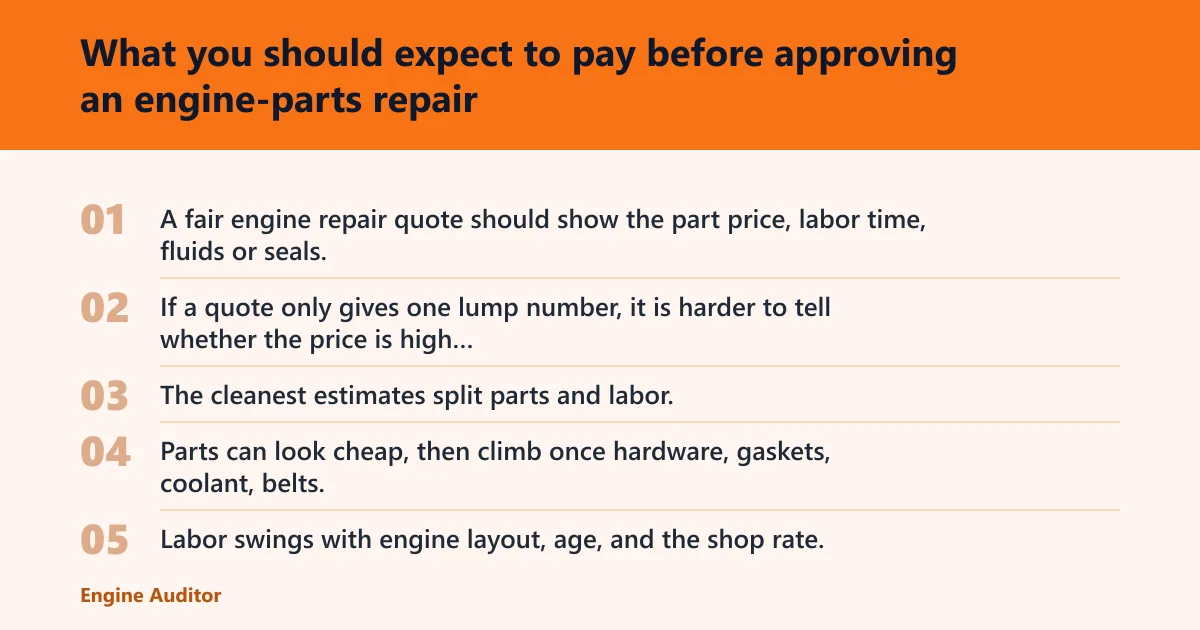
A fair engine repair quote should show the part price, labor time, fluids or seals, and any shop fees before tax. If a quote only gives one lump number, it is harder to tell whether the price is high because the part is expensive, the job is access-heavy, or the shop is padding diagnostics.
How shops build a quote
The cleanest estimates split parts and labor. Parts can look cheap, then climb once hardware, gaskets, coolant, belts, or one-time bolts are added. Labor swings with engine layout, age, and the shop rate, which is why the same repair can be cheap on one sedan and painful on a transverse V6 or a luxury car.
Why the same repair can differ by hundreds of dollars
Two cars can need the same part and still produce very different bills. A front-drive engine packed sideways under a cowl is harder to reach than the same part on a roomy truck engine bay. If a quote feels high, compare the listed labor hours, the part brand or tier, and the add-ons attached to the job.
| Repair | Fair low | Fair high | Labor drivers | Usually bundled with it |
|---|---|---|---|---|
| Alternator | $250 | $1,490 | Access around belts, brackets, and wiring; higher on tight engine bays | Belt, tensioner, battery test, terminal cleaning |
| Water pump | $230 | $1,100 | Cooling-system drain, pulley removal, access behind covers | Coolant, thermostat, gasket, timing hardware on some engines |
| Timing chain | $300 | $1,000 | Front cover removal, engine timing setup, resealing | Chain kit, guides, tensioner, seals, sprockets, bolts |
| Starter | $210 | $1,200 | Access from above or below, heat shielding, cable removal | Battery test, cable ends, relay check, heat shield hardware |
| Spark plugs | $100 | $650 | Cylinder count, coil removal, intake removal on some engines | Coils, boots, anti-seize if specified, valve cover tube seals |
| Fuel pump | $280 | $1,500 | Tank-drop labor or access-panel labor, pressure test, fuel bleed-down | Filter sock, tank seal, relay check, fuel line clips |
| Oxygen sensor | $110 | $550 | Rust, exhaust routing, upstream vs downstream location | Scan diagnosis, anti-seize if used, connector repair, exhaust leak check |
| Engine diagnostic | $90 | $220 | Scan-tool work, live data, pressure or circuit tests, road test | Sometimes credited toward repair, sometimes not |
📊 A proper car diagnostic costs $100–$180 at most shops. Source: Repairmath.
How much does it cost to replace an alternator?
An alternator replacement is usually fair when the quote lands inside the stated $250 to $1,490 range, with the spread driven by access, labor rate, and whether the battery or belt system needs attention too. If charging voltage is bad, the battery light is on, and the belt and cables check out, replacement is more defensible.
Signs the alternator, battery, or wiring is the real problem
Dim lights, a battery warning lamp, slow cranking, and repeated dead batteries can point to the alternator. But a weak battery, corroded terminals, loose grounds, or a slipping belt can mimic the same symptoms. A charging test should come before parts replacement when the diagnosis is not clear.
How much does it cost to replace a water pump?
A water pump job often prices out between $230 and $1,100, and the bill rises fast when the pump is buried behind covers or tied to other cooling components. The quote is usually fair if it includes coolant, a gasket, and any seals or fasteners that have to come off during the repair.
When the water pump is bundled with a timing job
Many engines place the water pump behind timing covers, so replacing it can mean extra labor that overlaps with a timing belt or chain service. That is why a pump on one engine may be a simple cooling repair, while on another it becomes part of a larger front-of-engine job.
Why access on the engine layout changes labor
Transverse engines often pack the pump against the frame rail or inner fender. Rear-wheel-drive layouts can be easier, but not always. If the quote looks high, check whether the shop is charging once for shared labor or double-counting work that should overlap with another job already opened up.
How much does it cost to replace a timing chain?
Timing chain replacement is often quoted at $300 to $1,000, but the real bill depends on whether the shop is pricing a single chain or a full kit with guides, tensioner, and seals. If the engine has timing rattle, correlation codes, or metal in the oil, the chain job may be justified.
Kit pricing versus a single part
A timing chain kit can range from $20 to $1000, which tells you why line-item detail matters. A cheap quote may be missing guides, sprockets, or one-time bolts. The labor range can also move, since timing chain replacement may take about 3 to 5 hours, and some engines require much more teardown.
Related parts that should be on the estimate
Look for seals, cover gaskets, tensioners, sprockets, and new bolts where the manufacturer calls for them. If the engine has oil leaks or cam/crank seal seepage, that work often belongs on the same estimate. A chain job without related hardware can be a false low price.
How much does it cost to replace a starter, spark plugs, fuel pump, and oxygen sensor?
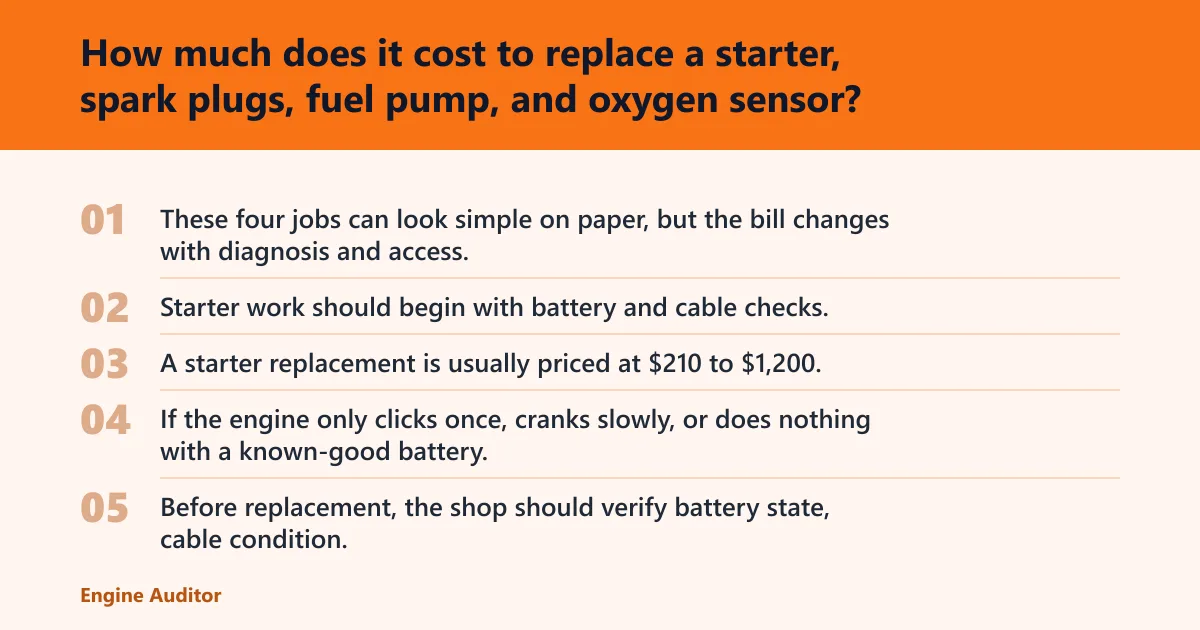
These four jobs can look simple on paper, but the bill changes with diagnosis and access. Starter work should begin with battery and cable checks, spark plug pricing depends on cylinder count and plug type, fuel pumps vary by tank access, and oxygen sensor replacement should follow code-based testing.
Starter: no-start checks before replacement
A starter replacement is usually priced at $210 to $1,200. If the engine only clicks once, cranks slowly, or does nothing with a known-good battery, a starter may be likely. Before replacement, the shop should verify battery state, cable condition, relay operation, and voltage drop at the starter circuit.
Spark plugs: cylinder count, plug type, and coils or boots
Spark plug replacement is priced at $100 to $650. Four-cylinder engines usually cost less than V6 or V8 engines because there are fewer plugs and less labor. Iridium and platinum plugs cost more than standard types, and coils or boots often ride along when a misfire has stressed the ignition system.
Fuel pump: tank-drop versus access-panel labor
Fuel pump replacement is priced at $280 to $1,500. A tank-drop job usually costs more than an access-panel job because the tank must be lowered, the fuel system relieved, and seals replaced. A pressure test should come before replacement when hard-start or stall symptoms could also be filter, relay, or wiring related.
Oxygen sensor: upstream vs downstream and code-based diagnosis
Oxygen sensor replacement is priced at $110 to $550 per sensor. Upstream sensors affect fuel control, while downstream sensors are more about catalytic converter monitoring. Code interpretation matters here, because a catalyst code can be caused by exhaust leaks, misfires, or mixture faults, not just a bad sensor.
Proof asset: fair-price breakdown for 8 common engine parts
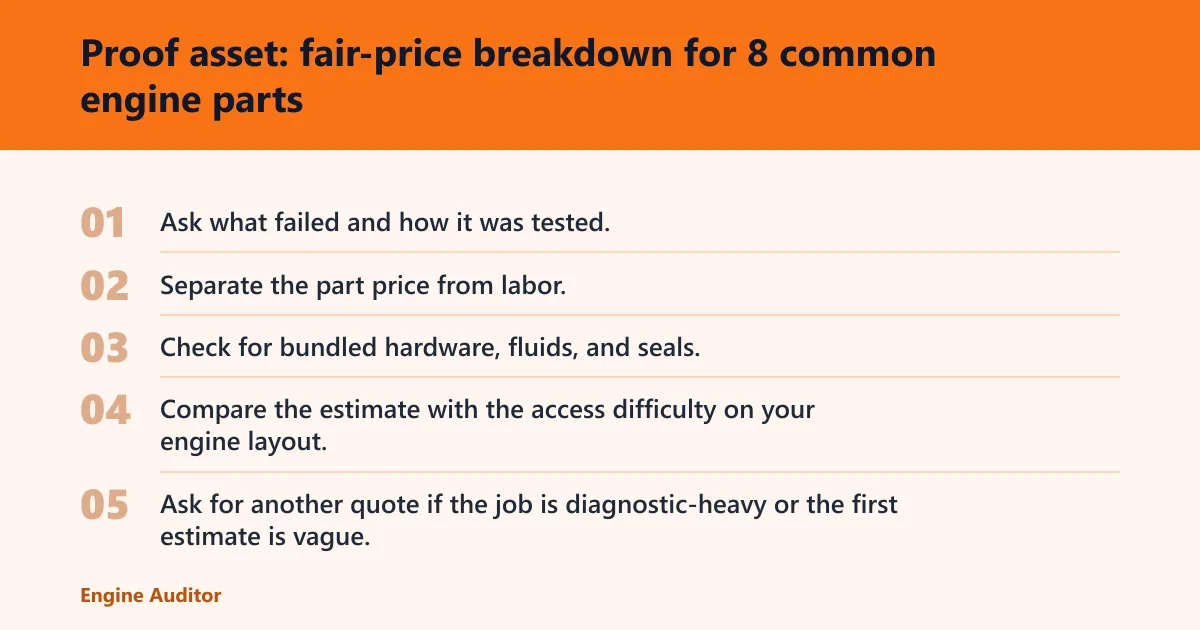
This breakdown helps decode a quote line by line. The goal is not the lowest number on the page. It is the number that matches the diagnosis, the access difficulty, and the parts that should be replaced at the same time.
| Part | Fair total range | Parts share | Labor share | What a fair quote should list |
|---|---|---|---|---|
| Alternator | $250 to $1,490 | Alternator, belt if worn, terminals | More labor on tight bays, belts, and bracket removal | Part tier, belt condition, charging test |
| Water pump | $230 to $1,100 | Pump, coolant, gasket, seals | Higher with timing cover overlap or difficult access | Coolant refill, gasket, thermostat if included |
| Timing chain | $300 to $1,000 | Chain, guides, tensioner, sprockets | High when front cover and timing setup are needed | Kit contents, seals, bolts, oil leak repair |
| Starter | $210 to $1,200 | Starter, cables, relay if faulty | Access from above or below can change time sharply | Battery test, cable inspection, heat shield parts |
| Spark plugs | $100 to $650 | Plugs, coils, boots, valve cover tube seals | Rises with cylinder count and intake removal | Plug type, coil condition, misfire codes |
| Fuel pump | $280 to $1,500 | Pump module, seal, filter sock | Tank-drop jobs cost more than access-panel jobs | Pressure test, relay check, tank seal, module tier |
| Oxygen sensor | $110 to $550 | Sensor, connector repair, exhaust hardware | Rust and exhaust routing raise labor | Sensor position, code, exhaust leak check |
| Engine diagnostic | $90 to $220 | Scan time, test leads, road test | More time for intermittent faults or multiple codes | Live data, circuit tests, compression or pressure test if needed |
- Ask what failed and how it was tested.
- Separate the part price from labor.
- Check for bundled hardware, fluids, and seals.
- Compare the estimate with the access difficulty on your engine layout.
- Ask for another quote if the job is diagnostic-heavy or the first estimate is vague.
Which engine parts are most expensive to replace?
Timing work, cooling jobs tied to timing covers, and access-heavy repairs are usually near the top of the bill. Engine replacement sits far above them, with engine replacement priced at $2,290 to $14,700 per job. Older cars can make that kind of repair poor value if the rest of the vehicle needs work too.
When an older car is better off with a smaller repair
If a car needs a starter, sensor, or alternator and the body, transmission, and suspension are still sound, repair is usually sensible. If the quote approaches major engine money on a high-mileage vehicle, compare the repair total with the car’s remaining value before approving deep teardown work.
Can I get a fair-price range before accepting a quote?
Yes. A fair range is possible when the shop identifies the failed part, explains the test that proved it, and lists the labor hours and add-ons separately. If the quote is built on a guess, especially for fuel pumps, starters, or oxygen sensors, ask for a diagnostic step first.
How to judge a quote quickly
Ask whether the estimate includes the part, labor, fluids, hardware, and tax. Ask whether the diagnostic charge will be credited toward the repair. If the price is far above the range for that repair and the shop cannot explain why access or extra teardown is needed, get another estimate.
What else gets replaced when an engine part is changed?
Common add-ons include belts, gaskets, seals, coolant, plugs, coils, boots, bolts, and heat shields, depending on the job. Those items are not always padding. Many are expected because the original part had to come off, or because reusing old hardware would raise the chance of a comeback repair.
What gets bundled most often
Water pumps often come with coolant and gaskets. Spark plugs often lead to coils or boots. Timing chain jobs often bring in guides, tensioners, seals, and sprockets. If those items are absent from a quote, the estimate may look low now and rise later.
Frequently asked questions
How much does it cost to replace an alternator?
Alternator replacement is priced at $250 to $1,490 per job. The lower end usually fits easier access and a simpler charging-system repair. Higher prices show up when the belt drive is crowded, the labor rate is high, or the battery and cable system need extra testing or cleanup.
How much does it cost to replace a water pump?
Water pump replacement is priced at $230 to $1,100 per job. The price rises when the pump shares space with timing components or sits in a hard-to-reach spot on the engine. A fair estimate should usually include coolant, gasket material, and any one-time hardware.
How much does it cost to replace a timing chain?
Timing chain replacement is often quoted at $300 to $1,000, but the real bill depends on whether the shop is pricing a chain only or a full kit. A fair quote should list guides, tensioner, seals, sprockets, and bolts if those parts are needed for the repair to hold.
How much does it cost to replace a starter?
Starter replacement is priced at $210 to $1,200 per job. Before approval, the shop should verify the battery, cables, relay, and starter circuit so the customer is not buying a starter for a no-start fault caused somewhere else. Access from above or below changes labor a lot.
How much does it cost to replace spark plugs?
Spark plug replacement is priced at $100 to $650 per job. Cylinder count matters, since a four-cylinder engine needs less time and fewer plugs than a V6 or V8. Platinum or iridium plugs cost more than standard plugs, and coils or boots may be added when misfires are present.
How much does it cost to replace a fuel pump?
Fuel pump replacement is priced at $280 to $1,500 per job. Tank-drop labor pushes the bill up fast, while access-panel jobs are usually cheaper. A pressure test should come before replacement when symptoms could also point to a relay, wiring fault, clogged filter, or another fuel-system issue.
How much does it cost to replace an oxygen sensor?
Oxygen sensor replacement is priced at $110 to $550 per sensor. Upstream sensors usually matter more for fuel control, while downstream sensors are more about catalytic converter monitoring. If a catalyst code is present, the shop should check for exhaust leaks and misfires before blaming the sensor alone.
Which engine parts are most expensive to replace?
Engine replacement is the highest-cost item here, at $2,290 to $14,700 per job. After that, timing-related jobs, water pumps tied to timing covers, and access-heavy fuel or starter repairs usually rise near the top. On an older car, those numbers can make smaller repairs the better call.
Products related to this article
Sponsored / affiliate links. As an Amazon Associate I earn from qualifying purchases. I may earn additional commission from eligible campaigns.