Oil pump vs water pump: engine pump roles explained
An oil pump fault usually shows up as a low oil pressure light, lifter noise, or bearing knock. A water pump fault usually shows up as overheating, coolant loss, or a whirring leak. If either warning appears, I stop the engine and inspect it. Ignoring the wrong pump can ruin an engine in minutes. This guide compares both pumps, the symptoms they cause, the lights and gauges to trust, and the damage path so you can diagnose before you guess.
This guide is part of our Car engine components: parts, functions and diagrams series.
Oil pump vs water pump: the core trade-off
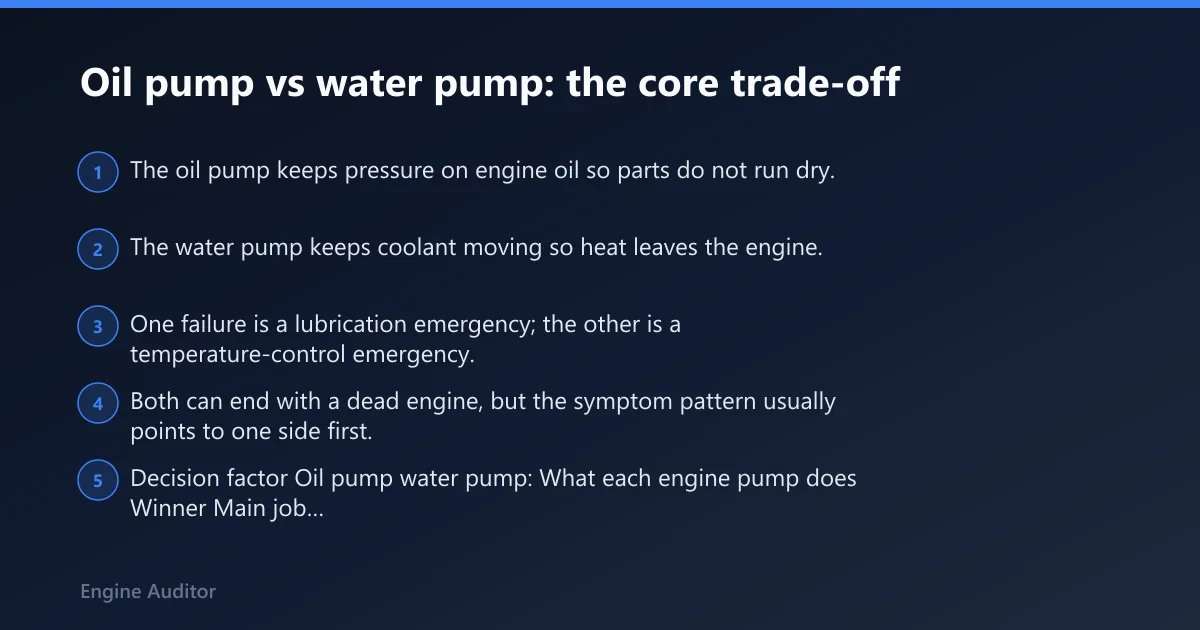


The oil pump keeps pressure on engine oil so parts do not run dry. The water pump keeps coolant moving so heat leaves the engine. One failure is a lubrication emergency; the other is a temperature-control emergency. Both can end with a dead engine, but the symptom pattern usually points to one side first.
| Decision factor | Oil pump | water pump: What each engine pump does | Winner |
|---|---|---|---|
| Main job | Circulates engine oil under pressure to bearings, pistons, and the camshaft | Circulates coolant through the engine and radiator to control operating temperature | Tie |
| Most useful warning sign | Oil pressure warning light, ticking, or knocking | Temperature warning, rising gauge, steam, or coolant loss | Tie |
| Typical drive method | Usually mechanically driven through geartrains linked to the crankshaft | Often driven by a belt, chain, or timing components; some use an electric auxiliary pump | Tie |
| Immediate damage risk | Bearing and cam damage can happen very fast under low pressure | Overheating can warp heads, damage gaskets, and boil coolant | Tie |
| First thing to check | Oil level, leaks, pressure reading, filter condition | Coolant level, belt condition, visible leaks, hose condition | Tie |
Main job
The oil pump’s job is pressure, not volume alone. The water pump’s job is circulation, not pressure in the same sense. That difference matters when diagnosis starts, because a bad oil pump usually announces itself through loss of pressure, while a bad water pump usually shows up as loss of coolant movement and overheating.
Warning pattern
Oil problems tend to stay on the lubrication side of the dashboard. Water-pump problems tend to move the temperature needle or trip the coolant warning. If both warnings appear together, the engine may already be hot enough to create secondary oil problems.
Drive method
Oil pumps are typically driven mechanically through geartrains linked to the crankshaft. Water pumps are often driven by a belt, chain, or timing components, though some engines use an external electric auxiliary pump. That difference helps explain why a broken belt can stop coolant circulation long before it affects oil pressure.
Damage risk
Low oil pressure can quickly damage bearings, cam lobes, and turbochargers. Coolant loss can overheat the engine, push coolant out of the reservoir, and in severe cases distort metal parts. In both cases, I shut the engine down and inspect it instead of trying to “make it home.”
According to Oil pump (internal combustion engine) – Wikipedia — Oil pressure in most engines should be about 10 psi per 1,000 rpm. (source)
What does an oil pump do in a car engine?
An oil pump circulates engine oil under pressure to bearings, pistons, and the camshaft. It also helps the oil carry heat away, so lubrication and cooling both depend on steady flow. In most engines, oil is pulled from the sump through a pickup, sent through a filter, and then distributed through oil passages and a pressure relief valve.
Oil flow path and related parts
The usual path starts in the oil pan or sump, where the pickup tube feeds the pump through a strainer. From there, oil goes through the filter and often through a cooler before it reaches the passages that feed the engine. The pressure relief valve limits pressure spikes and keeps the system from over-pressurizing when the oil is cold or thick.
Common oil pump types and drive methods
Common oil-pump types include gear pumps, trochoid pumps, and vane pumps. They are typically driven mechanically, most often through geartrains linked to the crankshaft; some designs use the camshaft. External electric auxiliary oil pumps exist, but they are the exception rather than the rule in passenger cars.
What does a water pump do in a car engine?
A water pump moves coolant through the engine, heater core, radiator, and hoses so the engine stays near its operating temperature. It does not cool by itself; it keeps coolant moving so the thermostat and radiator can do their jobs. When flow stops or drops, heat builds fast.
Cooling loop and supporting parts
The water pump circulates coolant through the block and cylinder head, then out toward the radiator. The thermostat controls when coolant enters the radiator, and the radiator sheds heat to the air. Hoses carry the coolant between those parts, so a bad hose can look like a pump problem at first.
Drive methods and electric exceptions
Many water pumps are driven by a belt, chain, or timing components. That means the pump’s failure can come from the pump itself, a worn bearing, or a drive issue. Some engines use an external electric auxiliary pump, sometimes for after-run cooling or packaging reasons.
How do I tell if my oil pump is failing?
An oil pump failure may show up as low oil pressure, ticking from the top end, lifter noise, or a deeper engine knock. The oil pressure warning light is the key clue. If the light is on or flashing and the engine is noisy, I stop it at once and check oil level and pressure.
What to check first
Start with the oil level, because low oil can look like pump failure. Then look for leaks around the filter, drain plug, and pump area, and confirm the oil filter is not restricted or incorrectly installed. If the level is correct, a mechanical oil pressure test matters more than guessing from sound alone.
Pressure clues that matter
A rough rule is about 10 psi per 1,000 rpm, and typical oil pressure peaks around 55–65 psi. Low pressure can point to a failing pump, a clogged pickup, worn bearings, or a relief valve issue. The pump is only one part of the circuit, so low pressure needs a full diagnosis, not a parts toss.
What not to keep driving with
Do not keep driving with a flashing oil light, clear engine knock, or pressure that stays low after adding the correct oil. Those symptoms mean the engine may already be starving for lubrication. Continued driving can turn a repair into a full engine replacement.
How do I tell if my water pump is failing?
A failing water pump may show up as overheating, coolant loss, steam, or a whirring noise near the pump. Seepage at the weep hole or a leak at the gasket area is a common clue. If the temperature gauge climbs and the radiator or reservoir keeps losing coolant, the cooling system needs immediate attention.
Noise and leak clues
A failing pump bearing may make a growl or whine, and a worn seal may leave dried coolant trails or damp residue. A leak near the pulley or the weep hole usually points to pump wear rather than a simple hose issue. If the pump wobbles, the bearing is already compromised.
Diagnosis matrix: which pump is failing?
This is the part most comparison pages skip. Use the symptom pattern first, then confirm with the right test. A light on its own is useful; a light plus the wrong noise or leak pattern is much better.
| Symptom or test result | More likely oil pump fault | More likely water pump fault | What to check first | Do not keep driving if… |
|---|---|---|---|---|
| Oil pressure light on | Yes | Unlikely | Oil level, filter, pressure reading | Light flashes or engine knocks |
| Temperature warning or rising gauge | Possible secondary effect | Yes | Coolant level, hoses, belt, pump leak | Gauge keeps climbing or steam appears |
| Ticking or bearing knock | Yes | Usually no | Oil pressure test, oil level, filter | Knock gets louder with rpm |
| Coolant smell or steam | No | Yes | Leak location, pump seal, hose joints | Coolant is boiling or spraying |
| Low oil pressure test | Yes | No direct link | Pickup, pump, relief valve, bearings | Pressure stays below expected range |
| Low coolant level and wet pump area | Unlikely | Yes | Pump seal, gasket, hose, radiator cap | Engine overheats again after refill |
How to read the matrix
If the oil light comes first, start with the lubrication system. If the temperature warning comes first, start with the cooling system. If both happen together, assume the engine may already be suffering secondary damage and stop before the diagnosis gets more expensive.
Can a bad oil pump cause overheating?
Yes, a bad oil pump can contribute to overheating, though it usually does so differently from a water pump. Pressurized oil also helps cool the engine, not just lubricate it. When oil flow drops, friction rises and heat removal gets worse, so the engine can run hot even if coolant is still present.
Why it is a different failure pattern
Oil-pump overheating usually comes with pressure warnings, ticking, or knock. A water-pump overheating problem usually comes with coolant loss, steam, or a hot radiator with poor circulation. If the engine is hot but the coolant level is normal, do not assume the water pump is the only issue.
Can a bad water pump cause low oil pressure?
Usually, it does not directly lower oil pressure. A bad water pump does not normally lower oil pressure directly, because the lubrication system and cooling system are separate circuits. Severe overheating, though, can thin the oil, damage bearings, and create secondary low-pressure problems after the engine has already been stressed.
When the two problems overlap
If the water pump fails badly enough to overheat the engine for long enough, oil pressure can drop as the oil gets thinner and parts wear faster. That is not the same as a primary oil-pump failure. It is a chain reaction, and it is why repeated overheating should never be ignored.
Which pump is more expensive to replace, oil pump or water pump?
There is no single answer for every engine, but the oil pump is often more labor-sensitive because it can be buried deeper in the engine. Water pumps are often simpler on some engines, though timing-driven designs can be just as involved. The job cost usually follows access, not the pump body alone.
Why labor matters more than parts
Both pumps can sit behind belts, covers, or other components that add time. Some vehicles replace the water pump during coolant service or timing service, while others make the oil pump a much larger teardown. The engine layout decides the bill more than the pump name does.
Do oil pumps and water pumps fail at the same time?
They can fail around the same time, but usually because of a shared cause rather than because one pump directly breaks the other. A broken belt, neglected coolant, contaminated oil, or severe overheating can set off a chain of failures. When both warnings appear, the engine should be treated as at risk.
Shared causes that can mislead diagnosis
A bad belt or tensioner can affect a belt-driven water pump and create overheating. Dirty oil, sludge, or a clogged pickup can hurt the oil pump’s delivery. Severe overheating can then damage bearings and create a second oil-pressure problem that looks like a pump failure after the fact.
What happens if you keep driving with a bad water pump?
Driving with a bad water pump can quickly lead to overheating, boiling coolant, loss of cabin heat, and engine damage. The risk rises fast if coolant is leaking or the temperature gauge keeps climbing. Once steam appears or the reservoir keeps emptying, continued driving is a bad bet.
Likely collateral damage
Overheating can warp the cylinder head, damage the head gasket, and leave the cooling system contaminated with combustion pressure. If the pump is part of the timing drive, that failure can also create mechanical damage beyond the cooling system. Stop early and the repair stays smaller.
What happens if you keep driving with a bad oil pump?
Driving with a bad oil pump can starve bearings, pistons, and the camshaft of pressurized oil. The engine may knock, seize, or wear out in a very short time once pressure drops. Unlike many cooling issues, lubrication loss can kill an engine before the temperature gauge looks dramatic.
Why the damage moves so fast
Oil is the separation layer between moving metal parts. When pressure disappears, metal can contact metal almost immediately under load. That is why a flashing oil light is treated as a shutdown warning, not a “get to the next exit” message.
Choose oil pump if… / Choose water pump if…
Choose the oil pump path if the engine shows low oil pressure, a flashing oil light, ticking, or bearing knock, especially when the oil level is correct and the pressure test is still low. Choose the water pump path if the engine shows overheating, coolant loss, steam, pump wobble, or seepage at the pump area. If both symptom sets appear, stop driving and inspect for a larger cooling failure, lubrication damage, or both.
Products related to this article
Sponsored / affiliate links. As an Amazon Associate I earn from qualifying purchases. I may earn additional commission from eligible campaigns.