How Much Does It Cost to Replace a Water Pump?
A water pump replacement usually costs about $300 to $1,000. Many four-cylinder cars are often quoted around $400 to $700, while V6/V8 or timing-belt-driven jobs are often quoted around $800 to $1,500. Ignore a leaking or noisy pump and you can overheat the engine, warp the head, or turn a moderate repair into a four-figure bill. This guide breaks down labor, parts, coolant, and the add-ons that make a quote normal, high, or inflated.
Water pump replacement cost at a glance
A fair quote usually includes the pump, a new gasket or seal, fresh coolant, and labor. National consumer ranges do conflict because some sources quote easier front-engine jobs, while others fold in dealer labor, coolant, and model-specific disassembly. For this article, the benchmark ranges below combine RepairPal fair-price estimates, CostHelper’s consumer pricing, and OEM service logic about timing-overlap and cooling-system refill requirements so the numbers stay comparable across vehicles.
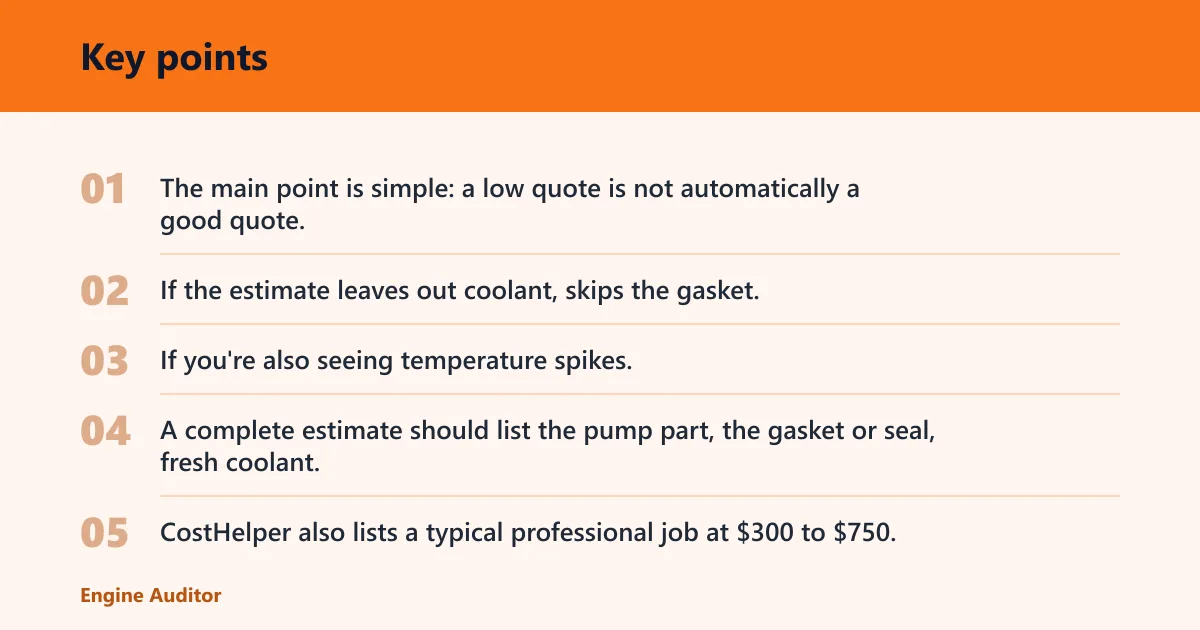
The main point is simple: a low quote is not automatically a good quote. If the estimate leaves out coolant, skips the gasket, or assumes fewer labor hours than the car really needs, the total can climb later. If you’re also seeing temperature spikes, compare the repair quote with common overheating symptoms and what they usually mean before you approve more driving.
What a standard quote usually includes
A complete estimate should list the pump part, the gasket or seal, fresh coolant, and labor hours. CostHelper also lists a typical professional job at $300 to $750, with parts at $50 to $100+ and labor at $200 to $450. On many cars, coolant must be drained and then refilled after installation. For the cooling-system side of the job, see our guide to a coolant flush and refill cost.
When a low quote may leave out needed items
Watch for quotes that mention only the pump part and labor. A missing coolant line item can matter, because the system has to be drained and refilled. A missing gasket line can matter too, because most replacements need a fresh seal to avoid seepage at the housing or pump face. On timing-driven engines, a cheap quote can also hide the cost of one-time-use hardware or a belt kit that should be replaced while the front of the engine is already open.
What drives the price?
Parts and labor make up the bill, but labor usually moves the total more than the pump itself. Access difficulty, engine layout, and local shop rates can change the quote sharply. A pump at the front of the engine is often quicker to reach than one buried behind covers or other accessories.
Parts cost versus labor cost
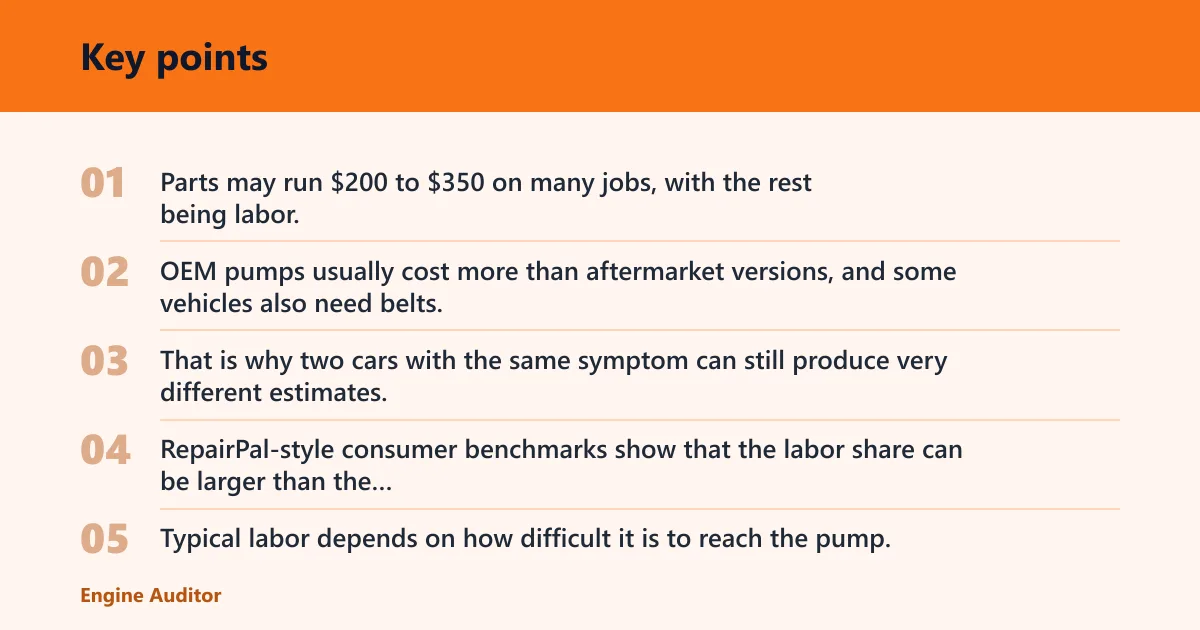
Parts may run $200 to $350 on many jobs, with the rest being labor. OEM pumps usually cost more than aftermarket versions, and some vehicles also need belts, pulleys, or related hardware. That is why two cars with the same symptom can still produce very different estimates. RepairPal-style consumer benchmarks show that the labor share can be larger than the part price on compact cars, while timing-overlap jobs can invert that relationship.
Why access changes labor hours
Typical labor depends on how difficult it is to reach the pump. CostHelper says the job takes about three and a half to four hours, but that is a general figure, not a promise for every vehicle. A pump near the front of the engine is usually simpler than one hidden behind timing components.
Suppose a compact car has a front-mounted pump with clear access. The estimate may stay close to the lower end because the tech can reach the housing quickly. Now suppose the pump sits behind timing covers on a V6. Labor climbs because the same disassembly exposes the timing belt area. That is also why some shops strongly recommend doing the belt service at the same time; if the front cover is already off, the incremental labor is much smaller than a second teardown later. If you’re weighing that decision, compare it with timing belt replacement cost.
How local shop rates affect the total
Local labor rates change the final number even when the parts are identical. A dealer rate, an independent shop rate, and a do-it-yourself parts bill are not the same kind of quote. The pump may cost the same, but the labor line can vary enough to move the repair by hundreds of dollars. In high-cost metro areas, shop labor can add enough to push a straightforward repair into the upper end of the national range even when the engine layout is simple.
Water pump quote decoder table
| Line item | Typical place on a normal estimate | When it signals extra work |
|---|---|---|
| Pump part | Should appear on every estimate | If the part price is far above the vehicle norm, the quote may include OEM pricing or a complete module |
| Gasket/seal | Should appear on every estimate | If omitted, the quote may be incomplete; if replaced with housing parts, the job may be more involved |
| Coolant | Should appear on every estimate | If the quote omits refill fluid, the final bill may rise after the repair because the system must be drained and refilled |
| Labor hours | Should appear on every estimate | If labor is much higher than typical for the engine, the pump may be harder to reach or tied to timing-cover removal |
| Access penalty | Should appear only when access is poor or the engine layout is tight | If this appears, expect more disassembly, more shop time, and a higher total than a straightforward pump swap |
An access penalty is not a scam line by itself. It is a shorthand for the extra labor needed when the pump is buried behind alternators, brackets, belts, or timing covers. The stronger the access penalty, the more the job depends on engine layout rather than the pump part price.
Should you replace the timing belt too?
If the water pump is driven by the timing belt, replacement often makes sense at the same time because the labor overlaps. Some cars have the water pump driven by the timing belt, and those jobs can push the total to $2,000 or more. That does not mean every pump job needs a timing belt, only that the overlap can make bundle pricing logical.
When timing belt overlap adds labor
When the pump sits behind timing covers, the shop may already need to remove the same parts required for a belt service. That is why the extra belt job can cost much less in labor when it is done together than when it is done later on its own. OEM service procedures treat the pump, tensioner, and idler access as part of the same front-engine teardown on many applications, which is why hidden labor can surprise owners who only budgeted for the pump.
What to ask before approving the repair
- Ask whether the pump is belt-driven, chain-driven, or driven by the serpentine belt.
- Ask whether the timing belt, tensioner, idler pulleys, or related seals are already exposed.
- Ask for separate labor and parts lines so you can see what is required and what is optional.
- Ask whether the quote includes coolant, gasket, and any one-time-use hardware.
A common first-timer mistake is approving a pump job without checking the timing belt interval. If the belt is already near its service limit, paying for the belt later can mean duplicating labor that was already paid for once.
How much for your car?
Model matters because the same repair can sit on opposite ends of the pricing range depending on engine layout. The Ford Explorer, Ford Focus, and Chrysler 300 can all land in different bands because some versions are easier to access than others and some engines tie the pump into timing service. European and luxury vehicles can cost more for the same reason.
Ford Explorer pricing notes
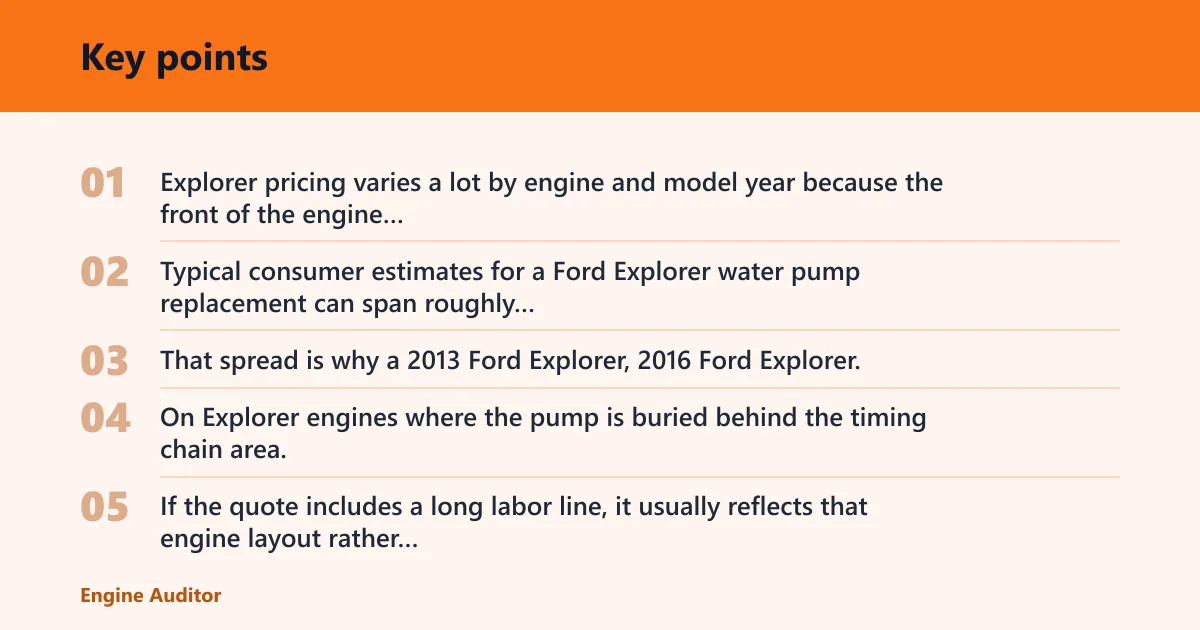
Explorer pricing varies a lot by engine and model year because the front of the engine is packaged differently on the 3.5L V6, 2.3L EcoBoost four-cylinder, and later turbocharged variants. Typical consumer estimates for a Ford Explorer water pump replacement can span roughly $850 to $1,700 on easier layouts, while timing-overlap or high-disassembly versions can run higher once labor hours rise from around 4 to 8+ hours depending on engine and driveline package. That spread is why a 2013 Ford Explorer, 2016 Ford Explorer, or 2017 Ford Explorer can produce very different quotes even though the symptom is the same.
On Explorer engines where the pump is buried behind the timing chain area, the mechanic is often fighting both access and cleanup: front cover removal, gasket surfaces, coolant drainage, and careful refill/bleeding afterward. If the quote includes a long labor line, it usually reflects that engine layout rather than a premium pump part.
Ford Focus pricing notes
A Ford Focus often falls closer to the lower or middle part of the range when the pump is easier to reach, but engine variant still matters. On common 2.0L and 2.3L layouts, consumer estimates are often closer to the midrange because labor is shorter and the pump is less buried; on some 1.0L EcoBoost configurations, packaging and timing-side access can add labor. In practice, the difference is often a few labor hours, not just a different part price.
The key reason the Focus can be cheaper than a larger SUV is that the front-end layout is often less complex. When the estimate adds major disassembly, though, the total climbs for the same reason it does on any car: more time to reach the pump, more coolant handling, and more opportunity for related seals or hoses to be replaced while the system is open.
Chrysler 300 pricing notes
A Chrysler 300 can be straightforward on one engine and much pricier on another. The 3.6L Pentastar V6 typically lands in a moderate range because the pump is usually serviced without the same timing-belt overlap seen on some other engines, while HEMI V8 applications can carry higher labor because of tighter access and additional accessory packaging. The reason is not the badge on the trunk. It is the access path, the engine bay packaging, and whether the shop must work around timing components or multiple belt-driven accessories.
That engine split matters because labor hours move differently. A cleaner V6 layout may be a several-hour job, while a tighter V8 bay can add time to remove belts, covers, or adjacent components. If the quote on a Chrysler 300 seems high, the biggest question is usually not the pump part itself but how much teardown the engine layout demands.
Why the same repair can vary by engine
Two vehicles with the same symptom can have different quotes because one uses a simple belt-driven pump and another places the pump deep in the engine stack. Parts cost matters, but labor time and access difficulty usually decide whether the final bill looks ordinary or expensive. That is also why national averages only work when they are paired with the exact engine code, not just the model name.
Dealer, independent shop, or DIY?
Dealer quotes usually run higher, independent shops often land closer to the middle, and DIY can lower labor cost but increase risk. The choice depends on access, tooling, and whether the job includes coolant bleeding and timing-component removal. A low parts bill is not enough if the cooling system is not serviced correctly afterward.
How dealer quotes usually differ
Dealers often use OEM parts and branded labor rates, so the quote can be higher even when the repair is straightforward. That can be worthwhile for complex layouts, but it does not always produce the lowest total. The estimate should still show the same core line items: pump, gasket, coolant, and labor.
Where independent shops can save money
Independent shops can save money by using lower labor rates or aftermarket parts when appropriate. That is often enough to bring the bill down without changing the repair itself. If the estimate is clearly itemized, you can compare apples to apples rather than guessing from a single total. This is especially useful on vehicles where the labor hours, not the part, explain most of the price gap.
What DIY saves and what it risks
DIY saves labor, and labor is the largest part of many difficult water pump jobs. But the risk is real: air trapped in the cooling system, a poor seal, or an incomplete refill can create overheating after the repair. Professional installation is the safer choice when the pump is buried or the timing system is involved. Bleeding the cooling system properly matters because even a small air pocket can cause hot spots, weak cabin heat, and repeat overheating complaints.
Frequently asked questions
How much does it cost to replace a water pump in a car?
The final price changes most when access is poor or the pump shares labor with timing components. A good quote should separate parts, coolant, and labor.
How much does it cost to replace a water pump on a Ford Explorer?
Explorer pricing varies by engine, but the model often lands above the simplest compact-car jobs because access can be tighter.
How much does it cost to replace a water pump on a Ford Focus?
A Ford Focus often stays closer to the lower part of the range when the pump is easier to reach, though engine version still matters. The quote should still include the pump, gasket, coolant, and labor. If the estimate adds major access work, the total can rise quickly.
How much does it cost to replace a water pump on a Chrysler 300?
A Chrysler 300 can be moderate or expensive depending on engine layout. The pump itself is not usually the biggest issue. Labor grows when the shop must work around tight packaging, accessory drive parts, or timing-related components that add disassembly time.
What makes water pump replacement more expensive on some cars?
Access difficulty is the biggest reason. A buried pump can require removal of belts, pulleys, brackets, or timing covers, and local labor rates matter too. OEM parts also cost more than aftermarket parts, and some engines need extra hardware or related service while the system is open.
Should I replace the timing belt at the same time as the water pump?
If the pump is driven by the timing belt, the answer is often yes because the labor overlaps. Some cars have the water pump driven by the timing belt, and the combined repair can save duplicated labor. Ask for separate lines so you can see whether the belt is required or merely convenient.
What extra parts should be included in a water pump replacement quote?
At minimum, look for the pump, a gasket or seal, coolant, and labor hours. A complete quote may also include belts, pulleys, tensioners, or related hardware if the engine design requires them. The coolant must be drained for the repair and refilled after installation.
Can I drive with a failing water pump?
Short trips may still be possible in some cases, but driving with a failing pump is risky because the engine can overheat fast. Leaks, a noisy bearing, or rising temperature are warning signs that should not be ignored. If the gauge climbs or coolant loss is visible, park the car and arrange service.
How much does it cost to replace a water pump in a car: the broad answer is usually?
The broad answer is usually $300 to $1,000, but the quote only makes sense when you see what is included. Parts, labor, coolant, and the gasket should be listed separately when possible. If the pump is hard to reach, labor can exceed the part price by a wide margin.
How much does it cost to replace a water pump on a 2017 ford explorer?
A 2017 Ford Explorer can fall well above a basic pump job if the engine layout requires major disassembly. The final quote depends on whether the pump is tied to timing service, how hard it is to access, and whether the shop includes coolant and related parts in the estimate.
How much does it cost to replace a water pump on a 2016 ford explorer?
A 2016 Ford Explorer can also show a large spread because different engines place the pump in different spots. A simple layout may stay near the middle of the market, while a buried pump or timing-overlap job can raise the total sharply. Ask for a line-item quote before approval.
How much does it cost to replace a water pump on a 2013 ford explorer?
A 2013 Ford Explorer can be priced like a routine repair or a major access job, depending on engine choice. The core cost factors are the same: pump price, labor time, coolant, gasket, and any overlap with timing components. If the quote seems high, ask which line item is driving it.
Sources
- RepairPal Fair Price Estimator
- CostHelper: Water Pump Replacement Cost
- Consumer Reports: Engine overheating and what to do
- NAPA Know How: Water Pump Replacement
- AAA: Understanding engine coolant and overheating
Products related to this article
Sponsored / affiliate links. As an Amazon Associate I earn from qualifying purchases. I may earn additional commission from eligible campaigns.