Car Timing Chain vs Timing Belt: Which Engine Uses Which?
Check the owner’s manual and the under-hood service label first: if the schedule lists a timing-belt replacement interval, it uses a belt; if there’s no replacement interval, many engines use a chain. Miss this and you could buy a car with a hidden costly repair, or lose an engine if a belt fails. This guide shows how to confirm it from manuals, labels, service records, mileage, and warning signs.
This guide is part of our Car engine components: parts, functions and diagrams series.
| Decision factor | Car Timing Chain | Timing Belt: Which One Does Your Engine Use? | Winner |
|---|---|---|---|
| Identification clues | Usually no scheduled replacement interval in the manual; often hidden inside the engine | Often listed with a mileage-based replacement interval in the manual and service schedule | Timing Belt: Which One Does Your Engine Use? |
| Maintenance burden | Depends on oil quality, chain guides, and tensioners | Requires scheduled replacement even if it runs quietly | Car Timing Chain |
| Failure risk pattern | Usually gradual wear, stretch, rattle, and correlation codes before failure | Can fail suddenly if overdue, cracked, contaminated, or stripped | Car Timing Chain |
| Cost exposure | Repair jobs often cost more | Service is usually cheaper than chain repair, but still time-sensitive | Timing Belt: Which One Does Your Engine Use? |
| Used-car risk when records are missing | Lower interval urgency, but oil history matters | High risk if the replacement record is missing or overdue | Car Timing Chain |
What a timing belt and timing chain do
How the crankshaft and camshaft stay synchronized
Both parts keep the crankshaft and camshaft turning together, so valves open and close at the right time. That timing lets the engine take in air, burn fuel, and push exhaust out in the correct order. If timing slips, the engine may misfire, run rough, or stop.
The crankshaft turns the pistons. The camshaft controls valve opening and closing. The timing belt or timing chain links those two rotating parts and keeps them in step.
Why valve timing matters for starting and running
When timing is correct, air enters, fuel burns, and exhaust exits in the right order. If the camshaft lags or jumps ahead, the engine can crank without starting, idle badly, or set fault codes. That is why timing problems often show up as drivability complaints before a full failure.
Interference engine versus non-interference engine
An interference engine has piston and valve paths that overlap. If timing is lost, valves can hit pistons, and the damage can be severe. A non-interference engine has more clearance, so a belt or chain failure may stop the engine without internal contact.
That difference matters more than belt versus chain alone. A belt failure on an interference engine can mean bent valves and piston damage. A chain issue can do the same if the engine is interference and timing moves far enough out of range.
According to Timing Belt vs Timing Chain: Which Does Your Car Have? (2026) — Replacement cost for timing belts is listed as $500-$1,200.
How to tell which one your engine uses
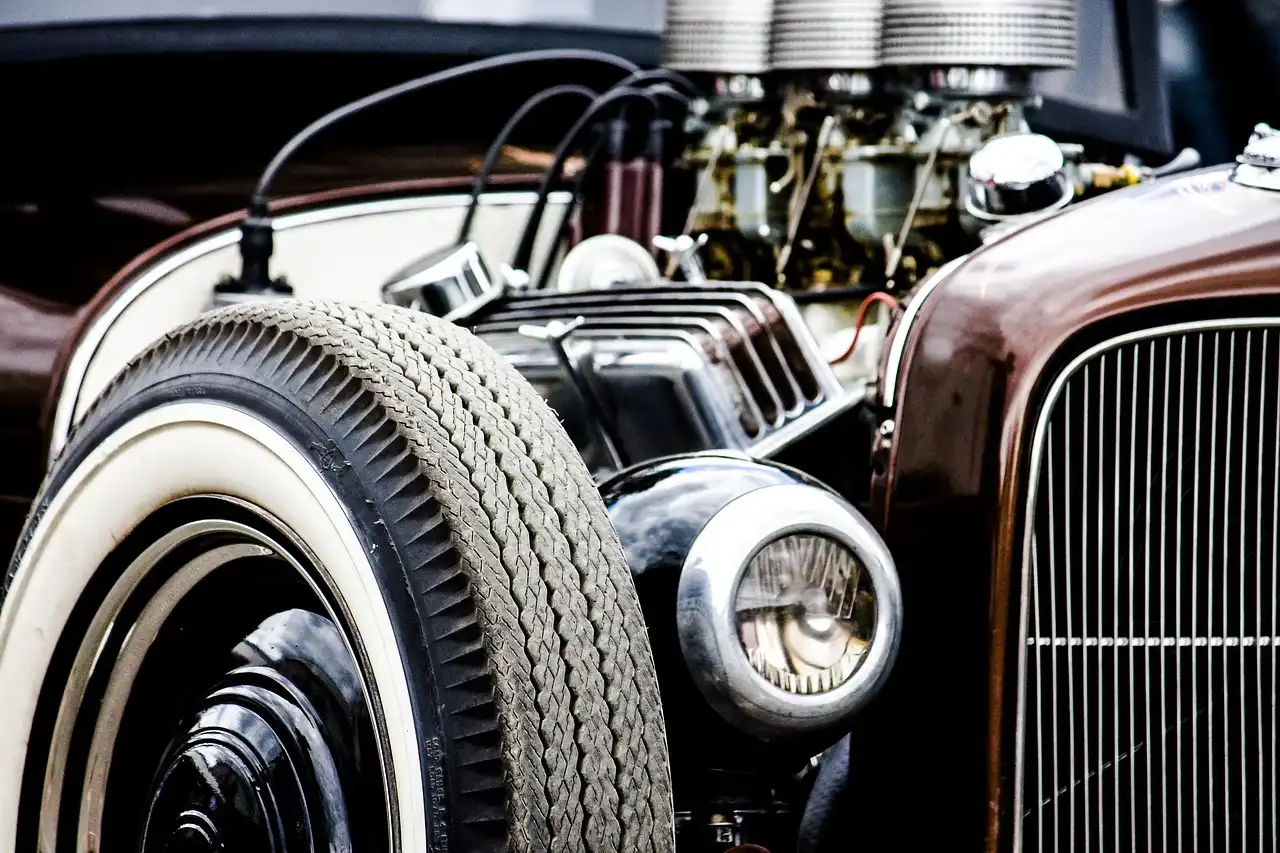
The fastest path is paperwork, not guessing from sound alone. Start with the owner’s manual, then check the emissions label under the hood, then compare service records and mileage. Those three sources usually tell the story faster than a visual inspection.
Check the owner’s manual for belt or chain wording
Look in the maintenance schedule, engine maintenance section, and any timing-service notes. Belt-equipped engines often list a replacement interval in the maintenance schedule. Chain-equipped engines often skip a replacement interval or say inspection only, which is a useful clue but not proof by itself.
Pay attention to exact wording. If the manual calls for timing-belt replacement at a mileage interval, that is strong evidence the engine uses a belt. If the manual mentions chain inspection, chain tensioner service, or chain noise, that points the other way.
Read the under-hood emissions label for engine family clues
The emissions label can identify the engine family, displacement, and calibration. That matters because timing hardware is usually engine-specific, not just model-specific. Two trim levels of the same car can use different timing designs.
If the label shows a specific engine code, use that code when checking the manual or service history. That is often more reliable than guessing by badge, trim, or transmission.
Use service records and mileage to infer the likely design
Service records are often the clearest clue. If you see repeated timing-belt replacement entries, the engine uses a belt. If you see frequent oil-change records and no belt service but the car is high mileage, a chain is more likely.
For a used car, missing paperwork matters. An overdue belt is a risk even if the engine sounds fine. A chain engine with poor oil history raises a different concern: guides, tensioners, and chain wear.
A visual and paperwork checklist you can use today
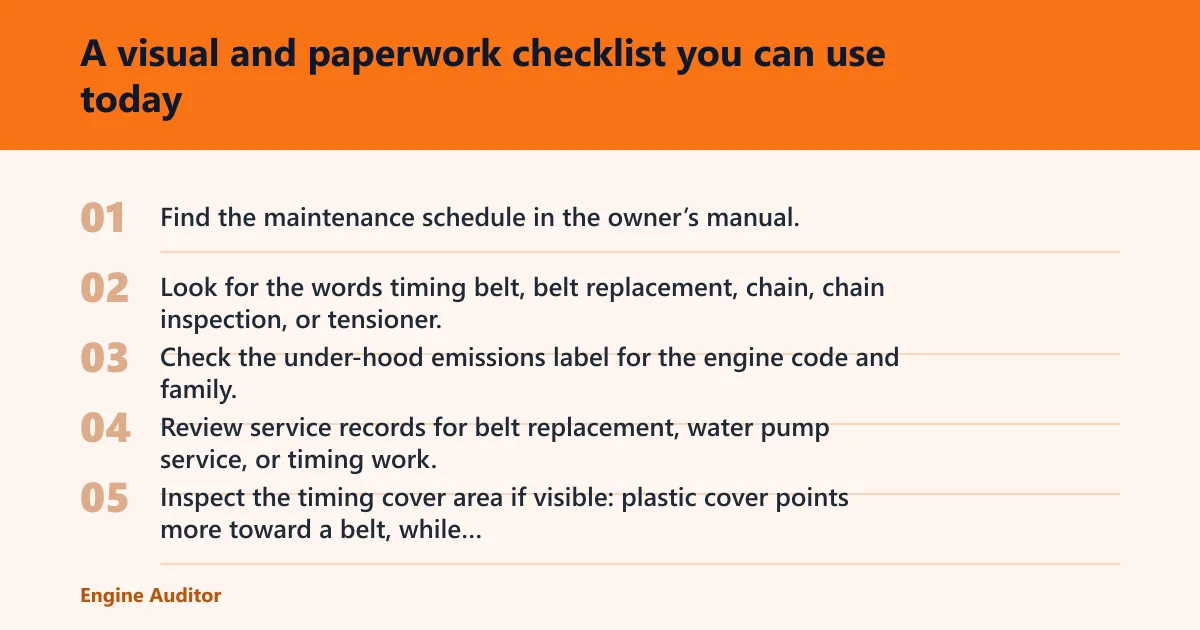
This checklist works when the owner’s manual is vague or the seller is unsure. Use it as a yes/no path, not a perfect proof test. One clue can be wrong; three or four matching clues usually are not.
- Find the maintenance schedule in the owner’s manual.
- Look for the words timing belt, belt replacement, chain, chain inspection, or tensioner.
- Check the under-hood emissions label for the engine code and family.
- Review service records for belt replacement, water pump service, or timing work.
- Inspect the timing cover area if visible: plastic cover points more toward a belt, while an internal chain is usually hidden deeper inside the engine.
- Review oil-change history, especially on chain engines.
- Listen for cold-start rattle, rough idle, misfire, or check-engine lights.
Timing cover shape and what it usually tells you
A belt is commonly hidden behind a cover, often plastic. That cover keeps dirt out and contains debris if the belt sheds material. Oil leaks around that area are bad news because oil can contaminate a belt and shorten its life.
Chains are usually inside the engine and lubricated by engine oil. If you see a front cover that is more integrated with the engine case, that is often a chain setup, though this is still a clue rather than proof.
Where belt replacement records usually appear
Belt replacement often shows up in a maintenance log as a major service. It may be listed with a water pump, tensioner, or idler pulley because those parts are commonly done together. A clean record with dates and mileage is what you want to see.
If the paperwork is missing and the engine is known to use a belt, assume the service may be overdue until proven otherwise. That matters most on interference engines.
What oil-change history can say about chain longevity
Timing chains depend on engine oil. Clean oil supports chain lubrication and helps the guides and tensioners work as designed. Neglected oil changes can accelerate wear, and the chain may suffer long before it actually breaks.
Sludge, missed intervals, or repeated low-oil operation are warning signs on chain engines. If the seller cannot document oil changes, the chain system deserves extra scrutiny.
Do these symptoms point to a belt or a chain?
Symptoms help, but they are not a substitute for records. Chain problems often announce themselves with rattle and correlation codes. Belt problems are more likely to hide until the belt is worn, oil-soaked, cracked, or stripped.
Chain rattle, guide wear, and tensioner noise
A timing chain problem may show up as a rattle on cold start. That sound often points to chain slack, worn guides, or a weak tensioner before the chain itself is finished. If the rattle fades as oil pressure builds, the tensioning system deserves attention.
Guide wear matters because the chain may still be intact while the support pieces fail first. That is why chain diagnosis is not just about the chain links.
Misfire, rough idle, and cam/crank correlation codes
P0016 and related codes are correlation codes. P0017, P0018, and P0019 usually mean the computer sees a mismatch between camshaft and crankshaft position. On a chain engine, that can point to stretch, a bad tensioner, or worn guides.
Misfire and rough idle are common to both belt and chain issues. The code pattern matters more than the symptoms alone.
Belt age, cracks, leaks, and sudden failure risk
Belt problems are often tied to age, mileage, contamination, or visible wear. A cracked belt, frayed edge, or oil leak near the timing cover raises risk. A belt can fail with little warning once it is past its service window.
That sudden-failure risk is why a timing belt is treated as scheduled maintenance, not a part to “wait and see” on.
Why maintenance history changes the answer
Timing belt service intervals and missed replacements
Timing belts are typically replaced every 60,000-100,000 miles. Some engines sit near the low end of that range, others near the high end. The exact interval depends on the engine, so the manual wins over general advice.
If the record is missing and the odometer is at or beyond the service window, treat the belt as overdue. That is especially important on interference engines, where a break can become an internal-engine repair.
How low oil and dirty oil hurt chain systems
Can low oil cause timing chain failure? Yes, low oil can accelerate wear because chains are lubricated by engine oil. Dirty oil does the same thing more slowly, starving guides, tensioners, and chain surfaces of clean lubrication.
Chain systems often survive a long time, but they do not ignore neglect. High mileage plus poor oil history is the combination that raises concern.
What oil leaks near the timing cover can do to a belt
Oil leaks around the timing cover can contaminate a belt. That softens the material, shortens service life, and can cause premature failure. If the front of the engine is wet with oil, the belt side deserves a closer look.
That is one reason belt inspections should include the front seal, cover area, and any signs of residue around the lower pulley area.
| Clue | Points more toward chain | Points more toward belt | What it means |
|---|---|---|---|
| Manual lists mileage-based replacement | No | Yes | Strong belt clue |
| Cold-start rattle | Yes | No | Often chain, guide, or tensioner noise |
| Oil maintenance is poor | Yes | Not directly | Chain wear risk rises |
| Oil leak at timing cover | No | Yes | Belt contamination risk rises |
| P0016 or related code | Yes | Sometimes | More often chain stretch or correlation fault |
What happens if timing is lost
What a broken timing belt can do
What happens if a timing belt breaks? The engine usually stops running immediately. If the engine is interference, the result can be valve-to-piston contact and expensive internal damage. If it is non-interference, the engine may stop without that internal collision.
A broken belt is often sudden. That is why overdue service on a belt engine is a real risk, not just deferred maintenance.
What a stretched or jumped timing chain can do
A stretched or jumped chain can throw off cam timing enough to cause rough running, misfires, and fault codes. If the chain, guides, or tensioner fail badly enough, the engine can stop or suffer internal damage in an interference design.
Timing-chain problems are often more gradual than belt failures. The car may warn you first with noise, codes, or poor idle quality.
Why interference engines are the expensive case
Interference engines can suffer valve-to-piston contact if timing is lost. That is where the repair bill usually climbs. Even a short timing event can bend valves, damage pistons, and turn a timing job into a major engine repair.
Non-interference engines are still not harmless when timing is lost. They may avoid internal contact, but they still leave the car stranded.
How much replacement usually costs
Timing belt replacement is usually less expensive than timing chain replacement, but the belt still needs scheduled service. Timing chains are inside the engine, so labor often drives the bill. Parts-only numbers can look manageable, then labor changes the picture fast.
Dealer versus independent-shop pricing
Replacement cost for timing belts is listed as $500-$1,200. Timing chain replacement is listed as $1,500-$3,500. Dealer pricing tends to land higher, while an independent shop may quote less if access is straightforward and no related parts are damaged.
Those figures are still only starting points. Engine layout, water pump access, and whether the job includes tensioners or seals all affect the final bill.
Parts-only costs and why labor dominates
The part itself is rarely the whole story. On belt jobs, labor rises when the belt is buried behind covers or when related parts should be replaced at the same time. On chain jobs, the engine may need major disassembly just to reach the timing set.
That is why a chain repair often costs more than the part itself suggests. The access time is the bill.
Why chain jobs often cost more than the part itself suggests
Chains can last a long time, often expected to last 200,000+ miles, but when they wear out, the repair usually lands in the expensive bracket. Guides and tensioners are part of the job, and those pieces often fail before the chain itself is done.
For a buyer, that means a quiet chain engine with clean oil history is one thing. A noisy chain engine with poor records is another.
Choose Car Timing Chain if… / Choose Timing Belt: Which One Does Your Engine Use? if…
Choose a chain engine if you want a design that often has no scheduled replacement interval and is backed by strong oil-change history. Choose a belt engine if the manual and records clearly show a current service interval and the belt has already been replaced on time. The wrong choice is the car with missing records and a known overdue belt.
For used cars, chain is the safer answer when documentation is thin and the engine family is known to use one. Belt is acceptable only when the replacement proof is there. If the car is interference and the belt history is uncertain, price the risk as real repair money, not a minor maintenance item.
Frequently asked questions
Does my car have a timing chain or timing belt?
Start with the owner’s manual and the under-hood emissions label. If the maintenance schedule lists timing-belt replacement at a mileage interval, it is very likely a belt engine. If there is no replacement interval and the engine is known for internal timing components, it is often a chain.
How can I tell if my engine uses a belt or chain?
Use three checks: manual wording, service records, and visible engine clues. Belt engines often have a plastic timing cover and documented replacement history. Chain engines usually have no scheduled belt service, rely on clean oil, and may show cold-start rattle when worn.
What are the signs of a timing chain problem?
A timing chain problem may show as a cold-start rattle, rough idle, misfire, or check-engine light. P0016 and related correlation codes often point to cam/crank mismatch. Worn guides and tensioners can fail before the chain itself reaches the end of its life.
What are the signs of a timing belt problem?
Timing belt problems often show up as age, mileage, cracking, fraying, or oil contamination rather than noise. Some belts fail with little warning. If the belt is overdue or the service record is missing, treat that as a serious risk rather than a harmless omission.
How often should a timing belt be replaced?
Timing belts are typically replaced every 60,000-100,000 miles, but the exact interval depends on the engine. The owner’s manual is the final word. If there is no proof of replacement and the mileage is near or beyond the interval, the belt should be treated as overdue.
What happens if a timing belt breaks?
The engine usually stops immediately. On an interference engine, the broken belt can cause valve-to-piston contact and major internal damage. On a non-interference engine, the car may simply stall without that kind of damage, but it will still need repair and towing.
Products related to this article
Sponsored / affiliate links. As an Amazon Associate I earn from qualifying purchases. I may earn additional commission from eligible campaigns.