Best Car Batteries for Cold Starts (2026): we compared
For cold-weather starting, buy the battery your car’s manual calls for, then pick the highest CCA that fits the tray and cables; in subfreezing climates, I aim for at least 700 CCA in a typical V6 or V8. Pick wrong, and you get slow cranking, no-start mornings, and a battery that dies early after a few hard freezes. This guide shows which specs matter, which are marketing noise, and how to match battery size, CCA, and type to your car and winter.
Quick comparison
| Product | Badge | Best for | Price | ||
|---|---|---|---|---|---|
 |
Odyssey Battery Battery, Extreme Series, AGM, 12V, 170 ColdOdyssey | Also great | 12V · 170 CCA · AGM | $172.00
Price as of 29 Sep 2026
|
View |
 |
ACDelco Silver 78SAGM (88866331) 24 Month Warranty AGM BCIACDelco | Budget pick | BCI Group 78 · 24-month warranty | $205.62
Price as of 29 Sep 2026
|
View |
 |
OPTIMA® Batteries High Performance DS46B24R YELLOWTOP®OPTIMA | Our pick | 12V · 450 CCA · 66 min RC | $289.99
Price as of 29 Sep 2026
|
View |
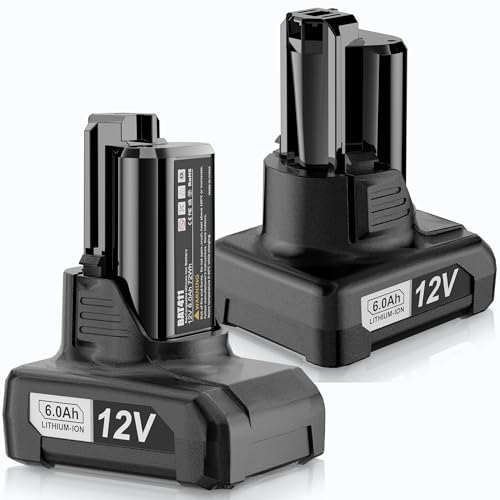 |
【Upgrade】2Pack 6.0Ah Replace Battery for Bosch 12VCaliHutt | Upgrade pick | 6.0Ah · 72Wh · Lithium-ion | $39.99
Price as of 29 Sep 2026
|
View |
Cold-start power comes first, then reserve capacity, then fitment. I have seen a strong spec sheet fail on the bench because the group size, terminal layout, or post orientation did not match the car.
One-line verdict: the OPTIMA RedTop 34/78 AGM is the best cold-weather all-around pick because it pairs 800 CCA with 100 minutes of reserve capacity and dual SAE and GM posts. For smaller cars with a tighter tray, the OPTIMA 25 RedTop AGM is the cleaner fit; for harsher cold starts where size allows, the Weize Platinum AGM BCI Group 94R brings the highest listed CCA.
How we chose
Cold-start numbers came first. CCA and reserve capacity matter more in winter than polished marketing language.
Fitment came next. Group size, terminal type, and post orientation decide whether the battery actually installs cleanly.
Winter-use value also mattered. AGM construction, recharge behavior, and vibration resistance help in short-trip driving and repeated starts.
Batteries with weak cold-start specs, fuzzy fitment details, or poor winter usefulness were left out of the main picks.
What battery is best for cold weather starting?
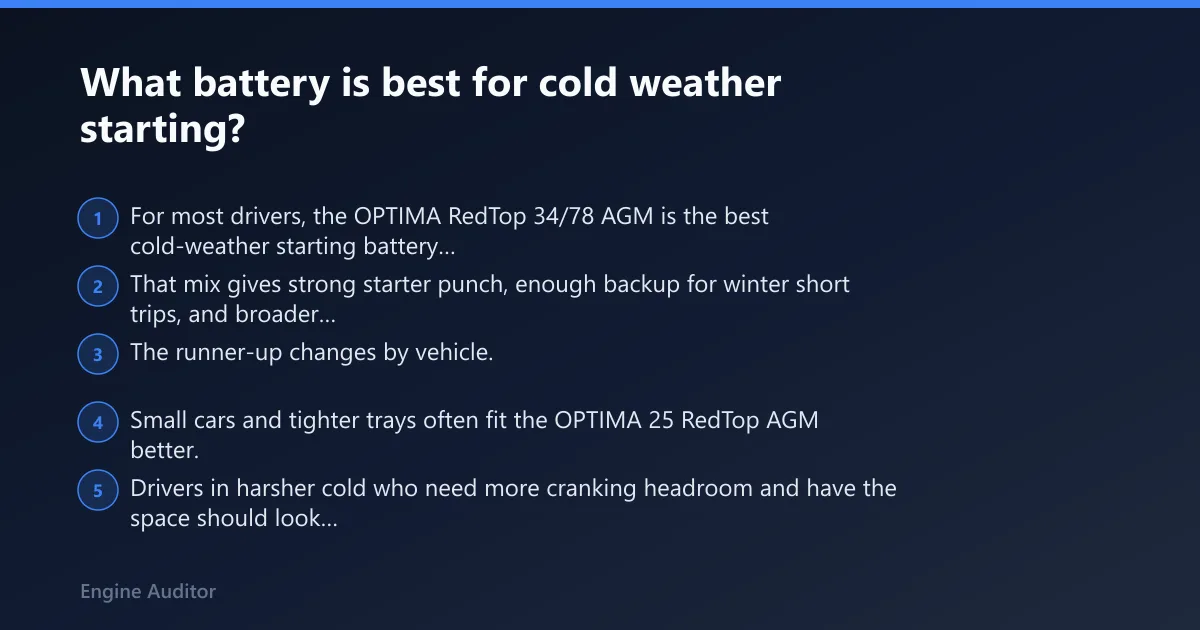
For most drivers, the OPTIMA RedTop 34/78 AGM is the best cold-weather starting battery because it combines 800 CCA, 100 minutes of reserve capacity, and dual SAE and GM posts. That mix gives strong starter punch, enough backup for winter short trips, and broader fitment than a narrow-post battery.
The runner-up changes by vehicle. Small cars and tighter trays often fit the OPTIMA 25 RedTop AGM better. Drivers in harsher cold who need more cranking headroom and have the space should look at the Weize Platinum AGM BCI Group 94R.
OPTIMA RedTop 34/78 AGM: best overall for winter starting
This is the strongest all-around choice for cold starts because it pairs 800 CCA with 100 minutes of reserve capacity. The SpiralCell AGM design adds vibration resistance and quicker recovery after use, which matters when a car sees repeated cold starts or short daily drives.
It also has dual SAE and GM posts, which gives it more fitment flexibility than a battery with only one terminal style. The main drawback is simple: it is not the smallest battery here, so some compact trays will not accept it without a group-size match and clearance check.
OPTIMA 25 RedTop AGM: best for smaller group applications
This battery fits a narrower use case. With 720 CCA, 44 Ah capacity, and SAE posts, it works better where the vehicle calls for a smaller form factor and the owner needs reliable winter starting without forcing an oversized case into a tight tray.
The drawback is cold-start headroom. It has less reserve and less starting power than the 34/78 and the Weize 94R, so it is the one to avoid if the car lives in repeated subfreezing mornings, sees lots of short trips, or has a known weak charging system.
Weize Platinum AGM BCI Group 94R: best high-CCA value
This is the high-output option in the group. It is listed with 850 CCA, 80 Ah capacity, and a 140RC rating, so it has the strongest cold-cranking figure here and the longest backup power on paper. The listed operating range is -22°F to 158°F, which fits severe winter use well.
The tradeoff is fitment discipline. BCI Group 94R must match the tray, hold-down, terminal orientation, and hood clearance. A battery with strong numbers is still a bad purchase if the case dimensions, 12.4 x 6.89 x 7.48 inches, do not suit the vehicle.
Which one should you buy
If winter starts are the priority and fitment allows it, buy the OPTIMA RedTop 34/78 AGM first. It gives the most balanced mix of CCA, reserve capacity, and terminal flexibility for everyday drivers who want a battery that starts well and keeps up with winter use.
Choose the OPTIMA 25 RedTop AGM if your car needs a smaller case and the manual or tray calls for that size. Choose the Weize Platinum AGM BCI Group 94R if your climate is harsher, your vehicle has room for it, and you want the highest CCA of the three.
If budget matters more than maximum cold-start margin, match the battery to the exact factory group size before chasing a bigger number. Extra CCA helps only when the battery still fits, clamps correctly, and clears the hood.
How do you choose the right battery for winter?
The right winter battery depends on climate, vehicle type, and how the car is used. Mild winters may only need a battery that matches factory specs closely, while repeated subfreezing starts and short-trip driving justify more CCA, more reserve capacity, and usually AGM construction.
Winter battery decision matrix
| Climate severity | Vehicle type | Usage pattern | Minimum CCA target | Preferred chemistry | Fitment checks |
|---|---|---|---|---|---|
| Mild winter, brief freezes | Compact car | Daily driving, longer trips | Match factory spec | Flooded or AGM | Group size, terminal orientation, hood clearance |
| Cold winter, regular freeze mornings | Mid-size sedan or crossover | Mixed commuting and errands | About 700 to 800 CCA | AGM preferred | BCI group size, post layout, hold-down style |
| Severe winter, repeated subfreezing starts | V6 or V8 truck, SUV, remote start use | Short trips, parking outside | 800 CCA or more | AGM strongly preferred | Tray space, cable reach, terminal type, hood clearance |
| Severe winter plus short trips | Any vehicle with accessories or parasitic draw | Frequent restarts, infrequent long drives | Upper end of factory range | AGM with strong reserve capacity | Reserve capacity, charging system health, battery age |
What CCA means in plain language
CCA, or cold cranking amps, is the battery’s starting-power rating in cold weather. Higher CCA means the battery can deliver more current when the engine oil is thick and the starter needs more force. Lower CCA can work in a mild climate, but it gives less margin when temperatures drop.
That is why a battery that feels fine in summer can struggle in winter. Cold slows the chemical reaction inside the battery and raises cranking demand at the same time.
Reserve capacity matters more than many shoppers think
Reserve capacity, or RC, is the number of minutes a battery can support electrical load before falling short. In winter, it matters because short trips, repeated starts, cabin blowers, heated seats, and daytime lights can drain the battery before the alternator fully restores it.
A battery with good RC can tolerate a weak charging day better than one that only looks strong on CCA. That is why the OPTIMA RedTop 34/78 with 100 minutes of reserve capacity is easier to live with than a battery that only advertises starting power.
AGM versus flooded lead-acid for winter reliability
AGM batteries are generally sealed, low-maintenance, and designed to help reduce spills. They also resist vibration better and usually recover faster after discharge than a conventional flooded battery. In winter, that helps when the vehicle sits outside, gets started several times a day, or runs accessories at idle.
A good flooded battery can still be acceptable in a mild climate with a normal daily commute. Once temperatures stay low and the car sees short trips, AGM becomes the safer buy more often than not.
Fitment checklist before buying
- Confirm the BCI group size in the owner’s manual or old battery label.
- Check terminal type: SAE posts, dual SAE and GM posts, or another layout.
- Verify positive and negative post orientation, including left negative and right positive placement when relevant.
- Measure tray length, width, and hood clearance before ordering.
- Check hold-down style and cable reach so the clamps do not sit under strain.
Do not buy checklist
- Wrong BCI group size.
- Wrong terminal layout or post orientation.
- CCA below the vehicle’s winter need.
- Reserve capacity that is too low for short-trip use.
- A battery older than the vehicle’s charging system can comfortably support.
- Any battery that forces the cables to twist or the hood to close against the posts.
Why does your car struggle to start on cold mornings?
Cold-morning starting trouble is not always a dead battery. The common causes are battery age, parasitic draw while parked, too many short trips, and weak charging output. Winter just makes every weakness show up faster because the battery loses output while the engine needs more cranking force.
Battery age and lost capacity
Old batteries lose usable capacity even if they still show voltage at rest. A battery that starts the car in warm weather can fail on the first hard freeze because it no longer has enough cold-start strength left.
Parasitic draw during parking
Alarm systems, dash cams, tracking devices, and a failed module can drain the battery while the car sits. If the battery keeps going flat after an overnight park, the battery may be fine and the real problem may be draw.
Short trips that never recharge the battery
Short errands do not always put enough energy back into the battery. That is where reserve capacity and AGM recharge behavior matter. A battery that is repeatedly undercharged will act weak long before its calendar life is over.
Weak alternator output and poor charging
If the alternator is underperforming, even a new battery will seem tired. Hard-start complaints that continue after replacement usually point to charging-system trouble, loose connections, or corrosion at the terminals.
Does cold weather affect car battery performance?
Yes. Cold weather slows the chemical reaction inside the battery and makes the starter work harder, so usable output drops just when the engine needs more current. That is why the same car can crank normally in October and struggle in January.
The fix is not guessing. Match CCA to the climate, keep the battery fully charged, and choose AGM when the car sees harsh winter use, short trips, or repeated starts.
How can I keep my car battery warm in winter?
The simplest way is to reduce cold soak. Park inside a garage when possible, use a battery blanket or engine block heater if the vehicle and climate call for it, and keep the battery fully charged so it starts the day with less stress.
How to keep a car battery warm in winter
Parking out of the wind helps more than many drivers expect. If garage parking is not available, a battery warmer or insulated cover can reduce overnight temperature loss. Clean terminals and a healthy charging system also help because a fully charged battery tolerates cold better than a partially discharged one.
How can I warm up a car battery in cold weather?
You usually do not warm the battery directly with heat. You reduce the load and give it a chance to recover. Turn off accessories before starting, let the battery recover after a cold soak, and use a charger or maintainer if the car sits for long stretches.
How to warm up car battery in cold weather
If the battery is too cold to crank strongly, a slow external charge is safer than repeated key turns. Repeated cranking can drain the battery further. If the battery is truly frozen or swollen, do not try to start the car until it has thawed and been checked.
How do I protect my car battery in winter?
Protection starts with charging, clean connections, and the right battery choice. Keep the battery fully charged, clean corrosion from the posts, avoid long periods of sitting, and choose AGM when the car faces cold weather, vibration, or frequent short trips.
How to protect car battery in winter
Check battery age before winter begins. Test the charging system if starts are slow. Tighten the hold-down so the battery does not move. If the car is parked for long periods, use a maintainer instead of letting the battery sit discharged for weeks.
What CCA do I need for winter starting?
Use the vehicle manual first, then move up to the highest CCA that still fits the tray and cables. For many compact cars, factory spec may be enough. For typical V6 and V8 vehicles in subfreezing climates, 700 CCA is a reasonable floor, and harsher winters often justify 800 CCA or more.
Higher CCA is useful only when the rest of the setup is correct. Wrong group size, weak terminals, or a bad alternator can erase the advantage quickly.
Is AGM better than lead-acid for cold weather?
AGM is usually the better choice for harsh winter use because it is spill-proof, maintenance-free, vibration-resistant, and generally recovers faster after discharge. It also handles repeated starts and short-trip use better than many conventional flooded batteries.
Flooded lead-acid can still work in milder climates or where the vehicle gets steady long drives. The price premium for AGM makes the most sense when cold starts, accessory loads, and parking outside all happen together.
Which battery size fits my car and winter needs?
The right battery size is the one that matches the vehicle’s BCI group, terminal layout, and clearance, while still giving enough winter CCA. Bigger is not better if the case does not sit correctly in the tray or the hood presses against the posts.
Use the old battery label, owner’s manual, and physical measurements to confirm the fit. Then decide whether winter use justifies moving from a basic flooded battery to AGM.
Frequently asked questions
What car battery is best for cold weather starting?
The best cold-weather starter is the battery that matches your vehicle’s fitment and gives the most CCA you can install safely. For many drivers, the OPTIMA RedTop 34/78 AGM is the strongest all-around choice because it combines 800 CCA, 100 minutes of reserve capacity, and dual SAE and GM posts.
Does cold weather affect car battery performance?
Yes. Cold reduces chemical output inside the battery and makes the engine harder to turn over. That is why a battery that works fine in mild weather can crank slowly or fail on freezing mornings, especially if it is old or only partly charged.
How can I keep my car battery warm in winter?
Keep it out of the cold when possible, fully charged, and secured cleanly in the tray. A garage, battery blanket, or maintainer can help. Clean terminals matter too, because poor connection adds resistance and makes winter starts harder.
How can I warm up a car battery in cold weather?
Use a charger or maintainer if the car has been sitting, and avoid repeated cranking. Turn off accessories before starting so the battery’s available power goes to the starter. If the battery is frozen or swollen, let it thaw before any start attempt.
How do I protect my car battery in winter?
Keep it charged, clean, and firmly mounted. Check the alternator if the battery keeps going flat, and look for parasitic draw if the car dies after parking. Replacing an old battery before winter often prevents the first cold snap failure.
What CCA do I need for winter starting?
Follow the manual first, then aim higher if your climate is severe. Around 700 CCA is a practical floor for many V6 and V8 vehicles in subfreezing weather, while harsher conditions often call for 800 CCA or more if the battery still fits correctly.
Products related to this article
Sponsored / affiliate links. As an Amazon Associate I earn from qualifying purchases. I may earn additional commission from eligible campaigns.