Why a Car Clicks but Won’t Start on Cold Mornings
A single click often points to a weak battery, a poor connection, or a starter relay issue. Rapid clicking points to low voltage. A slow crank points to battery, cables, or a dragging starter. Left alone, a winter no-start can leave you stranded and turn a simple battery or cable fix into an expensive tow or starter replacement. This guide gives a cold-morning decision tree for clicking, rapid clicking, and slow cranking so you can separate battery, cable, starter, fuel, and glow-plug faults.
This guide is part of our Vehicle troubleshooting guide series.
Why does my car click but not start when it’s cold outside?


Cold weather changes the failure pattern. A single click often points to a starter relay, solenoid, bad battery connection, or a starter that cannot move the engine against higher cold friction. Rapid clicking usually means system voltage is collapsing under load. A slow crank points to low battery output, cable resistance, or a starter drawing too much current.
Start by listening closely. One hard click is different from machine-gun relay chatter. If the engine cranks at normal speed but will not fire, the problem moves away from the starter circuit and toward fuel, spark, glow plugs, or engine management.
What to check first before you keep turning the key
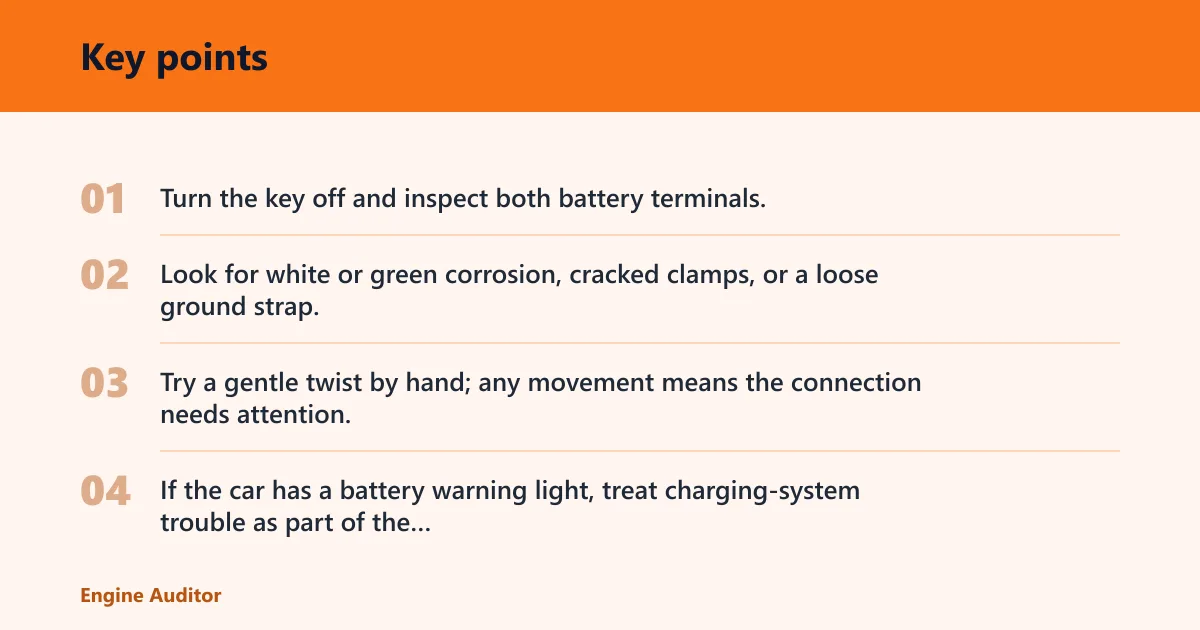
Check the battery terminals and clamps first. They must be tight and clean. Corrosion, looseness, damaged ground straps, or corroded positive cables can cause slow cranking or a single click even when the battery itself is not the only problem.
- Turn the key off and inspect both battery terminals.
- Look for white or green corrosion, cracked clamps, or a loose ground strap.
- Try a gentle twist by hand; any movement means the connection needs attention.
- If the car has a battery warning light, treat charging-system trouble as part of the diagnosis, not a separate issue.
Jump-starting can help if the battery is weak, but it can also hide a bad cable, weak starter, or charging fault. If the jump gets the engine running once and the problem returns after the next cold soak, do not assume the battery was the only fault.
📊 A healthy battery should read around 12.6 volts when cold and engine off. Source: Car Hard Start When Cold: Why It Struggles Then Runs Fine.
Is a weak battery the reason my car clicks on cold mornings?
Often, yes. A healthy battery should read around 12.6 volts when cold and engine off. Below 12.2 volts is the likely suspect zone. During cranking, voltage should stay above 9.6 volts. A big dive below that points to battery weakness or a battery that cannot deliver current in cold weather.
What voltage should a car battery read on a cold morning?
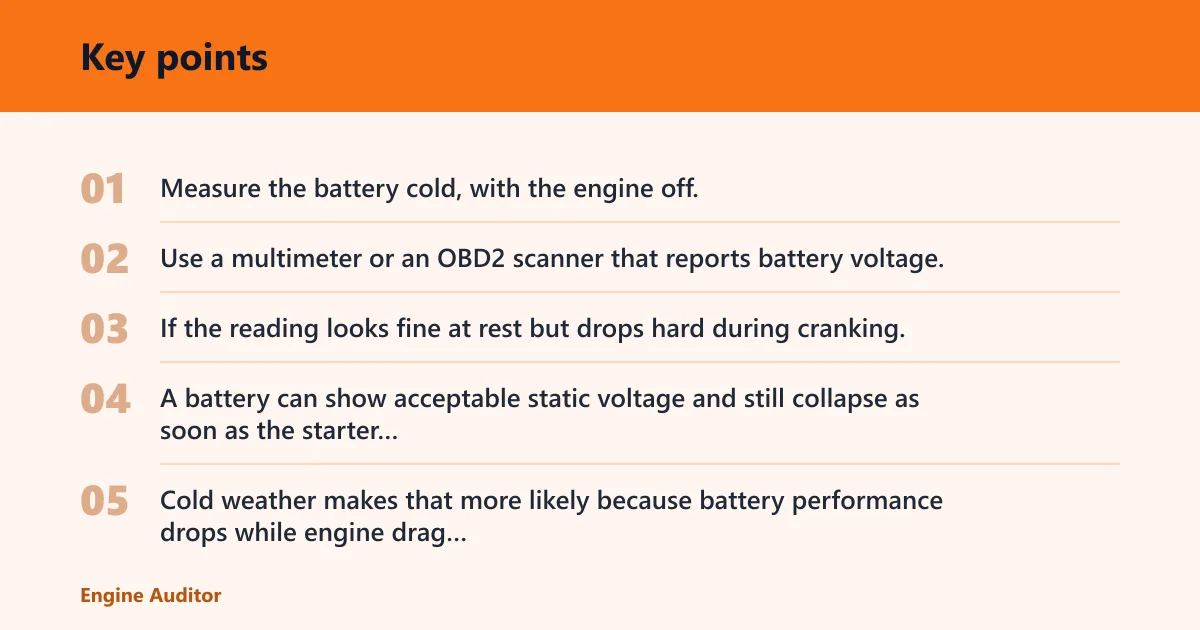
Measure the battery cold, with the engine off. Use a multimeter or an OBD2 scanner that reports battery voltage. Around 12.6 volts is healthy. Below 12.2 volts is suspect. If the reading looks fine at rest but drops hard during cranking, the battery may still be failing under load.
That load clue matters. A battery can show acceptable static voltage and still collapse as soon as the starter asks for current. Cold weather makes that more likely because battery performance drops while engine drag rises.
Can cold weather make a good battery fail to start my car?
Yes. Cold weather can reduce battery performance and increase engine drag. Thick oil, slower battery chemistry, and harder engine rotation all work against starting. A battery that is marginal in mild weather can fail on a freezing morning even if it starts the car on a warm day.
That is why a cold-morning no-start needs more than a “battery bad or good” answer. The same battery can pass a quick voltage check and still fall short under the higher load of a winter start.
How do you tell starter failure from battery failure?
If battery voltage is acceptable and the terminals are clean and tight, but the engine still gives a single click or cranks very slowly, the starter motor or starter solenoid moves up the list. Cable resistance and relay faults can mimic a dead battery, so do not replace the battery alone when the voltage checks do not support it.
Starter motor and solenoid clues after battery checks pass
A starter issue is more likely when the lights stay reasonably bright, the battery tests well, and the click comes from the starter area rather than the fuse box. A failing solenoid may click once without turning the motor. A worn starter can also draw high current and slow the crank even with a healthy battery.
That job often belongs in a garage workflow because access and load testing are more involved. If voltage stays reasonably high during cranking but the engine barely turns, the starter circuit is worth checking before installing more batteries.
Cable resistance and relay problems that mimic a dead battery
Loose battery clamps, damaged ground straps, and corroded positive cables can waste current before it reaches the starter. A relay can also click while sending too little power onward. Those faults produce the same winter complaint as a weak battery: click, no crank, or a slow turn followed by a dead stop.
Could fuel pressure leak-down cause a cold-morning no-start?
Yes. Fuel pressure bleed-down overnight can cause a normal crank with no fire, or a start that improves after key cycling. Use three key-on cycles as a fuel test. Turn the ignition ON and off three times, pausing a couple of seconds each time, then try to start. Faster starting after that points to leak-down.
What it means if the car starts better after sitting for a while
If the engine starts after several tries on a cold morning, then behaves better later in the day, fuel pressure loss or a temperature-related sensor error becomes more likely. A system that primes poorly after an overnight sit may need pump, regulator, injector, or check-valve diagnosis.
Do not keep cranking endlessly. Repeated key cycling can overheat the starter and drain a marginal battery. If three prime cycles do not change the result, move on to diagnostics instead of repeating the same start attempt.
What changes for gasoline engines in winter?
Gasoline engines that crank normally but refuse to fire often point to fuel delivery, spark, or sensor data rather than the starter. Spark plugs not changed in 40,000 to 50,000 km may need replacement. On direct-injection engines, intake valve carbon buildup can cause a catch-then-shake pattern before the idle smooths out.
Coolant temperature sensor readings that do not match outside air
The coolant temperature reading should match outside air within a few degrees when the engine is cold. If the scanner shows the engine warm on a frosty morning, the computer may reduce cold-start fuel too early. That can make a healthy engine act lean and hard to start.
This is a common low-cost clue on many VW, Audi, and Skoda models, where a faulty coolant temperature sensor is often a cheap part but an expensive guess if replaced without data.
Direct-injection intake valve carbon buildup and the catch-then-shake pattern
Direct-injection engines can build carbon on intake valves because fuel does not wash them clean. The result can be a brief catch, a rough shake, then a smooth idle once the engine clears itself. Misfire counters on a scan tool help confirm the pattern, and a walnut-blast cleaning is the usual fix.
Say a four-cylinder direct-injection car cranks at normal speed in cold weather, starts briefly, shakes hard, then settles. That is a different branch from a dead battery. It points you toward air, fuel, or deposit issues, not just starter current.
What changes for diesel engines in winter?
Diesel engines can crank normally and still refuse to fire because compression heat and glow plug performance matter more in cold weather. Glow plugs rarely fail all at once. A diesel with two tired glow plugs can produce long cranking and white or grey smoke for 30 seconds before it catches.
Do bad glow plugs cause clicking and no start on diesel cars?
They can, but the pattern is usually long crank, rough start, and smoke rather than a pure electrical click. Glow plugs are checked by resistance or by a garage test. If the engine cranks well but will not light off in the cold, glow system faults move up the list.
Compression issues, injector problems, or low fuel supply can also matter on diesel engines. The point is to separate “cranks but no fire” from “barely cranks.” Those are different branches.
Why does my car crank slower when it’s cold?
Cold engines turn harder because oil thickens and internal drag rises. Battery output also falls with temperature. Slow crank in cold weather therefore points first to battery state, clamp condition, cable resistance, or a starter near failure. If the battery passes voltage checks, the starter becomes more suspicious.
Cold-morning no-start decision table
| Symptom pattern | Outside temperature | Dash behavior | Voltage reading | Likely fault | Next test | Urgency |
|---|---|---|---|---|---|---|
| Single click, no crank | Below freezing or near it | Lights may stay on | 12.2 volts or lower resting, or a steep crank drop | Weak battery, loose clamp, bad ground, starter solenoid | Clean and tighten terminals, then retest crank voltage | High if stranded |
| Rapid clicking | Cold morning after overnight sit | Dash dims or resets | Crank voltage falls below 9.6 volts | Battery weakness or high cable resistance | Jump-start once, then test battery and cables | High |
| Slow crank | Any cold start | Normal accessories, sluggish starter | Above 9.6 volts but still slow | Starter motor dragging, cable resistance, thick oil, weak battery | Load test battery, inspect cables, then suspect starter | Medium to high |
| Normal crank, no fire | Cold soak overnight | Dash normal | Battery may test fine | Fuel pressure bleed-down, spark, coolant sensor, glow plugs | Three ON/OFF key cycles, scan live data, check engine type branch | Medium |
| Catch-then-shake, then smooths out | Cold weather | Cranks normally | Usually not battery related | Direct-injection intake valve carbon buildup or misfire issue | Check misfire counters, plugs, and intake condition | Medium |
| Diesel long crank with white or grey smoke | Cold start | Normal or slow crank | Battery may still be acceptable | Glow plugs, fuel delivery, compression | Glow plug resistance test or garage test | Medium |
When jump-starting helps and when it misleads
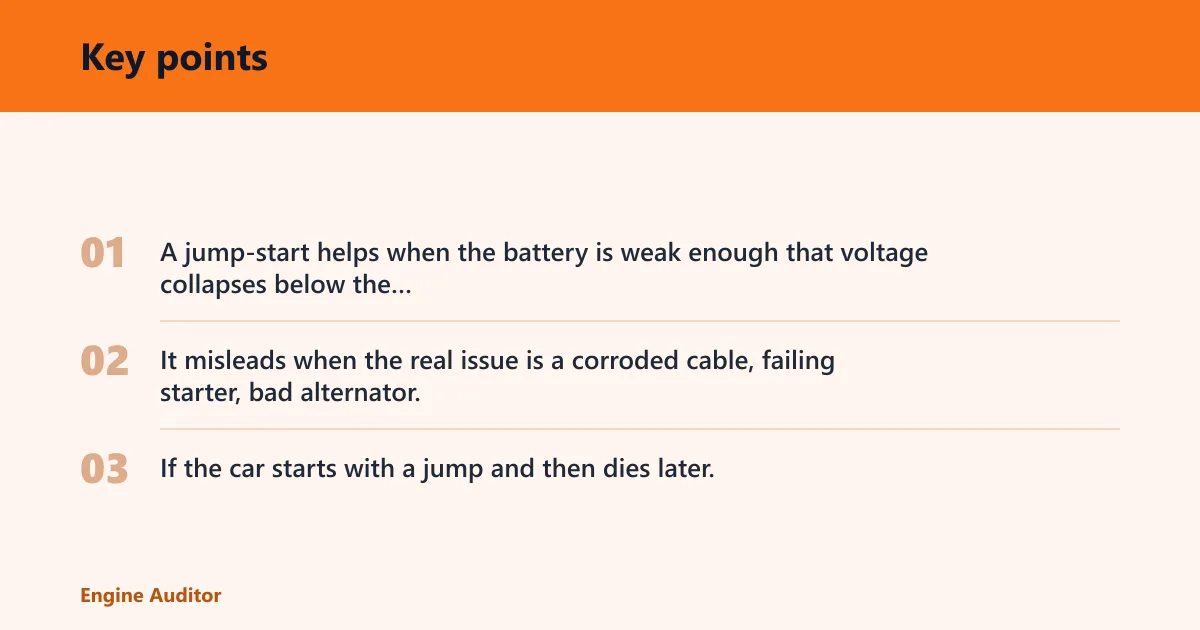
A jump-start helps when the battery is weak enough that voltage collapses below the starting threshold. It misleads when the real issue is a corroded cable, failing starter, bad alternator, or fuel problem. If the car starts with a jump and then dies later, the battery warning light should raise suspicion about charging trouble.
Why does my car start after a few tries on a cold morning?
If the engine starts after several attempts, the cause often shifts toward fuel pressure bleed-down, weak spark, marginal glow plugs, or a cold sensor reading that is off. A battery problem can also improve slightly after repeated key cycles, but a pattern of “more tries, better start” is especially useful for fuel and prime issues.
Pay attention to the exact change. If the first crank is slow and the second is stronger after a brief pause, that leans electrical. If the crank stays normal but the engine only fires after several ON/OFF cycles, fuel prime or sensor data becomes more likely.
Frequently asked questions
Could fuel pressure leaking down overnight cause a cold-morning click no-start?
It can, but usually the engine cranks normally rather than giving only a click. Use three key-on cycles as a fuel test. If the car starts better after those cycles or after sitting again, fuel pressure loss deserves attention.
How do I tell starter failure from battery failure in cold weather?
Check battery voltage first. Around 12.6 volts cold is healthy, below 12.2 volts is suspect, and cranking should stay above 9.6 volts. If those numbers are acceptable and the car still gives a single click or slow crank, the starter motor, solenoid, or cables move to the front of the line.
Products related to this article
Sponsored / affiliate links. As an Amazon Associate I earn from qualifying purchases. I may earn additional commission from eligible campaigns.