What Is Regenerative Braking in Electric Cars?
Regenerative braking in electric cars uses the drive motor as a generator during deceleration, slowing the car while sending energy back to the battery. Friction brakes still handle the rest. Ignore how it changes, and you can misread pedal feel, waste range, and be surprised when stopping power changes in cold weather or with a full battery. This guide explains how blended braking works, what regen feels like, and when it is reduced or absent.
This guide is part of our Electric vehicle basics: a simple owner guide series.
What is regenerative braking?
Regenerative braking is a braking system that turns motion into electricity during deceleration. The electric motor operates as a generator, creates drag that slows the vehicle, and sends recovered energy to the battery instead of losing all of it as heat.
That matters in EVs and hybrids because braking always sheds kinetic energy, which is the energy of motion. In a conventional car, friction brakes turn that motion into heat. In an EV or hybrid, regen recovers part of it and uses it again.
Most modern EVs and hybrids use some form of this system.
How does regenerative braking work?
When you lift off the accelerator, many EVs command the drive motor to resist wheel rotation. That resistance slows the car. The motor acts as a generator, and the electricity it makes flows back to the traction battery.
Here is the basic sequence:
- You ease off the accelerator.
- The control system asks for regen at a set level.
- The motor spins as a generator and creates drag.
- Recovered power goes to the traction battery in a BEV, or to the smaller battery in an HEV.
- The friction brakes finish the stop when needed.
That split matters. Regen helps slow the car and recover energy, but friction brakes still do the emergency work, the final few miles per hour, and any full stop where more stopping force is needed than regen alone can supply.
A common first-timer mistake is expecting lift-off regen to act like a parking brake. Picture a compact BEV rolling to a stop in town with a strong regen setting. It may slow hard at first, then need friction brakes near the end because regen weakens as speed drops.
What does regenerative braking feel like?
It usually feels like engine braking in a gas car, but the pull can be stronger or lighter based on the setting. Lift off the accelerator and the car may slow right away. In a high-regen mode, that slowdown can be firm enough that you use the brake pedal less often in city traffic.
The feel changes with calibration, speed, and battery state. At higher speeds, regen is often more noticeable. At very low speeds, it fades, so the last part of a stop usually feels more like normal braking.
Some cars give you adjustable regen levels such as low, standard, or higher settings selected by paddles, buttons, or a touchscreen. Tesla used to offer low and standard regen options, and from 2020 onward Tesla came with the standard option only. The naming and controls vary by brand.
Regen decision table
The table below shows when regen helps, when it backs off, and what you will feel in common driving situations.
| Driving scenario | Expected regen strength | Likely battery-state limitation | What the driver will feel |
|---|---|---|---|
| City stop-and-go traffic | Strong to moderate | Usually none unless the battery is near full | Noticeable lift-off slowdown and less pedal use |
| Highway cruising | Light to moderate | May be limited by a low regen setting rather than battery state | More coasting, less drag when you lift off |
| Full battery after charging | Weak or unavailable | Battery acceptance is limited because the pack is full | Car coasts more than expected; friction brakes do more work |
| Cold morning start | Reduced until the battery warms | Cold cells accept charge less readily | Soft, delayed deceleration compared with normal days |
| Steep downhill road | Often strong, then limited if the battery fills | Regen can taper if the pack reaches its acceptance limit | Good hold at first, then more reliance on friction brakes |
| Emergency stop | Secondary to friction braking | No useful regen assumption in a panic stop | Pedal effort and ABS behavior feel like normal braking first |
| Very low speed, near a stop | Weak | Regen is weakest at low wheel speed | The car rolls the last few feet unless friction brakes finish it |
What is one-pedal driving?
One-pedal driving is a high-regen calibration that can slow some EVs enough to bring them to a full halt without the brake pedal. It does not mean the brake pedal disappears. It means the accelerator does more of the slowing work, especially in stop-and-go traffic.
Whether it stops the car depends on model and speed. Some EVs can stop cleanly in one-pedal mode. Others still creep at the end and need the brake pedal for the last few feet.
That mode can be useful in traffic jams and on repeated short trips, where lift-off regen is used often. It can also help on downhill roads, though a full battery can cut into its effect.
Suppose a BEV is set to its strongest regen level before a downtown commute. Each lift of the accelerator gives a firm slowdown, so the driver may cover most stops without touching the brake pedal. If the battery is already full, that same route can feel far less controlled because regen headroom is smaller.
When does regenerative braking not work?
Regen does not always disappear, but it can be reduced or unavailable when the battery is full, cold, or unable to accept more charge. It can also fade at very low speeds, and friction brakes typically take over for emergency stopping and the final part of a complete stop.
A full battery is the most common surprise for new owners. If the pack cannot accept more energy, the car has nowhere to send recovered electricity, so regen is limited.
Cold weather matters too. A cold traction battery may accept less charge until it warms up, so regen can feel weaker for the first few miles. Steep descents can expose the same limit if the battery fills during the downhill run.
Traction-control events can also briefly reduce regen. If the tires are slipping or road grip is low, the control system may back off regen so the car stays stable.
Is regenerative braking only in electric cars?
No. Most modern EVs and hybrids use some kind of regenerative braking. The difference is what happens with the recovered energy. In a BEV, it goes into the high-voltage battery and can help extend driving range. In an HEV, it supports the gas engine and can help efficiency because the battery is much smaller.
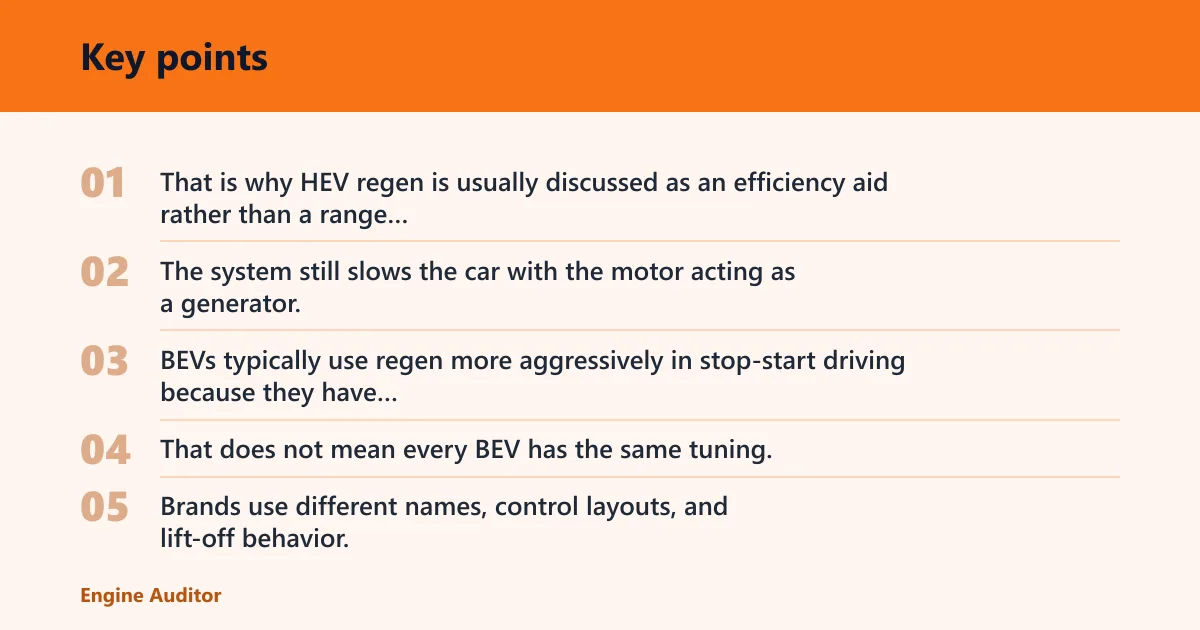
That is why HEV regen is usually discussed as an efficiency aid rather than a range extender. The system still slows the car with the motor acting as a generator, but the recovered electricity is stored in a small battery and used to assist the powertrain.
BEVs typically use regen more aggressively in stop-start driving because they have larger batteries and can store more recovered energy. That does not mean every BEV has the same tuning. Brands use different names, control layouts, and lift-off behavior.
Do all electric cars have regenerative braking? In practice, yes in the broad sense used by manufacturers and regulators, but the calibration may be subtle. Do all electric cars use regenerative braking the same way? No. The feel, strength steps, and one-pedal behavior vary from model to model.
Frequently asked questions
What is regenerative braking in electric cars?
It is a system that slows the car by turning the drive motor into a generator during deceleration.
How does regenerative braking work in electric cars?
When you lift off the accelerator or select stronger regen, the motor acts as a generator and creates drag. The car slows, recovered energy goes to the battery, and the friction brakes finish the stop when more braking force is needed.
Do all electric cars have regenerative braking?
Yes, in the broad owner-facing sense, though brands may label and tune it differently.
What is one-pedal driving in an EV?
It is a high-regen driving mode that can let the accelerator handle most slowing, and in some EVs it can bring the car to a stop.
Products related to this article
Sponsored / affiliate links. As an Amazon Associate I earn from qualifying purchases. I may earn additional commission from eligible campaigns.