Best Car Battery Brands for Value (2026): We Compared
For value, several car battery brands are commonly recommended, including Interstate, EverStart, DieHard, Motorcraft, and Odyssey, with the best buy usually being the one that matches the correct BCI group size, terminal layout, and required CCA at the lowest warranty-backed price. The wrong battery wastes money on poor fitment, weak cold-start power, or a short warranty that raises long-term cost. This guide ranks brands by price, warranty, fitment, spec strength, and who should buy each one.
Quick comparison
| Product | Badge | Best for | Price | ||
|---|---|---|---|---|---|
 |
Weize Platinum AGM Battery BCI Group 24F AutomotiveWEIZE | Our pick | Group 24F · 710 CCA · 120 RC | $161.99
Price as of 23 Oct 2026
|
View |
 |
OPTIMA® Batteries High Performance 25 REDTOP® Sealed AGMOPTIMA | Upgrade pick | RedTop 25 · 720 CCA · Maintenance-Free | $249.99
Price as of 23 Oct 2026
|
View |
Match the BCI group size first. Check terminal position, case length, hold-down style, and tray clearance before you care about the logo.
Then compare chemistry, CCA, reserve capacity, warranty, and local stock. A battery that is easy to replace again is not always the cheapest battery to own.
How we chose
This ranking weighs five things: fitment, chemistry, starting power, backup power, and the real cost of ownership. It favors brands that are easy to buy locally and easy to match to a vehicle without paying for unnecessary capacity.
AGM matters for some vehicles. Flooded lead-acid still makes sense for many everyday cars, especially when electrical demand is modest and the budget is tight.
Cold cranking amps show how much current a battery can deliver for engine starting in cold weather. Reserve capacity matters when accessories stay on, the charging system is stressed, or the vehicle idles in traffic.
Availability also changes value. A battery that is in stock at a parts store, dealer, or major retailer can beat a slightly cheaper option that requires shipping delays or a special order.
Car battery value matrix
| Brand | Product line | Typical price tier | Battery chemistry | Warranty length | Best-fit driver profile | Value warning |
|---|---|---|---|---|---|---|
| Odyssey | AGM performance lines | Premium | AGM | Varies by model | Trucks, performance vehicles, off-road rigs, and vehicles with heavy electrical loads | Bad buy for a basic commuter if a conventional battery with the right CCA and group size will do the job |
| Interstate | Lead-acid and AGM lines | Midrange | Lead-acid and AGM | Varies by line | Everyday drivers who want broad availability and a balanced spec set | Can be overpriced if you are paying for AGM when the vehicle only needs a standard flooded battery |
| EverStart | Value, Maxx, Platinum AGM | Budget to midrange | Lead-acid and AGM | Platinum AGM: 48 months | Price-sensitive buyers who shop Walmart and want a simple replacement | Cheapest lines can be weak value if the car needs higher reserve capacity or winter-start margin |
| DieHard | Standard, Gold, Platinum AGM | Budget to premium | Lead-acid and AGM | Varies by line | Drivers who want a known retail brand with a wide price spread | Line-to-line consistency is uneven, so the cheapest DieHard is not always the best DieHard |
| Motorcraft | OEM replacement lines | Midrange | Lead-acid and AGM | Varies by application | Ford owners who want OEM-fit reassurance and dealer-compatible replacement | Not the cheapest choice if your Ford accepts a common aftermarket battery with the same group size and specs |
Odyssey: best for demanding vehicles
Odyssey is the value leader only when the vehicle truly needs a premium AGM battery. Its batteries are especially associated with AGM design for demanding automotive applications, and the brand is ranked first because its batteries emphasize power, durability, and long-term performance.
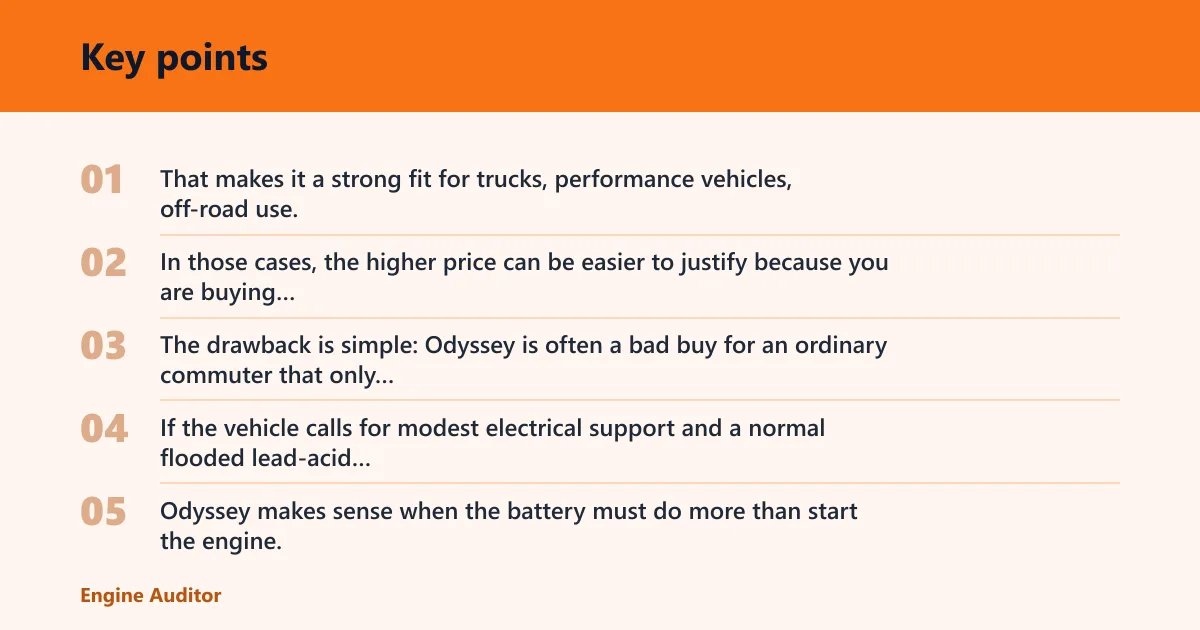
That makes it a strong fit for trucks, performance vehicles, off-road use, and vehicles with heavy accessory loads. In those cases, the higher price can be easier to justify because you are buying stronger cranking performance and better reserve capacity, not just a name.
The drawback is simple: Odyssey is often a bad buy for an ordinary commuter that only needs a standard replacement. If the vehicle calls for modest electrical support and a normal flooded lead-acid battery, premium AGM pricing can add cost without adding useful value.
Where it wins on value
Odyssey makes sense when the battery must do more than start the engine. Vehicles with winches, audio upgrades, repeated short trips, or higher accessory draw benefit from the stronger reserve and durability profile that premium AGM batteries usually provide.
Say your truck uses a BCI group size that supports an AGM upgrade and you routinely run lights, a camper load, or accessories at idle. In that case, a cheaper battery that meets only the minimum starting spec can look inexpensive and still cost more later if it fails early or leaves too little reserve.
When it is a bad buy
Odyssey loses value when the vehicle is a basic daily driver with little accessory load. If the factory spec is a conventional battery and the climate is mild, paying premium AGM pricing can exceed the real need.
A common first-timer mistake is buying the strongest battery on the shelf without checking the tray and terminal layout first. A powerful battery that does not fit the case, hold-down, or cable arrangement is not value at all.
Interstate: best for everyday drivers
Interstate is the most balanced pick for many drivers because it offers both conventional lead-acid and AGM products and is praised for broad availability across the United States. That mix matters: you can usually find the right battery type without overpaying for a specialty line.
For everyday driving, Interstate tends to work well because it covers the mainstream use case. If you want a battery that is easy to source and easy to replace again, that combination carries real value.
The drawback is that value depends on the exact line. A lower-spec flooded model may be the smart buy for a simple car, while an AGM version may be the better call for a vehicle with more electrical demand.
Why it fits mainstream use
Interstate is a practical middle ground for commuters, family cars, and many crossovers. The brand’s broad stock presence can reduce downtime, and that matters when a battery fails unexpectedly.
For an everyday vehicle, the best value is usually the battery that meets the required BCI group size and cold cranking amps without adding AGM cost you do not need. Interstate often lands in that zone.
Where cheaper alternatives make more sense
If the vehicle only needs a standard flooded replacement and the local price gap is large, EverStart or another budget line can be better value. The key is to compare line-specific warranty and CCA, not just the brand logo.
Interstate can also be a weaker buy when a retailer’s price is high relative to the warranty. If the same fitment is available cheaper with similar specs, brand loyalty alone is not enough to justify the extra spend.
EverStart: best budget pick
EverStart is Walmart’s exclusive battery brand, and that retail model keeps the line simple to compare. Its roughly $90 to $189 price range makes it one of the most affordable brand families in this ranking, and Platinum AGM models carry a 48-month warranty.
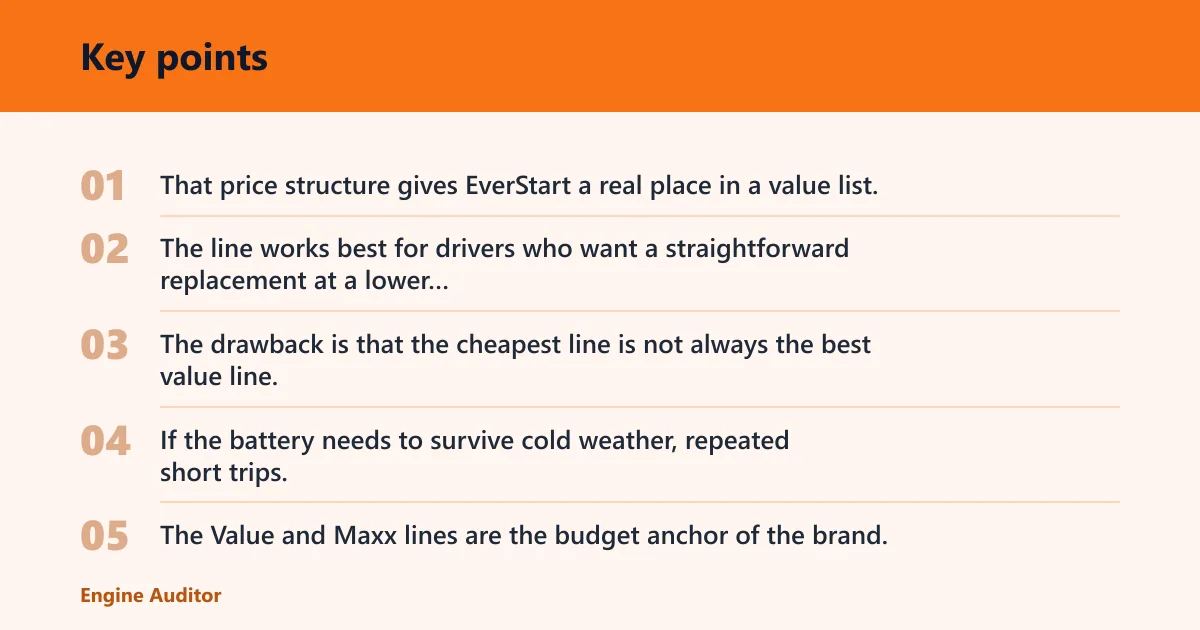
That price structure gives EverStart a real place in a value list. The line works best for drivers who want a straightforward replacement at a lower purchase price, especially when the needed group size is common and the vehicle does not demand a premium spec sheet.
The drawback is that the cheapest line is not always the best value line. If the battery needs to survive cold weather, repeated short trips, or higher accessory load, the lower tiers can stop being a bargain.
Value and Maxx lines
The Value and Maxx lines are the budget anchor of the brand. They are strongest when the goal is simple transportation and the car only needs a conventional battery with the correct group size and enough CCA for the climate.
The Front Desk Review lists EverStart Maxx 35N at $90 as the cheapest model in its comparison, which shows why the brand often attracts budget buyers. That price is only a win if the battery still matches the car’s requirements.
When Platinum AGM is worth it
EverStart Platinum AGM is worth paying for when the vehicle benefits from sealed construction, better vibration resistance, and more backup power. The 48-month warranty on Platinum AGM models also improves the cost picture if you plan to keep the car longer.
If a vehicle has stop-start operation, repeated short trips, or a noticeable electrical load from heated seats, infotainment, or charging gear, the premium line can be the better value even at a higher sticker price.
When not to buy it
Do not buy the Platinum AGM line simply because it sounds better. If the vehicle was designed for a standard flooded battery and you do mostly highway commuting, the extra cost may not return enough benefit.
EverStart also loses value if a lower-tier battery has a short warranty and low reserve capacity. A bargain battery that needs replacement sooner can cost more per month than a better midrange option.
DieHard: best for mixed budgets
DieHard has one of the widest price spreads in the group, roughly $80 to $220, which means the brand can serve both bargain shoppers and buyers willing to pay for more battery. Its Platinum AGM H5-AGM is highlighted as the top-rated model in that lineup.
That range is useful, but it also makes the lineup uneven. A good DieHard can be a strong value; a weak match in the wrong line can look cheap and still disappoint on spec or longevity.
The main drawback is consistency. You need to compare line, warranty, and fitment carefully because the brand mixes standard and premium products across the same retail channel.
Platinum AGM versus standard lines
The Platinum AGM line is the one to watch if you need better vibration resistance, stronger reserve, or a more demanding duty cycle. It is the better fit for vehicles with heavier electrical demand and for drivers who want more margin in cold weather.
Standard DieHard batteries can still make sense for simple commuter use. The trick is to avoid paying for AGM features that the car will never use.
What to watch for in consistency
DieHard’s value depends on the exact battery number on the shelf. Two batteries with the same brand name can differ a lot in CCA, reserve capacity, and warranty length, so the label matters more than the badge.
That is why DieHard ranks below Interstate for broad everyday value. It can be a good buy, but only after you check the line carefully and compare it against the local price of a similar-spec competitor.
Motorcraft: best for Ford fitment
Motorcraft is the safest value choice when the vehicle is a Ford and OEM-fit reassurance matters. Clarios manufacturing and dealer-plus-parts-store availability make it an easy match for owners who want the replacement path to look like the original one.
The brand’s main value is fitment confidence. If you want a battery that is built for Ford application logic and sold through familiar channels, Motorcraft removes some guesswork.
The drawback is price discipline. When a Ford accepts a common group size and standard specs, the Motorcraft premium may not be necessary unless the fitment or warranty terms are clearly better than the aftermarket options.
OEM fitment reassurance
Motorcraft is strongest when the vehicle’s battery tray, hold-down, and terminal arrangement are all tied to Ford’s original specification. That reduces the chance of buying the wrong case shape or cable orientation.
For a Ford owner who wants a low-friction replacement, that matters. The value is not just the battery itself; it is the lower risk of mismatch.
When brand loyalty is worth paying
Paying more for Motorcraft makes sense when the factory spec is unusual or the vehicle is sensitive to battery choice. It is also sensible when local dealer stock is easier to access than a cheaper aftermarket option.
If the exact fitment is common and the aftermarket battery offers the same group size, CCA, and warranty at a lower price, the Motorcraft premium may stop being the best value.
Which one should you buy?
Start with fitment, then buy the cheapest battery that meets the spec you actually need. If you drive a simple commuter car, EverStart or Interstate often wins on value. If your vehicle is demanding, Odyssey or a premium AGM from Interstate, DieHard, or Motorcraft can be the better long-term buy.
Best value by budget
For the lowest purchase price, start with EverStart Value or Maxx if the battery matches the car’s group size, terminal layout, and CCA needs. If the local price gap is small, Interstate is often the better step up because it is easier to source and usually has broader lineup coverage.
For buyers who can spend more, DieHard Platinum AGM or Odyssey can make sense when the vehicle needs the extra reserve and durability. Paying more for a premium battery only works when the spec advantage solves a real problem.
Best value by driving need
For everyday driving, Interstate is the safest all-around bet because it balances availability, lead-acid and AGM choices, and broad fitment coverage. For Ford owners, Motorcraft is the cleanest OEM-style choice. For trucks, off-road rigs, and vehicles with demanding electrical loads, Odyssey is the stronger value.
For cold-weather starting, prioritize CCA first and reserve capacity second. A battery with the right group size but weak winter performance is not a bargain.
When to spend more on AGM
Spend extra on AGM when the vehicle has stop-start behavior, short-trip use, high accessory draw, or vibration exposure. AGM’s sealed, spill-proof design and better vibration resistance are useful in those cases.
Do not buy AGM just because it is newer or more expensive. A standard flooded lead-acid battery is still the better value for many everyday cars with modest electrical loads.
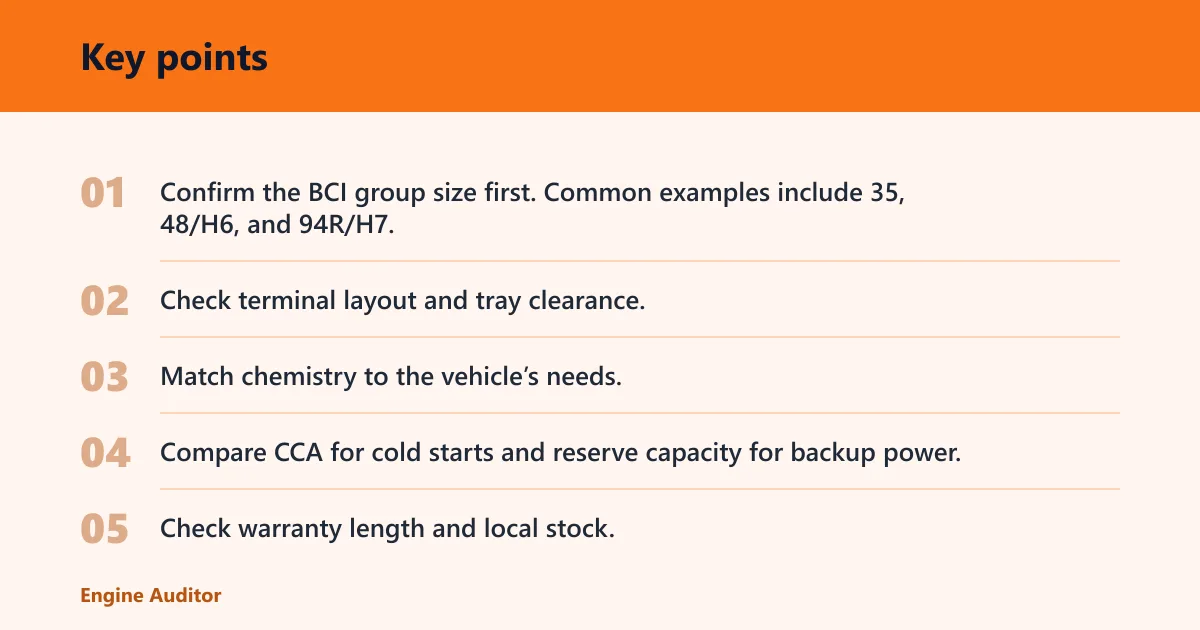
- Confirm the BCI group size first. Common examples include 35, 48/H6, and 94R/H7.
- Check terminal layout and tray clearance. The battery must physically fit and connect correctly.
- Match chemistry to the vehicle’s needs. AGM suits higher electrical demand; flooded lead-acid suits many basic replacements.
- Compare CCA for cold starts and reserve capacity for backup power.
- Check warranty length and local stock. A nearby battery with a decent warranty can beat a cheaper unit that is hard to replace.
- Buy the lowest-priced battery that satisfies all of the above. Paying more only makes sense when the higher tier solves a real use case.
A common mistake is choosing the cheapest battery label first and then discovering it does not match the car’s required size or terminal layout. Suppose a sedan needs a 48/H6 battery and the cheapest option in stock is a different group size with a better price tag. That battery is not value if it requires cable stretch, a loose hold-down, or returns.
Another common case is overbuying AGM for a basic compact car. If the car is a mild commuter with normal accessory load, a good flooded battery with the right CCA and warranty can cost less and still meet the need.
Frequently asked questions
What are the best car battery brands ranked by value?
For most buyers, Interstate ranks highest for general value, with EverStart strong on budget pricing, DieHard useful when the right line is chosen, Motorcraft best for Ford fitment, and Odyssey best for demanding vehicles. The right battery still depends on group size, CCA, reserve capacity, and warranty.
Which car battery brand lasts the longest for the money?
Odyssey is the best long-term value when the vehicle truly needs a premium AGM battery. Its focus on power, durability, and long-term performance helps justify the higher price. For less demanding cars, a lower-cost battery with the correct fit and warranty can still be better value overall.
Are AGM car batteries worth paying extra for?
AGM is worth the extra cost when the vehicle has higher electrical demand, stop-start use, short trips, or heavy vibration exposure. For many basic commuter cars, flooded lead-acid remains the smarter buy. AGM is a tool for a specific job, not an automatic upgrade.
Which battery brand is best for everyday driving?
Interstate is the best everyday-driving choice for most shoppers because it balances broad availability, lead-acid and AGM options, and practical fitment coverage. EverStart can beat it on price if the lower line still meets the car’s exact needs and the warranty is acceptable.
What car battery brand is best for cold-weather starting?
The best cold-weather brand is the one that gives you the required BCI group size and the highest suitable CCA for the money. Odyssey and premium AGM lines from Interstate or DieHard are often stronger choices for harsh winters, but fitment and CCA still come first.
How much should I spend on a good car battery brand?
Spend enough to match the vehicle’s requirements, then stop. For many everyday replacements, a midrange battery is enough. If you need AGM, stronger reserve capacity, or a longer warranty, expect to pay more.
Which car battery brands have the best warranty?
Warranty varies by line, not just by brand. EverStart Platinum AGM models carry a 48-month warranty, which is a strong retail benchmark. Premium AGM lines from other brands can also be attractive, but you should compare the exact model warranty before paying extra for a nameplate alone.
Is a cheaper battery brand actually worse value over time?
Sometimes yes. A cheaper battery is worse value if it has a short warranty, low reserve capacity, or weak cold-start margin for your climate. It is not worse value if it simply costs less while still meeting every requirement. The best purchase is the least expensive battery that fits the job.
Products related to this article
Sponsored / affiliate links. As an Amazon Associate I earn from qualifying purchases. I may earn additional commission from eligible campaigns.