Why Is My Radiator Fan Not Turning on?
A radiator fan that never turns on usually points to one of three faults: a command-side problem when the engine is hot but the fan stays off, a power-side problem when the relay has battery feed but the motor does not move, or a failed fan motor if power and ground are present. Leave it alone, and a small cooling fault can turn into overheating, warped parts, or engine damage. This guide sorts the failure by symptom pattern first, hot engine, AC request, high-speed only, or post-repair failure, then traces the fault to the command side, power side, or motor side.
Radiator fan decision table


| Symptom | Likely failing circuit | Quickest test | Likely next part to inspect |
|---|---|---|---|
| Won’t run when hot | Coolant temperature signal, relay, fuse, or fan motor | Read live coolant temperature with an OBD2 scanner, then check for fan command | Coolant temperature sensor, relay, fan fuse, motor, or wiring |
| Won’t run with A/C on | A/C request path to the fan control side | Turn the A/C on and look for fan command or relay click | Relay, fan control module, request wiring, or connector pins |
| High speed only fails | High-speed relay, resistor, or separate module channel | Check whether low speed works and command high speed with scan data if available | High-speed relay, control module, resistor, or related wiring |
| After installation | Connector pinout, ground, relay match, or wrong part | Compare connector fit, ground path, and relay layout against the vehicle diagram | Wrong relay, missing ground, damaged connector, or mismatched fan module |
Is the engine actually overheating?
If the gauge is climbing into the red, a warning light is on, or steam is present, stop driving and let the engine cool. If the gauge is already rising, do not keep driving until the cause is clear. Low coolant can make the fan look guilty when the real issue is poor temperature sensing, and a thermostat stuck closed can also cause overheating even when the fan issue is secondary.
Gauge reading and warning light check
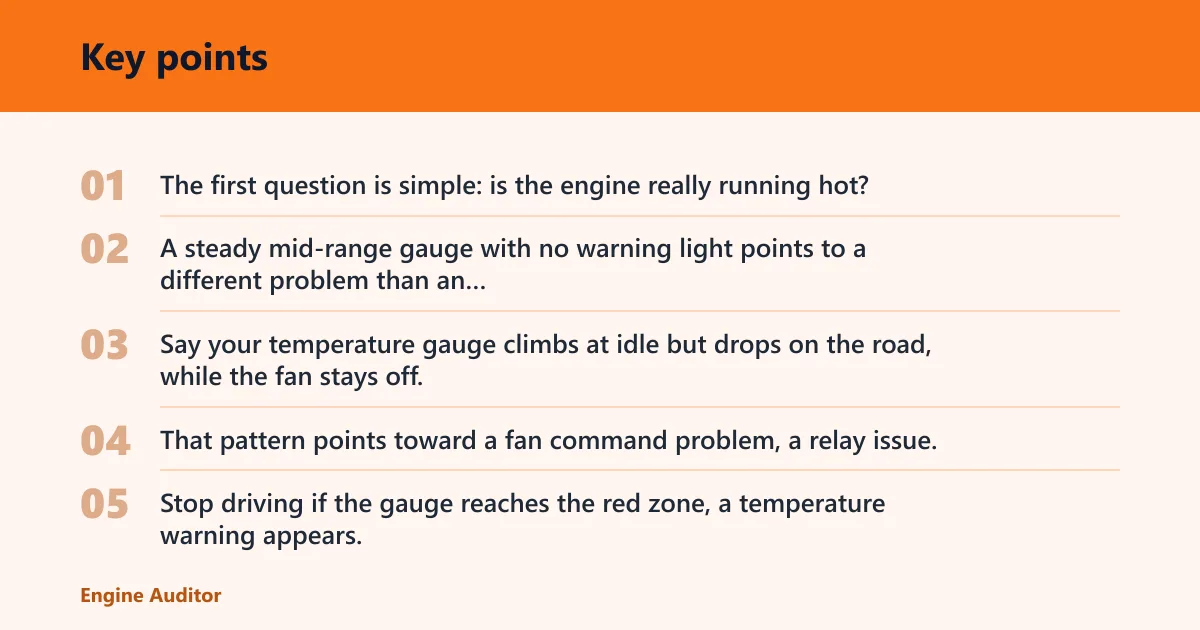
The first question is simple: is the engine really running hot? A steady mid-range gauge with no warning light points to a different problem than an active overheat, and your next move changes with that difference.
Say your temperature gauge climbs at idle but drops on the road, while the fan stays off. That pattern points toward a fan command problem, a relay issue, or a sensor signal that never tells the controller to start the fan.
When to stop driving
Stop driving if the gauge reaches the red zone, a temperature warning appears, or coolant is boiling over. At that point, the fan may be only part of the problem. A thermostat, water pump, belt drive, or leak can also be involved, and more driving raises the risk of engine damage.
Why low coolant can mimic a fan fault
Low coolant can push air into the cooling system, and that air can keep the coolant temperature sensor from reading correctly. On many engines, though, the ECT sensor can still read normally even when coolant is low, so low coolant is a clue, not proof, that the sensor is lying. A sensor sitting in steam or air may report a cooler condition than the engine actually has, which blocks fan activation and sends diagnosis in the wrong direction.
What does the scanner show?
An OBD2 scanner is the fastest way to separate a real fan fault from a bad temperature signal or missing command. Read codes first, then compare live coolant temperature on a cold engine and again as it warms. Not every basic OBD2 scanner can show fan request data or bidirectional fan controls, so if the scan tool shows implausible temperature data or no fan command at all, start on the command side.
Read fan and coolant temperature codes
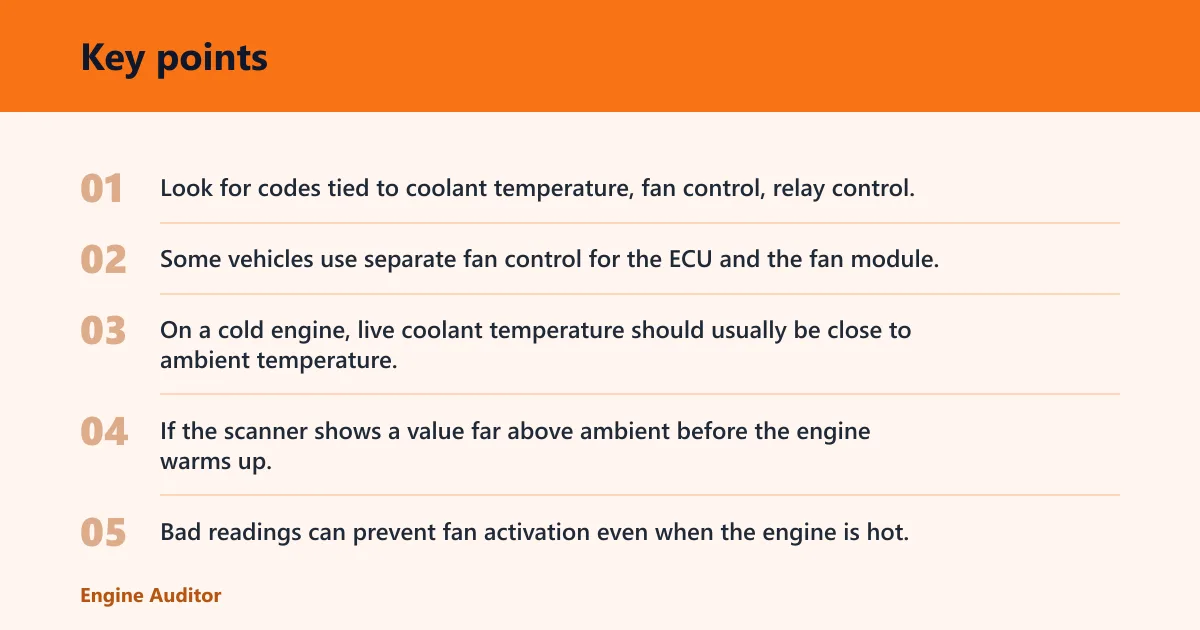
Look for codes tied to coolant temperature, fan control, relay control, or module communication. Some vehicles use separate fan control for the ECU and the fan module, so one bad input can affect fan operation while other systems still seem normal. That split matters on diagnosis.
Compare live coolant temperature to a cold start
On a cold engine, live coolant temperature should usually be close to ambient temperature. If the scanner shows a value far above ambient before the engine warms up, the coolant temperature sensor or its wiring is suspect. Bad readings can prevent fan activation even when the engine is hot.
Look for missing fan command or implausible sensor data
Some scan tools show fan request or fan duty data. If the engine is hot but the controller never requests fan operation, the fault may sit in the sensor input or control logic. If the request is present and the fan stays off, move to the relay, fuse, wiring, module, or motor.
Could low coolant be the trigger?
Yes. Check coolant level before deeper electrical testing, but only when the engine is safe to open. Low coolant can create air pockets that confuse temperature sensing and leave the fan off even though the engine is getting hot. Fix leaks first if the level is down, or the diagnosis may keep looping back to the same symptom.
Check the reservoir and radiator only when safe
Look at the reservoir level first. If the vehicle allows a safe radiator check after cooling, confirm that the radiator is full as well. A low reservoir with no visible leak still needs attention, because repeated air entry can make the fan cycle oddly or not at all.
Fix leaks before chasing electrical faults
Top-up without finding the leak is a short fix, not a repair. If air keeps entering the system, the coolant temperature sensor may keep seeing a false reading and the fan may never receive the right command. That can also lead to repeated overheating after repairs.
Why won’t the fan run when hot?
When the engine is hot and the fan stays still, the usual suspects are the coolant temperature sensor, the fan relay, the fuse, or the fan motor itself. Start with the scan data, then verify power and ground at the fan circuit. A quick continuity check is not enough; load testing matters because corroded wires can pass it and still fail once current flows.
Coolant temperature sensor fault
The coolant temperature sensor feeds engine temperature to the control logic. If it reads too cool, the fan may never activate. On some cars, separate inputs exist for the ECU and fan control, so one circuit can fail without setting off obvious drivability symptoms.
Fan relay and fuse checks
The fan relay is the high-current switch, often in the engine compartment fuse box. The fan circuit often uses a fuse sized for the vehicle’s current draw, and some vehicles also have a separate fuse for the fan control module. Check both, because a blown fan fuse can stop the motor and a smaller control fuse can stop the relay or module from being commanded.
Relay pin layouts are not universal, but some systems use terminal numbers such as 30, 85, 86, and 87. Pin 30 may have battery feed, the coil terminals should show the control pattern expected for the vehicle, and 87 may feed the fan when the relay is energized. If the relay clicks but output never reaches the fan side, replace the relay or inspect the socket.
Fan motor power and ground test
If power and ground reach the fan connector and the motor still will not run, the fan motor may be damaged. The direct battery test is the fastest and easiest test for that condition. If the motor runs directly from battery power, move back through the wiring, relay, and control side.
- Read codes and live data with an OBD2 scanner.
- Check coolant level after the engine cools enough to open safely.
- Inspect the fan fuse and any separate control-module fuse.
- Test relay power at the socket and verify pins 30, 85, 86, and 87.
- Check for battery voltage and ground at the fan connector with a multimeter.
- If power and ground are present, run a direct battery test on the motor.
Why won’t it run with the A/C on?
If the fan comes on with engine heat but stays off with A/C selected, the A/C request path is likely failing. That points toward the control module, relay control, request wiring, or a connector issue rather than a dead motor. The fan should respond to the A/C command on many vehicles even before the engine gets hot, but the exact fan-on temperature and A/C fan behavior can vary significantly by vehicle.
A/C request path to the control module
When A/C is turned on, the vehicle may command the fan to run for condenser airflow. If that request does not reach the fan control module or relay, the fan may stay idle until coolant temperature rises enough to trigger a separate path.
Relay or module not receiving the command
A bad relay can stop the fan from starting, but a failed fan control module can do the same on vehicles that use one. Heat and dust exposure can damage that module, and corrosion inside the housing or on the connector can break the command path even when the rest of the cooling system seems normal.
Wiring faults between the A/C request and fan circuit
Broken wiring or a bad connection can stop fan operation. Check for corrosion, bent pins, and damaged insulation, then do voltage and continuity checks under load where possible. A harness that passes a static continuity test may still fail once vibration or current flow starts pulling on the damaged section.
Suppose the A/C is cold, the compressor engages, and the fan still stays off while the engine temperature is normal. That pattern points away from overheating and toward the request side, where a relay, module, or connector may be missing the command from the A/C circuit.
Why does high speed fail?
On dual-speed or dual-fan systems, low speed and high speed can fail separately. If low speed works but high speed does not, the fault may be in a separate relay, resistor, or control channel for the high-speed circuit. One fan running and the other not is another clue that the system does not share a single failure point.
Dual-speed resistor or control path
Some systems use one path for low speed and another for high speed. A broken high-speed resistor, relay, or control output can leave low speed alive while high speed never comes on. That matters because high speed is often the last line of defense during heavy load, hot weather, or idle conditions.
Separate relay or module channel for high speed
High-speed failure may mean the fan control module lost one internal channel. Because some vehicles have separate fan control for the ECU and the fan module, a single failed path can create a symptom that looks partial rather than total. Heat and corrosion are common stress points for those modules.
When one fan runs and the other does not
Dual-fan setups can hide the failure. One fan may still run for A/C or low-speed demand while the other motor, relay, or connector is dead. That is why a symptom-first check matters: a partial fan response often points to a branch in the circuit, not the whole system.
Why does it fail after installation?
Post-installation failures often come from the wrong part, a reversed connector, a missing ground, or a relay with the wrong pinout. If the fan failed right after repair work, compare the part number, socket layout, and ground path before replacing anything else. The wiring may be correct on the old part and wrong on the new one.
Wrong connector or relay pinout
A connector that fits does not prove the pinout is correct. If the pins do not match the vehicle’s relay or module layout, the fan may never receive battery feed or control signal. That is especially common when a replacement relay looks similar but routes pins differently.
Missing ground or damaged connector pins
The fan motor needs a clean ground path, and the module or relay needs a solid ground reference as well. A loose ground bolt, corroded eyelet, or pushed-back terminal can stop the fan even after new parts go in. Inspect the connector cavity closely for heat damage and bent terminals.
Wrong part number or mismatched fan module
Some cars use a separate fan control module, and not every module matches every engine or option package. If the replacement part is close but not exact, the fan may fail on one speed, one request path, or both. Check the vehicle application before assuming the new part is good.
How to test in order
Start with the symptom pattern, then move from command side to power side to motor side. That order saves time and avoids swapping parts blindly. The scanner tells you whether the controller is asking for fan operation; the multimeter and load test tell you whether the circuit can deliver it.
Best test order for a dead fan
- Confirm whether the engine is hot, cool, or actively overheating.
- Check coolant level and look for signs of air in the system.
- Read codes with an OBD2 scanner.
- Compare live coolant temperature to a cold-start reading.
- Inspect the fan fuse, relay, module, and main connector.
- Use a multimeter to check for power, ground, and voltage drop.
- Run a direct battery test on the fan motor if power and ground are present.
What a multimeter can confirm
A multimeter is useful for checking whether battery voltage reaches the fan circuit, whether the relay is switching, and whether the ground path is intact. It works best with load testing because a weak wire or corroded terminal may read fine with no load and fail as soon as the fan tries to draw current.
Frequently asked questions
Why is my radiator fan not turning on when hot?
When the engine is hot and the fan stays off, the most likely causes are a bad coolant temperature signal, a failed relay, a blown fuse, or a dead fan motor. Start with the scanner and coolant level, then test for command, power, and ground at the fan circuit.
Why is my cooling fan not turning on with ac?
If the fan only fails with A/C on, the request path is the first place to look. The issue may be in the fan relay, fan control module, request wiring, or connector pins. Many cars command the fan from the A/C circuit before engine temperature rises enough to trigger it.
Why is my radiator fan not working on high speed?
High-speed-only failure usually points to a separate relay, resistor, or control channel rather than the whole fan system. Low speed may still work, which can hide the problem. Check whether the vehicle uses a dual-speed setup and compare the high-speed command to the actual output.
Why is my radiator fan not coming on?
If the fan never comes on at all, look at the basic chain first: fuse, relay, wiring, motor, and temperature input. Low coolant can also cause air pockets that distort the sensor reading. An OBD2 scanner and a multimeter will narrow the fault faster than guessing.
Why is my radiator fan not turning on after installation?
After installation, the most common misses are the wrong relay pinout, a missing ground, a damaged connector, or the wrong fan module. A part that fits physically may still be wired differently. Compare the new part against the vehicle’s socket layout and ground path before replacing it again.
Why would my radiator fan not turn on?
The fan may not turn on because the controller never gets the right temperature signal, because the relay or fuse cannot pass current, or because the motor itself is damaged. Some vehicles also have separate control paths for ECU and fan operation, which can make the fault look inconsistent.
Products related to this article
Sponsored / affiliate links. As an Amazon Associate I earn from qualifying purchases. I may earn additional commission from eligible campaigns.