Best Batteries for Trucks and Vans (2026): We Compared
The best heavy-duty car battery for trucks and vans matches the job: AGM for towing and accessory loads, high-CCA flooded or AGM for cold starts, and deep-cycle AGM for long idle time. Pick by reserve capacity, fitment, and vibration resistance, or you risk hard starts, shorter battery life, and charging-system strain.
Quick comparison
| Product | Badge | Best for | Price | ||
|---|---|---|---|---|---|
 |
OPTIMA® Batteries High Performance 25 REDTOP® Sealed AGMOPTIMA | Our pick | 25 REDTOP · 720 CCA · AGM | $249.99
Price as of 19 Oct 2026
|
View |
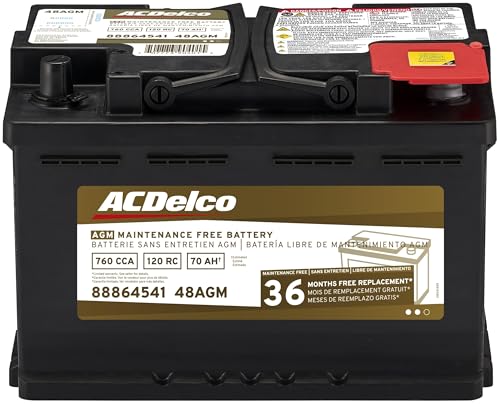 |
ACDelco Gold 48AGM (88864541) 36 Month Warranty AGM BCIACDelco | Upgrade pick | Group 48 AGM · Gold Series | $182.99
Price as of 19 Oct 2026
|
View |
This page compares heavy-duty truck and van batteries by use case, not by a single headline spec. That matters because a battery that starts a gas half-ton easily may still fail early in a delivery van with repeated idling and accessory load.
A good match usually balances CCA, reserve capacity, group size, and vibration resistance. The best choice changes with towing, cold weather, off-road use, or electrical load at idle.
How we chose
These picks and recommendations are based on published specs, fitment details, and buyer feedback patterns. The goal is to match battery type to duty cycle instead of chasing the highest CCA number.
- Cold-start performance: CCA is treated as a starting metric, not the whole decision.
- Accessory support: Reserve capacity matters for winches, lighting, refrigerators, inverters, and long idle periods.
- Fitment: Group size, terminal layout, and hold-down style determine whether the battery actually fits.
- Durability: Vibration resistance, maintenance-free construction, and warranty length signal real-world resilience.
- Duty cycle: Starting batteries, dual-purpose batteries, and deep-cycle batteries are separated by how the vehicle is used.
AGM battery: best for towing and work use
AGM is the best default for demanding truck and van duty because it handles vibration, accepts charge well, and supports accessory loads better than standard flooded lead-acid. It also uses a sealed absorbent glass mat construction, so it is maintenance-free and spill-resistant.
For towing, work trucks, and mixed driving, AGM’s better charge acceptance helps recovery after short trips and repeated starts. That matters when the alternator has to refill the battery quickly between stops, jobsite idle time, and trailer hookups.
One clear tradeoff: AGM usually costs more up front, and a weak charging system can still shorten its life. A premium battery cannot fix an undersized alternator, loose grounds, or chronic undercharging.
Top pick: OPTIMA YellowTop D34/78, based on published specs, buyer feedback, and its fit for mixed-duty trucks and vans. It lists 750 CCA, 120 minutes of reserve capacity, SpiralCell technology with 99.99% pure lead, and a 43.5-pound build that signals a heavy-duty construction.
- SpiralCell tech resists vibration 15 times more
- Maintenance-free design with 90-minute reserve capacity
- High 720 CCA for strong cold starts
This battery is for drivers who need strong starts and meaningful accessory support in one package. The dual terminal configuration also helps with retrofit wiring and mixed terminal setups, which is useful in work vehicles that have been modified over time.
The drawback is simple: this is not the lowest-cost option, and its benefit is wasted if the truck only sees short, easy commutes with little electrical demand. In that case, a less expensive battery may be enough.
When a premium flooded battery still works
A premium flooded battery can still make sense for a truck or van with modest accessory load, a healthy charging system, and mostly highway use. If the vehicle sees steady driving and the battery tray only allows a conventional flooded fit, a high-quality flooded unit may be the practical choice.
Even then, check the rating sheet carefully. If the vehicle sees frequent idling, rough roads, or repeated deep discharges, AGM is usually the better value over time because replacement frequency and downtime often matter more than sticker price.
Dual-purpose battery: best for accessory-heavy rigs
Dual-purpose batteries are the right middle ground when a truck or van needs strong starting power and repeated discharge-recharge cycling. They are better suited than pure starting batteries for rigs with lighting bars, inverters, radios, compressors, or camper-style electrical loads.
The key is not just CCA. Look for reserve capacity, deep-cycle capability, and charge acceptance, because accessory-heavy use can drain a starting battery faster than an alternator can recover it during short drives.
A common first-timer mistake is choosing a high-CCA battery for a van that idles for deliveries with the lights, phone chargers, and a cooler running all day. The engine may start fine in the morning, then battery life drops early because the use pattern keeps pulling the battery down faster than it gets recharged.
Product to consider: ACDelco Gold 48AGM is a BCI Group 48 AGM battery with a 36-month warranty, Silver Calcium stamped alloy, and a design aimed at better cycle performance. The published details point to a durable work-vehicle fit, especially when maintenance-free convenience matters.
- High density negative paste extends battery life
- Silver Calcium alloy improves cycle performance
- Robust separator prevents internal shorts
The drawback is fitment sensitivity. Group 48 is not interchangeable with every truck or van, so you still need to verify the tray dimensions, terminal orientation, and hold-down hardware before buying.
When you need repeated discharge and recharge
If the vehicle is frequently parked with accessory loads running, a dual-purpose battery is often the safer choice than a standard starting battery. It gives you more tolerance for cycling, but it is still not the same as a true deep-cycle battery.
That difference matters on jobsite vehicles and overland rigs. Repeated short discharge events can punish a starting battery quickly, while a dual-purpose design handles that abuse with less stress.
Deep-cycle battery: best for engine-off power
Deep-cycle batteries are best when the vehicle must run accessories with the engine off for long periods. They are the better fit for service bodies, camper vans, mobile workstations, and trucks that power tools or electronics without steady charging time.
Deep-cycle capability matters because a starting battery is built for short, high-output bursts, not repeated deeper draws. If the vehicle’s real job is engine-off power, high CCA alone will not solve the problem.
Alternator charging matters here. If the alternator is too small, or the truck only gets short trips, even a good battery can stay undercharged. That leads to sulfation, slow cranking, and shorter service life.
Use deep-cycle when the duty cycle is obvious: long idle, accessory loads, repeated shutdowns, and limited recharge time. In that setup, a deep-cycle AGM or dual-purpose battery usually makes more sense than a pure starting battery.
Truck battery matrix
| Use case | Recommended battery type | Minimum CCA range | Ideal reserve capacity range | Fitment notes | Common failure risk | When to upgrade to AGM or dual-purpose |
|---|---|---|---|---|---|---|
| Towing and highway hauling | AGM starting battery | 700-800+ CCA | 100-130+ minutes | Match group size, terminal layout, and hold-down style exactly | Heat, trailer brake loads, and repeated starts after stops | Upgrade if the truck also powers tools, lights, or a fridge while parked |
| Cold-climate starts | High-CCA AGM or premium flooded | 800-900+ CCA | 100-140 minutes | Check terminal polarity and tray clearance around insulation or covers | Slow cranking from cold-soaked oil and reduced battery output | Upgrade to AGM if the vehicle sits outside or idles in subfreezing weather |
| Off-road and rough-road use | AGM with high vibration resistance | 700-850+ CCA | 100-140 minutes | Choose a case that matches the tray and resists movement on rough terrain | Internal damage from vibration, loose hold-downs, and repeated shock | Upgrade to AGM if the route includes washboard roads, trail use, or harsh vibration |
| Delivery and long-idle routes | Dual-purpose AGM | 700-800+ CCA | 120-160+ minutes | Confirm accessory wiring, terminal type, and underhood heat clearance | Parasitic drain, short-trip undercharging, and repeated stop-start cycling | Upgrade to AGM when battery recovery between stops is poor |
| Accessory-heavy and PTO-style loads | Dual-purpose or deep-cycle AGM | 650-800+ CCA | 140-160+ minutes | Verify reserve capacity and whether the battery can physically fit taller cases | Voltage sag, premature sulfation, and rapid wear from engine-off draw | Upgrade to deep-cycle when loads run for long periods with the engine off |
| Dual-battery setups | Matched AGM pair | 700-900+ CCA each, depending on engine | 120-160+ minutes per battery | Match group size, terminal orientation, cable length, and tray or tray kit | Uneven charging, mismatched ages, and one weak battery dragging the pair down | Upgrade to dual-purpose if the second battery powers accessories or recovery gear |
Which battery should you buy?
If your truck or van tows, idles, sees rough roads, or carries accessories, start with AGM. It is the strongest default because it balances starting power, reserve capacity, vibration resistance, and maintenance-free convenience better than a standard flooded battery.
Choose a high-CCA battery only when cold starts are the main problem and accessory draw is light. If the vehicle spends a lot of time powering gear with the engine off, step up to dual-purpose or deep-cycle instead of chasing the biggest CCA rating.
Say your pickup runs a plow, a compressor, and auxiliary lights in winter. A battery with high CCA helps the first start, but reserve capacity and vibration resistance matter just as much once the vehicle starts idling for work.
Suppose a cargo van makes short delivery stops all day and runs a phone charger, a dash camera, and a cooler. A starting battery may work at first, but the better long-term fit is a dual-purpose AGM with stronger reserve capacity and better cycle tolerance.
For dual-battery setups, match the batteries closely. Mixing an old battery with a new one, or pairing mismatched types, often causes uneven charging and early failure. The second battery should support the actual load, not just fill space.
How to choose a truck battery
Match CCA to engine size and climate, but do not stop there. A diesel or large-engine truck often needs the higher end of the 700-900+ CCA range, while reserve capacity becomes more important if you idle, tow, or run accessories with the engine off.
Reserve capacity is measured in minutes. For heavy-duty use, a common target is around 100-160+ minutes, with the higher end helping accessory-heavy rigs and delivery vehicles that idle often.
Check the battery group size before anything else. Common truck and van sizes include Group 34/78, 48, 49, and 94R, and the battery must match tray dimensions, terminal layout, and hold-down style. A battery that is electrically good but physically wrong is still the wrong battery.
Dual terminal configuration matters for retrofits and mixed wiring setups. SAE and GM terminal compatibility can make installation easier, especially on trucks or vans that have been modified or that use different cable ends across fleets.
What to check before you buy
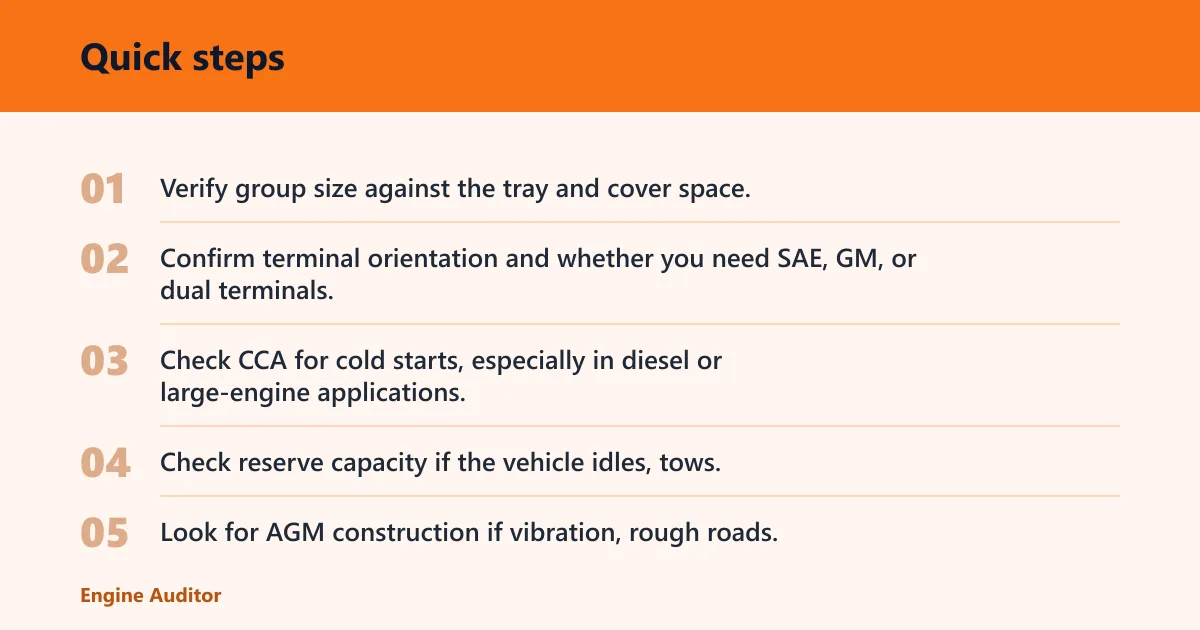
- Verify group size against the tray and cover space.
- Confirm terminal orientation and whether you need SAE, GM, or dual terminals.
- Check CCA for cold starts, especially in diesel or large-engine applications.
- Check reserve capacity if the vehicle idles, tows, or powers accessories with the engine off.
- Look for AGM construction if vibration, rough roads, or short-trip charging are part of the duty cycle.
- Use warranty length as one durability signal, not the only one.
Maintenance-free and spill-resistant construction is worth having in a work vehicle because it reduces upkeep and fits better in mounted or enclosed spaces. Vibration resistance matters too, especially on rough roads and off-road routes where loose internal parts can shorten battery life.
Warranty is a confidence signal. Premium options often offer 36 months or more, and that can be useful when a truck or van is expensive to keep out of service.
Price should be weighed against downtime, not just the sticker. A cheaper battery that fails early can cost more once towing, labor interruption, and repeat replacement are included.
Frequently asked questions
What is the best heavy-duty car battery for trucks and vans?
The best heavy-duty battery is usually an AGM model matched to the vehicle’s real duty cycle. For towing, work use, and mixed driving, AGM is the safer default because it handles vibration, charges well, and supports accessory loads better than standard flooded lead-acid.
How many cold cranking amps do I need for a truck battery?
Many truck and van buyers should look in the 700-900+ CCA range, with the higher end often fitting larger engines and diesel applications better. CCA matters most for cold starts, but it should be paired with the right reserve capacity and fitment.
Is AGM better than flooded lead-acid for trucks and vans?
For demanding use, yes, AGM is usually the better choice. It is sealed, maintenance-free, spill-resistant, and more vibration resistant, with better charge acceptance than standard flooded batteries. Flooded batteries can still work for simpler duty cycles and lighter accessory loads.
What reserve capacity should a heavy-duty truck battery have?
A common heavy-duty target is around 100-160+ minutes of reserve capacity. The higher end helps when the engine is off but accessories still need power, such as in delivery work, towing stops, or service-body use.
Will a Group 94R or Group 49 battery fit my truck or van?
Maybe, but only if the tray dimensions, terminal layout, and hold-down style match. Group size is a fitment standard, not a universal answer, so you should verify the case dimensions and cable reach before buying.
How long do heavy-duty truck batteries last in real use?
Battery life depends on heat, vibration, charging quality, and use pattern. Short trips, parasitic drain, alternator mismatch, and repeated deep discharge can shorten life well before the warranty ends, while a matched AGM battery in a healthy charging system usually lasts longer.
Are premium AGM batteries worth the extra cost for work vehicles?
Often yes, because the real cost is downtime, replacement frequency, and cold-weather performance loss, not just the purchase price. If the vehicle tows, idles, runs accessories, or sees rough roads, premium AGM usually pays back through better durability and fewer failures.
Products related to this article
Sponsored / affiliate links. As an Amazon Associate I earn from qualifying purchases. I may earn additional commission from eligible campaigns.