Can You Charge a Frozen Car Battery?
Updated: 2026-10-31
Bottom line: No, you should not charge a frozen car battery; move it to a warm, dry place until it is above freezing first, and replace it if the case is cracked, leaking, or swollen. Charging a frozen battery can vent acid, damage the plates, or trigger an explosion (Battery Council International; OEM service guidance).
No, you should not charge a frozen car battery; move it to a warm, dry place until it is above freezing first, and replace it if the case is cracked, leaking, or swollen. Charging a frozen battery can vent acid, damage the plates, or trigger an explosion. This guide shows how to decide whether to stop, thaw, test, charge, or replace the battery safely.
Internal damage in a frozen battery

- Measures specific gravity directly
- Supports 6V, 12V, and 24V batteries
- Clear scale for easy reading
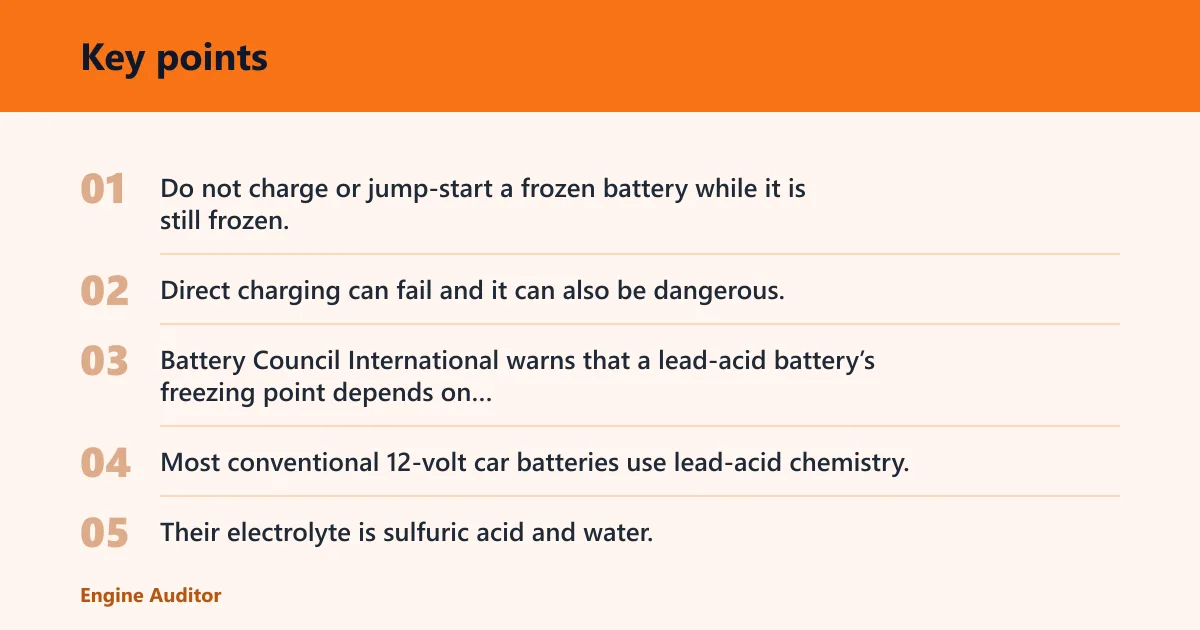
No. Do not charge or jump-start a frozen battery while it is still frozen. Direct charging can fail and it can also be dangerous, because internal damage may already exist even when the case looks normal. Battery Council International warns that a lead-acid battery’s freezing point depends on state of charge, so a partially discharged battery can freeze at warmer temperatures than a fully charged one.
Most conventional 12-volt car batteries use lead-acid chemistry. Their electrolyte is sulfuric acid and water, and the freezing point changes with state of charge. A discharged lead-acid battery is more likely to freeze in cold weather than a fully charged one, which is why BCI and OEM service literature emphasize charge maintenance in winter.
What can happen inside a frozen battery?
Ice expansion can crack the case, bulge the sides, or push electrolyte out through seams and vents. A battery may also suffer plate damage that is not obvious from the outside. If the battery is swollen, cracked, leaking, unusually hot, or giving off an unusual odor, stop. BCI and manufacturer manuals caution that these are signs to replace the battery or have it professionally inspected rather than recharge it.
Do not use a heat gun, hair dryer, boiling water, or other direct heat. Do not try to rescue a frozen battery with a jump pack, either. Jump-starting is unsafe while the battery is frozen and should wait until the battery is thawed and inspected.
Frozen battery decision checklist
Use this as a quick triage tool before you touch a charger. It separates a frozen battery from a cold one, then tells you the next correct step.
| Branch | What you see | What to do next |
|---|---|---|
| Frozen | Visible ice, a cracked case, a case that bulges outward, or electrolyte leak | Do not charge or jump-start. Move it to a warm, dry place and let it thaw gradually |
| Cold but not frozen | No ice, no bulging, no leak, no odor, but the battery is cold and the engine cranks slowly | Check voltage after it warms slightly. Charge only with a compatible charger if testing shows it needs it |
| Thawed but damaged | Battery has thawed, but the case is cracked, swollen, leaking, or smells unusual | Replace the battery or get professional help. Do not charge it |
Branch 1: the battery is frozen
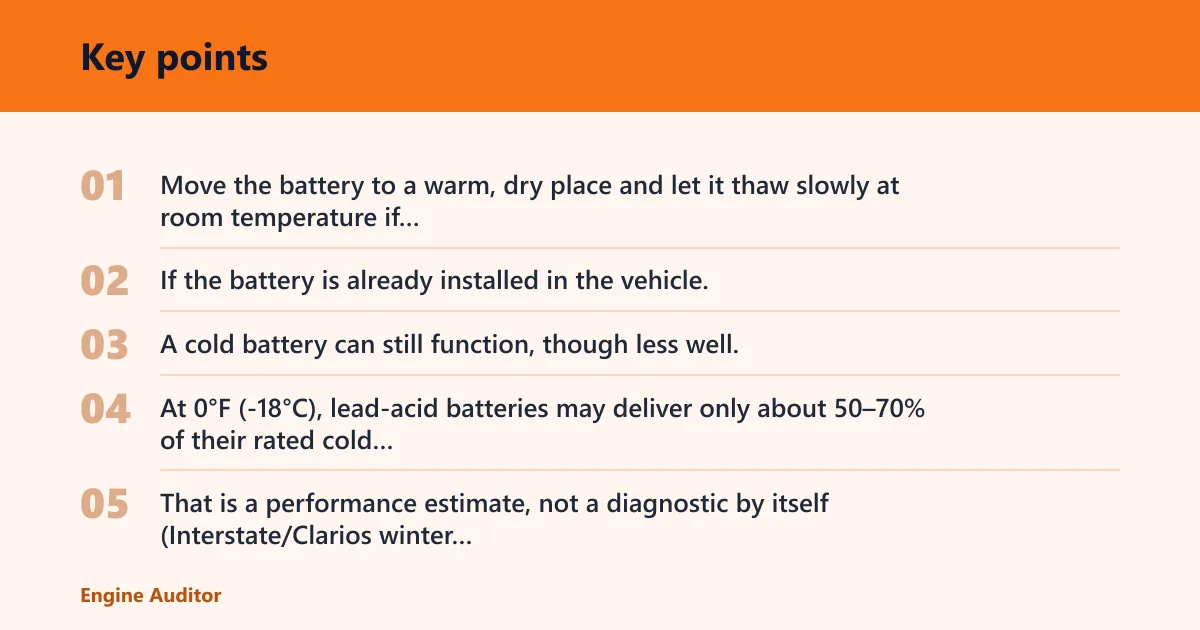
Stop. Move the battery to a warm, dry place and let it thaw slowly at room temperature if possible. If the battery is already installed in the vehicle, do not try to charge it until the battery is fully thawed and inspected.
Branch 2: the battery is cold but not frozen
Cold does not always mean frozen. A cold battery can still function, though less well, because cold weather slows electrochemical reactions and increases internal resistance. At 0°F (-18°C), lead-acid batteries may deliver only about 50–70% of their rated cold cranking amps, depending on battery design, age, and state of charge. That is a performance estimate, not a diagnostic by itself (Interstate/Clarios winter performance guidance; OEM service docs).
Suppose a 600 CCA battery has sat overnight at about -18°C. It may behave more like a 300 amp battery when you start the engine. That drop does not prove the battery is frozen, but it does explain weak cranking and why testing matters before you charge.
Branch 3: the battery is thawed but damaged
If thawing reveals cracks, bulging, leaks, or odor, replace the battery rather than charging it. A thawed battery can still be unsafe if the case was stressed while frozen. Internal damage can remain even when the exterior looks clean.
How to thaw a battery safely
Use temperature-safe thawing only. That means a warm, dry place or room temperature, with no direct heat and no rapid temperature change. The point is to thaw the battery gradually, not to warm it fast.
Safe thawing steps
- Disconnect the battery if access is safe and practical.
- Move it to a warm, dry, ventilated area.
- Let it thaw on its own.
- Inspect the case for cracks, bulging, leaks, or odor before any charging attempt.
- If anything looks wrong, stop and replace the battery or seek professional help.
Say your battery was sitting in an unheated garage and feels hard to the touch at the sides. Move it inside and let it warm gradually. Do not use a heat gun or set it near an open flame to speed things up.
Cold weather battery charging basics
Cold weather makes a battery work harder. Starting power drops because chemical reactions slow down and internal resistance rises. Charging also becomes less forgiving, so a charger that is correct for one battery type may be wrong for another.
Battery voltage and charge state
A healthy, fully charged 12-volt battery should read around 12.6 volts or higher after the surface charge has dissipated. A lower reading does not prove freeze damage, because resting voltage depends on battery state, recent charging, and temperature; however, a reading below about 12.4 volts often indicates the battery is not fully charged, and a frozen or recently thawed battery should still be inspected before charging (Interstate/Clarios/NOCO charging guidance; OEM service docs).
When a maintainer makes sense
A battery maintainer or trickle charger is useful for storage or infrequent driving. It can help keep charge up in winter, but it is not a fix for a frozen battery. Use it for prevention, not recovery.
Do not confuse a maintainer with a rescue tool. It cannot make a frozen battery safe to charge, and it cannot erase damage from ice expansion.
What the battery test should show
After the battery has thawed, test it before you connect a charger. The simplest first check is voltage. If the battery still looks damaged, skip charging and move to replacement or professional inspection.
For flooded batteries, a hydrometer can help confirm state of charge and cell imbalance after full thaw; it is not appropriate for sealed AGM batteries. For either battery type, perform a load test only after the battery has fully thawed and passed the visual inspection, because a battery that is still partially frozen can give misleading results and may be unsafe to stress (manufacturer manuals; OEM service docs).
| Post-thaw result | Voltage reading | Visible damage flag | Flooded lead-acid next action | AGM next action |
|---|---|---|---|---|
| Healthy and fully charged | 12.6 volts or higher | No cracks, bulges, leaks, or odor | Return to service or keep on maintenance charging if needed | Return to service or use a compatible maintainer if the vehicle sits often |
| Thawed but low | Below 12.6 volts | No visible damage | Charge with a charger suited to flooded batteries | Charge with AGM mode if the charger supports it |
| Thawed but suspicious | Any reading | Cracked, bulging, leaking, hot, or unusual odor | Replace or have it inspected professionally | Replace or have it inspected professionally |
Use the table as a go/no-go check. A battery can be thawed and still fail the visual test. A battery can also look fine and still need charging, but only after it has fully thawed and been checked.
Charging a thawed battery correctly
Once the battery is thawed and passed inspection, charge it with a charger that matches the battery voltage and chemistry. Use a charger suitable for your car’s battery type after thawing. Follow the temperature limits in the charger manual, too. Many manufacturer manuals and OEM service documents recommend a reduced-rate or chemistry-specific charging profile in cold conditions, especially for AGM batteries.
Flooded versus AGM
AGM batteries use the same broad lead-acid chemistry, but they often need different charging settings than flooded lead-acid batteries. Some vehicles use AGM as a 12-volt battery, and the charger should have a mode compatible with that type. Do not guess at the setting. NOCO, Optima, and OEM service documents all stress selecting the correct AGM mode or charging profile rather than using a generic setting.
A common first-timer mistake is using a basic charger set for flooded lead-acid on an AGM battery because both are 12-volt units. The voltage matches, but the charging profile may not. Use the mode the charger manual lists for AGM, if the battery is AGM.
Do not charge before inspection
Charging too early is the problem. If the battery is still frozen, stop. If it has thawed but the case is cracked or swollen, stop again. The safe order is thaw, inspect, test, then charge only if the battery passes.
Winter battery checklist
Use this checklist for roadside triage or shop handoff. It keeps the decision simple and avoids the usual mistakes.
- Check for visible ice, bulging, cracks, leaks, or odor.
- If the battery is frozen, do not charge or jump-start it.
- Thaw it gradually in a warm, dry place.
- Do not use direct heat, flames, boiling water, or fast warming.
- After thawing, inspect the case again.
- Test voltage; 12.6 volts or higher is the healthy, fully charged target for a 12-volt battery.
- If voltage is below that and the case is sound, charge with the correct charger mode.
- If the battery is damaged or smells unusual, replace it.
Picture a sedan that sat outside for a week in subzero weather. The battery is cold, the engine clicks, and the case looks normal. That calls for thawing if needed, then a voltage check. It does not call for an instant jump if the battery is still frozen.
Frequently asked questions
Can you charge a cold car battery?
Yes, if it is cold but not frozen, intact, and ready for charging after inspection. Cold weather reduces performance, so the battery may need a charge after it warms. Use a charger that matches the battery voltage and chemistry, and follow the charger’s temperature limits.
Can you recharge a frozen car battery?
No. A frozen car battery should not be charged or jump-started while frozen. Let it thaw first in a warm, dry place. After that, inspect it for cracks, bulges, leaks, or odor, then test voltage before you decide whether charging makes sense.
What happens if you charge a frozen car battery?
Charging a frozen battery can be ineffective and dangerous. The battery may vent acid, crack further, or fail internally. In a worst-case scenario, pressure buildup can create an explosion risk. That is why the safe answer is to thaw and inspect first.
Should you charge a frozen car battery?
No. Do not charge it until it is fully thawed and checked for damage. A frozen case can hide internal harm even when it looks normal from the outside. If the battery is swollen, cracked, leaking, or smells unusual, replacement is the safer call.
How do you charge a frozen car battery?
You do not charge it while it is frozen. First, thaw it gradually at room temperature or in a warm dry place. Then inspect it, test it, and only charge it if it passes. Use a charger matched to the battery type, especially if it is AGM.
Can you charge a car battery below freezing?
You can charge a cold battery if it is not frozen, undamaged, and the charger is suitable for the battery type. Below freezing is a temperature condition, not a damage diagnosis. The key is whether the battery is actually frozen and whether it has visible damage after thawing.
Can you charge a car battery in freezing weather?
Freezing weather makes charging and starting harder, but the battery itself may still be usable if it is not frozen. If it has been exposed to very low temperatures, bring it to a warm place first, inspect it, and then charge it with the correct settings.
Should you charge a cold car battery?
Sometimes. A cold battery that is not frozen and shows no damage may need charging after testing. A battery maintainer can help with winter storage or low-use vehicles, but it is not a fix for a frozen battery and should not be used to revive one.
How do you charge a cold car battery?
Check the battery first, then charge only if it is not frozen, not damaged, and the voltage suggests it needs charging. Use a charger that matches the battery’s voltage and chemistry. For AGM batteries, choose the AGM mode if the charger offers it.
Sources
- Battery Council International: lead-acid battery safety and freezing point guidance by state of charge.
- Interstate Batteries / Clarios winter battery guidance: cold-weather performance loss and charging considerations.
- Optima and NOCO product manuals: AGM charging mode guidance and charger selection.
- OEM service documentation: post-thaw inspection, voltage testing, and replacement criteria for damaged batteries.
Products related to this article
Sponsored / affiliate links. As an Amazon Associate I earn from qualifying purchases. I may earn additional commission from eligible campaigns.